
TL;DR:
- Most founders wrongly believe public chains are too slow and too risky for critical operations, but recent developments have changed that. Choosing between Ethereum and Hyperledger Fabric depends on trust models, with Ethereum suited for decentralization and ecosystems, and Fabric for high throughput and enterprise privacy. Emphasizing secure contract design, operational readiness, and early scalability planning is essential for building resilient, production-ready blockchain solutions.
Most tech founders still carry two assumptions about blockchain that no longer hold up under scrutiny: that public chains are too slow for real business workloads, and that any blockchain system is inherently too risky to trust with critical operations. Both of these ideas were reasonable concerns in 2018. In 2026, they're outdated. Modern development patterns, enterprise-grade platforms, and AI-assisted security workflows have fundamentally changed what's possible. This guide walks you through the platform choices, smart contract security essentials, performance realities, and advanced workflows you need to build blockchain products that are genuinely production-ready.
Table of Contents
- Understanding core blockchain platforms: Ethereum vs. Hyperledger Fabric
- Smart contract design patterns and security: practical essentials
- Performance, scalability, and real-world benchmarks
- Innovative development workflows: AI, threat modeling, and upgradeability
- Our perspective: what most blockchain guides don't tell you about scaling securely
- Build your next blockchain solution with expert support
- Frequently asked questions
Key Takeaways
| Point | Details |
|---|---|
| Platform choice matters | Choose your blockchain platform based on industry, TPS needs, and privacy—not just hype. |
| Security by design | Follow proven smart contract patterns, use static analysis, and test all edge cases to avoid critical vulnerabilities. |
| Benchmark for scalability | Verify real transaction rates and latency before deploying operations or digital products. |
| Innovative workflows win | AI-powered threat modeling and upgradable contracts give startups adaptive long-term advantages. |
| Avoid non-determinism | Design contracts and chaincode to be deterministic for reliable enterprise integration and scaling. |
Understanding core blockchain platforms: Ethereum vs. Hyperledger Fabric
With the rapid evolution of development approaches, your choice of blockchain platform isn't just a technical decision. It shapes how you handle trust, governance, performance, and long-term scalability. The two most commonly evaluated platforms for serious product work are Ethereum and Hyperledger Fabric, and they solve fundamentally different problems.
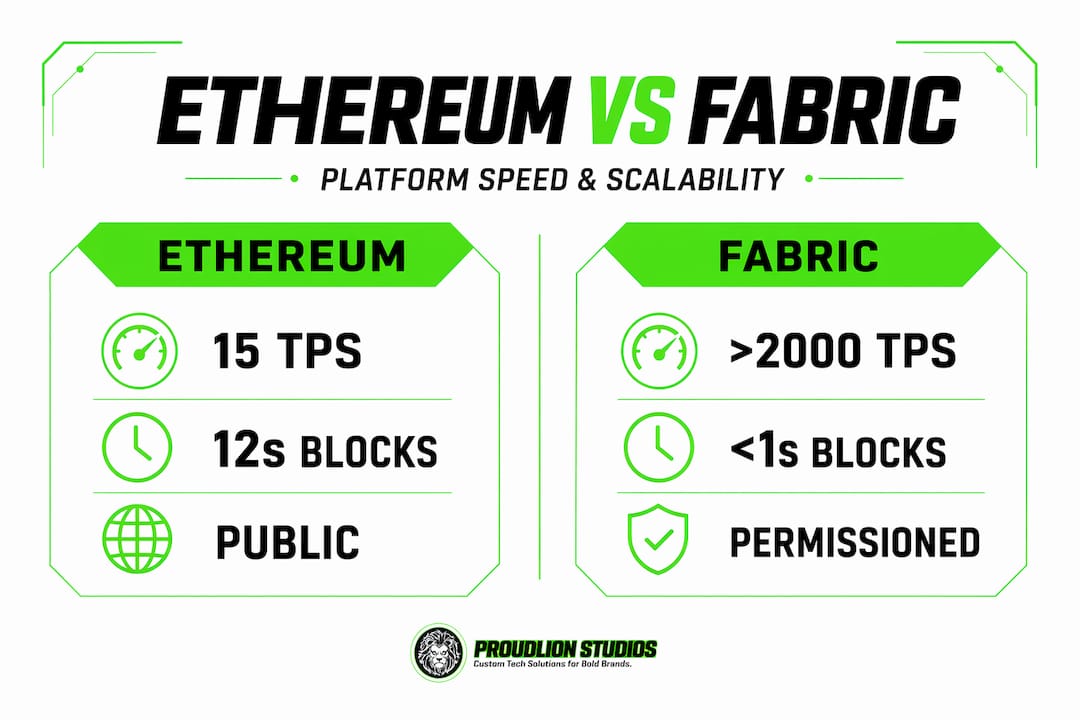
Ethereum is a public blockchain designed for decentralization. Anyone can participate, verify transactions, and deploy contracts without permission. That openness makes it the dominant platform for DeFi, tokenized assets, NFTs, and any product that benefits from an existing global ecosystem. You get network effects for free. Developers have access to a massive toolchain, audited contract libraries, and a well-documented security community. The trade-off is performance: Ethereum processes roughly 15 TPS with approximately 12-second latency under standard conditions.
Hyperledger Fabric is an enterprise-grade permissioned blockchain. Participants are known and credentialed, which removes the overhead of public consensus and lets the network focus on throughput. Fabric achieves around 2,000 TPS with sub-second finality in standard configurations, and can push toward 20,000 TPS with hardware and channel optimizations. That performance profile makes Fabric the right fit for supply chain systems, inter-bank settlement, healthcare data sharing, and any operational workflow that needs speed without sacrificing auditability.
| Feature | Ethereum | Hyperledger Fabric |
|---|---|---|
| Access model | Public, permissionless | Private, permissioned |
| Typical TPS | ~15 TPS | ~2,000 TPS (up to 20,000) |
| Latency | ~12 seconds | Sub-second |
| Smart contract language | Solidity | Go, JavaScript, Java |
| Best use case | DeFi, NFTs, public dApps | Enterprise ops, B2B workflows |
| Privacy | Transparent by default | Configurable per channel |
The key strategic question isn't which platform is better. It's which platform matches your trust model. Public blockchains prioritize decentralization but face real scalability constraints, while permissioned systems offer higher throughput and privacy but require all participants to trust the governing consortium. For startups building consumer-facing products with ecosystem network effects, Ethereum (or an Ethereum-compatible Layer 2) is usually the right starting point. For B2B or enterprise-internal workflows, Fabric wins by a wide margin.
"The most common mistake we see is a startup choosing Ethereum for a high-frequency operations use case because their developers know Solidity. Platform choice should follow your trust model, not your team's comfort zone."
You can explore real blockchain business wins from companies that made this distinction early and built accordingly.
- Use Ethereum when your product needs ecosystem integrations, token liquidity, or public verifiability
- Use Fabric when you need high TPS, channel-level privacy, and control over participant identity
- Consider Layer 2 solutions (Arbitrum, Optimism) when you want Ethereum compatibility with better throughput
Smart contract design patterns and security: practical essentials
Choosing the right platform is only the first step. What you build on top, and how you build it, determines whether your system is resilient or a liability. Smart contract vulnerabilities have led to hundreds of millions in losses across the industry. Most of those losses came from predictable, avoidable patterns.

The most fundamental pattern in Solidity development is the checks-effects-interactions sequence. Every function that modifies state should first validate all conditions (checks), then update internal state (effects), and only after that call external contracts or addresses (interactions). This order prevents reentrancy attacks, which occur when an external contract recursively calls back into yours before your state update completes. Smart contracts on Ethereum use this pattern alongside tools like Slither and Crytic for automated static analysis to catch issues before deployment.
Here's a practical security checklist for any Solidity contract going into production:
- Use Solidity 0.8.x or later. Modern Solidity versions include overflow protection natively, eliminating an entire class of arithmetic vulnerabilities that required manual SafeMath libraries in older versions.
- Apply checks-effects-interactions in every state-changing function. No exceptions, even for functions that seem low-risk.
- Implement an emergency stop (circuit breaker) pattern. This gives your team the ability to pause contract operations if an exploit is detected.
- Keep logic as simple as possible. Complexity is the enemy of security. Each conditional branch is a potential attack surface.
- Write unit tests that specifically target edge cases. Paused states, rate limits, zero-value transfers, maximum uint values, and reverted calls should all have dedicated test coverage.
- Run Slither and Crytic before every audit. Static analysis catches common issues in minutes and reduces the scope (and cost) of professional audits.
- Get at least one external audit before mainnet deployment. No internal review replaces a qualified external security assessment.
Pro Tip: Never deploy a contract that hasn't been tested against at least three edge-case scenarios beyond the happy path. If you can't break it yourself, you're not ready to trust real user funds to it.
For teams working on scalable blockchain app development, integrating security tooling into your CI/CD pipeline from day one is far cheaper than retrofitting it after a security incident. Treat Slither like a linter: it should run automatically on every pull request.
One commonly underestimated risk is access control fragmentation. Large contracts often accumulate multiple admin roles over time, each added for convenience. This creates a sprawling attack surface. Use well-audited access control frameworks like OpenZeppelin's "AccessControlorOwnable`, and document role responsibilities explicitly. Your advanced blockchain apps deserve the same security discipline you'd apply to a banking API.
Performance, scalability, and real-world benchmarks
Solid contract patterns provide a foundation, but startups must ensure their systems can handle real customer and operational loads. The gap between blockchain marketing claims and empirical benchmarks is wide enough to kill a product launch if you don't account for it.
The raw numbers tell a clear story. Empirical testing shows Ethereum at roughly 15 TPS with 12-second block confirmation times under normal network conditions. Hyperledger Fabric delivers approximately 2,000 TPS with sub-second finality in a standard deployment, and optimized configurations push that number significantly higher. For startups building high-frequency transaction systems, the platform choice is effectively decided by these numbers alone.
| Platform | Baseline TPS | Optimized TPS | Avg. Latency | Finality |
|---|---|---|---|---|
| Ethereum (mainnet) | ~15 | ~30 (with batching) | ~12 seconds | Probabilistic |
| Ethereum Layer 2 | ~2,000 | ~4,000+ | ~1-2 seconds | Near-instant |
| Hyperledger Fabric | ~2,000 | ~20,000 | Sub-second | Deterministic |
Where do startups typically hit scaling pain points? Three places come up repeatedly:
- Underestimating gas costs at scale. A contract that seems affordable in testing becomes prohibitively expensive when thousands of users interact with it simultaneously. Design for gas efficiency from the start, not after launch.
- Ignoring block confirmation UX. Twelve seconds feels like an eternity to a mobile user expecting instant feedback. Plan your UI state management around async confirmation, not synchronous completion.
- Choosing the wrong consensus for the use case. Ethereum's proof-of-stake works beautifully for trustless public applications. Using it for high-frequency B2B settlement is like using a public highway for private freight: the infrastructure exists, but it wasn't designed for your load pattern.
"Scalability isn't a feature you add later. It's an architectural decision you make on day one, and the wrong choice at the platform level will cost you far more to fix than it would have cost to get right from the start."
Strategies that actually work: For Ethereum-based products, Layer 2 solutions dramatically improve TPS and reduce gas costs while preserving the security guarantees of mainnet. For Fabric deployments, channel architecture and peer configuration have the biggest impact on throughput. Understanding AI for scaling blockchain products adds another optimization layer, letting you predict load patterns and pre-allocate resources before bottlenecks occur. The future of web and blockchain integration increasingly depends on systems that combine on-chain logic with off-chain compute, processed intelligently and routed efficiently.
Innovative development workflows: AI, threat modeling, and upgradeability
Performance solves scaling, but future-proof startups need development cycles that anticipate threats and evolve with product-market fit. Two capabilities separate teams that build resilient blockchain products from teams that constantly firefight: AI-assisted security workflows and upgradeable contract architecture.
AI-driven threat modeling is no longer experimental. You can integrate AI for threat modeling and oracle data management to surface potential attack vectors before auditors see the code. Tools that analyze contract call graphs, flag unusual permission structures, and simulate adversarial inputs are now accessible to small development teams, not just well-funded research groups. This doesn't replace human auditors. It means your code arrives at the audit stage already hardened against the most common categories of attack.
Upgradeable contract patterns solve a different problem: how do you fix bugs or add features to a deployed contract without migrating all your user data and breaking existing integrations? The two primary approaches are proxy patterns (where a proxy contract delegates calls to an implementation contract that can be replaced) and the diamond pattern (EIP-2535), which allows modular facets of logic to be added or swapped independently. The diamond pattern is particularly useful for complex products that will evolve over multiple years.
Key principles for safe upgradeability:
- Use timelocks on upgrade functions. A mandatory delay between proposing and executing an upgrade gives your community time to review changes and exit if they disagree.
- Separate storage from logic. Upgradeable proxies must maintain consistent storage layouts across versions. Accidental storage collisions are a well-documented source of post-upgrade bugs.
- Favor pull-over-push payments. In Solidity, pull payment patterns are safer than push patterns because they eliminate reentrancy risks in payment distribution logic.
- Avoid non-determinism in Fabric chaincode. This means no HTTP calls, no random number generation, and always sort map keys before iteration. Non-determinism in chaincode breaks the endorsement consensus that makes Fabric reliable.
Pro Tip: If your chaincode or smart contract ever needs to call an external data source, route that data through a properly designed oracle system with validation logic, not a direct HTTP call inside your contract code.
For startups in the fintech space using AI and blockchain, the combination of AI-assisted threat detection and upgradeable contracts creates a development loop that is dramatically safer and more adaptable than traditional deploy-and-hope workflows. You also reduce the cost and disruption of full contract migrations every time requirements change. The AI in blockchain dev space is moving fast, and teams that integrate these tools early build a compounding advantage.
Our perspective: what most blockchain guides don't tell you about scaling securely
The blockchain development literature is full of advice about what to do. It's much quieter about why things go wrong even when teams follow the checklists. Here's what hands-on work across multiple blockchain launches actually reveals.
Security checklists are necessary but not sufficient. A startup can follow every published best practice and still ship a vulnerable product because the real threats live in the operational edge cases that no checklist covers. What happens when your oracle goes stale during a market event and your contract processes thousands of transactions against bad data? What happens when your admin key holder leaves the company and your multisig quorum is suddenly unreachable? These scenarios aren't exotic. They happen to well-funded teams with experienced developers.
The second blind spot is upgrade path planning. Most early-stage teams treat upgradeability as a feature to add "when we need it." By the time they need it, adding it cleanly to a live contract is often impossible without a disruptive migration. The teams that avoid this mistake design upgrade paths before they write the first line of business logic, not after.
The third issue is the false choice between performance and security. We've seen startups choose Fabric specifically for its throughput and then strip out security controls because they perceived them as incompatible with high TPS. Deterministic design, proper access control, and thorough testing don't meaningfully impact performance. The tradeoff is imaginary. What actually kills performance is poorly optimized data structures and unnecessary on-chain operations that should have been handled off-chain.
The teams that build scalable SaaS products with blockchain successfully share one trait: they treat security and scalability as parallel tracks from day one, not sequential phases. They also invest in operational runbooks for failure scenarios before those scenarios occur. That discipline is harder to teach than any technical pattern, but it's the difference between a blockchain product that survives contact with real users and one that doesn't.
Build your next blockchain solution with expert support
If the patterns and decisions in this guide sound like the right foundation for your next product, translating that knowledge into a production-ready system requires more than documentation. It requires experienced execution.

Proud Lion Studios builds custom blockchain development solutions for startups and enterprises that need more than a templated approach. From secure smart contract development with full audit workflows to complete NFT and dApp solutions built for scale, our UAE-based technical team brings hands-on blockchain and AI expertise to every engagement. We're backed by the Aptos Foundation and work with clients across multiple countries on products that integrate blockchain, AI, and mobile technology into real operational outcomes.
Frequently asked questions
What are smart contracts and how are they secured?
Smart contracts are self-executing programs deployed on a blockchain that run exactly as coded without requiring a third party. They are secured through design patterns like checks-effects-interactions, professional auditing, and static analysis tools like Slither and Crytic that identify vulnerabilities before deployment.
How does Hyperledger Fabric achieve such high transaction speeds?
Fabric uses a permissioned architecture where all participants are credentialed, allowing it to bypass the energy-intensive consensus mechanisms of public chains. Chaincode is executed in simulation mode by endorsing peers, and empirical benchmarks confirm 2,000 TPS in standard configurations with near-instant finality.
Why is non-determinism a problem in smart contract development?
Permissioned ledgers like Fabric require all endorsing peers to produce identical results from the same inputs. Non-determinism in chaincode breaks this requirement and corrupts consensus, so contracts must avoid external HTTP calls, random operations, and unsorted map iterations. Similarly, edge cases like oracle stalls and timestamp reliance can introduce non-deterministic behavior that breaks consensus silently.
What security steps should every startup follow in blockchain development?
Every team should use Solidity 0.8.x for overflow protection, apply proven design patterns, write unit tests that specifically target paused states and rate limits, run static analysis tools before every audit, and treat every audit recommendation as mandatory, not optional.