
TL;DR:
- Successful SaaS scaling relies on clear problem definition and targeted AI or blockchain use cases.
- A hybrid, cloud-native architecture with phased integration of AI and blockchain reduces complexity.
- Continuous validation, restraint, and focus on customer outcomes ensure long-term platform performance.
Scaling a SaaS platform isn't just a technical problem. It's a trust problem, an automation problem, and a coordination problem all rolled into one. The moment your user base grows past a certain threshold, cracks appear: data integrity gets questioned, manual processes can't keep up, and competitors with smarter infrastructure start pulling ahead. Blockchain and AI aren't silver bullets, but when applied with discipline and a clear business rationale, they can fundamentally change how your platform performs, earns trust, and scales. This guide walks through exactly how to design, build, and validate a SaaS platform that leverages both technologies for real, measurable business outcomes.
Table of Contents
- Clarifying your SaaS vision: Problems, goals, and use cases
- Laying the groundwork: Core architecture and technology choices
- Step-by-step: Building and integrating blockchain and AI components
- Pitfalls, performance, and validation: Ensuring long-term SaaS success
- Our take: The real path to SaaS innovation with AI and blockchain
- Leverage expert help for your SaaS, blockchain, or AI vision
- Frequently asked questions
Key Takeaways
| Point | Details |
|---|---|
| Prioritize business goals | Let your SaaS vision and core metrics guide which technologies deliver real value. |
| Hybrid architecture wins | Build a cloud-native SaaS base and layer AI and blockchain where they solve real problems. |
| Start simple, scale fast | Iteratively add advanced features and validate each step to avoid costly missteps. |
| Monitor and optimize | Continuously test performance and business KPIs to sustain SaaS success as complexity grows. |
Clarifying your SaaS vision: Problems, goals, and use cases
Before touching a single line of code or evaluating a single blockchain protocol, you need ruthless clarity on what problem your SaaS platform actually solves. This sounds obvious, but most failed AI and blockchain projects skip this step or treat it superficially. They build around capabilities instead of problems, and they pay for it later.
Start by writing a one-sentence problem statement that your target customer would recognize and agree with immediately. Not a vision statement. Not a feature list. A problem statement. "Our customers spend 40% of their procurement time manually verifying supplier compliance" is a problem. "We democratize supply chain transparency" is not.
Once your problem is locked in, map where blockchain and AI genuinely help. Consider these use cases across industries:
- Trust and verification: Immutable audit trails for regulated industries like healthcare, finance, or legal services
- Decentralized payments: Crypto-native billing, cross-border settlements without intermediaries
- AI-driven workflow automation: Automating repetitive tasks like data classification, customer routing, or contract review
- Fraud detection: Real-time anomaly detection using machine learning models trained on transaction data
- Smart contract automation: Triggering actions automatically when defined conditions are met, removing human bottlenecks
The key discipline here is restraint. Not every workflow needs a blockchain. Not every decision needs an AI model. Ask yourself: would a traditional database solve this? If yes, use a traditional database. Add complexity only where it creates a clear competitive advantage or solves a problem that simpler tools can't.
"Success requires clear business value over hype, hybrid over fully decentralized."
Set outcome-based goals with measurable KPIs from the start. Examples include reducing manual reconciliation time by 60%, cutting payment settlement from 5 days to 4 hours, or improving fraud detection accuracy to above 95%. These aren't aspirational targets. They become your acceptance criteria for every architectural decision you make down the line.
For product managers specifically, this is also where you define your user journey. Who interacts with the blockchain layer, and do they even know it's there? Where does the AI touch the user experience? Mapping this early helps you prioritize features and avoid building blockchain infrastructure that your users never meaningfully benefit from.
If you're new to scoping this kind of platform, exploring scalable web app development frameworks can help you see how architecture decisions connect to real business outcomes. For enterprise-specific complexity, enterprise scalability insights offer a useful reference for larger deployments.
Laying the groundwork: Core architecture and technology choices
With your goals clear, it's time to select the right technology mix and define your SaaS architecture.
The single most important architectural principle for AI and blockchain SaaS: start cloud-native, add everything else selectively. Your core SaaS platform should run on proven cloud infrastructure. AWS, Google Cloud, and Azure all offer mature services for compute, storage, databases, and networking. Pick one based on your team's existing skills and your target market's preferences. Don't architect around blockchain or AI from day one. Build the rails first.
Here's a practical technology comparison to guide your choices:
| Layer | Options | Best for |
|---|---|---|
| Cloud foundation | AWS, GCP, Azure | Scalable core SaaS infrastructure |
| AI integration | OpenAI API, AWS SageMaker, Google Vertex AI | Rapid AI feature deployment |
| Blockchain (public) | Ethereum, Aptos, Solana | Open ecosystems, NFTs, DeFi |
| Blockchain (private/consortium) | Hyperledger Fabric, Quorum | Enterprise data privacy |
| Smart contracts | Solidity, Move | On-chain business logic |
| Data pipeline | Kafka, Pub/Sub, Kinesis | Real-time event streaming |
Layer AI into your platform through APIs and broker services first. This approach lets you swap models as the AI landscape evolves without rewriting core logic. For example, you can call an LLM (large language model) API for document processing while keeping all your business logic in your own codebase. When a better model ships in six months, you update the API call, not your entire system.
Blockchain should be added only where it's a genuine differentiator. As highlighted in research on blockchain SaaS startups, the right approach is to prioritize hybrid architectures where you build your SaaS core as standard cloud-native software, layer AI via APIs for efficiency, and add blockchain selectively for trust, payments, or verification use cases.
Pro Tip: Don't deploy a public blockchain for internal-only workflows. If your users and counterparties are all within your platform's trust boundary, a private ledger or even a well-audited traditional database with cryptographic signing will deliver similar guarantees at a fraction of the cost and latency.
For teams building enterprise-grade solutions, understanding blockchain for business at the architectural level will save months of rework. If you're considering user-facing conversational AI, exploring adding conversational AI early in the design process keeps integration cleaner.
Security and compliance must be baked in at this stage, not retrofitted. Define data residency requirements, encryption standards, and role-based access control before writing a single smart contract or connecting your first AI API. This is especially critical for SaaS platforms targeting regulated industries or international markets.

Step-by-step: Building and integrating blockchain and AI components
After planning your stack, here's how to move into actionable build steps without getting bogged down in tech complexity.
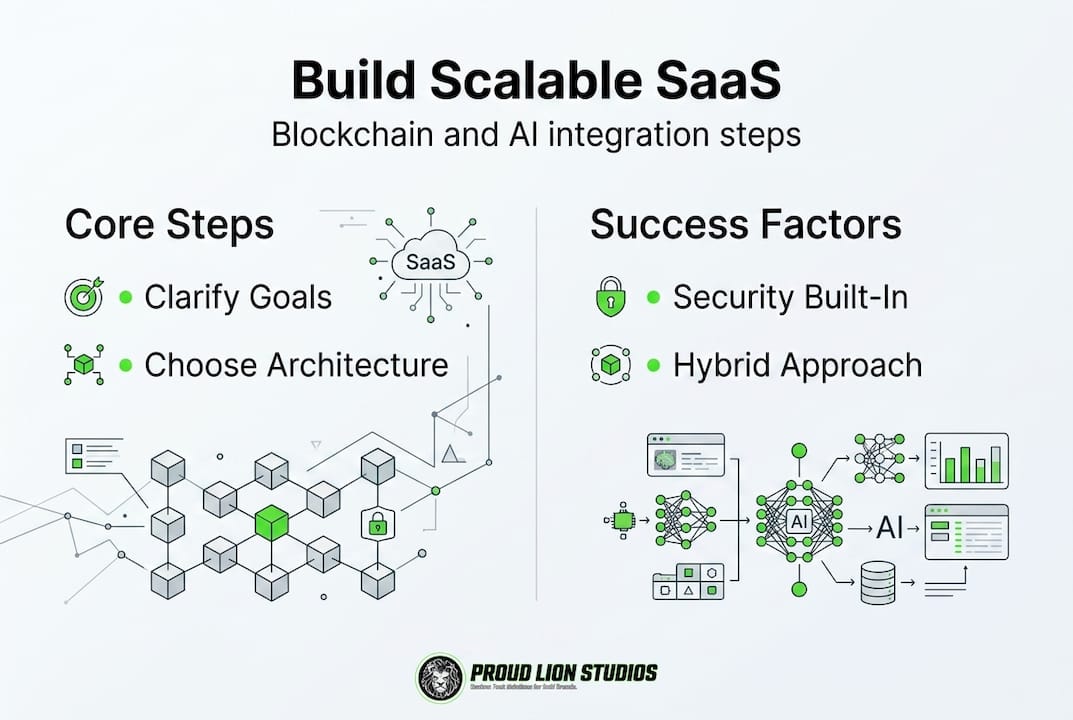
The build sequence matters enormously. Trying to integrate AI and blockchain simultaneously with your core SaaS build is one of the fastest routes to scope creep, missed deadlines, and fragile systems. Use a phased approach instead:
- Build the SaaS core. Get your core product working on standard cloud infrastructure. Auth, billing, user management, core workflows. Validate with real users before adding any advanced technology.
- Integrate AI APIs. Add AI capabilities through well-defined service boundaries. Start with one high-value use case. Automate one repetitive task. Measure impact before expanding.
- Add blockchain modules where relevant. Once your platform is stable and your AI integrations are proven, introduce blockchain where the business case is clear. Smart contracts for settlement, on-chain identity, tokenized assets.
- Connect the layers. Build event-driven bridges between your AI layer and blockchain layer only where they need to communicate. Keep them independently deployable as long as possible.
- Test interoperability. Run end-to-end tests that cross all three layers. Confirm that data flows correctly, edge cases are handled, and failure modes don't cascade.
Here's an honest comparison of three common approaches:
| Approach | Development effort | Time to market | Risk level | Best for |
|---|---|---|---|---|
| AI-first | Medium | Fast | Low | Automation-heavy SaaS |
| Blockchain-first | High | Slow | High | Trust-critical applications |
| Hybrid (recommended) | Medium-high | Medium | Medium | Most enterprise SaaS |
The evidence strongly supports the hybrid path. As shown in analysis of failed AI and blockchain projects, many projects fail due to overcomplication, regulatory gaps, and performance mismatches. Teams that try to build everything at once consistently underestimate integration complexity, especially around data consistency across blockchain and off-chain systems.
Pro Tip: Define your data ownership model before integrating AI and blockchain. Which data lives on-chain? Which stays off-chain but gets hashed for verification? Which goes to your AI training pipeline? Answering these questions upfront prevents architectural debt that's extremely expensive to fix later.
For practical automation strategy, AI agents for automation represents one of the fastest-growing areas of SaaS differentiation right now. Teams exploring how AI is reshaping product development should read up on AI innovation in SaaS, and if you're building complex enterprise integrations, AI workflow integration with existing CRM and ERP systems is often the highest-ROI starting point.
Pitfalls, performance, and validation: Ensuring long-term SaaS success
With your SaaS platform assembled, let's focus on maximizing its performance and avoiding costly setbacks.
The biggest operational risk for AI and blockchain SaaS platforms isn't the initial build. It's the slow accumulation of complexity after launch. Features get added, edge cases get patched, and before long, your clean architecture looks like a bowl of spaghetti. Here's how to stay ahead of it.
Recognize over-engineering early. Warning signs include:
- Smart contracts handling logic that could live in your application layer
- AI models running on every user action regardless of whether they add value
- More than three technology layers involved in a single user transaction
- Developer onboarding taking longer than two weeks due to system complexity
- A growing list of manual workarounds to handle edge cases
The performance concern specific to blockchain is what many architects call the "decentralization tax." Every transaction that goes on-chain adds latency compared to a database write. For high-frequency operations, this matters enormously. A supply chain platform writing thousands of events per minute to a public blockchain will hit throughput limits and face unpredictable gas costs. The solution is to batch non-time-critical records, write only cryptographic proofs on-chain, and keep raw data off-chain.
"Success requires clear business value over hype, hybrid over fully decentralized."
Build ongoing validation routines into your platform from the start. For AI components, this means monitoring model drift (the gradual degradation in prediction accuracy as real-world data shifts), tracking false positive and false negative rates, and running challenger models periodically against your production model. For blockchain components, validate smart contract behavior with automated test suites after every code update and audit regularly.
Key KPIs to monitor continuously across your integrated platform:
- AI accuracy rate: How often is your AI model making the right call?
- Transaction throughput: How many on-chain transactions per second can your system sustain?
- System latency: End-to-end response time across all three layers
- Cost per transaction: Including gas fees, API costs, and compute
- User-reported friction: Are users encountering unexpected errors or slowdowns from blockchain or AI components?
Feedback loops matter as much as the initial build. Real-world usage will surface edge cases your testing never anticipated. Build mechanisms to capture these quickly and feed them back into your development cycle. For inspiration on what successful platforms look like in practice, the blockchain-AI case studies from regional innovators offer valuable benchmarks. Platforms with a mobile-first user base should also factor in the considerations outlined in mobile SaaS growth factors to avoid performance gaps between web and mobile clients.
Our take: The real path to SaaS innovation with AI and blockchain
Here's the uncomfortable truth that most technology vendors won't tell you: the most successful SaaS platforms we've seen aren't the ones that use the most AI or the most blockchain. They're the ones where every architectural decision traces directly back to a measurable customer outcome.
We've worked with talented engineering teams that built genuinely impressive on-chain systems with sophisticated AI models, and then watched those platforms struggle to find product-market fit because the technology was solving problems the customer didn't actually care about. Over-decentralization is a particularly seductive trap. It feels rigorous. It signals seriousness. But it often adds cost and complexity without adding customer value.
The teams that win use hybrid models deliberately, not by default. They ask "what does decentralization actually buy us here?" before adding a blockchain component. They treat deep AI innovation as a tool for specific high-value tasks, not as a blanket solution to every workflow inefficiency. And they measure constantly, adjusting based on what the data tells them rather than what the architecture diagram suggests.
Restraint is a competitive advantage. Build less. Validate faster. Ship value sooner.
Leverage expert help for your SaaS, blockchain, or AI vision
If you're ready to scale your SaaS vision or need help overcoming technical hurdles, expert development can accelerate your journey. Building an integrated SaaS platform that spans cloud-native infrastructure, AI automation, and blockchain is genuinely complex work that benefits from experienced architectural guidance.
At Proud Lion Studios, we specialize in exactly this kind of integrated development. From initial architecture planning to full-scale deployment, our UAE-based team brings hands-on expertise across blockchain development services that are production-grade and audit-ready. We build smart contract expertise into platforms from day one, and help clients navigate tokenization and DApps use cases where the business case genuinely justifies it. Every engagement starts with your business outcomes, not our technology preferences.
Frequently asked questions
What is the biggest challenge in building a SaaS platform with blockchain and AI?
The biggest challenge is balancing advanced technology integration with clear business value. As the data shows, many projects fail due to overcomplication, regulatory gaps, and performance mismatches that could have been avoided with a clearer problem definition upfront.
When should blockchain be added to a SaaS platform?
Blockchain should be added when you need tamper-proof records, transparent payments, or verifiable trust that simpler tools can't provide. The best practice is to add blockchain selectively for trust, payments, or verification use cases after your core SaaS is stable.
How can I avoid over-engineering my SaaS platform?
Start with a minimal, scalable core and add AI or blockchain only where they create measurable customer value. Platforms that stay focused on outcomes over capabilities, as recommended by hybrid over fully decentralized approaches, consistently outperform those chasing technical completeness.
What's a "decentralization tax" in SaaS?
A decentralization tax refers to the added latency and operational complexity that blockchain components introduce compared to traditional database operations. The recommendation is to avoid the decentralization tax by reserving on-chain logic for use cases where the trust or transparency benefit clearly outweighs the performance cost.