

Enterprises today face a critical bottleneck that threatens to slow innovation: 80% of corporate knowledge lives in unstructured data such as PDFs, videos, and emails, making it increasingly difficult to extract actionable insights. As web development evolves, emerging technologies like AI, blockchain, and edge computing are transforming how we build scalable, secure applications. This guide explores these pivotal trends to help decision-makers navigate the future of web development.
Table of Contents
- Navigating the data explosion: taming unstructured content in web development
- AI-assisted coding and cybersecurity: boosting developer productivity and security
- Leveraging edge computing for faster, scalable web applications
- Integrating blockchain and web3 technologies for secure, scalable solutions
- How Proud Lion Studios can power your future web projects
- Frequently asked questions
Key takeaways
| Point | Details |
|---|---|
| AI and edge computing revolutionize speed | Developers using AI coding tools complete tasks 55% faster, while edge computing reduces time to first byte by 60-80%. |
| Blockchain drives secure scalability | Smart contracts and decentralized ledgers enable transparent, trustworthy transactions across finance, supply chain, and gaming sectors. |
| Unstructured data creates major challenges | Data entropy and format diversity limit AI effectiveness, requiring continuous governance and cleaning systems. |
| Cybersecurity automation addresses staffing gaps | AI automates repetitive security tasks as unfilled cybersecurity jobs grow from under 1 million to 3 million globally. |
Navigating the data explosion: taming unstructured content in web development
Enterprises collect massive volumes of data daily, but the majority exists in formats that resist traditional analysis. Videos, scanned documents, chat logs, and email threads create a fragmented knowledge base that AI systems struggle to process effectively. This phenomenon, called data entropy, occurs when information loses freshness and structure over time, rendering it less useful for machine learning workloads.
Startups leading the charge are building continuous data cleaning pipelines that automatically categorize, tag, and refresh unstructured content. These systems use natural language processing to extract meaning from text-heavy files and computer vision to parse visual data. Without proper data handling, even the most sophisticated AI models produce unreliable outputs, undermining trust in automated decision-making.
Key challenges include:
- Diverse file formats requiring specialized parsing logic
- Outdated information that skews model training
- Lack of metadata making search and retrieval inefficient
- Compliance requirements demanding strict data governance
Pro Tip: Implement automated metadata tagging at the point of data ingestion to maintain structure from day one, reducing entropy before it accumulates.
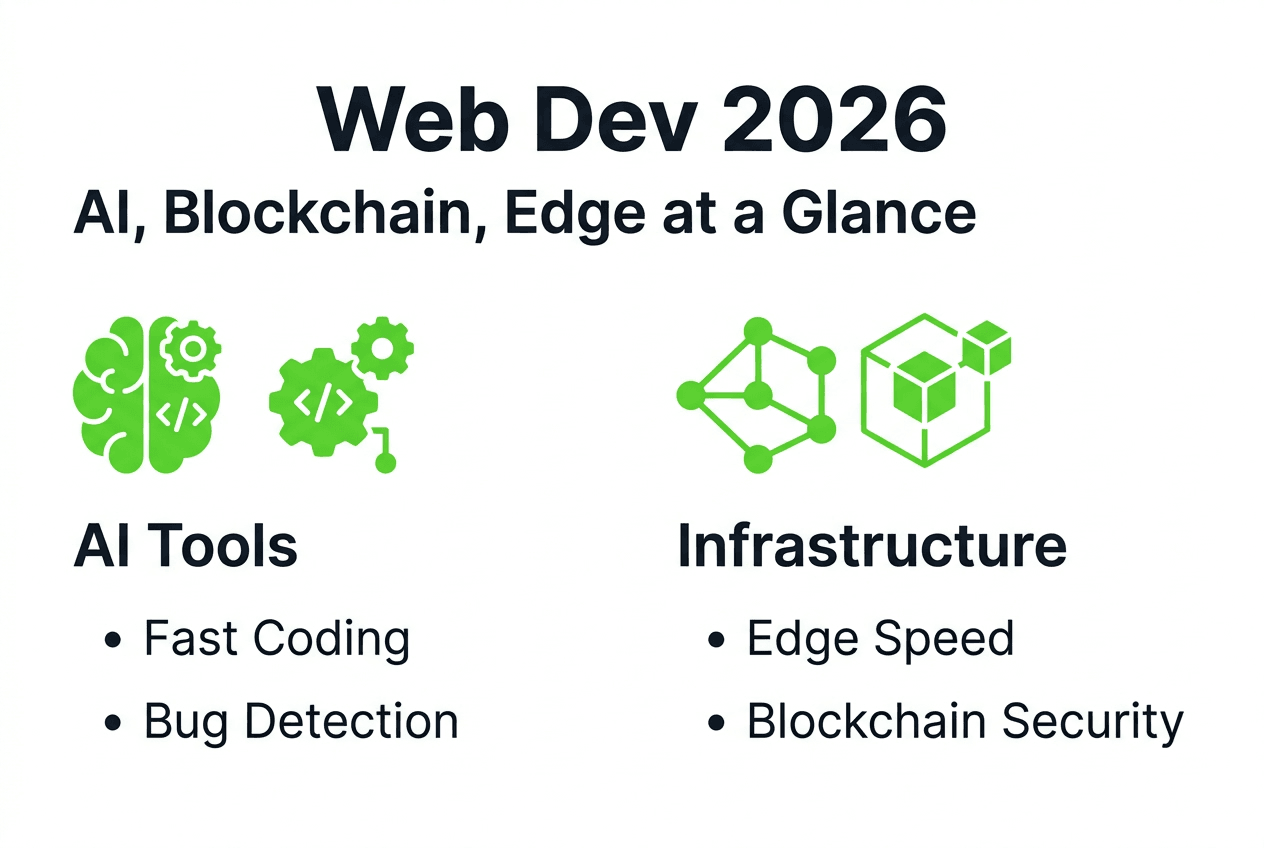
Addressing data entropy isn't optional for organizations planning AI-driven web applications. Clean, well-organized data directly impacts model accuracy, response times, and ultimately user satisfaction. As web development increasingly relies on intelligent features, establishing robust data governance frameworks becomes a foundational requirement.
AI-assisted coding and cybersecurity: boosting developer productivity and security
AI coding assistants have moved from experimental tools to essential productivity multipliers. Developers using AI coding tools complete tasks 55% faster than those relying solely on traditional methods, freeing up time for complex problem-solving and architectural decisions. These tools suggest code completions, detect bugs in real time, and even generate entire functions based on natural language descriptions.
Beyond coding speed, AI addresses a critical cybersecurity labor shortage. AI automates repetitive cybersecurity tasks, addressing unfilled jobs growing from under 1 million to 3 million positions worldwide. Threat detection, log analysis, and incident response workflows benefit enormously from machine learning models that identify patterns humans might miss. Automated systems can triage alerts, prioritize vulnerabilities, and even patch low-risk issues without human intervention.
Key benefits of AI in development and security:
- Faster code iteration with intelligent autocomplete and refactoring
- Reduced cognitive load for developers handling routine tasks
- Enhanced threat detection through anomaly recognition
- Scalable security monitoring across distributed systems
Pro Tip: Treat AI agents as collaborators, not replacements. Review all AI-generated code and security recommendations to maintain quality and catch edge cases the model might overlook.
"AI serves as an amplifier of human judgment, accelerating what developers already do well while highlighting areas that need attention."
The strategic adoption of AI tools requires balancing automation with oversight. Teams that integrate AI assistants into their workflows report higher job satisfaction because mundane tasks diminish, allowing engineers to focus on creative challenges. As cybersecurity trends evolve, organizations that leverage AI for both development and defense position themselves to scale efficiently while maintaining robust security postures.
Leveraging edge computing for faster, scalable web applications
Edge computing fundamentally changes how web applications deliver content by processing requests closer to users rather than routing everything through centralized data centers. Edge functions execute in under 50 milliseconds, enabling real-time personalization, authentication, and geolocation services without perceptible delay. This architecture drastically improves user experience, especially for global audiences spread across continents.

Edge reduces time to first byte by 60-80%, improving user experience worldwide by minimizing the physical distance data must travel. Caching strategies like stale-while-revalidate allow applications to serve cached content instantly while updating in the background, balancing freshness with speed. For dynamic content that changes frequently, edge middleware can decide whether to serve from cache or fetch fresh data based on real-time logic.
| Use Case | Edge Processing | Origin Processing |
|---|---|---|
| Authentication | Token validation, session checks | Initial login, credential verification |
| Personalization | User preferences, A/B tests | Complex recommendation engines |
| Static Assets | CDN caching, image optimization | Asset compilation, original storage |
| Payment Processing | Fraud detection signals | Transaction execution, database writes |
Heavy computational tasks like payment processing and complex database transactions still execute at origin servers to maintain data consistency and scalability. However, moving lightweight operations to the edge reduces load on central infrastructure, enabling applications to handle traffic spikes gracefully. Amazon found that every 100ms of latency costs 1% in sales, demonstrating the direct revenue impact of performance optimization.
Key edge computing advantages:
- Ultra-low latency for time-sensitive operations
- Reduced bandwidth costs by caching at network edges
- Improved resilience through distributed processing
- Enhanced privacy by processing data closer to users
Pro Tip: Combine edge computing with process automations to trigger workflows based on user interactions in real time, creating responsive experiences that feel instant.
As web applications grow more sophisticated, edge computing becomes essential infrastructure rather than an optional enhancement. The ability to deliver sub-50ms response times globally separates market leaders from competitors struggling with sluggish performance.
Integrating blockchain and web3 technologies for secure, scalable solutions
Blockchain technology extends beyond cryptocurrency to provide foundational infrastructure for trustless, transparent web applications. Decentralized ledgers record transactions immutably, creating audit trails that resist tampering and build user confidence in data integrity. Smart contracts automate business logic without intermediaries, executing predefined rules when conditions are met, reducing operational overhead and eliminating single points of failure.
The global web development market is worth over $89 billion in 2026, with blockchain development as a key driver of growth across industries. Financial services use blockchain for settlement and compliance, supply chains track goods from manufacture to delivery, and gaming platforms enable true digital ownership of in-game assets. The shift from centralized databases to distributed systems fundamentally changes how developers architect applications.
| Aspect | Traditional Web | Blockchain Web |
|---|---|---|
| Data Storage | Centralized servers | Distributed nodes |
| Trust Model | Platform provider | Cryptographic verification |
| Transaction Speed | Milliseconds | Seconds to minutes |
| Transparency | Limited visibility | Public audit trails |
| Scalability | Vertical scaling | Horizontal network growth |
Key blockchain integration benefits:
- Enhanced security through cryptographic verification
- Reduced fraud via transparent transaction histories
- Automated workflows with self-executing smart contracts
- User ownership of data and digital assets
While blockchain introduces complexity, the trade-off often justifies the investment for applications requiring high trust and transparency. Blockchain development and smart contract development enable businesses to future-proof their platforms as decentralized technologies gain mainstream adoption. Organizations exploring Web3 capabilities position themselves to capture new markets and business models that centralized architectures cannot support.
How Proud Lion Studios can power your future web projects
Navigating AI, blockchain, and edge computing requires specialized expertise that bridges emerging technologies with practical business outcomes. Proud Lion Studios delivers cutting-edge solutions tailored to startups and enterprises seeking competitive advantages through innovation. From blockchain development that establishes trust to AI agents that automate complex workflows, the studio's UAE-based technical team builds scalable applications designed for tomorrow's challenges.
Whether you're integrating smart contracts, deploying edge-optimized infrastructure, or building intelligent automation with process automations, partnering with specialists accelerates development and reduces risk. Explore how Proud Lion Studios can transform your vision into reality at proudlionstudios.com.
Frequently asked questions
What is the biggest challenge in future web development?
Managing and structuring vast amounts of unstructured data represents the primary obstacle for AI-driven web development. Data entropy degrades information quality over time, limiting model effectiveness and requiring continuous governance. Organizations that implement automated cleaning pipelines and metadata systems gain significant advantages in deploying intelligent features.
How does edge computing improve website performance?
Edge computing reduces time to first byte by 60-80% by processing requests at network locations closest to users rather than routing through distant data centers. Caching patterns like stale-while-revalidate serve content instantly while updating in the background, balancing freshness with speed. This architecture delivers sub-50ms response times globally, directly improving engagement and conversion rates.
Can AI replace developers in web development?
AI amplifies developer productivity but cannot substitute human judgment, creativity, and strategic thinking. Developers using AI coding tools complete tasks 55% faster, allowing them to focus on complex problem-solving rather than routine coding. Effective AI-assisted workflows enhance rather than eliminate the need for skilled engineers, as explored in the future of artificial intelligence.
Why is blockchain important for future web apps?
Blockchain enables secure, decentralized transactions and automates business logic through smart contracts, creating trustless systems essential for scalable applications. Industries like finance, supply chain, and gaming benefit from transparent audit trails and reduced intermediary costs. As the web development market exceeds $89 billion in 2026, blockchain development services become critical for organizations future-proofing their digital infrastructure.
Recommended
- Build mobile apps with AI, blockchain & game tech in 2026
- Build mobile apps with AI, blockchain & game tech in 2026 - Software & Web3 Development in Dubai | Proud Lion Studios
- Mobile apps in tech: startup growth strategies for 2026 - Proud Lion Studios
- f01i.ai – AI Crypto Trading Bot Builder | No Commissions | Automated Trading
- Digital Marketing Trends 2026: What Marketers Must Know