

Blockchain is not a cryptocurrency story. It never really was. 81% of executives view blockchain as mainstream technology, yet most organizations still struggle to move from interest to actual implementation. The gap between knowing blockchain matters and knowing what to do with it is where most startups and enterprises get stuck. This guide maps the real barriers, showcases the infrastructure breakthroughs changing the game, and gives you a practical framework to move from confusion to measurable results.
Table of Contents
- Why blockchain matters for startups and enterprises
- Top hurdles: From legacy integration to skills shortages
- Breakthroughs: High-performance blockchain infrastructure and AI integration
- AI and blockchain: Practical synergy for real-world business
- From confusion to clarity: Success patterns for blockchain adoption
- Ready to unlock blockchain's full potential?
- Frequently asked questions
Key Takeaways
| Point | Details |
|---|---|
| Tackle integration first | Legacy system integration is the largest barrier, so plan for staged adoption. |
| Adopt pilot frameworks | Small-scale, quick pilots with measurable ROI beat large 'big bang' transitions. |
| Leverage AI synergies | Combining AI and blockchain unlocks powerful predictive, trust, and audit capabilities. |
| Choose proven infrastructure | Go with matured, scalable solutions backed by industry benchmarks and real-world case studies. |
| Focus on business outcomes | Always tie technology adoption to real pain points and value, not just trends. |
Why blockchain matters for startups and enterprises
Blockchain is, at its core, a shared ledger that no single party controls. Every transaction is recorded, timestamped, and visible to all authorized participants. That sounds simple, but the business implications are enormous. Fraud becomes harder. Disputes get resolved faster. Regulators get the audit trails they demand without you building separate reporting systems.
The applications go well beyond payments. Supply chain visibility, digital identity verification, tokenization of real-world assets, and decentralized finance (DeFi) protocols are all live use cases generating real revenue for companies today. When you layer AI on top of blockchain infrastructure, you get something even more powerful: secure, verifiable predictive analytics where the underlying data cannot be manipulated.
Here is what blockchain actually delivers for your business:
- Tamper-proof records that build trust with customers, partners, and regulators
- Automated smart contracts that execute transactions without intermediaries
- Tokenization of assets, loyalty points, and equity for new revenue models
- Decentralized identity that reduces KYC (Know Your Customer) friction
- Cross-border settlement that cuts transaction time from days to seconds
"Blockchain transforms coordination and trust without replacing all legacy systems overnight. The technology is a tool, not a governance solution."
Understanding blockchain development explained in practical terms helps you set realistic expectations. And if you are a startup evaluating your first Web3 move, the Web3 benefits for startups are concrete and measurable when approached correctly.
Top hurdles: From legacy integration to skills shortages
Knowing blockchain's promise is one thing. Knowing what slows you down is what actually saves your project. Most organizations hit the same five walls, and the order matters.
- Legacy system complexity — Existing ERP, CRM, and database architectures were not built to talk to distributed ledgers. Retrofitting them is expensive and technically demanding.
- Skills shortage — Blockchain developers are scarce. Smart contract auditors are even scarcer. Hiring or training takes time most teams do not have.
- Scalability concerns — Early blockchain networks processed fewer than 20 transactions per second. Enterprise workloads need thousands.
- Regulatory uncertainty — Rules around tokenized assets, data residency, and smart contract enforceability vary by jurisdiction and change frequently.
- Cost and ROI ambiguity — Without clear metrics upfront, blockchain projects balloon in scope and fail to demonstrate value.
Integration with legacy systems and the lack of technical standards remain the top blockers for enterprise adoption in 2026. The table below shows how these barriers stack up by organization type:
| Barrier | Impact on startups | Impact on enterprises |
|---|---|---|
| Legacy integration | Low (greenfield builds) | Very high |
| Skills shortage | High | Medium (budget for hiring) |
| Scalability | Medium | High |
| Regulatory demands | Medium | Very high |
| ROI clarity | High | Medium |
Pro Tip: Do not try to replace your entire infrastructure at once. Start with one process, one pain point, and one measurable outcome. A focused pilot on invoice reconciliation or supplier verification will teach you more in 90 days than a year of planning.
Building scalable blockchain apps from the start avoids costly rewrites later. And if you want to understand why ignoring these barriers puts your product roadmap at risk, the case for future-proof with Web3 architecture is well documented.
Breakthroughs: High-performance blockchain infrastructure and AI integration
The infrastructure story has changed dramatically. The bottlenecks that made enterprise blockchain impractical three years ago are being dismantled by a new generation of Layer-1 and decentralized compute platforms.

MegaETH exceeds 100k TPS with sub-10ms latency, and Aethir offers decentralized GPU clouds purpose-built for enterprise AI workloads. These are not whitepaper promises. They are live networks handling real transaction volumes.
| Platform | Speed (TPS) | Key strength | AI support | Enterprise readiness |
|---|---|---|---|---|
| MegaETH | 100,000+ | Ultra-low latency | On-chain AI execution | Early stage, high potential |
| Monad | 10,000+ | EVM compatibility | Parallel processing | Growing ecosystem |
| Aethir | N/A | Decentralized GPU cloud | Full AI workload support | Enterprise-grade |
| Akash | N/A | Open compute marketplace | AI model hosting | Production ready |
| Ritual | N/A | On-chain AI verification | Native AI integration | Research to production |
Layer-1 blockchains are maturing, but most projects are still in the growing ecosystem stage. That means early movers get the advantage of shaping integrations before standards lock in, but they also carry more technical risk.
Decentralized GPU networks like Aethir and Akash are particularly relevant for enterprises running AI models that require both compute power and data integrity. When your AI model trains on blockchain-secured data, every input and output is auditable. That matters enormously in regulated industries like finance, healthcare, and logistics.
Exploring Web3 infrastructure options early gives your team the context to choose the right foundation before you commit budget.
AI and blockchain: Practical synergy for real-world business
Combining AI and blockchain is not a marketing tagline. It solves a specific and expensive problem: how do you trust the outputs of an AI system when the data it trained on could have been altered?
Blockchain creates an immutable audit trail for every data input, model update, and decision output. AI brings pattern recognition and predictive power that static ledgers cannot provide on their own. Together, they create systems that are both intelligent and verifiable.
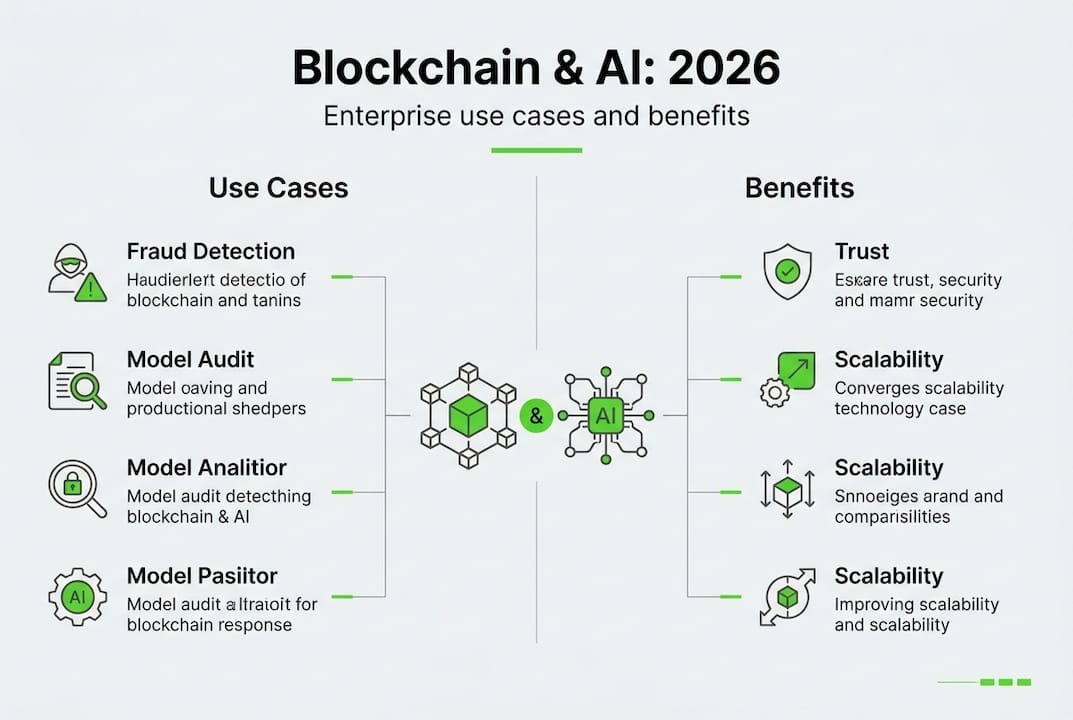
AI-blockchain synergy excels in predictive analytics on immutable data, covering fraud detection, demand forecasting, and secure model verification. Here is where that plays out in practice:
- Fraud detection — AI flags anomalies in real time while blockchain records every transaction, making it impossible to cover tracks after the fact
- Supply chain forecasting — Personalized demand predictions run against verified, tamper-proof supplier and logistics data
- KYC automation — AI processes identity documents while blockchain stores verified credentials, eliminating redundant checks across platforms
- Model verification — Enterprises can prove their AI made a specific decision based on specific data, critical for regulatory compliance
- Decentralized data marketplaces — Businesses monetize proprietary datasets while maintaining cryptographic proof of ownership
Pro Tip: If you are deploying AI-driven recommendations or decisions to end users, publish a blockchain-anchored audit log. It is one of the fastest ways to build user trust in automated systems, especially in financial services and healthcare.
See how AI innovation with blockchain is reshaping product development, and explore what goes into building AI-powered blockchain products that scale.
From confusion to clarity: Success patterns for blockchain adoption
Most blockchain projects fail not because the technology does not work, but because the implementation strategy was wrong from the start. The organizations that succeed follow a recognizable pattern.
Startups and enterprises succeed via pilots with 90-day ROI targets, cross-functional teams, and incremental migration rather than full system overhauls. Here is the framework that works:
- Define the pain point first — Choose one process where lack of transparency, fraud risk, or manual reconciliation is costing you measurable money or time.
- Build a cross-functional team — Include legal, operations, IT, and a blockchain specialist. Blockchain projects that live only in the tech department almost always stall.
- Run a 90-day pilot — Scope it tightly. One use case, one integration point, one success metric. Ship something real.
- Measure and document ROI — Track time saved, errors reduced, and cost per transaction before and after. This data funds your next phase.
- Migrate incrementally — Use the pilot results to prioritize the next integration. Never try to migrate everything at once.
| Success factor | Why it matters | Common mistake |
|---|---|---|
| Clear pain point | Keeps scope tight | Building for blockchain's sake |
| Cross-functional team | Prevents siloed decisions | Tech-only ownership |
| 90-day pilot | Proves value fast | Multi-year roadmaps with no milestones |
| Measurable ROI | Justifies next investment | Vague efficiency claims |
| Incremental migration | Reduces risk | Full rip-and-replace approach |
Pro Tip: Avoid overengineering. The question is never "can we put this on a blockchain?" The question is "does blockchain solve this problem better than what we already have?" If the answer is not clearly yes, keep looking.
For teams ready to build, scalable blockchain solutions require the right architecture decisions from day one, not as an afterthought.
Ready to unlock blockchain's full potential?
Moving from exploration to execution is where most teams need a partner, not just a platform. At Proud Lion Studios, we work with startups and enterprises to design, build, and scale blockchain and AI-powered products that solve real business problems.
Our blockchain development services cover everything from architecture strategy to smart contract deployment, with a UAE-based technical team that has delivered projects across multiple countries and industries. We also build AI agents for business that integrate directly with blockchain infrastructure for auditable, automated workflows. Whether you need a 90-day pilot or a full-scale product, our smart contract solutions are built for your specific use case, not templated packages. Connect with us to start your discovery session.
Frequently asked questions
How does blockchain improve business operations?
Blockchain provides an unalterable ledger for tracking business interactions, automating transactions through smart contracts, and giving all stakeholders real-time visibility into shared processes.
What is the biggest obstacle when integrating blockchain?
Integration with legacy systems is the top barrier, because existing enterprise software was not designed to communicate with distributed ledger networks without significant middleware development.
What are the top use cases for blockchain-AI combos?
AI-blockchain synergy excels in fraud detection, secure demand forecasting, KYC automation, and model verification where auditability and predictive accuracy both matter.
How should enterprises start with blockchain to ensure ROI?
Begin with a tightly scoped pilot targeting one measurable pain point, build a cross-functional team, and set a 90-day deadline to demonstrate concrete results before expanding.
Do all blockchain projects really decentralize power?
No. Even with decentralized technology, DAO voting and governance structures can still see power concentrate among a small group of token holders or founding teams.