

Building a blockchain app sounds straightforward until you're three weeks into architecture decisions and still haven't written a single line of production code. Founders and CTOs face a real tension: blockchain promises decentralization, transparency, and new revenue models, but the tooling is fragmented, security is unforgiving, and the wrong chain choice can cost you months. This guide walks you through every critical phase, from picking your stack to deploying and scaling, so you can move fast without making expensive mistakes. Whether you're building a DeFi protocol, an NFT marketplace, or an enterprise transparency layer, the roadmap ahead applies directly to your situation.
Table of Contents
- What makes blockchain app development unique?
- Key tools and requirements for building blockchain apps
- Step-by-step process: How to build your blockchain app
- Common pitfalls and how to avoid them
- What does success look like? Verifying and scaling your blockchain app
- Partner with blockchain development experts
- Frequently asked questions
Key Takeaways
| Point | Details |
|---|---|
| Choose the right stack | Ethereum and Solana offer distinct advantages for security or scalability—align your choice with the product and business model. |
| Layer 2 for savings | Using Layer 2 solutions like Polygon can lower your transaction costs by as much as 90 percent. |
| Test before mainnet | Rigorous testing on testnets helps catch security flaws and scalability issues before costly mainnet launches. |
| Measure key metrics | Track transactions per second and gas fees to ensure your blockchain app meets user growth targets. |
| Partner with experts | Specialized blockchain development teams can help you avoid pitfalls and accelerate time to market. |
What makes blockchain app development unique?
Traditional app development gives you the luxury of patching bugs after launch. Blockchain doesn't. Once a smart contract is deployed on-chain, its logic is immutable. That single fact changes everything about how you plan, test, and ship.
Understanding blockchain development basics is the first step before writing any code. Blockchain apps operate on decentralized networks where no single party controls the data. Every transaction is verified by consensus, recorded permanently, and visible to anyone with access to the chain. This creates trust without intermediaries, but it also means your security model must be airtight from day one.
Choosing the right network is one of the most consequential decisions you'll make. Ethereum prioritizes security and decentralization using a modular L1 plus L2 architecture, while Solana optimizes for speed and scalability through a monolithic design combining Proof of History and Proof of Stake, though with more centralized validators. Your use case drives the choice: DeFi and security-critical apps favor Ethereum, while high-frequency trading and gaming lean toward Solana.
Here's what makes blockchain development structurally different from building a standard web app:
- Smart contracts replace backend logic and are immutable once deployed
- Consensus mechanisms determine transaction finality and speed
- Token integration requires careful economic modeling before launch
- Transaction limits and gas fees directly affect user experience and cost
- Wallet authentication replaces traditional login systems
- Decentralized apps require frontend clients that communicate with on-chain state
The consensus model you choose shapes every downstream decision: how fast users transact, how much they pay, and how much you can scale. There is no neutral choice here.
These constraints apply whether you're building DeFi protocols, NFT platforms, gaming economies, or enterprise audit trails. Now that you know why blockchain is different, let's see what you need to get started.
Key tools and requirements for building blockchain apps
Your tech stack determines how fast you can iterate and how stable your app will be under real load. The two dominant ecosystems, Ethereum and Solana, each have mature but distinct toolchains.

| Component | Ethereum stack | Solana stack |
|---|---|---|
| Smart contracts | Hardhat / Foundry (Solidity) | Anchor / Rust |
| Frontend | React / Next.js | React |
| Blockchain library | ethers.js / Web3.js | @solana/web3.js |
| Wallet integration | MetaMask | Phantom |
| RPC infrastructure | Alchemy / Infura | QuickNode / Helius |
The full-stack blockchain application setup above covers the core layers: contract development, frontend interaction, and infrastructure. Each tool has a specific job, and skipping any layer creates gaps that show up as bugs or security holes in production.
Beyond the stack itself, every developer environment needs these fundamentals:
- IDE setup: VS Code with Solidity or Rust extensions installed
- Version control: Git with branch protection rules for contract code
- Testnet access: Sepolia (Ethereum) or Devnet (Solana) for safe testing
- Local wallets: MetaMask or Phantom configured for testnet networks
- Block explorer access: Etherscan or Solscan for transaction verification
If you're building for mobile, the blockchain mobile apps guide covers additional SDK and wallet considerations specific to iOS and Android. For founders newer to the space, the Web3 for entrepreneurs overview explains the broader ecosystem context.
Pro Tip: Configure your testnet environment completely before touching mainnet. Gas costs and irreversible transactions on mainnet make early-stage mistakes very expensive.
Once you have your tools and environment ready, it's time to map out the development process.
Step-by-step process: How to build your blockchain app
Most failed blockchain projects don't fail because of bad ideas. They fail because teams skip steps or underestimate the complexity of each phase. Here's the sequence that works:
- Define your use case and business logic before touching code. What problem does the blockchain solve that a database can't?
- Select your chain based on throughput, cost, and ecosystem fit.
- Design your smart contract architecture, mapping out functions, access controls, and data structures.
- Write and unit test contracts using Hardhat or Anchor on a local environment.
- Deploy to testnet and run integration tests with real wallet interactions.
- Build your frontend and connect it to the contract using ethers.js or @solana/web3.js.
- Run a security audit on all contract code before mainnet deployment.
- Deploy to mainnet and verify contract code on the relevant block explorer.
- Monitor and iterate using on-chain analytics and user feedback.
Choosing where to deploy matters as much as how you build. Here's a quick comparison:
| Chain | Best for | TPS | Avg. cost |
|---|---|---|---|
| Ethereum L1 | DeFi, high-value assets | 15-30 | High |
| Polygon | NFTs, games, enterprise | Up to 65,000 | Very low |
| Solana | High-frequency apps, gaming | 2,000-4,000 | Very low |
| Optimism / Arbitrum | Ethereum apps needing scale | Varies | Low |
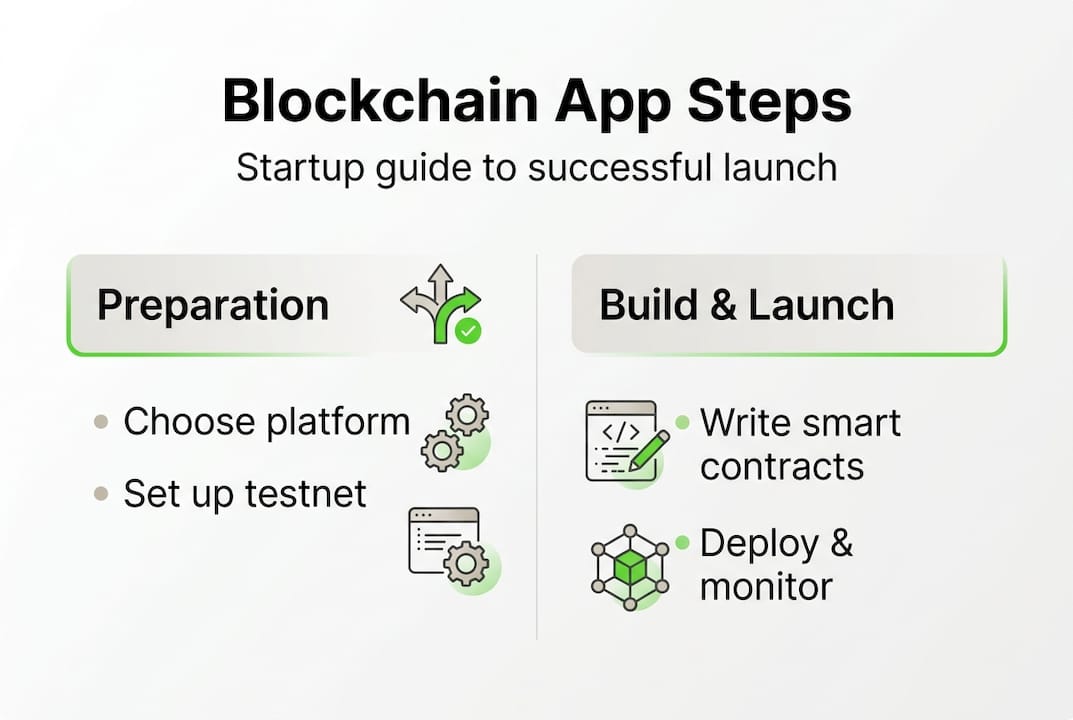
For Ethereum-based apps under load, L2 solutions like Polygon and Optimism can reduce gas fees by up to 90%. Solana's parallel execution engine, Sealevel, supports a theoretical 65,000 TPS, making it viable for apps with high transaction volume. For storage, use IPFS for off-chain assets like NFT metadata to keep on-chain costs manageable.
Pro Tip: Always test contract edge cases on testnet with simulated high-volume transactions before mainnet. One missed edge case in a financial contract can drain user funds.
Before you go live, stress-test your contracts with batch transactions and benchmark your throughput against your expected user load. A contract that works at 10 users may break at 10,000.
Review the Web3 development checklist before deployment, and consider professional smart contract development support for complex financial logic. You now have a roadmap; let's ensure you avoid common mistakes that could sink your project.
Common pitfalls and how to avoid them
Even experienced teams make predictable mistakes in blockchain projects. Knowing them in advance is a real competitive advantage.
- Skipping security audits: Smart contract vulnerabilities have cost the industry billions. Use tools like Slither or MythX, and get a third-party audit before mainnet.
- Underestimating gas fees: High Ethereum L1 fees can make your app economically unviable. Plan for L2 scaling from the start to keep costs manageable.
- Ignoring UX and wallet onboarding: Most users don't understand seed phrases or gas. Simplify wallet connection and abstract complexity wherever possible.
- Choosing the wrong chain: Picking Ethereum L1 for a high-frequency game, or Solana for a compliance-heavy DeFi product, creates problems that are hard to fix post-launch.
- No upgrade path: Immutable contracts are a feature, but you need a proxy pattern or governance mechanism if you ever need to fix logic.
- Overlooking token economics: If your app uses a token, model the incentive structure carefully before launch. Bad tokenomics can kill adoption fast.
To optimize your Web3 project, treat security and scalability as first-class requirements, not afterthoughts.
Pro Tip: Budget at least 15-20% of your development timeline for testing and audits. Rushing this phase is the single most common reason blockchain projects get exploited.
With risks handled, let's see what a successful blockchain launch looks like.
What does success look like? Verifying and scaling your blockchain app
Deployment is not the finish line. It's the starting gun. Here's how to verify your launch and set up for growth.
Deployment verification checklist:
- Confirm contract deployment transaction on block explorer
- Verify contract source code is published and readable
- Test all core user flows with real wallets on mainnet
- Confirm frontend connects correctly and displays accurate on-chain data
- Check wallet connection works across MetaMask, Phantom, and mobile wallets
Key metrics to monitor post-launch:
- Transactions per second and latency under real load
- On-chain versus off-chain balance accuracy
- Active wallet count and retention over 7 and 30 days
- Failed transaction rate and error types
- Gas or fee spend per user action
Here's how the major chains compare on performance benchmarks:
| Chain | Real-world TPS | Theoretical TPS | Avg. tx cost |
|---|---|---|---|
| Ethereum L1 | 15-30 | ~100 (with L2) | $1-$20+ |
| Solana | 2,000-4,000 | 65,000 | <$0.01 |
| Polygon | ~7,000 | 65,000 | <$0.01 |
Solana's theoretical ceiling of 65,000 TPS makes it one of the most startup-ready chains for high-volume applications, though real-world throughput sits closer to 2,000-4,000 TPS under current network conditions. For apps expecting rapid user growth, plan your blockchain mobile app launch strategy around these real-world numbers, not theoretical peaks.
Iterate fast. Use on-chain analytics tools like Dune Analytics or Nansen to track user behavior, then ship improvements in short cycles. The teams that win in Web3 are the ones that treat post-launch as an active product phase, not a maintenance mode.
Partner with blockchain development experts
Building a blockchain app from scratch is a serious technical undertaking, and the margin for error is slim. Getting the architecture right from the start saves months of rework and protects your users.
At Proud Lion Studios, we work with startups and CTOs across every phase of blockchain product development. From strategy and chain selection to full-stack builds, our blockchain development services cover the entire lifecycle. Our team brings deep smart contract expertise to financial protocols and complex on-chain logic, and we build production-grade NFT and dApp solutions for founders who need more than a template. If you're ready to move from idea to a live, scalable product, let's talk about what your build actually needs.
Frequently asked questions
What is the easiest blockchain platform for startup app development?
Ethereum is the most widely adopted starting point for startups because of its mature tooling, extensive testnet options, and large developer community. The ecosystem around Hardhat, ethers.js, and MetaMask makes onboarding faster than most alternatives.
How do I reduce costs when building blockchain apps?
Using Layer 2 solutions like Polygon or Optimism can reduce gas fees by up to 90% compared to Ethereum L1. Batching transactions and storing assets off-chain with IPFS also cuts costs significantly.
How fast are different popular blockchains?
In real-world conditions, Ethereum processes 15-30 TPS, Solana handles 2,000-4,000 TPS, and Polygon reaches up to 65,000 TPS. Always design for real-world throughput, not theoretical maximums.
What are common mistakes in blockchain app development?
Skipping security audits and ignoring L2 scaling options early are the two most damaging mistakes startups make. Both are fixable before launch but very costly to address after users are on-chain.
Do I need a specialized wallet to build or test blockchain apps?
Yes. Tools like MetaMask for Ethereum and Phantom for Solana are essential for signing transactions, testing contract interactions, and simulating real user flows during development.