

TL;DR:
- Enterprises are adopting AI, blockchain, and mobile tech to manage complex workflows securely.
- Integrating emerging technologies requires careful planning, error handling, and pilot testing.
- Spec-driven development and anticipation are key to building scalable, resilient enterprise systems.
Off-the-shelf software promises simplicity but often delivers compromise. When your business operates across multiple markets, handles sensitive transactions, or needs to scale fast, generic tools become a liability rather than an asset. Enterprises in 2026 are accelerating adoption of AI, blockchain, and mobile technologies precisely because these tools address what packaged software cannot: complex workflows, real-time security, and seamless integration across distributed teams. This article gives you a practical roadmap for understanding enterprise software development, choosing the right architecture, and avoiding the integration pitfalls that quietly drain operational efficiency.
Table of Contents
- Understanding enterprise software development: Key concepts and approaches
- Integrating blockchain and AI: Building secure, automated, and scalable platforms
- Mobile and cross-platform strategies for modern enterprises
- Navigating integration and edge cases: Making new systems work with legacy tech
- Our perspective: Why successful enterprise software is built on anticipation, not just adaptation
- Ready to future-proof your enterprise technology?
- Frequently asked questions
Key Takeaways
| Point | Details |
|---|---|
| AI and blockchain synergy | Combining blockchain and AI dramatically enhances security, compliance, and automation in enterprise apps. |
| Mobile-first advantage | Prioritizing mobile and cross-platform development helps enterprises boost productivity and meet users where they are. |
| Edge case management | Spec-driven development and explicit error handling are non-negotiable for robust integration with legacy systems. |
| Proactive strategy wins | Anticipating technology shifts is more effective than reacting to problems after they occur. |
Understanding enterprise software development: Key concepts and approaches
Enterprise software development is not just a larger version of building a standard app. It is the practice of designing, building, and maintaining systems that serve complex organizational needs at scale, with strict requirements around security, uptime, and integration. Unlike off-the-shelf tools, custom enterprise solutions are built around your specific workflows, compliance requirements, and growth targets.
Decision-makers often underestimate how much the development methodology shapes the final product. Here is a quick breakdown of the most relevant approaches:
- Agile: Iterative, flexible, and ideal for projects where requirements evolve. Delivers working software in short cycles.
- Waterfall: Sequential and structured. Works well when requirements are fully defined upfront, such as regulatory compliance systems.
- DevOps: Bridges development and operations teams to accelerate deployment and improve reliability through automation.
- Spec-driven development: Every feature, edge case, and integration point is specified before a single line of code is written. This is critical for complex systems where ambiguity leads to expensive failures.
For enterprises building on scalable web app development frameworks, spec-driven development is increasingly the standard. It forces teams to think through failure modes, data contracts, and system boundaries before they become production problems.
"The choice of methodology is not a technical decision. It is a business decision that determines how fast you can respond to market changes without breaking what already works."
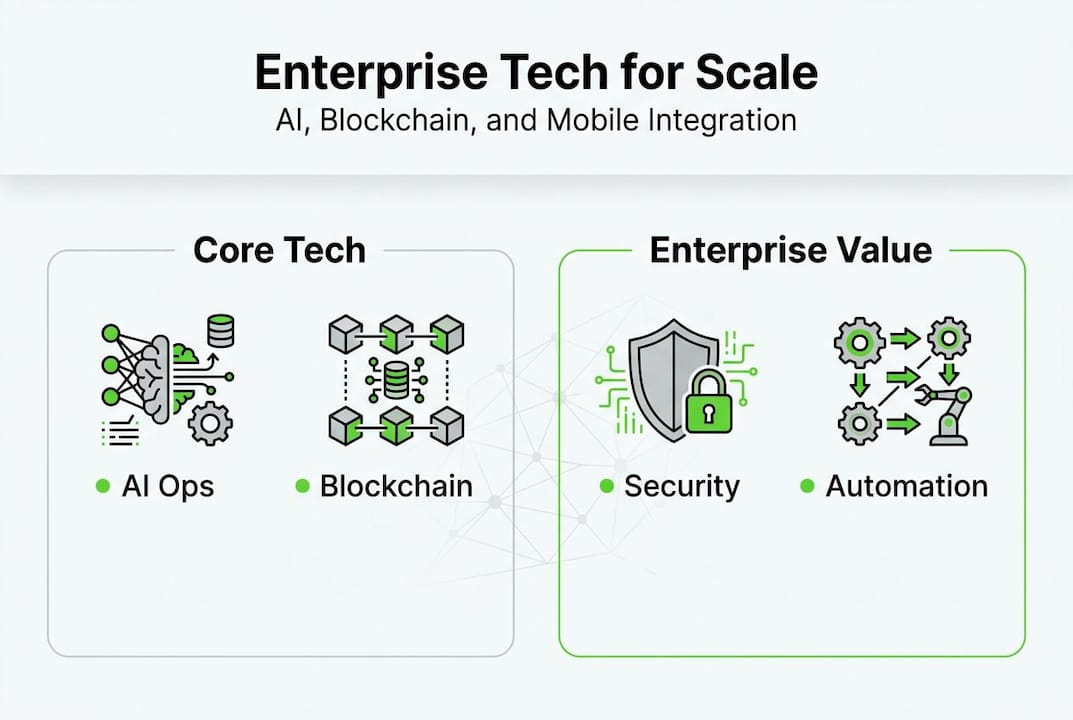
The shift toward AI-driven innovation and blockchain-based architectures is reshaping what enterprise software looks like at its core. Blockchain integration and AI are now foundational for secure and efficient enterprise systems, and organizations that treat them as optional add-ons rather than core infrastructure are already falling behind. Understanding enterprise product development approaches helps contextualize why methodology selection is so consequential at this scale.
Integrating blockchain and AI: Building secure, automated, and scalable platforms
Combining blockchain and AI is not a trend. It is a structural shift in how enterprises manage trust, automate decisions, and reduce operational costs. Blockchain provides an immutable ledger that makes records tamper-proof, while smart contracts execute business logic automatically when predefined conditions are met. AI adds a layer of intelligence on top, detecting anomalies, predicting demand, and automating repetitive decisions.
Consider supply chain management. Maersk-IBM TradeLens uses AI and blockchain for measurable cost savings and efficiency gains in global supply chains, reducing paperwork and improving cargo visibility across hundreds of ports. That is a real-world proof point, not a theoretical benefit.
| Feature | Conventional systems | Blockchain and AI systems |
|---|---|---|
| Data integrity | Centralized, editable | Immutable, auditable |
| Process automation | Manual or rule-based | Smart contract-driven |
| Fraud detection | Reactive | Predictive and real-time |
| Compliance reporting | Labor-intensive | Automated and verifiable |
Here is a practical roadmap for integrating these technologies into your existing environment:
- Audit current workflows to identify where data integrity and automation gaps create the most risk or cost.
- Define smart contract logic for high-frequency, rule-based processes like payments, approvals, or inventory updates.
- Layer AI models on top of blockchain data to generate predictions, flag anomalies, and surface insights.
- Run a controlled pilot in one business unit before scaling across the organization.
- Measure and iterate using clear KPIs tied to cost reduction, error rates, and processing speed.
For a deeper look at how this applies to your sector, explore blockchain for business use cases and how AI for process improvement drives measurable outcomes. Organizations also increasingly look at future-proofing with Web3 as a strategic layer for decentralized resilience.
Pro Tip: Always pilot advanced features like smart contracts or AI fraud detection in a low-risk, isolated environment first. This protects your core operations while you gather real performance data.
Mobile and cross-platform strategies for modern enterprises
Your enterprise platform is only as powerful as its accessibility. If key workflows are locked to desktop environments or require VPN access, you are already limiting productivity for distributed teams and field-based employees. Mobile-first solutions are essential for operational agility and reaching distributed teams or customers at scale.
The business case for mobile enterprise applications is strong:
- Real-time data access: Field teams can pull inventory levels, customer records, or compliance checklists instantly.
- BYOD (Bring Your Own Device) support: Reduces hardware costs while empowering employees to work from familiar devices.
- Push notifications and alerts: Keep decision-makers informed without requiring them to log into a separate dashboard.
- Offline functionality: Critical for operations in areas with unreliable connectivity.
| Framework | Best enterprise use case | Key strength |
|---|---|---|
| React Native | Cross-platform internal tools | Fast development, shared codebase |
| Flutter | Customer-facing apps | Consistent UI across platforms |
| Swift / Kotlin | High-performance native apps | Full device feature access |
| Xamarin | Microsoft-ecosystem enterprises | Deep Azure and Office 365 integration |
The real challenge is not building the app. It is ensuring adoption. A beautifully engineered mobile platform fails if employees revert to spreadsheets because the UX is frustrating. Explore mobile app strategies for startups for practical guidance on driving adoption, and look at scalable blockchain apps to understand how mobile and blockchain can work together in production environments.

Pro Tip: Prioritize UX research and continuous feedback loops from actual end users during every sprint. Adoption rates are directly tied to how intuitive the first ten minutes of use feel.
Navigating integration and edge cases: Making new systems work with legacy tech
Building a new platform is the exciting part. Integrating it with the systems already running your business is where projects stall, budgets overrun, and timelines collapse. Legacy systems often rely on outdated APIs, inconsistent data formats, and undocumented business logic that no one fully understands anymore.
The most dangerous integration failures are not the ones that crash loudly. They are the silent ones. Edge cases like data parsing errors and legacy integration failures can silently compromise entire knowledge bases and operations without triggering any visible alerts. A parser that is 95% accurate sounds reliable until you realize the 5% failure rate is corrupting records across thousands of daily transactions.
"Silent failures are the most expensive kind. They compound over time, and by the time you notice them, the damage is already embedded in your data."
Here are the best practices for managing integration risk:
- Map every data contract between old and new systems before writing integration code.
- Build explicit error handling for every API call, not just the happy path.
- Use spec-driven development to document expected inputs, outputs, and failure modes for each integration point.
- Implement monitoring and alerting at the data layer, not just the application layer.
- Test with real production data in a staging environment before going live.
For scalable enterprise solutions that survive contact with legacy infrastructure, the investment in spec-driven design pays back many times over. Understanding legacy software management principles and applying agentic workflow strategies can dramatically reduce the risk of these silent failures during complex migrations.
Our perspective: Why successful enterprise software is built on anticipation, not just adaptation
Most enterprise software projects are launched in reaction mode. A regulation changes, a competitor ships a feature, or a system breaks under load, and suddenly there is a project. This reactive cycle is expensive, stressful, and produces brittle systems that need constant patching.
The enterprises we see winning long-term are the ones that build anticipation into their development process. They are asking "what if" questions before problems arrive: What if transaction volume triples next quarter? What if a new compliance requirement changes our data retention rules? What if a key third-party API is deprecated?
Spec-driven development is the operational tool that makes this possible. When you specify not just what the system does today but how it should behave under edge conditions and future scenarios, you create software that ages gracefully instead of becoming technical debt. Explore AI-driven innovation insights to see how forward-looking design is reshaping what enterprise platforms can do.
Pro Tip: Set aside dedicated time in every project sprint to prototype for "what-if" scenarios, not just current requirements. Even a two-hour whiteboard session per sprint can prevent weeks of emergency rework later.
Reactive development is not a failure of talent. It is a failure of process. Build anticipation into your workflow, and your software will compound in value instead of compounding in technical debt.
Ready to future-proof your enterprise technology?
The frameworks in this article only create value when they are executed by a team that has built these systems before, across real industries, with real stakes.
At Proud Lion Studios, we build custom enterprise platforms that combine enterprise blockchain solutions, AI automation, and mobile app development expertise into cohesive, scalable products. From smart contract architecture to cross-platform mobile deployment, our UAE-based technical team delivers solutions tailored to your specific operational needs. We also specialize in RWA, NFT and DApp integration for enterprises exploring Web3 infrastructure. If you are ready to move beyond generic software and build something that actually scales with your business, let's talk.
Frequently asked questions
How do blockchain and AI integration improve enterprise software security?
Blockchain and AI together safeguard contracts and automate fraud detection by combining immutable records with real-time anomaly identification, making it significantly harder for bad actors to manipulate data or exploit system vulnerabilities.
What are the main challenges in integrating new enterprise software with legacy systems?
Typical challenges include data silos, unreliable parsing, and the risk of silent failures. Edge cases like data parsing errors and legacy integration failures can corrupt knowledge bases without triggering visible alerts, making explicit error handling and spec-driven design essential.
How can startups benefit from mobile-first enterprise solutions?
Mobile-first solutions drive operational agility for startups by enabling real-time data access, supporting remote and distributed teams, and extending core business capabilities directly to customers through intuitive, cross-platform applications.
Is spec-driven development necessary for all enterprise platforms?
For complex or distributed systems, yes. Spec-driven development helps overcome edge case failures and data loss by forcing teams to define expected behaviors, failure modes, and integration contracts before any code is written, which prevents costly silent errors in production.