

Blockchain mobile apps promise transformative business models, but integrating decentralized tech into mobile environments introduces unique challenges. Performance bottlenecks, complex user experiences, and high transaction costs can derail even well-funded projects. This guide delivers practical, expert-backed strategies to help you overcome these hurdles. You will learn how to select the right SDKs, architect hybrid solutions, optimize smart contracts, and scale your blockchain mobile app successfully in 2026. Whether you are building DeFi wallets, supply chain trackers, or NFT marketplaces, these proven steps will accelerate your development and reduce costly mistakes.
Table of Contents
- Preparing your blockchain mobile app project
- SDK comparison for mobile blockchain development
- Executing blockchain integration in mobile apps
- Troubleshooting common blockchain mobile app challenges
- Verifying and scaling your blockchain mobile app
- Elevate your blockchain mobile app with Proud Lion Studios
- FAQ
Key takeaways
| Point | Details |
|---|---|
| Blockchain mobile integration is complex | Performance, usability, and cost challenges require careful planning and architecture. |
| Hybrid architectures are essential | Combine on-chain logic with off-chain storage and Layer 2 solutions for scalability. |
| SDK selection drives success | Web3j and MetaMask SDK enable Ethereum interaction and embedded wallet functionality. |
| Smart contract rigor prevents errors | Thorough audits and gas optimization avoid irreversible bugs and high costs. |
| Clear use cases add business value | DeFi, crypto wallets, and supply chain tracing deliver tangible ROI and innovation. |
Preparing your blockchain mobile app project
Successful blockchain mobile apps start with clear use case definition. Blockchain adds value when it solves real problems like transparent supply chain tracking, decentralized finance, or secure digital identity. Generic implementations waste resources and confuse users. Define exactly why your app needs blockchain, what decentralized features deliver unique benefits, and how users will interact with on-chain data. This clarity shapes every technical decision downstream.
Selecting the right SDKs accelerates development and reduces friction. Web3j enables Ethereum interaction for Android apps, handling smart contract calls, transaction signing, and blockchain queries. MetaMask SDK provides embedded wallet functionality, letting users approve transactions without leaving your app. These tools abstract low-level blockchain complexity, so you focus on business logic instead of cryptographic primitives. Evaluate SDK documentation, community support, and update frequency before committing.
Architecture choices determine scalability and user experience. Hybrid models combine direct blockchain calls for critical transactions with backend services for heavy lifting and off-chain storage for non-sensitive data. Pure on-chain architectures struggle with mobile constraints like limited storage, intermittent connectivity, and battery life. A decentralized apps guide explains how to balance decentralization with performance. Plan your data flow carefully, identifying which operations must happen on-chain versus off-chain.
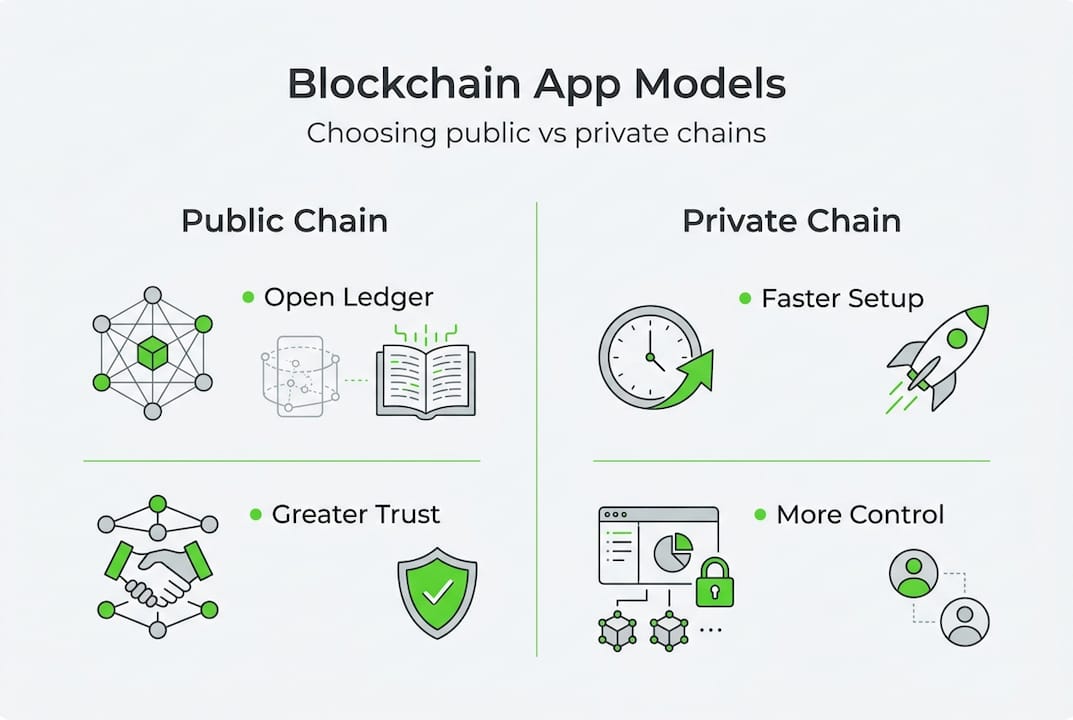
Scalability planning prevents bottlenecks as your user base grows. Layer 2 solutions like Polygon or Optimism reduce transaction costs and increase throughput without sacrificing security. Off-chain logic handles computationally expensive tasks, syncing results to the blockchain only when necessary. Consider whether your app needs a public blockchain for maximum transparency or a private chain for controlled access and lower costs. Public chains suit consumer-facing apps, while enterprise solutions often benefit from permissioned networks.
Evaluate public versus private blockchain trade-offs based on your business model. Public blockchains offer transparency and censorship resistance but come with variable gas fees and slower confirmation times. Private blockchains provide predictable costs and faster transactions but sacrifice some decentralization benefits. Your choice impacts user experience, operational costs, and regulatory compliance. Match blockchain type to your app's core value proposition.
Pro Tip: Start with testnet deployments to validate your architecture and SDK integration before committing to mainnet. This saves gas fees and lets you iterate quickly without risking real user funds.
SDK comparison for mobile blockchain development
| SDK | Primary use case | Platform support | Key advantage |
|---|---|---|---|
| Web3j | Ethereum smart contract interaction | Android, Java | Mature ecosystem and extensive documentation |
| MetaMask SDK | Embedded wallet integration | Android, iOS | Seamless user transaction approvals |
| WalletConnect | Multi-wallet connectivity | Cross-platform | Broad wallet compatibility |
| Ethers.js | Lightweight Ethereum library | JavaScript/React Native | Small footprint and fast performance |
Executing blockchain integration in mobile apps
Integrating blockchain SDKs into your mobile project requires careful configuration and testing. Install Web3j or MetaMask SDK via Gradle or CocoaPods, then configure node provider endpoints like Infura or Alchemy. These services handle blockchain infrastructure, so you avoid running your own nodes. Set up network parameters for mainnet, testnet, or Layer 2 chains depending on your deployment stage. Test connectivity thoroughly, handling network errors and timeout scenarios gracefully.
Smart contract development demands rigorous auditing before deployment. Contracts are immutable once deployed, so bugs become permanent and costly. Write comprehensive unit tests covering edge cases, gas optimization, and security vulnerabilities. Use tools like Hardhat or Truffle for local testing, then deploy to testnet for integration validation. Engage third-party auditors for critical contracts handling user funds. Smart contract development services provide expert auditing and optimization.
Embedded wallet implementation simplifies user onboarding and transaction flows. MetaMask SDK integration lets users approve transactions within your app interface, eliminating context switching to external wallets. Configure deep linking so wallet interactions feel native. Handle transaction states clearly, showing pending, confirmed, and failed statuses with actionable error messages. Users should understand what they are approving and why, reducing friction and support requests.

Gas optimization directly impacts user experience and operational costs. Flatten data structures to minimize storage slots, reducing write costs. Batch transactions when possible, amortizing base gas fees across multiple operations. Time transactions during low network congestion periods to capture lower gas prices. Monitor gas usage in production, identifying expensive operations for refactoring. Small optimizations compound, especially for high-volume apps.
Layer 2 scaling solutions improve speed and reduce costs without compromising security. Protocols like Polygon process transactions off the main Ethereum chain, then batch settlements back to Layer 1. This increases throughput from 7 transactions per second on Bitcoin to thousands on Layer 2. Users experience faster confirmations and lower fees, critical for mobile apps where latency kills engagement. Evaluate Layer 2 options based on ecosystem support, security model, and migration complexity.
Pro Tip: Implement transaction queueing and retry logic to handle network congestion gracefully. Mobile users expect instant feedback, so queue transactions locally and update UI optimistically while blockchain confirmations happen in the background.
- Install and configure blockchain SDKs with node provider endpoints
- Develop and audit smart contracts thoroughly before mainnet deployment
- Integrate embedded wallets for seamless user transaction approvals
- Optimize gas usage through data structure flattening and transaction timing
- Deploy Layer 2 solutions to improve speed and reduce transaction costs
Troubleshooting common blockchain mobile app challenges
Mobile storage constraints force strategic data management decisions. Blockchain data grows continuously, quickly exhausting mobile storage budgets. Offload historical data to off-chain storage like IPFS or centralized databases, keeping only recent or critical transactions on-device. Compress blockchain data using efficient serialization formats. Cache frequently accessed data to reduce redundant network calls. Users should never encounter storage errors due to blockchain overhead.
Slow transaction speeds frustrate users accustomed to instant mobile experiences. Bitcoin processes 7 transactions per second, far below payment processor benchmarks. Layer 2 protocols and hybrid architectures mitigate this gap. Process non-critical operations off-chain, syncing to blockchain asynchronously. Show transaction progress clearly, setting realistic expectations for confirmation times. Consider state channels for high-frequency interactions, settling final states on-chain.
Battery drain from continuous blockchain polling degrades user experience. Minimize unnecessary blockchain interactions by caching data locally and syncing only when needed. Use efficient SDKs that optimize network calls and cryptographic operations. Implement smart polling intervals based on user activity, reducing background sync frequency when the app is idle. Monitor battery impact during testing, identifying and fixing energy-intensive operations.
User experience complexity around wallets and transactions creates onboarding friction. Design intuitive wallet interactions that explain transaction purposes in plain language. Minimize required transaction approvals by batching operations where possible. Provide clear visual feedback for transaction states, avoiding technical jargon. Test with non-technical users to identify confusion points. The future of mobile apps frameworks discusses UX patterns that work.
Offline mode limitations require thoughtful architecture. Blockchain interactions need network connectivity, but mobile apps often face intermittent connections. Cache essential data locally so users can browse and prepare transactions offline. Queue transactions for submission when connectivity returns. Show clear offline indicators and explain what actions are unavailable. Sync state carefully when reconnecting, handling conflicts and stale data gracefully.
Pro Tip: Implement progressive disclosure for blockchain features. Start users with simple, familiar interactions, gradually introducing advanced blockchain capabilities as they gain confidence and understanding.
"The key to successful blockchain mobile apps is hiding complexity behind familiar interfaces. Users should experience benefits like transparency and security without needing to understand Merkle trees or gas optimization." - Blockchain UX Research
Verifying and scaling your blockchain mobile app
Benchmarking guides technology selection and optimization priorities. Compare blockchain platforms on latency, energy consumption, and storage efficiency. BigchainDB IoT benchmarks show 245ms write latency and 82% storage reduction versus Ethereum, demonstrating how platform choice impacts performance. Test your app under realistic load conditions, measuring transaction throughput, confirmation times, and resource usage. Use these metrics to identify bottlenecks and validate architectural decisions.
Continuous monitoring of smart contract execution prevents cost overruns and performance degradation. Track gas consumption per transaction type, identifying expensive operations for optimization. Monitor contract interaction patterns, detecting unusual activity that might indicate bugs or attacks. Set up alerts for gas price spikes, pausing non-critical operations during network congestion. Analyze transaction success rates, investigating failures to improve reliability.
Tokenization and interoperability unlock new business models and revenue streams. Tokenify blockchain solutions enable asset tokenization, loyalty programs, and fractional ownership. Interoperability protocols let your app interact with multiple blockchains, expanding ecosystem reach. Plan tokenomics carefully, ensuring token utility drives genuine value rather than speculation. Consider regulatory implications of token issuance in your target markets.
Scaling strategies maintain performance as user adoption grows. Layer 2 solutions handle increased transaction volume without proportional cost increases. Hybrid architectures distribute load between on-chain and off-chain systems, preventing blockchain bottlenecks from degrading overall app performance. Implement horizontal scaling for backend services supporting blockchain operations. Monitor user growth patterns, scaling infrastructure proactively before performance degrades.
User feedback drives UX improvements and identifies blockchain-related friction. Collect qualitative feedback on wallet interactions, transaction flows, and feature clarity. Track quantitative metrics like transaction completion rates, time to first transaction, and support ticket themes. A/B test different blockchain interaction patterns, optimizing for conversion and satisfaction. Startup growth strategies for mobile apps emphasizes user-centric iteration.
Pro Tip: Create a blockchain health dashboard showing real-time metrics like gas prices, network congestion, and transaction success rates. This helps your team make informed decisions about feature releases and user communications.
Blockchain platform performance comparison
| Metric | BigchainDB | Ethereum | Polygon |
|---|---|---|---|
| Write latency | 245ms | 13 seconds | 2 seconds |
| Read latency | 180ms | Variable | 1 second |
| Storage efficiency | 82% reduction vs Ethereum | Baseline | 60% reduction vs Ethereum |
| Transaction cost | Low | High (variable gas) | Low (subsidized) |
Elevate your blockchain mobile app with Proud Lion Studios
Building blockchain mobile apps requires specialized expertise across smart contracts, mobile development, and decentralized architecture. Proud Lion Studios delivers end-to-end blockchain development services tailored to your business goals, whether you are launching a DeFi platform, NFT marketplace, or supply chain solution. Our team handles everything from architecture design to mainnet deployment, reducing your time to market and technical risk.
Our smart contract development services ensure your on-chain logic is secure, efficient, and audited by experts. We optimize gas usage, implement comprehensive testing, and provide ongoing monitoring to prevent costly errors. Tokenization and NFT services unlock innovative business models, from loyalty programs to asset tokenization. Partnering with experienced blockchain developers accelerates your roadmap and ensures your app meets enterprise standards for security and scalability.
FAQ
What blockchain SDKs are best for mobile app development?
Web3j and MetaMask SDK are top choices for Ethereum-based mobile development. Web3j handles smart contract interactions and transaction signing on Android, while MetaMask SDK provides embedded wallet functionality for seamless user approvals. Both offer extensive documentation and active community support. WalletConnect enables multi-wallet connectivity for broader ecosystem compatibility.
How can I improve transaction speeds in my blockchain mobile app?
Deploy Layer 2 scaling solutions like Polygon or Optimism to increase throughput and reduce confirmation times. Hybrid architectures that process non-critical operations off-chain dramatically improve perceived speed. Batch transactions when possible to amortize base costs. State channels work well for high-frequency interactions, settling final states on-chain periodically.
Do I always need cryptocurrency to use blockchain in my mobile app?
Private or permissioned blockchains enable secure data sharing without requiring cryptocurrency. These networks suit enterprise use cases where transparency and immutability matter more than public decentralization. Participants can transact using traditional authentication, reducing complexity and cost. Public blockchains require native tokens for gas fees, but Layer 2 solutions often subsidize costs significantly.
What are common mistakes to avoid when deploying smart contracts in mobile apps?
Never deploy smart contracts without thorough audits, as they are immutable once on-chain. Optimize data structures to minimize gas costs, improving user experience and reducing operational expenses. Test extensively on testnets before mainnet deployment. Engage smart contract development services for expert review and optimization. Implement emergency pause mechanisms for critical contracts handling user funds.