

TL;DR:
- Web3 games are defined by player ownership of in-game assets on a blockchain.
- Choosing the right blockchain depends on transaction costs, throughput, and development ecosystem.
- Successful Web3 game design emphasizes fun first, with blockchain as a transparent, integrated feature.
The Web3 gaming market is projected to hit $48.55B in 2026, yet most studios still struggle to ship games players actually want to play. The gap between blockchain ambition and real player retention is wide, and it's not closing fast enough. If you're a developer or publisher looking to integrate Web3 technologies into your next game, the challenge isn't understanding what blockchain can do. It's knowing which problems it actually solves and how to build around the ones it doesn't. This guide walks you through the full process, from foundations to launch-ready optimization, with the kind of practical detail that gets results.
Table of Contents
- Understand the fundamentals of Web3 gaming
- Set up your game for blockchain integration
- Build and test core Web3 game features
- Test, verify, and optimize your Web3 game
- What most guides miss about Web3 game development
- Ready to take your Web3 game to the next level?
- Frequently asked questions
Key Takeaways
| Point | Details |
|---|---|
| Web3 gaming is evolving | True adoption depends on solving user experience, not just technology challenges. |
| Choose the right blockchain | Weigh cost, speed, and community before integrating tech into your game. |
| Gameplay comes first | Focus on fun and transparent game loops, using blockchain where it matters most. |
| Real testing drives success | Robust verification and feedback cycles prevent costly mistakes in live games. |
| Invisible blockchain wins | Mass-market success will go to games where blockchain benefits are seamless and unobtrusive. |
Understand the fundamentals of Web3 gaming
With the market opportunity in mind, let's clarify what makes a game truly Web3 and where current debates stand.
A Web3 game is defined by one core principle: players own their in-game assets. Not in a terms-of-service sense, but verifiably, on a public blockchain. Items exist as NFTs (non-fungible tokens) or fungible tokens that players can trade, sell, or move across games. Smart contracts (self-executing code on a blockchain) handle economic rules, asset minting, and sometimes game logic, removing the need for a centralized authority to validate outcomes.
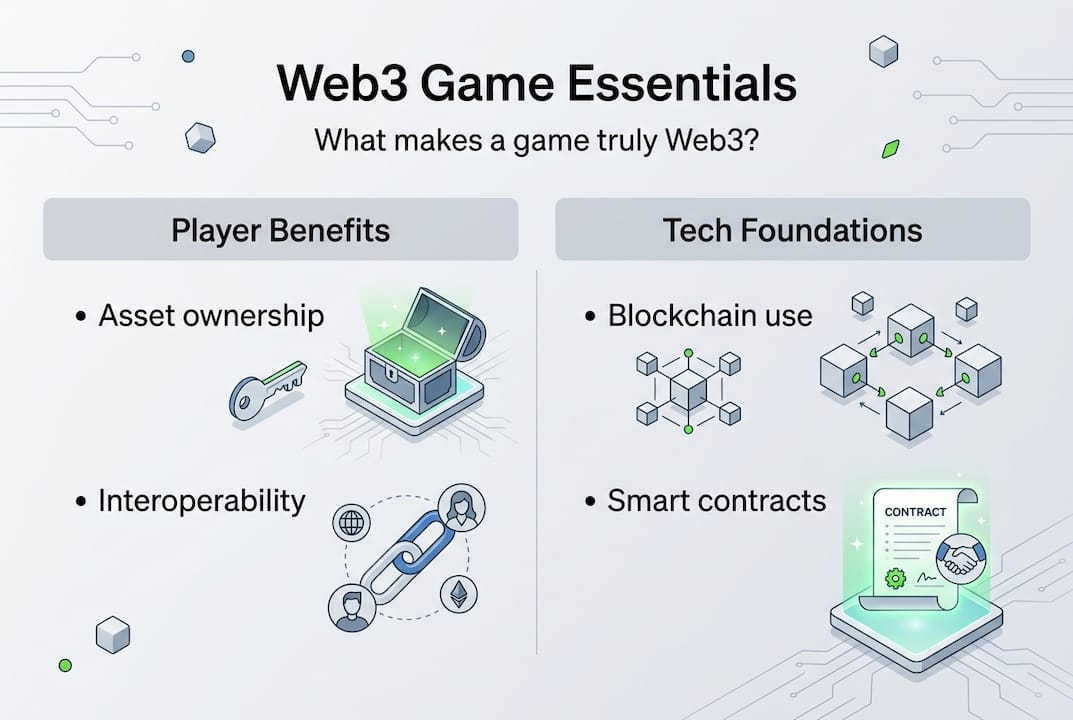
But the industry is deeply split on what this means in practice. Optimists emphasize ownership and interoperability as genuine innovations, pointing to fun-first hybrid titles as the path forward. Skeptics argue that poor UX and speculation-driven play-to-earn (P2E) models have poisoned the well for mainstream adoption. Both sides have valid points, and understanding this tension helps you build smarter.
Here's a quick look at how different philosophies approach the market:
| Philosophy | Goal | Example approach |
|---|---|---|
| Invisible blockchain | Mainstream F2P audiences | Blockchain as backend, no wallet friction |
| Crypto-native | Token speculation and game theory | Prominent wallet UI, token rewards |
| Fun-first hybrid | Sustainable retention | Gameplay leads, blockchain adds ownership |
The data shows where the opportunity lies:
- Web3 gaming is projected to exceed $100B by 2030, driven by hybrid models
- Titles prioritizing gameplay over tokenomics are showing stronger retention curves
- Mobile remains the largest segment for new player acquisition
Stat to know: Angry Dynomites achieved 400K users and 1.1M on-chain trades without offering token rewards, proving that fun-first design can drive real blockchain engagement.
Understanding why Web3 matters beyond speculation gives your project a clearer strategic foundation. The studios winning right now aren't selling tokenomics. They're selling experiences backed by verifiable ownership.
Set up your game for blockchain integration
With a solid understanding of the market and philosophies, you're ready to choose the best foundation and tools for your Web3 game.
Chain selection is arguably the most consequential decision you'll make. It affects transaction costs, throughput, developer tooling, and the community your game can tap into. Here's a side-by-side comparison of the most common choices:
| Blockchain | Tx cost | Throughput | Dev ecosystem | Best for |
|---|---|---|---|---|
| Ethereum L1 | High | ~15 TPS | Mature, large | High-value NFT drops |
| Solana | Very low ($0.00025/tx) | 65,000 TPS | Growing fast | High-frequency in-game transactions |
| Ethereum rollups | Very low (up to 99.6% savings) | Variable | Expanding | Scalable hybrid games |
| Ronin | Low | ~100,000 TPS | Gaming-focused | Guild and social games |
Solana's transaction costs at $0.00025 per transaction compared to Ethereum L1, and rollups reducing costs by up to 99.6%, make them compelling for studios that expect high transaction volumes. For Solana vs Ethereum NFT gaming specifics, throughput and ecosystem maturity are the deciding factors.
Here's a step-by-step setup process:
- Choose your blockchain based on your game type, expected transaction volume, and target player base
- Set up your development environment with the chain's SDK, a testnet wallet, and a local node or RPC provider
- Plan your on-chain vs. off-chain architecture by listing which features require trustless verification (asset ownership, trades) and which don't (physics, matchmaking)
- Integrate your toolstack: smart contract frameworks, wallet connectors, and NFT standards relevant to your chosen chain
- Configure your multiplayer blockchain game infrastructure for state management and transaction batching
Pro Tip: Prioritize Layer 2 or Layer 3 rollups early in your architecture planning. The fee savings alone can determine whether your in-game economy is financially viable at scale. Study Aptos vs Ethereum for gaming if you want a deeper look at alternative L1 performance benchmarks.
For scalable blockchain development patterns, the key principle is always the same: only put on-chain what must be trustless. Everything else belongs off-chain.

Build and test core Web3 game features
With your environment ready, it's time to build the features and gameplay mechanics that define a great Web3 game.
Most teams make the mistake of treating blockchain integration as a feature layer they bolt on at the end. It needs to be a structural decision. Here's the build sequence that works:
- Wallet integration first: support non-custodial wallets with a frictionless login flow; players should be in-game within 30 seconds of connecting
- NFT and asset system: define your asset schema, mint logic, and metadata standards before writing any game logic that depends on them
- In-game economy design: set token emission rates, sink mechanics, and trading rules in smart contracts before the economy goes live
- Gameplay loop testing: run the full loop with blockchain calls included so you catch latency and UX issues early
For the features themselves, modern Web3 games need:
- Cross-chain asset compatibility so players aren't locked into one ecosystem
- Provably fair randomization using verifiable random functions (VRF) on-chain
- Transparent trading mechanics with on-chain order books or DEX integrations
- Simplified onboarding that abstracts wallet complexity for non-crypto players
Blockchain excels with high-value assets and interoperability but faces hard limitations for real-time gameplay. Fast-paced combat or physics simulation can't wait for transaction confirmation times. Handle these entirely off-chain, then anchor final game state on-chain periodically.
Pro Tip: Start with off-chain logic for all gameplay systems and migrate modules on-chain incrementally. This lets you ship faster and reduce the UX risk of introducing blockchain friction before players are invested in the experience.
You can find Web3 game services that cover the full build stack, or follow a structured Web3 workflow guide for a process-level breakdown of each integration phase.
Test, verify, and optimize your Web3 game
After building core features, ensuring robust testing and optimization determines your project's real-world viability.
Web3 game testing is fundamentally different from traditional QA. You're not just testing for bugs. You're testing economic attack vectors, contract exploits, and the durability of your player incentive loops. Here's a layered approach:
| Layer | What to test | Tools to use |
|---|---|---|
| Smart contracts | Logic, overflow, reentrancy | Hardhat, Foundry, Certora |
| Frontend | Wallet connection, tx feedback, error states | Playwright, Cypress |
| Economy | Inflation, sink/source balance, bot resistance | Custom simulation scripts |
| Integration | End-to-end player flows with real chain calls | Testnet environments |
Your verification checklist should include:
- Unit test every contract function including edge cases and failure modes
- Simulate economic attack vectors such as wash trading, bot farming, and liquidity draining
- Run usability studies with players who have never used a crypto wallet
- Monitor on-chain costs across different network congestion levels
- Keep live feedback channels open post-launch to catch emergent economy issues fast
Optimization is ongoing. Use rollups or alternative chains to reduce costs as your player count scales. Monitor gas usage per feature and refactor expensive operations. The goal is for blockchain to feel instantaneous to players.
"Real long-term success comes from fun experiences, not speculative token rewards."
Angry Dynomites reached 1.1M on-chain trades without token incentives, demonstrating that genuine engagement loops beat artificial reward inflation every time. That kind of result comes from relentless testing and listening to real users. For broader blockchain app troubleshooting patterns, the same principles apply: test early, test often, and prioritize user clarity over technical elegance.
What most guides miss about Web3 game development
Having learned the full how-to process, it's worth stepping back to consider what truly separates successful Web3 projects from failed ones.
Here's the uncomfortable truth: most Web3 game failures aren't technical failures. They're design failures. Studios got caught up in tokenomics whitepapers and token launch strategies while shipping games that weren't fun to play. The blockchain was front-and-center. The gameplay was an afterthought.
The studios that are actually retaining players in 2026 treat blockchain the way great mobile games treat their backend. Players don't think about the infrastructure. They think about the experience. True ownership and interoperability are powerful features, but they only matter if players care enough to stay.
Our view at Proud Lion Studios is that the mass-market future of Web3 gaming is invisible blockchain. The technology earns its place by making things possible that weren't before, not by demanding players learn a new financial system just to enjoy a game. Stay focused on mobile game innovation trends and real community engagement. Build the fun first. Then let blockchain earn its place in the architecture.
Ready to take your Web3 game to the next level?
If you're ready to implement everything discussed above with expert guidance, here's how Proud Lion Studios can help.
Building a Web3 game that actually retains players requires the right technical architecture and the game design instincts to back it up. At Proud Lion Studios, we work with developers and publishers at every stage, from early architecture decisions to launch-ready smart contract audits.
Our team brings deep experience across Solana, Aptos, Ethereum, and Layer 2 ecosystems, with hands-on delivery from ideation to live games. Explore our blockchain development services to see how we approach integration for serious game studios. If you're building with NFTs, on-chain economies, or token-gated content, our tokenization and NFT solutions are built for production-grade scale. Let's build something players actually want to keep playing.
Frequently asked questions
What are the key benefits of using Web3 in gaming?
Web3 enables true ownership and asset interoperability, giving players verifiable control over in-game items and opening new economic models for developers beyond traditional in-app purchases.
Which blockchain is best for developing a Web3 game?
It depends on your transaction volume and budget. Solana offers low costs and high throughput, Ethereum provides the widest adoption, and Layer 2 rollups give you the best of both at scale.
How do you balance fun gameplay with blockchain integration?
Focus on seamless UX and keep blockchain in the background. The mass-market path is invisible blockchain where players experience great gameplay first, with ownership as a benefit rather than a requirement.
What common mistakes should Web3 game developers avoid?
Over-relying on tokenomics and speculation instead of core gameplay is the most common failure mode. P2E models focused on speculation rather than fun have proven unsustainable, and skipping smart contract audits compounds the risk significantly.