

Many entrepreneurs hear about Web3 and wonder if it's just another tech buzzword or a genuine business opportunity. The confusion is understandable. Web3 promises true digital ownership and decentralization through blockchain, but what does that actually mean for your business? This guide cuts through the hype to reveal how blockchain, NFTs, and AI combine to create tangible value. You'll discover practical strategies to future-proof your digital products, understand real challenges, and identify which Web3 technologies deliver measurable returns in 2026.
Table of Contents
- Understanding Web3's Core: Decentralization And True Digital Ownership
- How AI Enhances Web3: Automation, Security, And Personalized Experiences
- Challenges Of Decentralization And Practical Enterprise Solutions
- Strategies To Future-Proof Your Digital Products With Web3 In 2026
- Explore Proud Lion Studios' Web3 And Blockchain Solutions
Key takeaways
| Point | Details |
|---|---|
| Decentralized ownership | Web3 enables users to control digital assets directly without platform intermediaries through blockchain technology. |
| AI integration advantage | Combining AI with blockchain automates processes, detects fraud, and personalizes experiences to boost profitability. |
| Decentralization limits | Pure decentralization faces validator concentration and governance challenges that require hybrid solutions. |
| Enterprise pathways | Layer 2 scaling, permissioned chains, and no-code tools provide practical implementation routes for businesses. |
| ROI-focused strategy | Prioritize measurable outcomes like cost reduction and compliance over vanity metrics to maximize Web3 value. |
Understanding Web3's core: decentralization and true digital ownership
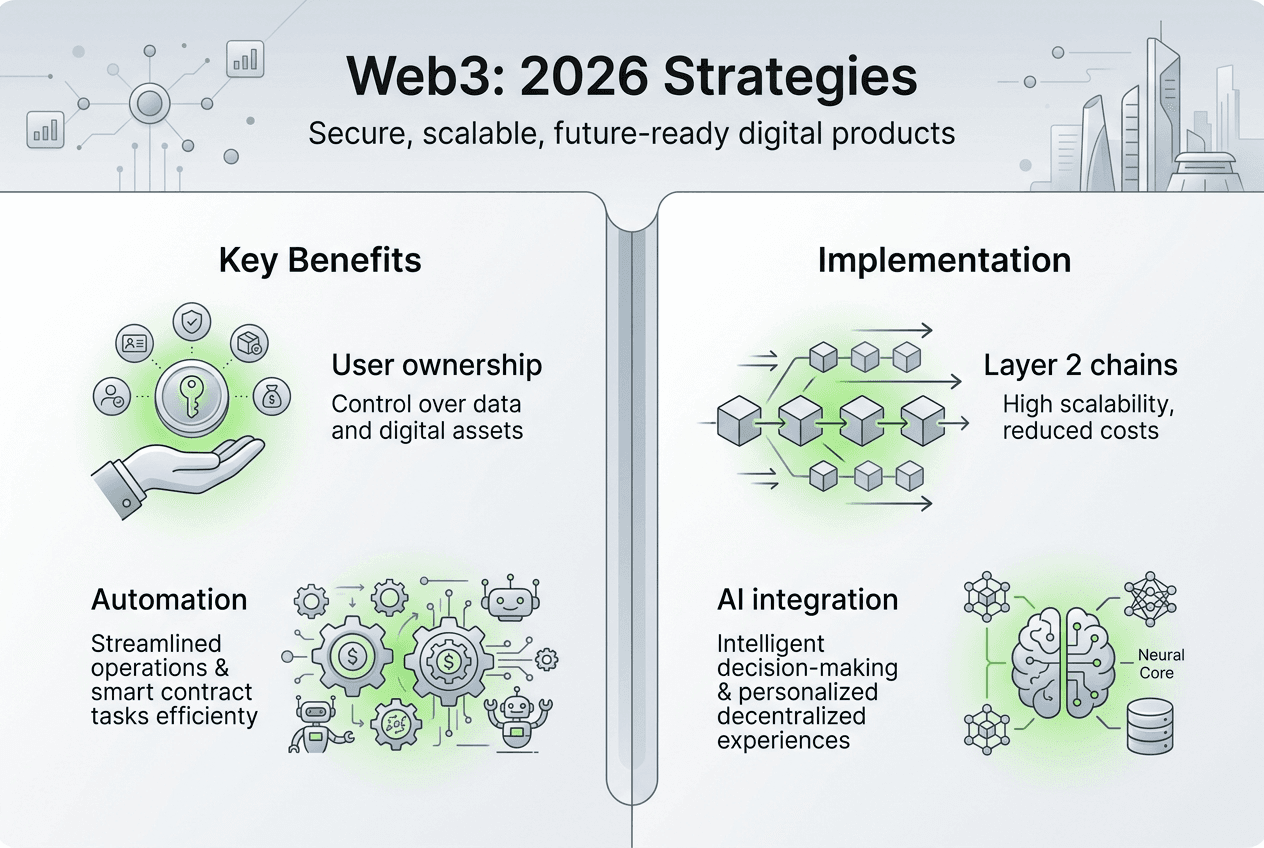
Web3 represents a fundamental shift in how digital assets work. Unlike Web2 platforms where Facebook, Google, or Amazon control your data and content, Web3 enables true digital ownership through blockchain technology. You own your assets directly. No middleman can revoke access or change the rules.
Blockchain creates this shift through decentralization. Instead of one company's servers holding all data, blockchain distributes information across thousands of nodes worldwide. Each transaction gets verified by multiple participants, creating a transparent record nobody can alter retroactively. This removes the need to trust a central authority.
Smart contracts take this further. These are programmable agreements that execute automatically when conditions are met. Imagine a rental agreement that releases payment when you check in, verified by your phone's GPS. No landlord approval needed. No payment processor taking fees. The contract handles everything trustlessly.
NFTs (non-fungible tokens) represent unique digital items on the blockchain. Each NFT proves ownership of a specific asset, whether that's digital art, a game item, or a concert ticket. Unlike traditional digital files that anyone can copy, NFTs establish verifiable scarcity and ownership. This creates new business models around digital collectibles, membership access, and Web3 blockchain digital revolution applications.
The contrast with Web2 is stark. In Web2, platforms own the relationship with users. They control algorithms, monetization, and access. Instagram can delete your account. Spotify sets royalty rates. In Web3, users hold their assets in personal wallets. Platforms become interfaces to interact with blockchain protocols, not gatekeepers.
For entrepreneurs, this means building products where users truly own what they purchase. Game items persist beyond your game's servers. Loyalty points transfer between programs. Content creators earn directly without platform cuts. This user-centric model aligns incentives differently than traditional platforms.
Key Web3 technologies you need to understand:
- Blockchain networks like Ethereum, Solana, and Aptos that process transactions
- Smart contracts that automate business logic without intermediaries
- NFTs that tokenize unique digital or physical assets
- Cryptocurrency wallets that give users direct asset control
- Decentralized apps (dApps) that run on blockchain infrastructure
Pro Tip: Start by identifying which parts of your business model benefit most from user ownership. Build Web3 features around genuine value, not just because blockchain sounds innovative. What is Web3 2026 guide tech entrepreneurs explains implementation approaches in detail.
How AI enhances Web3: automation, security, and personalized experiences
AI transforms Web3 from a static decentralized system into an intelligent, adaptive ecosystem. The combination creates what many call the most profitable tech stack for startups in 2026. AI and blockchain integration enables automation, fraud detection, supply chain optimization, and personalized experiences that drive real business value.
Consider fraud detection. Traditional blockchain analysis requires manual review of suspicious transactions. AI algorithms process millions of transactions in real time, identifying patterns humans would miss. Machine learning models flag potential security threats before they cause damage, protecting your users and reducing losses.
Supply chain management gains unprecedented transparency when AI meets blockchain. Sensors track products from manufacture to delivery, recording data on-chain. AI analyzes this verifiable data to optimize routes, predict delays, and ensure authenticity. Luxury brands use this to combat counterfeits. Food companies trace contamination sources in minutes instead of weeks.

Smart contracts become dynamic with AI integration. Traditional smart contracts execute fixed rules. AI-powered contracts adapt based on real-world data. Insurance payouts process automatically when AI verifies claim conditions through satellite imagery or IoT sensors. No claims adjuster needed. Settlement happens instantly.
Personalization reaches new levels in decentralized systems. AI analyzes on-chain behavior while respecting privacy through zero-knowledge proofs. You get Netflix-quality recommendations without giving up personal data to a central server. Users control what information they share while still enjoying tailored experiences.
Practical AI applications in Web3:
- Automated market makers that optimize liquidity and trading fees
- Predictive analytics for token price movements and portfolio management
- Natural language interfaces that make blockchain interactions intuitive
- Content moderation in decentralized social networks without censorship concerns
- Dynamic NFTs that evolve based on owner behavior or external events
The profitability angle matters most for businesses. AI reduces operational costs dramatically. Automated customer service through AI agents handles routine queries 24/7. Smart routing minimizes transaction fees. Predictive maintenance prevents costly downtime. These aren't theoretical benefits. Companies implementing AI-blockchain stacks report 30-40% cost reductions in specific operations.
User engagement improves when AI personalizes Web3 experiences. Gaming platforms adjust difficulty based on player skill. DeFi protocols recommend optimal yield strategies. NFT marketplaces surface collections matching your taste. Better engagement means higher retention and lifetime value.
Pro Tip: Focus AI integration on specific pain points first. Trying to add AI everywhere dilutes impact. Pick one area like customer support or transaction optimization, prove ROI, then expand. The future of artificial intelligence explores strategic implementation approaches.
Challenges of decentralization and practical enterprise solutions
Web3's decentralization promise faces real-world limitations you need to understand. Decentralization often fails at scale due to validator concentration and governance oligarchies. The largest Ethereum validators control significant network power. Bitcoin mining pools concentrate in specific regions. These realities contradict the distributed ideal.
Infrastructure dependencies create another challenge. Most dApps rely on centralized services for key functions. Front-ends run on AWS. Data storage uses traditional cloud providers. API calls go through centralized endpoints. True end-to-end decentralization remains rare because it's expensive and complex.
Governance captures attention as tokens concentrate. Early investors and founders often hold majority voting power in DAOs (decentralized autonomous organizations). Decisions that should represent community consensus instead reflect whale preferences. This plutocracy undermines democratic governance promises.
Enterprises face practical barriers adopting pure decentralization. Public blockchains lack privacy for sensitive business data. Transaction speeds can't match traditional databases. Regulatory compliance requires knowing your customer, conflicting with anonymity. These constraints demand hybrid approaches.
Hybrid permissioned chains, Layer 2 scaling, and no-code tools provide practical methodologies for enterprises. Permissioned blockchains restrict participation to verified entities while maintaining cryptographic security and auditability. Banks use these for interbank settlements. Supply chains track goods across trusted partners.
Layer 2 solutions like Polygon, Arbitrum, and Optimism process transactions off the main blockchain, then batch-settle to Layer 1. This achieves thousands of transactions per second at cents per transaction. You get blockchain security with near-traditional performance. Gaming and social apps become viable.
AI-powered dynamic NFTs combine on-chain assets with off-chain intelligence. The NFT lives on blockchain providing ownership proof. AI algorithms hosted on decentralized storage like IPFS generate personalized content or evolve traits based on interactions. This hybrid model balances decentralization with functionality.
No-code platforms democratize Web3 development. You don't need Solidity expertise to launch an NFT collection or create a token. Visual interfaces handle smart contract deployment. This lowers barriers for entrepreneurs testing Web3 concepts without massive technical investment.
| Aspect | Pure Decentralization | Hybrid + Layer 2 Solutions | | --- | --- | | Scalability | Limited by consensus (15-30 TPS) | High throughput (1000+ TPS) | | Transaction Cost | Variable, often high during congestion | Consistently low (under $0.01) | | Privacy | Public by default | Configurable with zero-knowledge proofs | | Regulatory Compliance | Challenging due to anonymity | Supports KYC/AML requirements | | Business Control | Minimal, governed by token holders | Balanced governance with admin functions |
The table shows why enterprises lean toward hybrid models. You sacrifice some decentralization purity but gain practical functionality. For most business use cases, this tradeoff makes sense. Your customers care about speed, cost, and reliability more than maximum decentralization.
Security considerations differ between approaches. Pure decentralization resists censorship and single points of failure. Hybrid systems introduce trusted components that become attack vectors. Layer 2 solutions inherit Layer 1 security but add complexity. Evaluate your threat model carefully. What is Web3 2026 guide tech entrepreneurs covers security frameworks in depth.
Strategies to future-proof your digital products with Web3 in 2026
Implementing Web3 successfully requires focusing on measurable outcomes rather than following hype. Future-proofing requires prioritizing AI-blockchain stacks alongside Layer 2 scaling and verifiable data for compliance. These aren't buzzwords. They're specific technologies delivering ROI today.
Start by defining success metrics that matter for your business. Revenue per user, customer acquisition cost, retention rates, and operational efficiency beat vanity metrics like total wallet connections or token trading volume. Web3 should improve your bottom line, not just add blockchain for appearances.
Choose your blockchain stack strategically. Ethereum offers the largest ecosystem and developer community but comes with higher costs. Solana provides speed but has faced reliability concerns. Aptos and Sui represent newer high-performance options with modern programming languages. Match the chain to your specific requirements around speed, cost, and ecosystem support.
Layer 2 solutions provide the best balance for most applications in 2026. They offer Ethereum security with practical performance and costs. Polygon dominates gaming and NFTs. Arbitrum leads in DeFi. Optimism focuses on public goods funding. Research which Layer 2 aligns with your use case and existing integrations.
Zero-knowledge proofs enable privacy-preserving verification. You can prove facts about data without revealing the data itself. This unlocks compliant Web3 applications. Prove you're over 21 without sharing your birthdate. Verify creditworthiness without exposing financial details. ZK technology matures rapidly, making previously impossible applications viable.
Verifiable data addresses compliance and trust challenges. Oracles bring real-world information on-chain in tamper-proof ways. Chainlink and similar services let smart contracts react to external events reliably. This bridges Web3 with existing business systems and regulatory requirements.
Five practical steps to future-proof your digital products:
- Audit your current product for features benefiting from user ownership or decentralization, starting with high-friction areas like payments or data portability.
- Build a proof of concept on a Layer 2 testnet to validate technical feasibility and user experience without production costs or risks.
- Integrate AI automation for customer support, transaction optimization, or personalized recommendations to reduce operational overhead while improving engagement.
- Implement verifiable credentials or zero-knowledge proofs for privacy-preserving compliance if your industry faces regulatory requirements around data handling.
- Establish clear KPIs measuring cost savings, revenue impact, or user retention specifically attributed to Web3 features before scaling investment.
The key is incremental adoption. You don't need to rebuild everything on blockchain. Identify specific pain points where Web3 technologies provide clear advantages. Payments processing costs too much? Crypto rails reduce fees. Users want data portability? Give them wallet-based identity. Fraud eating profits? Blockchain creates immutable audit trails.
Timing matters in 2026. Infrastructure has matured enough for production applications. User adoption reached critical mass in key demographics. Regulatory frameworks provide more clarity than previous years. But competition intensifies as more businesses recognize Web3's value. Moving now positions you ahead of laggards while learning from early adopter mistakes.
Integration with existing systems deserves attention. Your Web3 features need to work alongside traditional infrastructure. APIs bridge blockchain and conventional databases. Hybrid wallets combine crypto and fiat. Gradual migration paths let users adopt new features at their comfort level. AI in software development innovation 2026 explores integration patterns in detail.
Explore Proud Lion Studios' Web3 and blockchain solutions
Now that you understand Web3's potential and practical implementation strategies, you might wonder how to actually build these solutions. Proud Lion Studios specializes in blockchain development tailored to your specific business needs. Whether you're creating NFT marketplaces, decentralized applications, or exploring Web3 games, our Dubai-based team brings technical expertise across Ethereum, Solana, Aptos, and emerging chains.
Our smart contract development services ensure your business logic executes securely and efficiently on-chain. We combine blockchain infrastructure with AI automation to deliver solutions that reduce costs while enhancing user experiences. From initial concept to production deployment, we focus on measurable outcomes that future-proof your digital products. Our approach emphasizes practical implementation over theoretical possibilities, helping you navigate Web3's complexities with confidence.
FAQ
What sets Web3's digital ownership apart from Web2?
Web3 uses blockchain and NFTs to grant users direct ownership without intermediaries, unlike Web2 centralized platforms. This enables trustless transactions where you control assets in your wallet rather than depending on a company's servers. Platforms become interfaces to protocols you own, not gatekeepers who can revoke access or change terms unilaterally.
How does AI improve Web3 business applications?
AI automates processes, detects fraud, optimizes supply chains, and personalizes user experiences in decentralized systems. This integration boosts profitability and efficiency in Web3 startups by reducing operational costs 30-40% in specific functions. Smart contracts become dynamic, adapting to real-world conditions, while machine learning identifies security threats before they cause damage.
What are common decentralization challenges in Web3 today?
Decentralization faces issues with concentration of validators and reliance on centralized infrastructure despite blockchain's distributed promise. Governance often gets dominated by wealthy token holders, reducing true decentralization to plutocracy. Most dApps depend on traditional cloud services for front-ends and storage, creating single points of failure that contradict Web3's ideals.
Which Web3 solutions are practical for enterprises in 2026?
Hybrid permissioned blockchains combined with Layer 2 scaling provide balance between decentralization and performance for business needs. No-code tools lower barriers to entry for enterprises developing Web3 apps without extensive blockchain expertise. Zero-knowledge proofs enable privacy-preserving compliance, while verifiable data oracles bridge on-chain smart contracts with real-world business systems reliably.
Recommended
- What is Web3? A 2026 guide for tech entrepreneurs
- Future of web development in 2026: AI, blockchain, edge
- Web3 & Blockchain Digital Revolution - Proud Lion Studios
- Future of mobile apps 2026: frameworks, tech, and strategy
- What Is Future Proofing? 28% More Adaptive Productivity – Optio Station: Best Project Management App for Prioritization