

TL;DR:
- Web3 integration addresses scaling challenges by replacing centralized systems with transparent blockchain infrastructure.
- Proper readiness assessment, protocol selection, and phased implementation are crucial for successful integration.
- Continuous security monitoring and incremental testing help prevent costly vulnerabilities post-launch.
Most startup founders hit the same wall: the digital tools that powered early growth start showing cracks as the business scales. Payments get disputed, data gets siloed, and trust between parties requires expensive intermediaries. Web3 integration addresses these gaps by replacing centralized bottlenecks with transparent, programmable infrastructure. But the gap between "we should explore blockchain" and "we have a working integration" is wider than most teams expect. This guide walks you through every stage of that journey, from readiness assessment to live monitoring, with the kind of practical detail that actually holds up when your engineers start asking hard questions.
Table of Contents
- Assessing business readiness for Web3 integration
- Selecting the right Web3 stack and partners
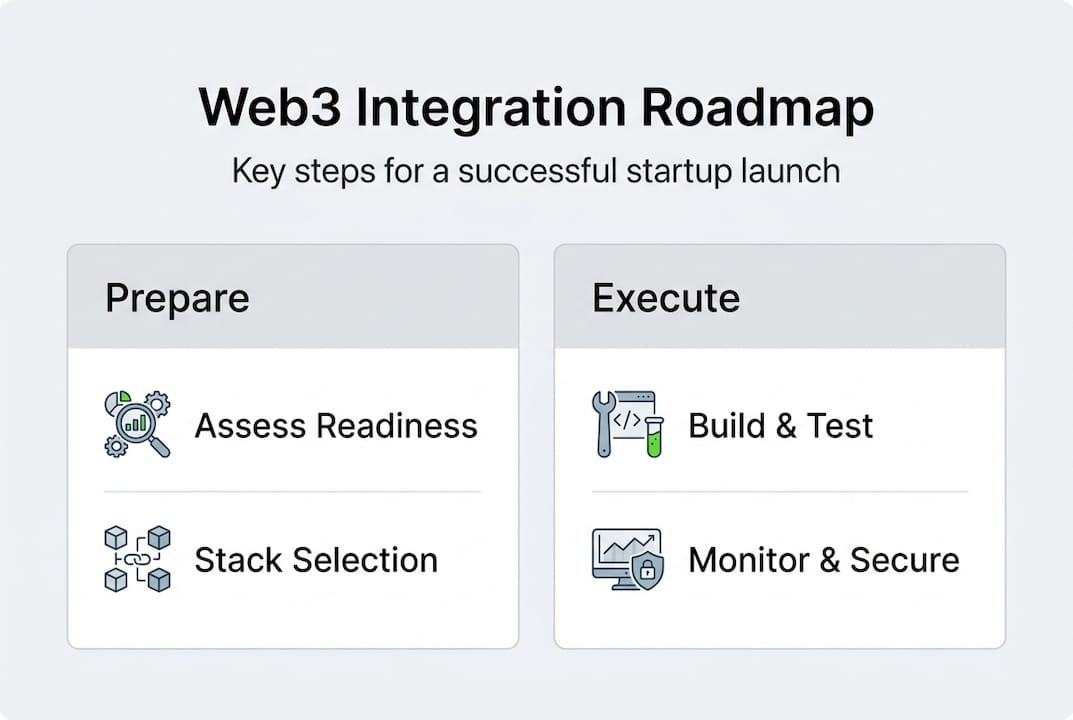
- Step-by-step Web3 integration: Implementation roadmap
- Testing, monitoring, and securing your Web3 integration
- The hidden barriers and overlooked wins in Web3 integration
- Accelerate your Web3 journey with expert support
- Frequently asked questions
Key Takeaways
| Point | Details |
|---|---|
| Plan before integrating | Careful readiness assessment prevents tech and business blockers that derail Web3 projects. |
| Choose tools carefully | Stack selection, protocol choices, and partner vetting can drastically affect cost and project outcomes. |
| Prioritize security | Continuous monitoring and best practices like OpenZeppelin libraries are essential for long-term success. |
| Iterate and test | Start with pilot phases and automated testing to minimize risk and uncover hidden issues early. |
Assessing business readiness for Web3 integration
With the need for transformation set, the first step is making sure your team and infrastructure are truly prepared. Before you write a single line of smart contract code, you need an honest picture of where your business stands technically and organizationally.
Start by defining Web3 fundamentals within your leadership team. Misaligned expectations between founders, engineers, and investors cause more failed pilots than bad code ever does. Once everyone shares a working vocabulary, you can map your actual use cases.
Common Web3 use cases for startups:
- Decentralized payments and cross-border settlements
- NFT-based loyalty programs or digital ownership
- Supply chain provenance tracking
- Tokenized equity or revenue sharing
- Decentralized identity and credentialing
Each use case carries different infrastructure requirements. A payment integration needs wallet connectivity and fiat on-ramps. An NFT marketplace needs minting infrastructure, metadata storage, and royalty logic. Knowing your primary use case narrows your stack decisions considerably.
For infrastructure, you have three main paths: cloud-hosted nodes (fastest to start, vendor-dependent), on-premises nodes (maximum control, high operational overhead), or hybrid setups that balance both. Most early-stage startups benefit from cloud-hosted solutions while they validate product-market fit, then migrate toward hybrid as volume grows.
Here is a practical readiness table to guide your assessment:
| Requirement | What to check | Common blocker |
|---|---|---|
| Developer familiarity | Web3 SDK experience, Solidity knowledge | Team trained only in Web2 stack |
| Infrastructure | API access, node connectivity | Firewall restrictions, legacy monoliths |
| Legal and compliance | Jurisdiction rules, token classification | Unclear regulatory status |
| Budget allocation | Gas fees, audit costs, tooling | Underestimated operational costs |
| Stakeholder alignment | Board, legal, product consensus | No internal Web3 champion |
One often-ignored dimension is stakeholder education. Your legal team needs to understand smart contract enforceability. Your finance team needs to understand gas fee accounting. Running a two-hour internal workshop before your first sprint saves weeks of back-and-forth later.
Common Web3 pitfalls include network mismatches and RPC limits, both of which can derail a project that looked perfectly scoped on paper. Reviewing the engineering challenges in Web3 before your planning phase is one of the highest-leverage things you can do. Understanding blockchain use cases for startups at this stage also helps you prioritize which integrations deliver the fastest return.
Selecting the right Web3 stack and partners
Once your current state and objectives are clear, the next challenge is picking tools and allies that align with your vision. The protocol you choose shapes your costs, speed, and long-term optionality more than almost any other decision.
| Protocol | Avg. transaction cost | Finality speed | Ecosystem maturity | Best for |
|---|---|---|---|---|
| Ethereum | $1-$15 | ~12 seconds | Very high | DeFi, NFTs, enterprise |
| Polygon | $0.001-$0.01 | ~2 seconds | High | High-volume apps, gaming |
| Solana | Under $0.001 | ~0.4 seconds | Growing | Speed-critical applications |
| Aptos | Under $0.001 | ~1 second | Emerging | Move-based, scalable dApps |
Beyond protocol selection, you need middleware to connect your app to the chain. Tools like Alchemy and Infura act as RPC (remote procedure call) providers, meaning they relay your app's requests to the blockchain. RPC rate limits can impact both cost and reliability. Alchemy's free tier, for example, provides 30 million compute units per month, which sounds generous until a product launch spikes your traffic.
How to vet and select integration partners:
- Review their public case studies for projects similar to your scale and industry.
- Ask for a technical architecture walkthrough, not just a sales deck.
- Confirm their audit history and security practices for smart contract work.
- Clarify ownership of deployed contracts and private keys from day one.
- Negotiate API rate limits and service-level agreements before signing.
Custodial versus non-custodial wallet architecture is another fork in the road. Custodial solutions (where a third party holds keys) are easier to implement and better for mainstream users. Non-custodial solutions give users full ownership but require more UX investment to avoid losing customers at onboarding. Most consumer-facing startups start custodial and offer non-custodial options as a power-user feature.

Pro Tip: Always map out your API cost curve at 10x your expected traffic before committing to a provider. Common integration mistakes frequently trace back to teams that modeled costs at average load, not peak load.
For a structured approach to making these choices, the Web3 development checklist covers the key decision points in sequence. Brushing up on Web3 terms entrepreneurs must know also prevents costly miscommunications with technical vendors.
Step-by-step Web3 integration: Implementation roadmap
With the tech stack in place and partners on board, execution is all about disciplined implementation. Rushing this phase is where most cost overruns and security incidents originate.
Implementation sequence:
- Preparation: Finalize architecture diagrams, assign wallet management responsibilities, and document all off-chain data dependencies.
- Smart contract authoring: Write contracts with modular, upgradeable patterns. Keep logic minimal and well-commented.
- Internal code review: Conduct peer review focused on logic errors, not just syntax. Use static analysis tools like Slither.
- Off-chain component setup: Configure your backend APIs, database schemas for on-chain event indexing, and webhook listeners.
- Testnet deployment: Deploy to a public testnet (Sepolia for Ethereum, devnet for Solana) and run full integration tests.
- Bug bounty or external audit: Even a lightweight audit catches issues your internal team normalizes.
- Staged mainnet rollout: Launch to a limited user group first. Monitor gas usage, error rates, and user drop-off before full release.
Pro Tip: Gas optimization is not just a cost issue, it is a user experience issue. Edge cases like chain reorgs, input validation failures, and poor gas management are the most common sources of production incidents. Structured optimization work can cut gas costs by up to 40%, which matters significantly at scale.
Chain reorganizations (reorgs) deserve special attention. A reorg happens when the network temporarily disagrees on which block is canonical, potentially reversing recent transactions. Your backend must treat transactions as final only after a safe number of block confirmations, not immediately after broadcast.
For a more detailed look at sequencing your build, the Web3 app workflow guide covers common sequencing errors. Understanding Web3 digital transformation at the business level also helps you communicate progress to non-technical stakeholders. Reviewing integration pitfalls and solutions before your first mainnet push is time well spent.
Testing, monitoring, and securing your Web3 integration
Implementation is only half the journey. The real advantage is in making sure things stay secure and performant long after launch.
The most dangerous smart contract vulnerability is reentrancy, where an external contract calls back into yours before the first execution completes, draining funds in a loop. The DAO hack of 2016 lost $60 million this way. Testing for reentrancy is non-negotiable.
Automation tools every Web3 startup should use:
- OpenZeppelin Defender: Automates smart contract monitoring, access control, and upgrade management
- Tenderly: Real-time transaction simulation, alerting, and debugging
- Datadog: Infrastructure-level monitoring for your off-chain components
- Forta: Decentralized threat detection network for on-chain anomalies
- Hardhat/Foundry: Local testing environments for smart contract unit and integration tests
"Security nuances such as checks-effects-interactions, OpenZeppelin libraries, and continuous monitoring must not be overlooked." Treating security as a one-time audit rather than an ongoing practice is one of the most expensive mistakes a startup can make.
The checks-effects-interactions pattern is a coding convention that prevents reentrancy by ensuring you update your contract's internal state before making any external calls. It costs nothing to implement and prevents an entire class of attacks.
For ongoing monitoring, set up alerts for unusual gas spikes, failed transactions above a threshold, and wallet balance drops on your treasury addresses. These signals often indicate an attack or a misconfigured contract before users start reporting problems.
Review secure development practices to build a repeatable security process, and explore Web3 benefits for startups to understand how a well-secured integration translates into measurable business value. The full breakdown of security strategies is worth bookmarking for your engineering team.
The hidden barriers and overlooked wins in Web3 integration
Having covered the step-by-step how, it is worth being honest about what actually unfolds in practice. The integration process is rarely as linear as any checklist makes it look.
The biggest hidden barrier we see is not technical. It is organizational. Teams underestimate how much legacy complexity sits beneath their existing systems. A payment flow that looks simple on a diagram often has years of exception-handling logic baked in, and mapping that logic to smart contract equivalents takes real time.
Failed pilots almost always share one trait: they tried to migrate too much at once. The startups that recover fastest are the ones that scope their first integration to a single, isolated workflow, prove it works, then expand. Modular rollouts beat big-bang migrations every time.
The surprising upside nobody talks about is internal alignment. When a team goes through the discipline of mapping their processes to on-chain logic, they almost always discover redundancies and inefficiencies in their existing operations. The integration process itself becomes an audit of your business model.
Open feedback loops between your engineering team, your early users, and your partners are what separate recoverable mistakes from catastrophic ones. Review real startup integration lessons to see how other founders navigated this transition without losing momentum.
Accelerate your Web3 journey with expert support
If this guide has made one thing clear, it is that Web3 integration rewards preparation and punishes shortcuts. Getting the stack, security, and sequencing right from the start is what separates projects that scale from ones that stall.

At Proud Lion Studios, we offer full-cycle blockchain development services built for startups that need results, not templates. Whether you are building a decentralized payment layer, launching tokenization and NFT features, or setting up crypto payment integration for your platform, our UAE-based team handles the architecture, audits, and deployment. Book a consultation and get a clear roadmap tailored to your business goals.
Frequently asked questions
What are the biggest mistakes startups make with Web3 integration?
Startups most often underestimate network mismatches and RPC limits and skip ongoing security monitoring, both of which create compounding problems after launch.
How can I optimize gas fees when integrating Web3?
Focus on smart contract efficiency during the design phase and use audits to surface optimization opportunities. Structured gas optimization can cut fees by up to 40% depending on contract complexity.
Which security measures are most critical during Web3 integration?
Adopt the checks-effects-interactions pattern, use OpenZeppelin libraries for standard contract logic, and set up continuous monitoring from day one rather than treating security as a launch-time checkbox.
What is the safest way to test new Web3 features before going live?
Deploy to a public testnet first, run a bug bounty or external audit, then use a staged mainnet rollout with a limited user group before opening to full traffic.