

Ethereum has long been the assumed default for blockchain gaming, but that assumption is cracking. Aptos, a newer chain built from the ground up for speed and scale, is pulling serious developer attention in 2026. Some of the most innovative Web3 explained gaming projects are now launching on Aptos first, not Ethereum. This guide breaks down both chains across performance, security, developer experience, and ecosystem strength so you can make a clear, confident decision for your next game.
Table of Contents
- How Aptos and Ethereum approach blockchain gaming
- Performance and scalability: Transaction speed and throughput
- Security, programming languages, and developer experience
- Ecosystem, growth, and adoption for Web3 gaming in 2026
- Our verdict: The real-world trade-offs for gaming studios
- Need help building your next blockchain game?
- Frequently asked questions
Key Takeaways
| Point | Details |
|---|---|
| Aptos outpaces on speed | Aptos’s parallel execution enables far higher transaction throughput than Ethereum, ideal for large-scale games. |
| Ethereum’s ecosystem is robust | Ethereum boasts a mature developer community and NFT history, but faces scalability hurdles without Layer 2s. |
| Developer experience differs | Aptos Move is secure and modern, while Solidity on Ethereum is widely used but can be tricky for beginners. |
| Ecosystem fit matters most | The right chain depends on your game’s needs—speed for multiplayer action, or ecosystem breadth for NFT-heavy titles. |
How Aptos and Ethereum approach blockchain gaming
Blockchain changed gaming by introducing real digital ownership. Players can hold, trade, and monetize in-game assets without a central authority controlling supply or access. Play-to-earn models, on-chain economies, and verifiable item scarcity all depend on a blockchain that can handle high transaction volumes without grinding to a halt. Choosing the wrong chain means your players feel that friction every time they make a move.
Ethereum is the classic choice. It launched smart contract infrastructure that made decentralized applications possible, and its ecosystem is enormous. Thousands of developers know Solidity, the primary programming language for Ethereum smart contracts. However, Ethereum's mainnet processes roughly 15 to 30 TPS (transactions per second) using serial execution, meaning each transaction is processed one after another. For gaming, that is a serious bottleneck.
Ethereum's answer has been Layer 2 solutions (L2s), which are separate networks that process transactions off the mainnet and settle results back to Ethereum. L2 scaling helps, but it also adds complexity. Developers must choose between competing L2 ecosystems, each with different tooling, liquidity, and user bases.
Aptos takes a fundamentally different approach. Built by former Meta engineers, it uses Block-STM, a parallel execution engine that processes multiple transactions simultaneously. The result is theoretical throughput up to 160,000 TPS with sub-second finality. For gaming, that means near-instant confirmation of player actions, which is exactly what real-time experiences demand.
Here is a quick snapshot of where each chain stands philosophically:
- Ethereum: Battle-tested, massive developer community, relies on L2s for gaming-grade performance
- Aptos: Purpose-built for high throughput, native parallel processing, growing but younger ecosystem
- L2s on Ethereum: Necessary for scale, but introduce fragmentation and added developer overhead
- Aptos tooling: Newer, but specifically designed with Web3-native games in mind, including Gamestack
"The architecture of a blockchain is not just a technical detail. For game studios, it is the foundation your entire player economy is built on."
If you are building future-proof Web3 products, understanding these foundational differences is the first step toward picking the right platform.
Performance and scalability: Transaction speed and throughput
Now that we have set the scene, let us get specific about how these two blockchains perform under the stress of modern gaming.
Aptos's Block-STM engine uses optimistic parallel execution. It assumes most transactions do not conflict with each other, processes them simultaneously, and only retries the ones that do conflict. This is a smart design for gaming environments where thousands of players are doing independent things at the same time, like crafting items, trading assets, or completing quests.

Ethereum's mainnet processes transactions serially, one at a time. At 15 to 30 TPS on mainnet, a spike in player activity can cause delays and rising gas fees that kill the user experience. L2 solutions like Arbitrum and Optimism help dramatically, but they fragment your player base and complicate your infrastructure.
Here is how the two chains compare on key performance metrics:
| Metric | Aptos | Ethereum (mainnet) |
|---|---|---|
| Theoretical TPS | Up to 160,000 | 15 to 30 |
| Real-world peak TPS | ~22,000 | ~15 to 30 |
| Finality | Sub-second | ~12 seconds |
| Execution model | Parallel (Block-STM) | Serial (EVM) |
| Gaming scalability | Native | Requires L2s |
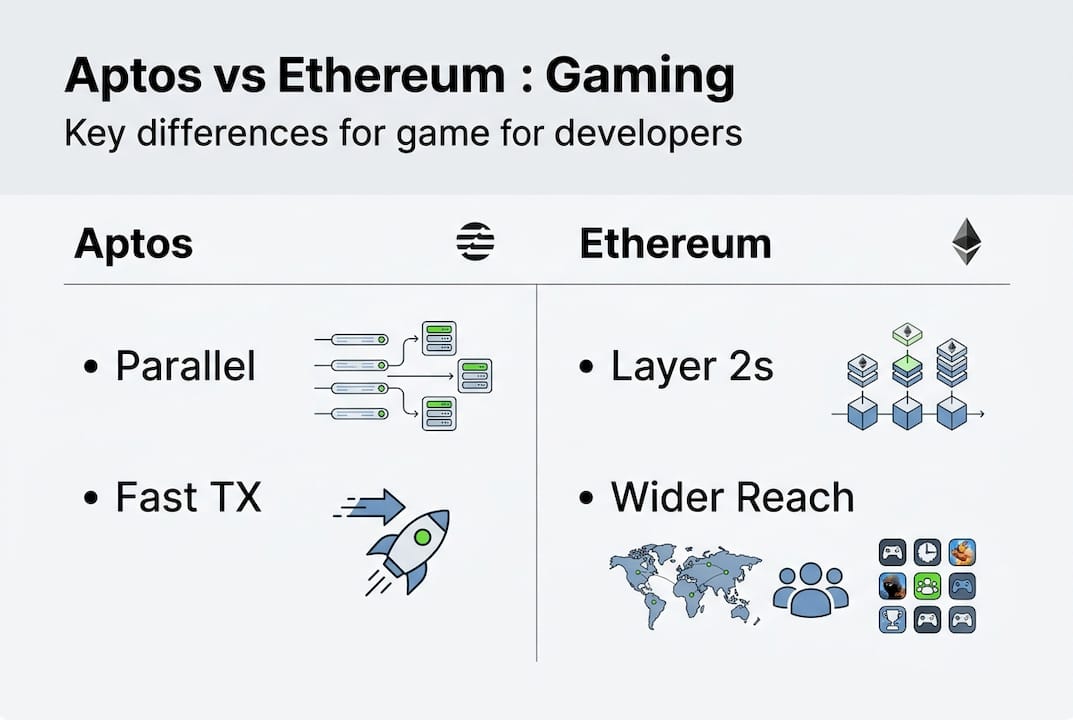
Aptos has recorded 22,000 TPS peak on mainnet with over 4.6 billion total transactions processed, while Ethereum L2 gaming activity has surged 20,000% but remains fragmented across competing solutions.
That fragmentation matters. When your players are split across Arbitrum, Base, and Optimism, liquidity is thin on each, and cross-chain asset movement adds friction. Aptos keeps everything on one unified layer, which simplifies the experience for both developers and players.
Pro Tip: When evaluating chains for your game, test conflict retry rates under simulated peak load. Aptos's parallel model handles independent actions well, but games with shared global state, like a single auction house, can trigger more retries. Design your game logic to minimize shared state conflicts.
For studios tracking mobile gaming innovation trends, latency is especially critical. Mobile players expect instant feedback. A blockchain that adds even 500 milliseconds of delay to core actions will hurt retention. Aptos's sub-second finality is a genuine competitive advantage here. If you are planning scalable blockchain apps that need to serve thousands of concurrent users, these numbers are not abstract. They are the difference between a game that feels fluid and one that feels broken.
Security, programming languages, and developer experience
Of course, fast tech is only helpful if it is secure and developer-friendly. So, how do these chains compare on developer experience and contract safety?
Ethereum uses Solidity, one of the most widely adopted smart contract languages in the world. The documentation is extensive, the community is massive, and the tooling ecosystem, including Hardhat, Foundry, and OpenZeppelin, is mature. If your team already knows Solidity, Ethereum is a lower-friction starting point.
However, Solidity carries real risks. Reentrancy attacks, where a malicious contract repeatedly calls back into a vulnerable function before the first execution finishes, have caused hundreds of millions in losses. The Ethereum ecosystem is mature but the language itself requires developers to be vigilant about a class of bugs that simply do not exist in Aptos.
Aptos uses Move, a language originally developed at Meta for the Diem project. Move is resource-oriented, meaning digital assets are treated as first-class resources that can only exist in one place at a time. You cannot accidentally duplicate a token or leave an asset in an undefined state. The Move language's resource model eliminates entire categories of reentrancy vulnerabilities by design, and its support for dynamic NFTs makes it particularly well-suited for gaming progression systems.
Here is what that means in practice for game developers:
- Dynamic NFTs on Aptos: Items can evolve, level up, and change properties natively without complex workarounds
- Solidity NFTs on Ethereum: ERC-721 and ERC-1155 standards are proven but require additional logic for dynamic behavior
- Move's safety guarantees: Fewer audit-critical bugs, which can reduce your security review costs
- Solidity's tooling advantage: More third-party integrations, more auditors familiar with the language
Pro Tip: Before committing to a chain, audit your team's existing skills. If nobody on your team knows Move, budget for a 4 to 6 week learning curve before you hit production velocity. Reviewing a solid web3 security checklist early in the project can save you from costly mistakes regardless of which chain you choose.
Move's learning curve is real, but studios that invest in it gain a security model that is structurally stronger for managing in-game economies where exploits can destroy player trust overnight.
Ecosystem, growth, and adoption for Web3 gaming in 2026
Knowing the technical differences, let us examine which chain is winning the hearts and wallets of players and developers.
Ethereum's gaming history is unmatched. Axie Infinity, Gods Unchained, and Decentraland all built on Ethereum and proved that blockchain gaming could attract millions of users. The NFT infrastructure is deep, with OpenSea, Blur, and dozens of marketplaces already integrated. But Ethereum L2 gaming activity has surged 20,000% while spreading across multiple competing L2 networks, creating a fragmented landscape that complicates user onboarding and asset portability.
Aptos is growing fast. Top games on the Aptos network are recording 100,000 or more weekly active wallets, and the chain's Gamestack infrastructure is specifically designed to lower the barrier for Web3 game developers. Aptos Foundation grants are actively funding studios that build on the chain, which means real financial support for early movers.
Here is a practical framework for evaluating which ecosystem fits your project:
- Define your player scale. If you expect millions of concurrent users from day one, Aptos's native throughput is a stronger foundation.
- Assess your NFT strategy. Ethereum has deeper marketplace liquidity for high-value NFT collections. Aptos is better for dynamic, gameplay-integrated assets.
- Evaluate your team's network. Ethereum has more available Solidity developers for hire. Move talent is growing but still specialized.
- Check grant availability. Aptos Foundation and Ethereum ecosystem funds both offer grants, but Aptos is actively prioritizing gaming projects in 2026.
- Consider your timeline. Ethereum's tooling is more mature. Aptos is moving fast but some infrastructure is still maturing.
For studios ready to build web3 game development projects that need to scale quickly, Aptos offers a compelling combination of speed, native gaming infrastructure, and active ecosystem support.
Our verdict: The real-world trade-offs for gaming studios
Here is the uncomfortable truth most comparison articles skip: neither chain is universally better. The "bigger ecosystem wins" argument that favors Ethereum misses the point for studios building real-time, action-heavy games. Ethereum's serial execution and L2 fragmentation are genuine obstacles, not minor inconveniences.
Aptos is promising for gaming and social applications precisely because its parallelism handles the independent, high-frequency transactions that define modern multiplayer games. Ethereum remains the right choice if your project centers on high-value NFT trading, requires deep DeFi integration, or your team is already deeply invested in Solidity.
The studios we see succeeding are not picking a chain based on hype. They are matching chain architecture to game design. If your core loop involves thousands of simultaneous player actions, Aptos wins on paper and in practice. If your game is NFT-collection-first with lighter on-chain logic, Ethereum's ecosystem depth is hard to beat.
For AAA multiplayer blockchain games where player experience is non-negotiable, the performance gap between Aptos and Ethereum mainnet is simply too large to ignore. Neither chain is permanently future-proof, but right now, Aptos is the more honest choice for studios that prioritize scale and player experience above all else.
Need help building your next blockchain game?
Deciding between Aptos and Ethereum is just the first step. Building a game that actually performs, retains players, and scales without breaking requires deep expertise across smart contracts, NFT architecture, and game design.
At Proud Lion Studios, we have hands-on experience with both chains, backed by Aptos Foundation funding and a UAE-based technical team that has shipped real products. Whether you need blockchain development services, end-to-end NFT and DApp solutions, or specialized smart contract expertise, we build to your game's specific requirements, not a template. Reach out to discuss your project and get a clear technical recommendation from a team that has already navigated these decisions.
Frequently asked questions
Which blockchain is better for high-speed online multiplayer games: Aptos or Ethereum?
Aptos is better suited for high-speed multiplayer games because its parallel execution engine handles thousands of simultaneous transactions with sub-second finality, while Ethereum mainnet processes transactions serially at a fraction of that speed.
Is it easier to develop secure game logic on Aptos or Ethereum?
Aptos's Move language offers structural security advantages, including elimination of reentrancy risks through its resource-oriented model, but Ethereum's Solidity has more available developers, auditors, and mature tooling, so the easier choice depends on your team's existing skills.
Can I use NFTs for gaming progression on both Aptos and Ethereum?
Both chains support NFTs, but Aptos's dynamic NFT support is natively built into the Move language, making it simpler to build items that evolve with player progression without complex workarounds.
How big is the Aptos gaming ecosystem compared to Ethereum's?
Ethereum's ecosystem is significantly larger overall, but Aptos is growing rapidly, with leading games already attracting 100,000 or more weekly active wallets and dedicated infrastructure like Gamestack supporting new game studios.