

TL;DR:
- A structured multi-phase workflow ensures reliable, secure, and cost-effective Web3 application development.
- Proper planning, security audits, testing, and monitoring are essential to prevent costly failures.
- Teams with disciplined processes ship faster, adapt better, and maintain long-term trust and stability.
Building a Web3 application without a defined workflow is like wiring a building without a blueprint. Teams that skip structured planning routinely face runaway costs, security vulnerabilities, and deployments that break under real traffic. The good news is that a multi-phase lifecycle covering planning, environment setup, smart contract development, testing, frontend integration, deployment, and maintenance gives you a repeatable, auditable path from idea to production. This guide walks you through each phase with practical tools, concrete examples, and hard-won lessons so your team can ship faster, reduce rework, and build applications your users actually trust.
Table of Contents
- Plan your Web3 workflow: Requirements, architecture, and toolchain
- Develop and secure smart contracts for reliability
- Integrate, test, and deploy: From local environments to mainnet
- Troubleshooting, optimization, and maintenance in Web3 workflows
- Why successful Web3 applications start with workflows—not code
- Accelerate your Web3 project with expert support
- Frequently asked questions
Key Takeaways
| Point | Details |
|---|---|
| Plan before you build | A clear workflow and toolset reduce costly mistakes and pivots. |
| Secure contract development | Following best practices and audits ensures your app’s integrity and reliability. |
| Iterative testing wins | Testing in local and test environments prevents mainnet disasters and reduces costs. |
| Continuous maintenance is vital | Addressing RPC rate limits, gas volatility, and regular upgrades keeps your Web3 app competitive. |
Plan your Web3 workflow: Requirements, architecture, and toolchain
Every successful Web3 project starts with a clear answer to one question: what business problem does this solve? Skipping that step is the single most common reason projects stall after the first sprint. Before a single line of code is written, map out your user flows, define what data must live on-chain versus off-chain, and document the acceptance criteria your stakeholders will use to judge success.
On-chain logic should be reserved for actions that require trustless verification: asset transfers, ownership records, governance votes. Off-chain logic handles everything else, including user authentication, media storage, and analytics. Mixing the two carelessly inflates gas costs and complicates your architecture. A simple diagram separating these layers early saves weeks of refactoring later.
Choosing the right blockchain network is equally strategic. Ethereum offers the largest developer ecosystem and the most battle-tested tooling, but its gas fees can be prohibitive for high-frequency transactions. Polygon and other Layer 2 networks dramatically reduce costs while inheriting Ethereum's security model. Your choice should map directly to your transaction volume, user geography, and compliance requirements, not to hype.
Once the architecture is clear, lock in your toolchain. The table below covers the core tools most teams rely on:
| Tool | Purpose |
|---|---|
| Hardhat | Local development and testing environment |
| Ganache | Personal blockchain for rapid local simulation |
| MetaMask | Browser wallet for user authentication and transaction signing |
| ethers.js | JavaScript library for contract interaction |
| OpenZeppelin | Audited smart contract libraries and standards |
| IPFS | Decentralized file and metadata storage |
Before finalizing your stack, review the Web3 development checklist to catch gaps early. If your team is newer to the space, the What is Web3 guide provides solid grounding on core concepts.
Key planning deliverables before you move forward:
- Defined on-chain vs. off-chain data map
- Selected blockchain network with documented rationale
- Agreed toolchain with version pinning
- User flow diagrams reviewed by non-technical stakeholders
Pro Tip: Involve your legal, compliance, and product stakeholders in the architecture review before development starts. Changing a core data model after contracts are deployed is expensive and sometimes impossible without a full redeployment.
Develop and secure smart contracts for reliability
With your foundation mapped, smart contract logic becomes your next task. Solidity remains the dominant language for EVM-compatible chains, and for good reason: it has the largest library of audited code, the most active developer community, and the best tooling support. Use it unless you have a specific reason to choose an alternative like Vyper.
Writing secure Solidity is not just about avoiding bugs. It requires deliberate patterns. Best practices like access controls, events, and the checks-effects-interactions pattern are non-negotiable for production-grade contracts. Access control ensures only authorized addresses can trigger sensitive functions. Events create an immutable audit trail that your frontend and monitoring tools can consume. The checks-effects-interactions pattern prevents reentrancy attacks, which have drained hundreds of millions of dollars from poorly written contracts.
Follow this sequence when developing each contract:
- Write the contract logic with inline comments explaining each function's intent.
- Add unit tests in Hardhat covering happy paths and edge cases.
- Run static analysis tools like Slither to catch common vulnerabilities automatically.
- Conduct an internal peer review focused on logic correctness and gas efficiency.
- Deploy to a local Ganache instance and run integration tests.
- Engage an external security audit before any mainnet deployment.
"An unaudited smart contract on mainnet is not a product. It is a liability. The cost of an audit is always lower than the cost of an exploit."
For contracts that need to evolve over time, proxy patterns like the OpenZeppelin Transparent Proxy or UUPS (Universal Upgradeable Proxy Standard) allow you to upgrade logic without changing the contract address your users interact with. This is critical for enterprise applications where business rules change.

For deeper guidance on the full build process, the blockchain app development steps guide covers architecture decisions in detail. If you want a team to handle smart contract development end to end, that is also a viable path for teams with tight timelines.
Pro Tip: Gas optimization is not premature optimization in Web3. Write gas-efficient code from the start by minimizing on-chain storage writes, using mappings over arrays where possible, and batching operations.
Integrate, test, and deploy: From local environments to mainnet
With your smart contracts ready, integration and deployment are your next critical steps. Connecting contracts to your frontend typically involves React as the UI framework, with ethers.js or Web3.js handling contract calls. Wallet connection libraries like RainbowKit or ConnectKit simplify the user experience across dozens of wallet providers. Your frontend should handle wallet state, transaction confirmations, and error states gracefully, because users will encounter all three regularly.
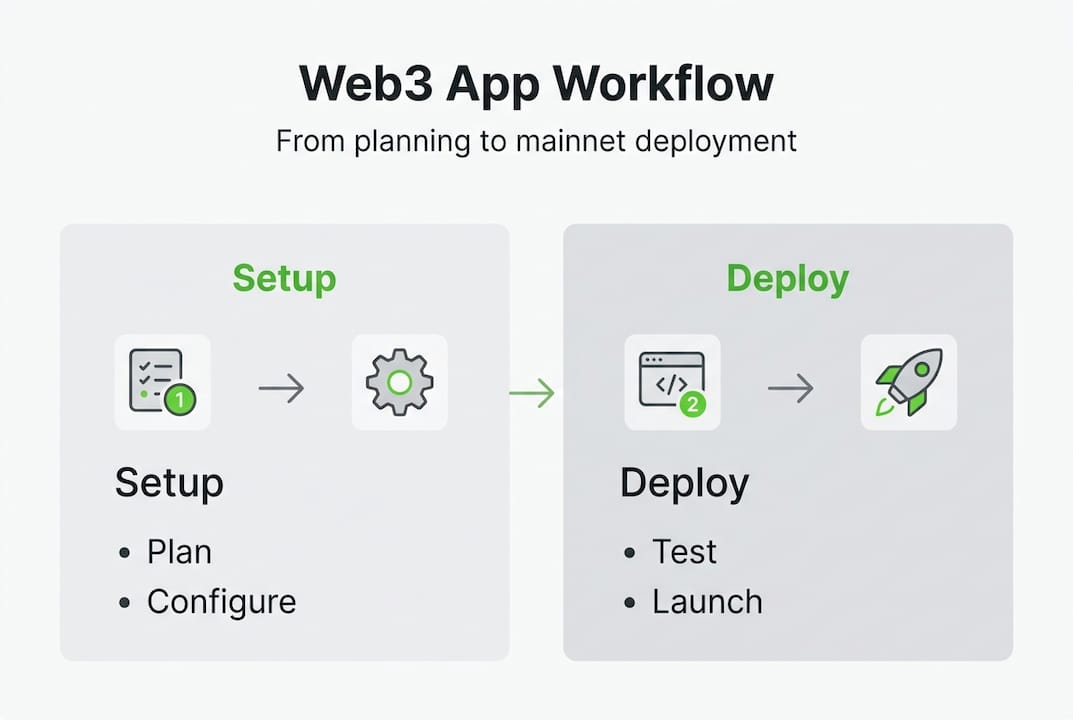
Testing must happen in layers. Local testing with Hardhat and Ganache lets you iterate quickly without spending real funds. Testnet deployment on Sepolia gives you a realistic environment with actual network latency and peer behavior. Only after both layers pass end-to-end checks should you consider mainnet.
| Stage | Environment | Key Risk |
|---|---|---|
| Unit testing | Hardhat local | Logic errors, missed edge cases |
| Integration testing | Ganache local | Contract interaction bugs |
| Testnet deployment | Sepolia | Network-specific behavior, gas estimation |
| Mainnet deployment | Ethereum/Polygon | Real financial exposure, irreversibility |
Before pushing to mainnet, run through this pre-deployment checklist:
- All unit and integration tests pass with 100% coverage on critical paths
- External security audit completed and findings resolved
- Contract ABI and addresses documented and version-controlled
- Frontend error handling tested for failed transactions and wallet rejections
- Monitoring and alerting configured for contract events
Post-deployment monitoring is not optional. Set up event listeners for your key contract functions and alert your team when anomalies appear. Tools like Tenderly or Alchemy's webhook system make this straightforward. To understand why this discipline matters long-term, the article on how to future-proof your products frames the broader strategic case well. Teams building on mobile should also review the blockchain mobile apps guide for platform-specific considerations.
Troubleshooting, optimization, and maintenance in Web3 workflows
Deployment is not the finish line. Efficient Web3 workflows depend on proactive troubleshooting and continuous optimization once your app is live. Edge cases like RPC rate limits, chain reorganizations, and gas spikes are common in production and can silently degrade your application's reliability and cost profile.
RPC rate limiting happens when your app sends too many requests to a node provider like Infura or Alchemy within a short window. The fix is a combination of request caching, exponential backoff on retries, and load balancing across multiple RPC endpoints. Chain reorganizations (reorgs) occur when the network temporarily reverses recent blocks. Your app should wait for a minimum number of block confirmations before treating a transaction as final, typically 12 blocks on Ethereum for high-value operations.
Gas price spikes are a real operational risk. During periods of high network congestion, transaction costs can increase by 10x or more within minutes, directly impacting your users and your business model if you subsidize fees.
Key ongoing maintenance tasks your team should schedule:
- Monitor wallet library updates and test compatibility after each release
- Review contract upgrade proposals against the current proxy implementation
- Audit on-chain storage growth and optimize data structures quarterly
- Rotate RPC endpoints and API keys on a regular schedule
- Track network upgrades (hard forks) that may affect contract behavior
On the optimization side, reduce frontend hangs by pre-fetching contract state during page load rather than on user action. Use multicall patterns to batch multiple read operations into a single RPC request. For write operations, give users clear gas estimates before they confirm transactions so there are no surprises.
For a broader view of how these challenges fit into the startup context, the Web3 explained for startups resource covers the operational realities teams often underestimate.
Why successful Web3 applications start with workflows—not code
Here is something most technical guides will not tell you: the teams that ship reliable Web3 applications are not necessarily the ones with the best developers. They are the ones with the best processes.
We have seen projects with talented engineers fail because they treated workflow as an afterthought. They wrote excellent contracts but had no testing discipline, no deployment checklist, and no post-launch monitoring. The first gas spike or RPC outage exposed every gap at once.
Mature teams treat their workflow as a strategic asset. They invest in securing and optimizing their project before the first line of production code is written. They run retrospectives after each phase. They document decisions so that when a team member leaves, the institutional knowledge does not leave with them.
The practical result is lower cost overruns, faster incident response, and applications that survive infrastructure volatility. Process discipline is not a constraint on creativity. It is what makes creativity sustainable at scale. If you want a competitive advantage in Web3, build your workflow before you build your product.
Accelerate your Web3 project with expert support
Putting a structured workflow into practice takes time, specialized knowledge, and a team that has navigated the real-world pitfalls described above. That is exactly where we come in.

At Proud Lion Studios, our Dubai-based team works with startups and enterprises to architect, build, and audit Web3 applications from the ground up. Whether you need support with blockchain development services, a thorough review from our smart contract experts, or end-to-end delivery of tokenization and DApps, we bring the process discipline and technical depth your project needs. Reach out to discuss your architecture and get a clear path forward.
Frequently asked questions
What are the main phases of a Web3 application workflow?
Typical phases are planning, environment setup, smart contract development, testing, frontend integration, deployment, and ongoing maintenance. Each phase builds directly on the last, so skipping one creates compounding risk in the stages that follow.
Which tools are essential for building Web3 applications?
Common tools include Hardhat and Ganache for local environments, MetaMask for wallet management, and React with ethers.js for frontend integration. OpenZeppelin libraries add a layer of audited, reusable contract logic that reduces your security surface area.
How do you test Web3 applications before deploying to mainnet?
Start with local testing in Hardhat, move to public testnets like Sepolia, and only deploy to mainnet once everything passes end-to-end checks. Skipping the testnet phase is one of the most common and costly mistakes teams make.
What are common pitfalls in Web3 workflows?
Watch out for RPC rate limits and reorgs, gas spikes, and poor coding patterns that can cause downtime and high costs. Building retry logic, monitoring, and upgrade paths into your workflow from the start keeps these issues manageable rather than catastrophic.