
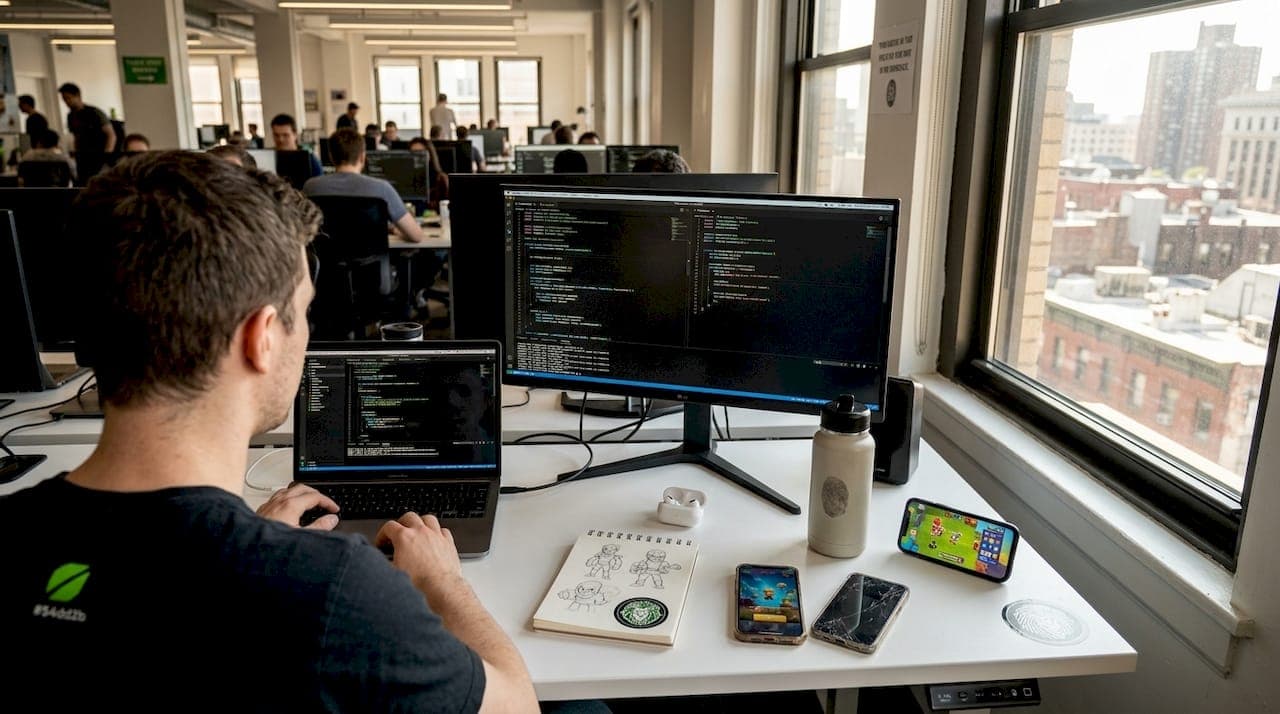
Mobile gaming in 2026 is not a slow-moving industry you can catch up with later. New hardware, smarter AI, and shifting player expectations are compressing the window between "emerging trend" and "industry standard" down to months. Developers and studios that wait for a trend to fully mature before acting often find themselves rebuilding from scratch while competitors are already scaling. This article breaks down the most impactful mobile game development trends of 2026, gives you a framework for evaluating which ones fit your project, and shows you exactly how to act on each one.
Table of Contents
- Criteria for evaluating 2026 mobile game development trends
- Artificial intelligence and machine learning integration
- Blockchain and NFT-powered mobile games
- Augmented and virtual reality advancements
- Cloud gaming and cross-platform play
- Social features, community, and user-generated content
- Monetization models: Subscriptions, ads, and in-app purchases
- Summary comparison: Which trends fit your game and team?
- Leverage the latest trends with Proud Lion Studios
- Frequently asked questions
Key Takeaways
| Point | Details |
|---|---|
| AI and personalization | AI tools create personalized experiences that maximize engagement and retention. |
| Blockchain monetization | NFTs and blockchain unlock new revenue streams and secure digital asset trading. |
| AR/VR immersion | AR and VR elevate storytelling and gameplay in ways not possible with traditional mobile games. |
| Cloud and cross-platform | Cloud gaming and cross-platform play expand access to broader audiences and simplify game distribution. |
| Social-driven growth | Community-driven features and user-generated content fuel viral growth and long-term retention. |
Criteria for evaluating 2026 mobile game development trends
Not every trend deserves your time or budget. Before you chase the next shiny technology, you need a filter. The anticipated shifts in mobile app and game design for 2026 point to five core criteria that separate genuinely valuable trends from noise.
Here is what to measure each trend against:
- Technology adaptability: Can your current stack integrate AI, blockchain, or AR/VR without a full rebuild?
- Player engagement and retention: Does the trend measurably improve session length, return rate, or social sharing?
- Monetization potential: Does it open new revenue streams or improve conversion on existing ones?
- Global accessibility: Can players on mid-range devices in emerging markets still access the experience?
- Scalability: Will the feature hold up as your player base grows from thousands to millions?
Pro Tip: Score each trend you consider on a 1 to 5 scale across these five criteria. Any trend scoring below 15 total is probably not worth prioritizing for your next release cycle.
Using this framework with 2026 app frameworks as a reference point keeps your decisions grounded in real business outcomes rather than hype.
Artificial intelligence and machine learning integration
AI is not a feature you bolt on at the end of development. In 2026, it is a foundational layer that shapes how games are built, balanced, and monetized. AI's role in shaping mobile games now spans the entire development lifecycle, from content generation to post-launch optimization.
Here is where AI and ML are delivering the most value right now:
- Procedural content generation: AI builds levels, quests, and environments dynamically, reducing manual design hours while keeping content fresh for returning players.
- Personalized gameplay: ML models analyze individual player behavior and adjust difficulty, pacing, and rewards in real time.
- Smarter NPCs: AI-powered non-player characters (NPCs) adapt to player strategies instead of following fixed scripts, making single-player experiences feel genuinely competitive.
- Predictive monetization: Algorithms identify which players are likely to convert on a purchase and serve the right offer at the right moment.
Pro Tip: Start with AI-driven difficulty scaling before tackling procedural generation. It is faster to implement, immediately visible to players, and gives your team hands-on experience with ML pipelines before taking on more complex systems.
Studios using AI for mobile games are reporting shorter QA cycles and higher day-30 retention rates because the game adapts to the player rather than forcing the player to adapt to the game.
Blockchain and NFT-powered mobile games
Blockchain is solving a problem that has frustrated players for years: you spend real money on in-game items, and the moment the game shuts down, everything disappears. Blockchain and NFT technology will transform mobile game monetization and user engagement by giving players verifiable ownership of digital assets.
| Feature | Traditional model | Blockchain model |
|---|---|---|
| Asset ownership | Developer-controlled | Player-owned via NFT |
| Item trading | Locked to platform | Open marketplace |
| Revenue model | One-time purchase | Royalties on resale |
| Player trust | Low (server-dependent) | High (on-chain verification) |
Key applications for your game:
- NFTs as rare in-game items, skins, or characters that players can trade or sell
- Smart contracts that automatically execute play-to-earn rewards without manual processing
- Secure peer-to-peer marketplaces built directly into the game interface
- Player-driven economies where supply and demand set item values
Pro Tip: If you are new to blockchain in mobile gaming, start with a single NFT drop tied to a limited in-game event. This tests your smart contract infrastructure and gauges player appetite before you commit to a full economy redesign.
Augmented and virtual reality advancements
AR and VR are no longer just for headset enthusiasts. Mobile AR, powered by the cameras and sensors already in most smartphones, is becoming a practical tool for everyday game design. AR and VR are set to boost engagement in mobile games through immersive experiences that blend the physical and digital worlds.

Here is a breakdown of where each technology stands for mobile developers:
| Technology | Best use case | Main challenge | Adoption readiness |
|---|---|---|---|
| Mobile AR | Location-based games, overlays | Battery drain, lighting conditions | High (most smartphones) |
| Mobile VR | Immersive story worlds | Requires headset accessory | Medium (growing market) |
| Mixed reality | Social and multiplayer layers | Complex development pipeline | Low to medium |
Key considerations when building AR or VR features:
- Test across at least three device tiers (flagship, mid-range, budget) before launch
- Design AR interactions that work in both indoor and outdoor lighting
- Keep VR sessions short by default to reduce motion discomfort for new users
- Use progressive loading to maintain frame rates on lower-spec devices
Pro Tip: AR features that use the player's real environment (their room, their street) create a personal connection that purely digital environments cannot replicate. That emotional hook drives sharing and organic discovery.
Cloud gaming and cross-platform play
Cloud gaming strips away the hardware ceiling. Instead of requiring players to own a powerful device, the game runs on remote servers and streams to any screen. Cloud gaming is enabling scalable and accessible game experiences for a global audience, which is a massive opportunity for studios targeting markets where flagship phones are not the norm.
"The studio that builds for the global median device, not the flagship, wins the next billion players."
What cloud and cross-platform play unlock for your studio:
- Game streaming: Players access your title on any device without downloading large files or meeting hardware requirements.
- Cross-platform progression: A player starts on mobile, continues on PC, and picks up on a smart TV without losing progress.
- Reduced churn from device upgrades: Players do not lose access when they switch phones.
- Expanded player pools: Cross-platform matchmaking fills lobbies faster and keeps competitive modes alive longer.
For indie studios, cloud gaming strategy means you can compete with larger studios on reach without matching their hardware optimization budgets.
Social features, community, and user-generated content
The games with the longest lifespans in 2026 are not the ones with the biggest budgets. They are the ones with the most active communities. Social features and UGC increasingly drive mobile game retention by turning passive players into active contributors.
Here is a practical roadmap for building social momentum:
- Add integrated sharing tools that let players export clips, screenshots, or achievements directly to social platforms with one tap.
- Build leaderboards with context, not just global rankings but friend-based and regional boards that feel winnable and personal.
- Create community-driven game modes where players vote on weekly challenges or contribute to seasonal events.
- Enable user-generated content such as custom levels, skins, or mods, and build a moderation pipeline before you launch it.
- Reward community participation with in-game currency, exclusive cosmetics, or early access to new content.
Pro Tip: UGC moderation is the part most studios underestimate. Build your content review system before you open UGC to the public. A single viral piece of inappropriate content can damage your app store rating overnight. Check out social features in apps for more on building retention-focused community tools.
Monetization models: Subscriptions, ads, and in-app purchases
The freemium model is not dead, but it is evolving fast. Players in 2026 are more resistant to aggressive monetization and more willing to pay upfront for a fair experience. Monetization strategies are adapting to new consumer preferences and game structures across every genre.
Key monetization approaches worth evaluating:
- Subscription access: Monthly passes that bundle premium content, ad removal, and exclusive rewards. Lower friction than one-time purchases for casual players.
- Interactive ad formats: Playable ads and rewarded video that give players genuine value (extra lives, in-game currency) in exchange for engagement.
- Microtransactions with transparency: Clearly priced cosmetic items with no pay-to-win mechanics. Players spend more when they trust the system.
- Battle passes: Time-limited progression tracks that create urgency and reward consistent play without locking core gameplay.
| Model | Best for | Risk |
|---|---|---|
| Subscription | Casual and mid-core games | Churn if content cadence slows |
| Rewarded ads | Hypercasual and puzzle games | Ad fatigue if overused |
| Battle pass | Live-service and competitive games | Requires constant content updates |
| NFT marketplace | Blockchain-native games | Regulatory and market volatility |
For mobile monetization trends, the studios winning in 2026 are combining two or three of these models rather than relying on a single revenue stream.
Summary comparison: Which trends fit your game and team?
Use this table to quickly match each trend to your project's priorities.
| Trend | Player impact | Ease of adoption | ROI potential | Best for |
|---|---|---|---|---|
| AI and ML | Very high | Medium | High | All game types |
| Blockchain and NFTs | High | Low to medium | Very high | Mid-core, strategy |
| AR and VR | Very high | Medium | Medium to high | Action, adventure |
| Cloud gaming | High | Low (infrastructure) | High | All game types |
| Social and UGC | High | Medium | Medium | Live-service games |
| Subscription monetization | Medium | High | Medium to high | Casual, mid-core |
If you are a small team with limited resources, AI integration and social features offer the best return for the effort. If you have blockchain expertise or a partner studio, NFT economies and play-to-earn models can generate outsized revenue. AR and VR reward studios willing to invest in device testing and iterative design.
Leverage the latest trends with Proud Lion Studios
Knowing which trends to pursue is only half the equation. Executing them well, on time and within budget, is where most studios struggle. At Proud Lion Studios, we build mobile games and digital products that integrate the exact technologies covered in this article.
Our team delivers end-to-end mobile app development services for studios and entrepreneurs ready to ship in 2026. Whether you need AI integration solutions to personalize your player experience or full-stack blockchain game development to power your NFT economy, we bring the technical depth and product thinking to make it real. Based in Dubai with a fully UAE-based team and a client portfolio spanning multiple countries, we specialize in custom solutions that are built for scale from day one.
Frequently asked questions
Which trend has the most impact on player engagement in 2026?
AI-powered personalization and AR/VR immersion are leading player engagement in 2026 mobile games, with AI delivering measurable retention gains and AR creating the emotional hooks that drive organic sharing.
How are blockchain and NFTs changing mobile game revenue models?
Blockchain and NFTs are enabling secure digital trading, player-driven economies, and play-to-earn models that generate ongoing revenue through marketplace royalties rather than one-time purchases.
What does cloud gaming mean for independent mobile game studios?
Cloud gaming allows indie developers to scale their reach and reduce device dependency, making global distribution easier without the cost of heavy device-specific optimization.
What are the main challenges with adopting AR/VR in mobile games?
The biggest challenges are hardware compatibility, user adoption rates, and maintaining gameplay quality across devices, as outlined in AR/VR adoption challenges for mobile platforms.
How do social and user-generated content features affect mobile game retention?
Social features and UGC promote engagement, viral reach, and stronger player communities, which directly reduce churn and extend the active lifespan of a mobile game.