

TL;DR:
- Future-proofing builds organizational resilience through proactive planning, elastic infrastructure, and AI integration. Leaders must adopt scenario-based strategies and continuous improvement practices to thrive amid market disruptions. It is an ongoing process requiring cultural shifts, modular pilots, and a focus on technological adaptability.
Future-proofing your business is the practice of embedding resilience and adaptability into your core operations so you can thrive amid unpredictable market shifts and technological disruptions. This discipline, formally known as strategic resilience planning, goes far beyond reactive fixes. It demands proactive decisions about technology infrastructure, leadership mindset, and organizational design. Business owners who treat adaptability as a core competency, rather than a crisis response, consistently outperform those who wait for disruption to force their hand. This guide covers why future-proofing matters, what it requires, and how to execute it in 2026.
Why future-proof your business: key benefits and ROI
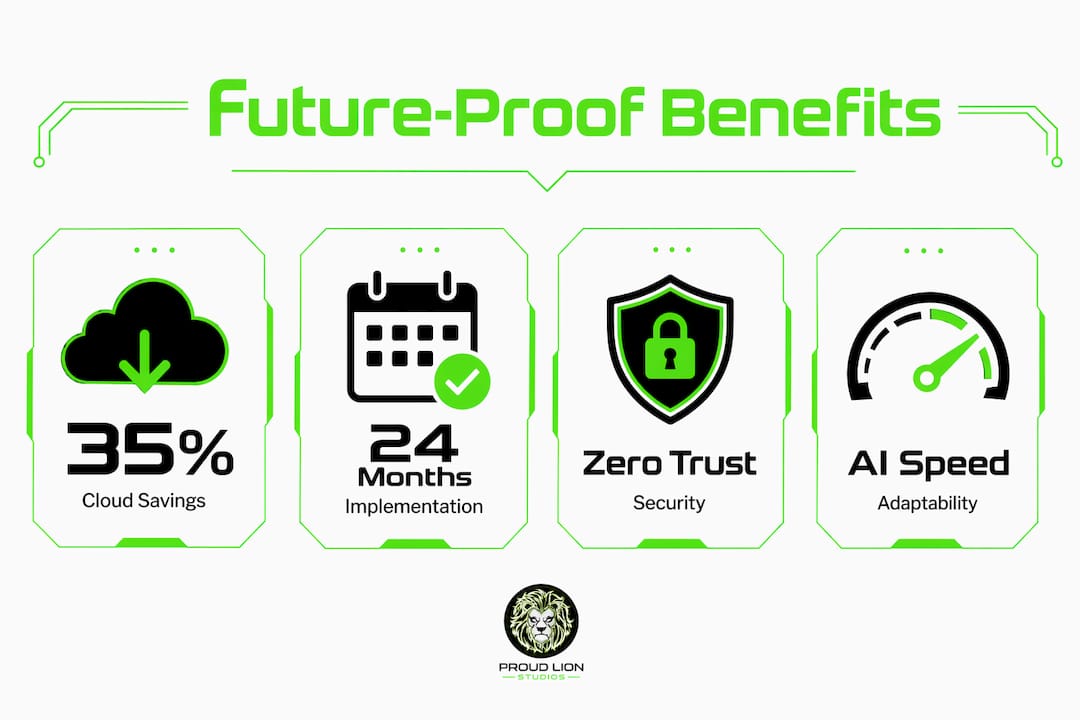
The financial case for future-proofing is concrete. 35% of enterprise cloud spend is wasted due to poor scalability and resource management. That figure represents real budget that proactive infrastructure planning recovers and redirects toward growth.
Beyond cost recovery, future-proofing delivers three compounding advantages:
- Faster execution. AI integration in customer service, finance, and supply chain has moved from competitive advantage to operational necessity. Businesses using AI automation compress go-to-market cycles and reduce execution risk on new initiatives.
- Sustained market relevance. Companies that monitor consumer behavior shifts in real time adapt their offers before competitors notice the trend. Reactive businesses adapt after market share has already moved.
- Lower long-term costs. Proactive design prevents technical debt. Technical debt is the accumulated cost of shortcuts taken today that require expensive fixes later.
"Future-proofing is not a one-time project. It is an ongoing operational capability that compounds in value the longer you commit to it. Leaders who treat it as a continuous discipline build organizations that absorb disruption rather than collapse under it."
The return on investment from future-proofing is not speculative. It shows up in reduced emergency IT spending, shorter product cycles, and the ability to enter new markets without rebuilding your entire technology stack from scratch.
Pro Tip: Audit your current cloud and software subscriptions quarterly. Eliminating redundant tools and right-sizing capacity is the fastest way to recover wasted spend and fund future-proofing initiatives.
How does leadership mindset shape future-proofing success?
The single biggest obstacle to future-proofing is not technology. It is leadership thinking locked into single-forecast planning. Most executives build one annual plan and defend it against reality. That approach fails in volatile markets.
Leaders must shift from defensive resilience to proactive growth by scenario planning 3–5 plausible futures and preparing trigger-based playbooks for each. A trigger-based playbook defines in advance what conditions will prompt a specific strategic response. This removes the delay caused by debating whether a market signal is significant enough to act on.
The practical steps for building this leadership capacity follow a clear sequence:
- Map 3–5 plausible futures. Identify the market conditions, regulatory shifts, or technology breakthroughs that could reshape your industry within 24 months.
- Assign triggers to each scenario. Define the specific signals, such as a competitor pricing move or a regulatory announcement, that activate each playbook.
- Pilot modular processes in one value chain. Starting small avoids the common pitfall of attempting to future-proof an entire organization at once. Prove the model in one area, then scale what works.
- Reduce individual dependencies. Standardized and documented processes allow teams to pivot independently without waiting for a single expert or decision-maker to unblock progress.
- Review and update playbooks quarterly. Markets move faster than annual planning cycles. Quarterly reviews keep your scenarios calibrated to current conditions.
Pro Tip: Run a "pre-mortem" before launching any major initiative. Ask your team to imagine the project failed 12 months from now and work backward to identify the most likely causes. This surfaces hidden assumptions before they become expensive mistakes.
What does future-ready technology infrastructure look like?
Technology infrastructure is where future-proofing either holds or breaks down. Most businesses make one critical error: they purchase infrastructure based on fixed capacity targets instead of designing for workload elasticity. Designing for elasticity avoids costly resets every 24–36 months that drain budgets and delay growth.

The distinction between bleeding-edge and future-ready infrastructure matters here. Bleeding-edge means adopting the newest technology as soon as it ships. Future-ready means building systems that can absorb new technology without requiring a full rebuild. The two are not the same, and confusing them is expensive.
| Infrastructure approach | Characteristics | Risk level |
|---|---|---|
| Fixed-capacity legacy systems | Built for current load, rigid architecture | High. Requires full replacement as needs grow. |
| Cloud-native elastic platforms | Scales up and down with demand | Low. Absorbs growth without emergency spending. |
| API-first modular design | Components connect and swap independently | Low. Integrates new tools without rebuilding core systems. |
| Hybrid cloud models | On-premise plus cloud for sensitive workloads | Medium. Balances control with flexibility. |
Static infrastructure risks downtime, delays, and emergency spending when workloads shift unexpectedly. Adaptable platforms absorb storage growth, application dependencies, and rising user expectations without crisis-mode responses.
Security is not optional in future-ready infrastructure. Zero Trust security architecture and multi-factor authentication (MFA) are now industry standards, not premium add-ons. Zero Trust means no user or device is trusted by default, even inside your network. Every access request is verified. Businesses that skip these protocols expose themselves to breaches that erase years of competitive progress. Proud Lion Studios builds cybersecurity-aware systems into every development engagement for exactly this reason.
Pro Tip: Adopt an API-first architecture from the start. Ignoring API-first design creates technical debt that severely limits your ability to integrate AI and automation tools later, often at three to five times the original build cost.
How does AI integration accelerate business adaptability?
AI is the most direct tool available for compressing the time between sensing a market shift and responding to it. Businesses that integrate AI across functions gain a structural speed advantage over those that do not.
The practical applications of AI for business adaptability include:
- Customer service automation. AI agents handle routine inquiries at scale, freeing human teams to manage complex or high-value interactions. Response times drop from hours to seconds.
- Financial forecasting. Machine learning models process transaction data and market signals to produce rolling forecasts that update in real time, replacing static quarterly models.
- Supply chain monitoring. AI flags demand anomalies and supplier risks before they become stockouts or delivery failures.
- Consumer behavior analysis. Pairing external trend data with internal sales data gives executives a clearer picture of where demand is heading, not just where it has been.
Small businesses gain the most from AI adoption because it gives them enterprise-level operational sophistication without the headcount. A 10-person team with the right AI tools can execute what previously required a 50-person department. That is a structural shift in competitive dynamics, not a marginal improvement.
AI-powered marketing tools, such as those used in eCommerce ad automation, demonstrate how AI compresses testing cycles and improves targeting precision across channels. The same principle applies across every business function. Proud Lion Studios specializes in AI automation for business that connects these capabilities into a coherent operational system.
How do you build an organization that keeps future-proofing itself?
Future-proofing is not a project with a completion date. Successful future-proofing requires 12–24 months of focused evolution across hardware standards, cybersecurity protocols, and ongoing staff training. That timeline reflects the reality that organizational change moves slower than technology change.
Building a self-renewing organization requires four sustained commitments:
- Continuous staff upskilling. Technology evolves faster than most training programs. Quarterly learning sprints on new tools, security protocols, and process changes keep your team current without overwhelming them.
- Documented, modular processes. When processes live in one person's head, they create a single point of failure. Written, modular processes allow any team member to execute, adapt, or hand off work without bottlenecks.
- Iterative process improvement cycles. Treat your internal operations the same way a product team treats software. Ship, measure, improve, repeat. Small improvements compounded over 24 months produce significant operational gains.
- Proactive technical debt management. Every shortcut taken in system design accumulates as debt. Schedule regular architecture reviews to identify and address debt before it blocks your next growth phase.
Pro Tip: Create a "future-proofing backlog" the same way a software team maintains a product backlog. List every known technical debt item, process gap, and training need. Prioritize and address three to five items per quarter. This keeps improvement systematic rather than reactive.
Key Takeaways
Future-proofing your business is a continuous operational discipline that combines leadership scenario planning, elastic technology infrastructure, AI integration, and organizational learning to sustain competitive advantage through any market condition.
| Point | Details |
|---|---|
| Cloud waste is recoverable | Up to 35% of enterprise cloud spend is wasted. Fixing scalability issues funds future-proofing directly. |
| Scenario planning beats single forecasts | Map 3–5 plausible futures with trigger-based playbooks to act fast when markets shift. |
| Elastic infrastructure prevents costly resets | Design for workload elasticity to avoid full rebuilds every 24–36 months. |
| AI levels the competitive field | Small businesses using AI automation can match the operational output of much larger teams. |
| Future-proofing is ongoing, not one-time | Commit to 12–24 months of continuous improvement across technology, processes, and people. |
What I've learned from watching businesses resist change
I have watched well-funded businesses lose their market position not because a competitor outspent them, but because their infrastructure could not absorb a new tool fast enough. A company with a rigid, monolithic codebase tried to integrate an AI-driven customer service layer. The integration took 14 months instead of the planned 6 weeks. By the time it launched, the market had moved again. That is the real cost of static infrastructure. It is not just the emergency spending. It is the opportunity cost of being perpetually behind.
The businesses I have seen succeed at future-proofing share one trait: they treat it as a leadership discipline, not an IT project. The CEO is asking scenario planning questions in every quarterly review. The operations lead is running modular pilots before committing to full rollouts. The tech team is building with API-first principles from day one, not retrofitting them after the fact.
The hardest mindset shift is accepting that you cannot predict the future. You can only build an organization agile enough to respond to it faster than your competitors. Scenario planning does not give you the right answer. It gives you the mental readiness to act when the answer becomes clear. That readiness is the actual competitive advantage.
— Amal
Proud Lion Studios builds the technology layer your future-proofing strategy needs
Proud Lion Studios works with startups and enterprises across multiple countries to build the technology foundations that make long-term adaptability possible. The studio's UAE-based team specializes in blockchain development, AI automation, mobile applications, and smart contract systems, all designed with modularity and elasticity from the ground up. Every engagement focuses on real business outcomes, not templated packages. If your current technology stack is creating drag instead of enabling growth, Proud Lion Studios builds systems that grow with your business rather than against it. Contact the team to discuss a tailored solution for your specific market and operational context.
FAQ
What does future-proofing a business actually mean?
Future-proofing means embedding resilience and adaptability into your business model so it can absorb market shifts and technological disruptions without requiring a full rebuild. It covers leadership strategy, technology infrastructure, and organizational culture simultaneously.
Why is future-proofing more urgent in 2026 than in previous years?
AI integration across customer service, finance, and supply chain has shifted from a competitive advantage to an operational baseline. Businesses that have not adopted these tools are now operating at a structural disadvantage in speed and cost efficiency.
How long does it take to future-proof a business?
Effective future-proofing requires 12–24 months of focused effort across technology upgrades, cybersecurity improvements, and staff training. It is an ongoing capability, not a project with a fixed end date.
What is the biggest technology mistake businesses make when future-proofing?
The most common error is purchasing infrastructure based on fixed capacity targets rather than designing for workload elasticity. This forces expensive full replacements every 24–36 months instead of incremental upgrades.
Where should a business leader start with future-proofing?
Start with a modular pilot in one value chain rather than attempting to transform the entire organization at once. Prove the model, measure the results, then scale what works across the rest of the business.