

TL;DR:
- AI is revolutionizing digital transformation by enabling autonomous decision-making and workflow redesign. Successful transformation requires ongoing leadership commitment, CEO ownership, and measuring Return on Autonomy rather than traditional adoption metrics. Most failures stem from layering AI onto legacy processes instead of redesigning work around AI-native workflows.
Artificial intelligence is defined as the primary force reshaping digital transformation, moving organizations beyond process automation into autonomous decision-making and workflow redesign. The role of AI in digital transformation is no longer a technology question. It is a strategic leadership question. AI systems like large language models, machine learning pipelines, and AI agents are rewriting how banks approve loans, how retailers personalize offers, and how manufacturers predict failures before they happen. Business leaders who treat AI as a software upgrade will miss the structural shift entirely. This article gives you the research-backed framework to understand what AI transformation actually requires and how to measure whether you are achieving it.
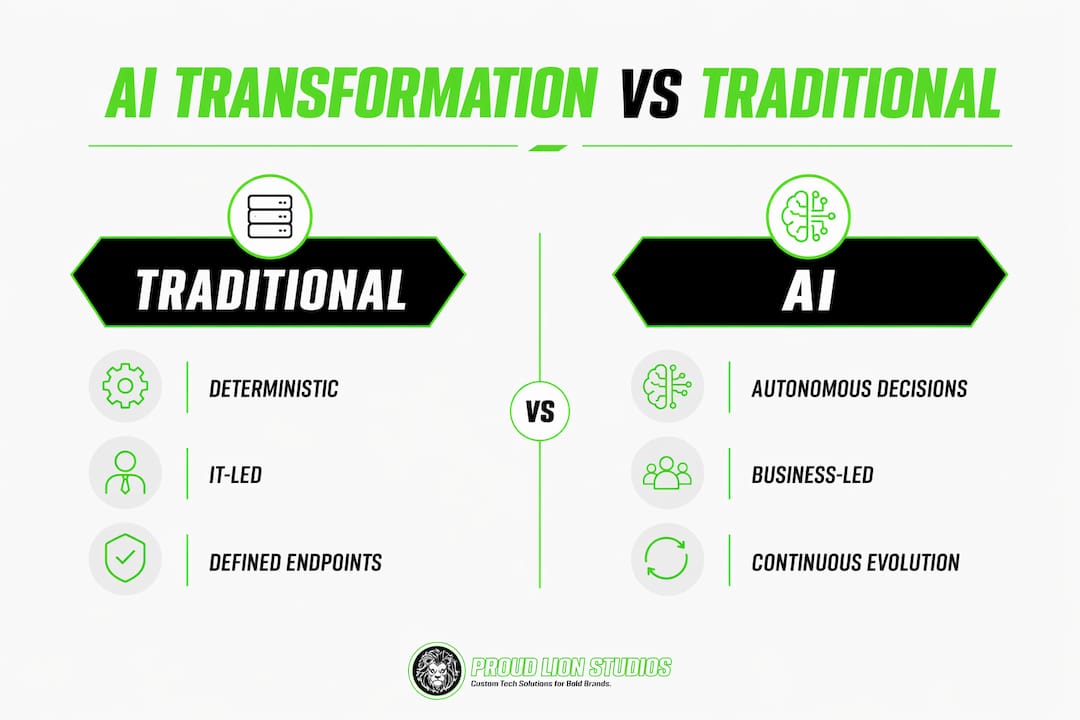
How AI in digital transformation differs from earlier digital initiatives
Traditional digital transformation is defined by deterministic outputs. You automate a process, and the system produces the same result every time. AI transformation operates on a fundamentally different principle. AI-generated outputs are probabilistic, meaning the system produces the most likely correct answer, not a guaranteed one. That single distinction changes everything about governance, accountability, and how you build operating models.

Earlier digital initiatives were IT-led projects with defined endpoints. A company deployed an ERP system, migrated to the cloud, or built a customer portal. Success was binary: the system worked or it did not. AI transformation has no endpoint. Models drift, data distributions shift, and performance degrades without continuous monitoring and retraining. This is not a deployment. It is an ongoing operational commitment.
The ACE Framework, developed to map organizational AI maturity, describes three zones: Automate (replacing repetitive tasks), Augment (supporting human judgment), and Transform (redesigning entire workflows around AI-native processes). Most organizations are stuck in the Automate zone, capturing only a fraction of available value. True transformation requires reaching the Transform zone, where AI agents handle end-to-end decisions without human intervention at each step.
| Dimension | Traditional digital transformation | AI transformation |
|---|---|---|
| Output type | Deterministic, rule-based | Probabilistic, context-dependent |
| Governance model | IT-managed, project-based | CEO-led, continuous oversight |
| Endpoint | Defined go-live date | No endpoint; ongoing retraining |
| Value driver | Process efficiency | Workflow redesign and autonomous decisions |
| Leadership owner | CIO or IT department | CEO and board |
Pro Tip: Map your current AI initiatives against the ACE zones before committing budget. If every initiative sits in the Automate zone, you are spending on efficiency gains while competitors are redesigning entire business models.
What leadership must own to make AI transformation succeed
The CEO must spend 15 to 25% of time on AI strategy for meaningful adoption and impact. That number surprises most executives, but it reflects a structural reality: AI transformation fails when it is delegated to a Chief AI Officer or an innovation team operating outside the core business. The decisions that determine AI success, including data access, role redesign, and budget allocation, sit at the CEO and board level.
BCG research shows that 70% of AI transformation value comes from people-related actions: change management, role redesign, and building the behavioral habits that make AI outputs trusted and used. Technology accounts for the remaining 30%. Organizations that invert this ratio, spending most of their energy on model selection and infrastructure, consistently underperform.
The most dangerous trap for leadership is what researchers call the micro-productivity trap. This is where AI tools improve individual task speed without changing the underlying workflow or business outcome. A sales team using AI to write emails faster is not transforming. A sales team where AI qualifies leads, drafts proposals, and schedules follow-ups autonomously is operating in a different competitive category. The distinction matters enormously for AI-driven digital initiatives that actually move revenue.
Here are the four leadership imperatives that separate organizations achieving transformation from those collecting tools:
- Shift the measurement frame. Replace adoption metrics (seats licensed, features activated) with Return on Autonomy (RoA), which measures how much decision-making capacity AI has genuinely taken over. Measuring Return on Autonomy is the key to evaluating real transformation progress.
- Redesign roles before deploying tools. AI embedded in legacy job descriptions produces marginal gains. AI embedded in redesigned roles produces structural change.
- Centralize AI platforms and talent. Fragmented AI investments across business units create duplication and governance gaps. Centralized platforms increase effectiveness and reduce risk.
- Build emotional buy-in, not just training. Employees who fear job displacement will work around AI systems rather than with them. Change management must address the emotional dimension directly.
Pro Tip: Before your next AI investment, ask one question: "If this works perfectly, does it change the structure of how we work, or does it just make the current structure faster?" If the answer is faster, you are buying efficiency. If the answer is structural change, you are buying transformation.
Practical AI applications reshaping business operations
Leading firms automate 30 to 50% of workflows via AI, freeing millions of human hours, with a projected 150% ROI over five years. That figure is not theoretical. Banks like JPMorgan Chase use AI agents to review legal documents that previously required thousands of attorney hours. Retailers like Amazon deploy machine learning to personalize product recommendations at a scale no human merchandising team could match.
The mechanism behind these gains is the AI agent workflow. AI agents replace human judgment in workflows by ingesting data, analyzing patterns, generating outputs, and executing decisions autonomously. This four-step cycle (ingest, analyze, generate, execute) replaces what used to require a human at each stage. In financial services, this means credit decisions in seconds. In healthcare, it means diagnostic support that flags anomalies before a physician reviews the scan.
Here are five concrete AI applications producing measurable operational impact in 2026:
- Predictive maintenance in manufacturing. AI models analyze sensor data from equipment and predict failures days before they occur, cutting unplanned downtime by significant margins.
- AI-powered customer service. Large language models handle tier-one support queries end to end, with human agents handling only complex escalations. Resolution times drop and cost-per-contact falls.
- Dynamic pricing in retail. AI systems adjust prices in real time based on demand signals, competitor data, and inventory levels, a task that previously required analyst teams.
- Fraud detection in banking. Machine learning models identify anomalous transaction patterns in milliseconds, catching fraud that rule-based systems miss entirely.
- Personalized learning in enterprise training. AI platforms like Coursera for Business and Degreed adapt content delivery to individual learning patterns, improving completion rates and knowledge retention.
Digitally mature companies redesign organizational structure around AI agents integrated with human talent to deliver end-to-end outcomes. This is the defining structural shift: cross-functional teams where AI handles the high-volume, pattern-based work and humans handle judgment, relationships, and exceptions.
| Industry | AI application | Primary outcome |
|---|---|---|
| Banking | Automated credit decisioning | Faster approvals, reduced default rates |
| Retail | Real-time personalization engines | Higher conversion, lower churn |
| Manufacturing | Predictive maintenance models | Reduced downtime, lower repair costs |
| Healthcare | Diagnostic image analysis | Earlier detection, reduced physician load |
How to measure and sustain AI transformation impact
Organizations executing AI transformation achieve 10.3x ROI versus 3.7x ROI for those layering AI additively. That gap is not a rounding error. It represents the difference between organizations that redesign workflows around AI and those that bolt AI onto existing processes. The measurement framework you use determines which category you fall into.
Return on Autonomy is the right metric for transformation. It measures the percentage of decisions, tasks, and workflows that AI now owns end to end, without human intervention at each step. Traditional adoption metrics, such as the number of users on an AI platform or the number of features activated, tell you nothing about whether the business has actually changed. You can have 100% adoption of a tool and zero transformation of the underlying work.
AI transformation requires ongoing investment in model maintenance, retraining, and performance evaluation to avoid degradation. Models trained on 2024 data will drift as market conditions, customer behavior, and data distributions shift. Organizations that treat AI deployment as a one-time project will find their models producing increasingly unreliable outputs within 12 to 18 months. Governance frameworks must include scheduled retraining cycles, output drift monitoring, and human review thresholds for high-stakes decisions.
Pro Tip: Build your AI governance practices into the operating model from day one, not as a compliance afterthought. Define which AI outputs require human review, set drift thresholds that trigger retraining, and maintain audit trails for every consequential decision the system makes.
Only 5% of companies achieve substantial value from AI, while 60% see no material value. The gap between these groups is not model quality or data volume. It is governance, leadership commitment, and the willingness to redesign work rather than just add tools.
Key takeaways
AI transformation delivers 10.3x ROI only when organizations redesign workflows around AI-native processes, invest 70% of their effort in people and governance, and measure Return on Autonomy rather than adoption metrics.
| Point | Details |
|---|---|
| AI transformation vs. adoption | Deploying AI tools without redesigning workflows produces 3.7x ROI; full transformation produces 10.3x ROI. |
| CEO ownership is non-negotiable | CEOs must dedicate 15 to 25% of their time to AI strategy for transformation to take hold across the organization. |
| People drive 70% of the value | Change management, role redesign, and behavioral buy-in outweigh technology investment in determining AI success. |
| Governance must be built in | Probabilistic AI outputs require continuous monitoring, drift detection, and audit trails from the start. |
| Measure Return on Autonomy | Adoption metrics measure tool usage; RoA measures how much decision-making AI has genuinely taken over. |
Why most AI transformations fail before they start
I have seen organizations spend eight figures on AI infrastructure and come away with nothing but a faster version of the same broken process. The pattern is consistent: leadership delegates AI to a technology team, the technology team deploys tools, and the business units use those tools to do the same work slightly faster. Nobody asks the harder question, which is whether the work itself should still exist in its current form.
The uncomfortable reality is that AI transformation is primarily a leadership and organizational design challenge. The technology is available, mature, and well-documented. What is rare is a CEO willing to spend a quarter of their time on AI strategy, a board willing to redesign job structures before the ROI is proven, and a change management function that treats emotional resistance as a first-class problem rather than a communication issue.
I am also skeptical of the "start small and scale" advice that dominates most AI transformation frameworks. Starting small is fine for learning. But organizations that stay small, running dozens of disconnected pilots without a governing architecture, end up with a portfolio of tools that do not talk to each other and a workforce that is confused about which AI to trust. Deliberate sequencing matters more than speed. Pick the two or three workflows where AI-native redesign would produce the most structural impact, go deep on those, and build the governance model that can scale to the rest of the business.
The enterprise AI roadmap question is not "where can we use AI?" It is "which workflows, if redesigned around AI, would change our competitive position?" That question requires CEO-level judgment, not a technology audit.
— Amal
How Proudlionstudios builds AI transformation for enterprises
Proudlionstudios is a Dubai-based technology studio that builds the infrastructure AI transformation actually requires: custom AI agents, machine learning pipelines, and the blockchain and smart contract architecture that makes autonomous decisions auditable and secure.

For organizations moving beyond pilots into production-grade AI systems, Proudlionstudios delivers mobile app development and smart contract development that integrate directly with AI workflows. The team is fully UAE-based, works across multiple industries, and builds to real business outcomes rather than templated packages. If your organization is ready to move from AI adoption to AI transformation, Proudlionstudios has the technical depth to get you there.
FAQ
What is the role of AI in digital transformation?
AI's role in digital transformation is to move organizations beyond rule-based automation into autonomous decision-making, where AI agents redesign entire workflows rather than just accelerating existing ones. The distinction between AI adoption and AI transformation determines whether organizations achieve 3.7x or 10.3x ROI.
How does AI transformation differ from traditional digital transformation?
Traditional digital transformation produces deterministic outputs through IT-led projects with defined endpoints. AI transformation produces probabilistic outputs requiring continuous governance, CEO-level ownership, and ongoing model retraining to maintain performance.
Why do most AI transformation initiatives fail?
Research from BCG shows that 60% of companies see no material value from AI, primarily because they layer AI onto legacy workflows rather than redesigning work around AI-native processes. Leadership delegation and weak change management are the most common failure points.
How should business leaders measure AI transformation success?
Leaders should measure Return on Autonomy (RoA), which tracks the percentage of decisions and workflows AI owns end to end, rather than adoption metrics like seat counts or feature activation rates. Deloitte's 2026 research identifies RoA as the defining metric for genuine transformation progress.
How much time should a CEO spend on AI strategy?
According to Bain, CEOs must dedicate 15 to 25% of their time to AI strategy for meaningful transformation to occur. Organizations where AI is delegated entirely to technology teams consistently underperform those with direct executive ownership.