
TL;DR:
- Up to 42% of AI projects are abandoned due to poor data and unclear strategies.
- Successful AI automation focuses on process standardization, quality data, and phased scaling.
- Human augmentation, supported by strong leadership and disciplined processes, yields higher long-term ROI.
Despite the headlines and executive boardroom buzz, 30 to 42% of AI projects are abandoned before they ever deliver value, most often because of poor data quality, undefined strategy, or broken processes that automation simply cannot fix. AI automation is not a switch you flip. It is a discipline that demands deliberate preparation, executive commitment, and a clear-eyed understanding of where technology ends and process thinking begins. If you are a business leader trying to separate real ROI from expensive experiments, this guide gives you the frameworks, data, and honest perspective you need to get it right.
Table of Contents
- Why AI automation matters for modern business
- How to prepare your business for AI automation
- Common pitfalls: Why AI automation projects fail
- Human vs. machine: Finding the right balance in business automation
- Scaling AI automation: Frameworks, metrics, and next steps
- What most executives miss about AI automation
- AI automation solutions built for business growth
- Frequently asked questions
Key Takeaways
| Point | Details |
|---|---|
| Audit before you automate | Assess and standardize processes and data before deploying AI to avoid magnifying problems. |
| Avoid common pitfalls | Failed AI projects are most often caused by poor data, unclear objectives, and lack of oversight. |
| Prioritize augmentation | Augment human teams with AI for the best ROI, not just cost reduction. |
| Start small, scale wisely | Pilot automation in 20-40% of workflows and expand as you gain experience and process maturity. |
| Measure and refine | Use metrics like accuracy and exception rates to drive continual AI improvement. |
Why AI automation matters for modern business
Having seen where so many automation projects go wrong, let's clarify what successful businesses get right from the start.
The case for AI automation is not built on hype. It is built on compounding advantages that widen the gap between leaders and laggards over time. Businesses that deploy AI effectively gain speed on repetitive tasks, improved output quality through consistent execution, and the ability to scale operations without proportionally scaling headcount. Decision intelligence, meaning the use of AI to surface patterns in large datasets that humans would miss, is becoming a genuine competitive differentiator across industries from finance to logistics.
Consider what business efficiency with AI actually looks like in practice. A logistics company using AI-powered route optimization cuts fuel costs and delivery times simultaneously. A financial services firm using AI for document review reduces compliance processing from days to hours. These are not hypothetical scenarios. They are operational realities for companies that invested in getting the foundation right.
The core drivers behind successful AI automation include:
- Speed: Automated workflows execute in milliseconds, removing bottlenecks that slow human-dependent pipelines.
- Quality and consistency: AI applies the same logic every time, reducing human error rates across high-volume tasks.
- Scalability: Automation can handle ten times the transaction volume without ten times the cost.
- Decision intelligence: Predictive models surface insights that improve strategic choices across procurement, marketing, and operations.
The barriers, though, are real. AI initially costs three times more than human-executed processes upfront, with enterprise licensing and infrastructure fees running into hundreds of thousands of dollars per month. The learning curve for teams is steep. And without executive sponsorship, even technically solid projects lose momentum.
"The businesses winning with AI are not necessarily spending the most. They are the ones with the clearest business case and the strongest internal commitment to see implementation through."
AI success is ultimately a leadership challenge as much as it is a technology challenge. Recognizing that early saves enormous time and budget.
How to prepare your business for AI automation
Once the importance is clear, the natural next step is ensuring your business is ready to actually implement AI, the right way.

Preparation is where most organizations underinvest, and it is precisely where the most value is created or destroyed. Before you automate anything, you need to audit what you actually have. Many organizations discover that their workflows are far more fragmented, manual, and undocumented than they assumed. Automating a broken process does not fix it. It accelerates the problems at scale.
Here is a practical preparation sequence to follow:
- Map your current workflows end to end. Document every step, every handoff, and every decision point. If a process cannot be clearly described, it cannot be reliably automated.
- Audit your data sources. Identify where data is generated, stored, and consumed. Flag inconsistencies, duplicate records, and gaps. AI models are only as good as the data feeding them.
- Identify bottlenecks and exception-heavy areas. Processes that generate frequent exceptions or require frequent human judgment are poor early candidates for full automation.
- Standardize before automating. Eliminate unnecessary variation in how tasks are completed. Consistency in inputs produces consistency in outcomes.
- Select low-risk starting points. Choose processes where errors are recoverable and volume is high. These give you fast learning cycles without catastrophic downside.
Prioritize process audit and standardization before AI deployment to avoid amplifying inefficiencies. The recommended target is a 20 to 40% initial automation rate, scaling to 60 to 80% as process maturity improves. Jumping straight to 80% automation on your first attempt is a recipe for chaos.
Scalable AI approaches recognize that phased rollouts protect organizational stability while allowing teams to learn and adapt. Similarly, proper AI workflow integration into your existing CRM and ERP systems requires clean data pipelines, not just clever software.
Pro Tip: Before selecting any AI tool or platform, run a two-week process documentation sprint with the actual people doing the work. Frontline staff know where the real exceptions live, and that knowledge is gold for designing automation that holds up in production.
"Readiness is not about your tech stack. It is about how well you understand your own operations before you hand them to a machine."
Common pitfalls: Why AI automation projects fail
Even the best-laid plans go awry without awareness of common stumbling blocks.
Failure in AI automation rarely announces itself loudly. It creeps in through degraded data, scope creep, and the slow realization that the model is no longer performing as expected. Understanding the specific failure modes lets you build defenses against them from day one.
Between 30 and 42% of AI projects are abandoned due to poor data quality, lack of clear objectives, and unstandardized processes. These are not exotic technical failures. They are organizational failures dressed in technical language. The most common pitfalls include:
- Poor data quality: Garbage in, garbage out. If your training data is inconsistent, biased, or incomplete, your model will reflect every flaw.
- Undefined success metrics: Projects without clear KPIs drift. Teams disagree on what "working" means, and the project loses executive support.
- Automating exceptions-heavy processes too early: Processes with high exception rates expose poor standardization and create massive human review burdens.
- Ignoring model drift: AI models degrade over time as real-world conditions change. A greater than 5% accuracy drop should trigger automatic retraining protocols, but many organizations have no monitoring in place.
- Removing humans entirely too soon: Exceptions always exist. High exception rates are a symptom of deeper process problems, not just a technical glitch.
| Failure mode | Root cause | Prevention strategy |
|---|---|---|
| Poor data quality | Fragmented, unclean data sources | Audit and standardize before deployment |
| Undefined objectives | No clear KPIs or business case | Define measurable outcomes upfront |
| Model drift | Changing real-world conditions | Continuous monitoring with retraining triggers |
| Over-automation of exceptions | Unstandardized processes | Start with low-exception, high-volume tasks |
| Lack of human oversight | Over-reliance on automation | Design human-in-the-loop for all edge cases |
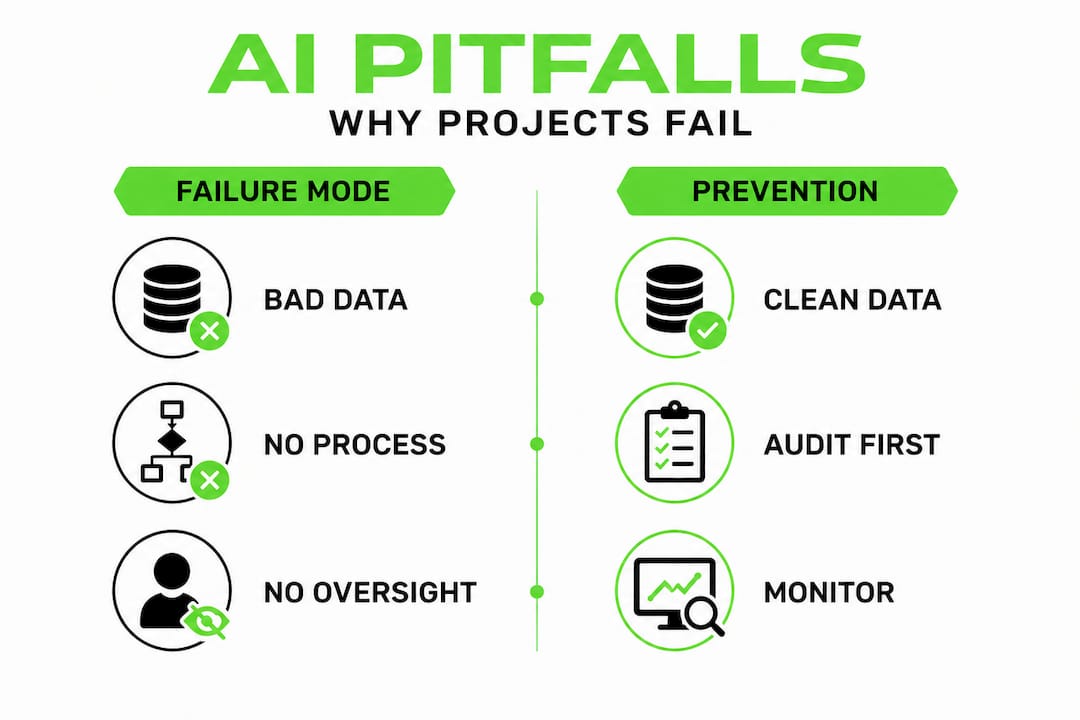
Lessons from real AI agent projects consistently show that human oversight is not a sign of a weak automation strategy. It is a sign of a mature one. Understanding which AI agent options match your specific use case also dramatically reduces failure risk by aligning tool capabilities with process requirements.
Pro Tip: Build a monitoring dashboard before you launch any automation. Tracking exception rates, accuracy scores, and processing times from day one gives you early warning signals before small problems become expensive failures.
Human vs. machine: Finding the right balance in business automation
Understanding the causes of failure is step one. Choosing the right approach for your context is just as important.
The most persistent misconception in AI automation is that the goal is to remove humans from the equation entirely. In reality, the businesses generating the highest long-term ROI are using AI to make their people more effective, not to replace them wholesale. This is the augmentation model, and the data supports it strongly.
Leaders achieve 3.8 times better ROI when they combine executive sponsorship with the right implementation partners, rather than attempting full automation driven purely by cost-cutting mandates. Augmentation means AI handles the repetitive, high-volume, rules-based work while humans handle judgment, exceptions, relationships, and creative problem-solving. This division of labor is not a compromise. It is a strategy.
| Approach | Best for | Risk level | ROI timeline |
|---|---|---|---|
| Full automation | Rules-based, high-volume, low-exception tasks | Medium to high | 12 to 24 months |
| Human augmentation | Complex decisions, exception handling, strategy | Low to medium | 6 to 18 months |
| Hybrid (phased) | Most enterprise environments | Low | 9 to 18 months |
Key considerations when deciding where to automate versus where to empower people:
- Task variability: High variability means more exceptions, which means more human involvement is needed.
- Error cost: If mistakes are recoverable and low-stakes, automate. If mistakes are costly or compliance-sensitive, augment first.
- Data availability: Full automation requires large, clean, consistent datasets. Augmentation can work with thinner data.
- Team readiness: Teams resistant to AI adoption will undermine automation. Augmentation often generates faster buy-in because people see AI as a tool helping them, not replacing them.
Measuring success in human-augmented automation goes beyond cost savings. Adaptability, speed of exception resolution, and model accuracy over time are equally important indicators. Exploring AI innovation insights across different industries shows that the most durable gains come from systems designed for humans and machines to work together, not in opposition.
Scaling AI automation: Frameworks, metrics, and next steps
With strategy, tools, and team in place, scaling and continual improvement become the focus.
Scaling AI automation successfully requires moving through deliberate phases rather than attempting a single large transformation. The phased approach protects your business, generates real-world learning quickly, and builds organizational confidence at every step.
Here is a proven scaling sequence:
- Pilot phase: Select one or two high-volume, low-exception processes. Define success metrics clearly. Run for 60 to 90 days and measure rigorously.
- Consolidation phase: Document what worked, fix what did not, and standardize the winning model. Invest in monitoring infrastructure before expanding.
- Scaling phase: Expand to adjacent processes that share similar data structures and workflow patterns. Replicate the winning framework, do not reinvent it each time.
- Optimization phase: Use accumulated performance data to fine-tune models, adjust thresholds, and identify new automation candidates.
- Continuous improvement: Set review cycles, typically quarterly, to assess model drift, exception rates, and business outcome alignment.
Target a 20 to 40% initial automation rate, scaling to 60 to 80% as process maturity and data quality improve. This is not a conservative approach. It is a realistic one that keeps failure rates low and learning rates high.
The metrics that matter most when scaling include:
- Accuracy rate: Are automated decisions matching expected outcomes?
- Exception rate: What percentage of cases require human intervention?
- Processing time: Is automation actually faster than the human baseline?
- Cost per transaction: Is unit economics improving as volume scales?
- Model drift rate: How quickly is accuracy degrading over time?
Pro Tip: Do not wait for perfect data before starting your pilot. Good-enough data with a tight feedback loop beats perfect data with a slow review cycle every time. The goal is learning fast and improving continuously.
Deploying purpose-built AI agent solutions dramatically accelerates the scaling phase because they are designed to handle specific business functions, whether that is customer service, data extraction, compliance monitoring, or internal workflow orchestration. Off-the-shelf generic tools rarely deliver the same measurable ROI in enterprise contexts.
What most executives miss about AI automation
Most conversations about AI automation obsessively focus on technology selection. Which model? Which platform? Which vendor? These questions matter, but they are not the primary determinants of success. In our experience working with startups and enterprises, the executives who consistently get the best results spend as much time on process design and cultural alignment as they do on technology.
The uncomfortable truth is that AI amplifies whatever organizational habits already exist. If your team is disciplined, data-driven, and process-oriented, AI will make them dramatically more effective. If your organization runs on informal knowledge, inconsistent processes, and siloed data, AI will surface every one of those problems at scale. Deploying AI into a dysfunctional process is like putting rocket fuel in a car with a broken engine. You do not go faster. You break down faster.
Leaders who achieve 3.8 times better ROI share one common trait. They treat AI as an organizational transformation initiative, not a technology procurement project. That means executive sponsors who stay actively involved beyond the approval stage, governance frameworks that address AI ethical implications before they become liabilities, and partnerships with specialists who have navigated these challenges in real enterprise environments.
The businesses that will define the next five years of competitive advantage are not the ones with the biggest AI budgets. They are the ones building the strongest human-AI working relationships, grounded in disciplined processes and honest measurement.
AI automation solutions built for business growth
Armed with practical frameworks and a fresh perspective, here is how to accelerate your journey.
Knowing what to do and having the right partner to execute it are two different things. At Proud Lion Studios, we build custom AI agent solutions designed for the specific operational realities of growing startups and established enterprises. Our approach begins with process analysis, not product pitches, because the best automation strategy is always grounded in your actual business workflows and data environment.

We combine AI automation expertise with blockchain development services to deliver systems that are not only intelligent but verifiable, auditable, and built to scale across complex regulatory environments. Whether you need AI agents handling customer workflows, predictive analytics improving operational decisions, or full-stack digital transformation, our UAE-based team brings hands-on experience from dozens of real deployments. Let's build automation that actually performs.
Frequently asked questions
What is the biggest risk of rushing into AI automation?
Automating before auditing processes or cleaning data often amplifies preexisting inefficiencies, and 30 to 42% of projects are abandoned as a direct result of exactly that mistake.
How much of a business can realistically be automated by AI?
Most businesses can automate 20 to 40% of processes initially, scaling to 60 to 80% as data quality and process standardization improve over time.
Is it better to fully automate or augment human teams with AI?
Long-term ROI is consistently higher when AI augments skilled teams, with leaders achieving 3.8 times better returns through executive sponsorship and augmentation-first approaches.
What timeline should I expect before seeing ROI from AI automation?
Returns vary significantly by scope, but upfront AI costs can run three times the equivalent human process cost, meaning meaningful ROI typically accumulates over several quarters to two or more years.
How should exceptions and model drift be handled after automation?
Set clear thresholds so that a greater than 5% accuracy drop automatically triggers model retraining, and always maintain a human-in-the-loop process for high-risk exception cases.