
TL;DR:
- AI implementation relies on a structured, phased process to succeed and generate measurable value.
- Most failures occur due to poor change management and missing decision checks, not technology issues.
AI tools implementation steps are the structured, sequential phases that move an organization from identifying an AI opportunity to generating measurable business value. Without a defined process, up to 70% of AI projects fail due to poor change management and missing human decision checkpoints. That failure rate is not a technology problem. It is a process problem. The most effective approach follows a 90-day phased roadmap, starting with a focused pilot before any full deployment. Business leaders who treat AI adoption as a one-time install rather than a structured, iterative process consistently underperform those who build measurement and governance into every phase from day one.
What are the right prerequisites before implementing AI tools?
Every successful AI deployment process starts with clarity on what you are trying to achieve. Define the specific business outcome you want before selecting any tool. "Improve customer response time by 40%" is a goal. "Use AI" is not.
Data readiness is the most underestimated prerequisite. AI tools perform only as well as the data they process. Audit your existing data sources for completeness, accuracy, and accessibility before committing to any platform. Poor data quality is one of the most common reasons pilots fail to produce results that translate to full deployment.
Assigning a single AI implementation owner is non-negotiable. Decentralized AI adoption creates shadow AI, where employees use unapproved tools that expose sensitive data to security risks. One designated owner controls tool access, license management, and connector permissions across the organization.
Before writing a single line of code or signing a software contract, confirm these prerequisites are in place:
- A written statement of the business problem AI will solve, with a target metric attached
- A data audit confirming source quality, volume, and access permissions
- A named AI implementation owner with authority over tool governance
- A written policy covering approved AI use, data handling, and escalation procedures
- A budget that accounts for integration work, not just software licenses
- A training plan for the teams who will use the tools daily
Pro Tip: Set your success metric before the pilot starts, not after. Teams that define "what good looks like" in week one make faster decisions and avoid scope creep during testing.
How to select the right AI tools and design a pilot program
Tool selection is where most organizations lose weeks to indecision. The right framework cuts that time significantly. Evaluate every candidate tool against three criteria: alignment with your stated business goal, technical compatibility with your existing infrastructure, and the realistic cost of integration.

The layered AI tool stack consists of four components: foundation models such as GPT, frameworks such as LangChain, vector databases such as Pinecone, and automation platforms such as Zapier. Each layer serves a distinct function. Selecting the right combination for your specific use case matters more than choosing the most advanced option in any single category.
| Tool category | Primary function | Best for |
|---|---|---|
| Foundation models | Language understanding and generation | Content, analysis, Q&A |
| Orchestration frameworks | Chaining AI tasks and logic | Complex multi-step workflows |
| Vector databases | Storing and retrieving context | Knowledge bases, search |
| Automation platforms | Connecting apps and triggers | No-code workflow integration |
Once you select your stack, design a 4–8 week pilot with clearly defined metrics. The pilot is not a proof of concept. It is a measurement exercise. Track outcome metrics, adoption rates, user satisfaction scores, and edge cases from the first day of testing. Review those metrics weekly. Teams that skip this discipline cannot distinguish a tool problem from a configuration problem when results disappoint.
An automated measurement loop from day one is the single most important structural decision in your pilot design. Without it, you are collecting anecdotes instead of data.
Pro Tip: Starting with simpler configurations reduces cost and keeps adoption steady. Reserve extended reasoning modes and advanced features for after your team is comfortable with the baseline tool behavior.
For a deeper look at evaluating enterprise-grade options, the 2026 enterprise AI selection guide covers evaluation criteria in detail.
What are best practices for integrating AI tools into existing systems?
Integration is where project budgets most often break down. Expect 30–50% of your total project cost to go toward connecting AI tools to your existing workflows and data systems. That figure surprises most leaders who budget only for software licenses. Plan for it from the start.
For straightforward workflows, no-code and low-code platforms such as Make.com, Zapier, and n8n handle most connection requirements without custom development. These platforms connect AI outputs to existing apps through visual interfaces, which reduces both cost and implementation time. For complex automation that requires conditional logic, memory, or multi-step reasoning, frameworks such as LangChain provide the control that no-code tools cannot.
Building automated fallback mechanisms into your AI agent design is a best practice that most teams skip until something breaks in production. Progressive wait times and error logging keep AI agents performing reliably when tools or network connections fail. Build these in during the pilot, not after launch.
Key integration practices and pitfalls to avoid:
- Map every data touchpoint before writing integration logic
- Use no-code platforms for simple triggers and data transfers
- Reserve custom frameworks for workflows requiring memory or multi-step reasoning
- Test integrations with real production data, not sanitized samples
- Document every connector and API dependency for future maintenance
- Never integrate directly to a production system during the pilot phase
How to train your team and manage change for successful AI adoption?
Change management determines whether your AI investment pays off. The 70% failure rate in AI projects traces directly to poor adoption, not poor technology. Tools that employees distrust or avoid deliver no value regardless of their technical capability.
Human-in-the-loop design is the most effective way to build that trust. Place human decision checkpoints at every critical step in the AI workflow at launch. Fully automated end-to-end processes sound efficient, but they remove the human oversight that catches errors and builds confidence over time. Start with humans reviewing AI outputs, then automate gradually as accuracy is confirmed.
Effective training goes beyond a one-time onboarding session. A people-first approach combines initial skills training with continuous education as the tools evolve. Explain the business reason behind each AI tool, not just how to use it. Teams that understand why a tool exists adopt it faster and use it more effectively.
Follow these steps to deploy change management and training together:
- Communicate the business goal and the role AI will play before the pilot begins
- Identify internal champions who will model confident AI use for their peers
- Run hands-on training sessions with real use cases, not generic demos
- Create a feedback channel where teams can report problems without judgment
- Share weekly pilot results with all stakeholders to build transparency
- Adjust workflows based on user feedback before scaling
Pro Tip: Create a safe space for experimentation. Teams that can test AI tools without fear of making costly mistakes learn faster and surface better use cases than teams operating under strict performance pressure.
For a structured view of how AI fits into a broader organizational strategy, the enterprise AI roadmap guide covers phased rollout planning and ROI tracking in depth.
How to measure, optimize, and scale AI tools post-implementation?
Measurement is not a phase that follows implementation. It is a continuous process that starts on day one of the pilot. AI tools typically improve 30–60% in performance metrics over the first three months after launch. That improvement only happens when you are actively tracking, tuning, and adjusting based on real data.
The metrics that matter most fall into four categories: outcome metrics tied to your original business goal, adoption rates showing how many team members use the tool regularly, user satisfaction scores reflecting trust and ease of use, and edge case logs capturing failures the system did not handle correctly. Review all four weekly during the pilot and monthly after full deployment.
| Metric category | What to measure | Why it matters |
|---|---|---|
| Outcome metrics | Cost reduction, revenue impact, time saved | Proves ROI against original business goal |
| Adoption rate | Active users as a share of total users | Reveals training gaps and resistance points |
| User satisfaction | Survey scores, support ticket volume | Tracks trust and usability over time |
| Edge case log | Failure types, frequency, resolution time | Drives prompt tuning and workflow fixes |
| Accuracy rate | Error rate on AI outputs reviewed by humans | Determines readiness to reduce human review |
Scaling from pilot to full deployment requires a clear threshold decision, not a calendar date. Scale when your outcome metrics are stable, your adoption rate exceeds a defined target, and your edge case log shows no unresolved critical failures. Scaling before those conditions are met multiplies problems rather than results.
Iterative prompt tuning and workflow adjustment during the 60-day post-launch measurement window is where most of the performance gains occur. Treat this period as active development, not passive monitoring. The teams that schedule weekly optimization reviews consistently outperform those that treat launch as the finish line.
What I have learned about AI implementation that most guides skip
The honest truth about AI implementation is that the technology is rarely the hard part. Every project I have observed that struggled did so because of organizational dynamics, not model selection or API configuration. The team that owns the tool, the clarity of the business goal, and the willingness to act on measurement data matter more than which foundation model you choose.
The shadow AI problem is more widespread than most leaders realize. Employees who feel their legitimate needs are not being met will find their own tools. The answer is not restriction. It is a faster, more responsive governance process that gives teams approved options quickly. A single AI implementation owner who moves fast and communicates clearly does more to prevent shadow AI than any policy document.
I have also seen organizations rush to scale because the pilot looked promising after two weeks. Reliable ROI calculation requires at least 60 days of post-launch data. Two weeks of good results can reflect novelty effects, not sustainable performance. Patience at the measurement stage protects you from scaling a tool that will underperform at volume.
The leaders who get the most from AI treat it as an evolving capability, not a finished product. They budget for tuning, they reward teams who surface problems early, and they revisit their original business goal every quarter to check whether the tool is still solving the right problem.
— Amal
Proud Lion Studios' approach to AI implementation
Proud Lion Studios works with startups and enterprises across multiple countries to build AI agents, automation workflows, and integrated digital products that connect to real business outcomes. The studio's UAE-based technical team handles everything from initial scoping to full deployment, including the integration work that typically consumes 30–50% of an AI project budget.

Whether you need a custom AI agent built from the ground up or a structured plan for connecting AI to your existing systems, Proud Lion Studios builds to your specific requirements rather than templated packages. The team also brings deep experience in blockchain development and mobile app development, making it possible to integrate AI capabilities across web, mobile, and decentralized platforms in a single engagement. Contact Proud Lion Studios to discuss your implementation goals and get a scoped plan.
FAQ
What are the core AI tools implementation steps?
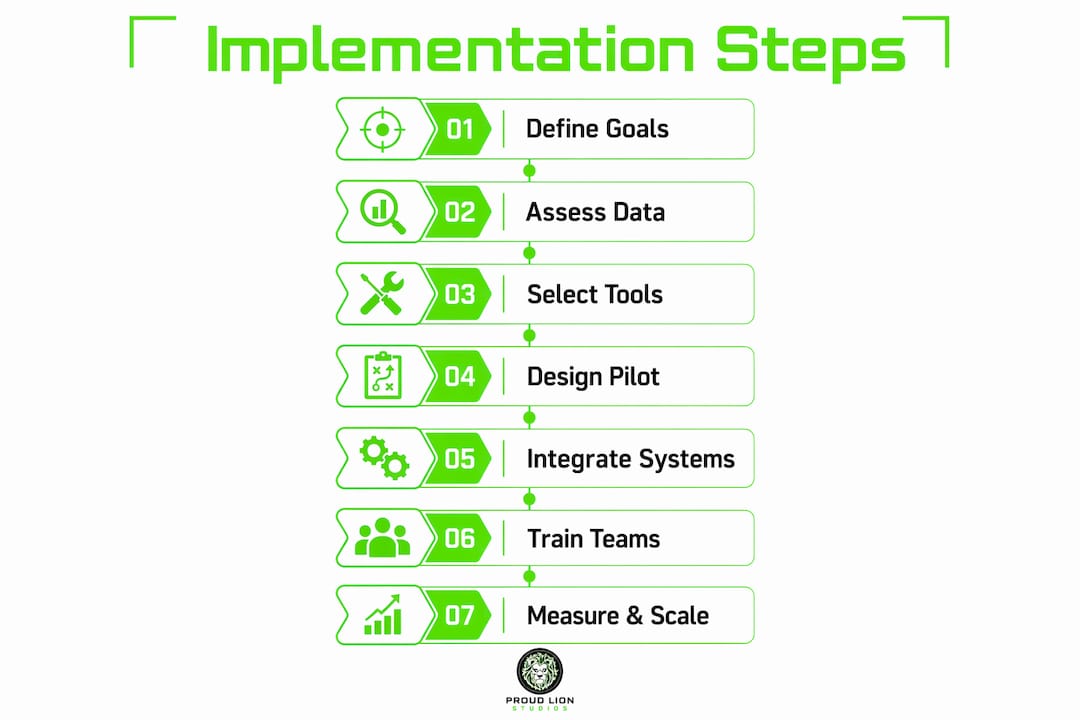
The core steps are goal definition, data readiness assessment, tool selection, pilot design, integration, team training, and continuous measurement. A structured 90-day phased roadmap covering these steps gives most organizations a reliable path from pilot to full deployment.
Why do so many AI implementation projects fail?
Up to 70% of AI projects fail because of poor change management and missing human decision checkpoints, not technology failures. Adoption problems and unclear business goals are the two most common root causes.
How long should an AI pilot program run?
A pilot should run 4–8 weeks with defined metrics tracked from day one. Scaling decisions require at least 60 days of post-launch data to separate genuine performance from early novelty effects.
How much of the project budget should go to integration?
Budget 30–50% of your total project cost for system and workflow integration. Most leaders underestimate this figure by planning only for software licensing costs.
What is shadow AI and why does it matter?
Shadow AI refers to unapproved AI tools that employees use without organizational oversight. It creates data leakage and security risks, and the best mitigation is appointing a single AI implementation owner with clear governance authority.
Key takeaways
Effective AI implementation requires structured phases, clear ownership, and continuous measurement from the pilot's first day.
| Point | Details |
|---|---|
| Define goals before tools | Set a specific outcome metric before selecting any AI platform or vendor. |
| Appoint one AI owner | A single governance owner prevents shadow AI and keeps tool access controlled. |
| Budget for integration | Allocate 30–50% of project cost to connecting AI tools to existing workflows. |
| Measure from day one | Track outcome metrics, adoption, satisfaction, and edge cases weekly during the pilot. |
| Scale on data, not optimism | Wait for 60 days of stable post-launch data before expanding beyond the pilot group. |