
TL;DR:
- Building an effective AI program requires developing an end-to-end operating model that integrates strategy, data governance, and value measurement. Organizations that treat AI as a continuous capability outperform those with isolated deployments, ensuring measurable returns and scalability. Focusing on operational readiness and outcome-based workflows is essential for enterprise AI success in a competitive landscape.
Most executives who greenlight an AI initiative assume the hard part is choosing the right model. It is not. The hard part is building the operating infrastructure around that model so it actually changes how work gets done and generates returns you can measure. McKinsey data consistently shows that organizations treating AI as a one-time deployment rather than a continuous operating capability fall short of their value targets. This article lays out the frameworks, assessment tools, architecture decisions, and benchmarking approaches that separate enterprises realizing measurable AI value from those still waiting for it.
Table of Contents
- Why enterprise AI requires an end-to-end operating model
- Assessing AI maturity: Frameworks and prioritization
- Choosing platforms and architectures for scalable, secure enterprise AI
- Benchmarking and quantifying value: Assessing ROI for enterprise AI
- The new direction: Outcome-focused workflow automation
- What most enterprise AI guides miss
- Explore customized enterprise AI and automation solutions
- Frequently asked questions
Key Takeaways
| Point | Details |
|---|---|
| Roadmaps drive value | Sequencing workstreams from strategy to value realization offers measurable business outcomes for enterprise AI. |
| Assess maturity first | A formal maturity framework ensures alignment and sets realistic priorities for AI investment and deployment. |
| Platform choice matters | Selecting scalable, secure platforms with orchestration and compliance features is critical for enterprise success. |
| Benchmark beyond leaderboards | Only workflow-specific, system-level metrics reliably measure real-world enterprise AI value. |
| Automation equals impact | Outcome-focused workflow automation is the new standard for delivering measurable enterprise results. |
Why enterprise AI requires an end-to-end operating model
Dropping a model into production is not a strategy. It is a starting point, and a fragile one. Most enterprises struggle precisely because their AI investments are disconnected, project-by-project deployments that never build on each other. Each initiative reinvents the wheel on data pipelines, governance policies, and integration patterns. The compounding cost of that fragmentation is enormous, and it shows up as missed ROI projections and board-level skepticism.
Gartner's AI roadmap guidance makes this explicit: enterprise AI programs need an end-to-end operating model that sequences workstreams from strategy to value realization, not just model deployment. The workstreams span strategy definition, data infrastructure, governance, engineering standards, culture change, and explicit value measurement. Skip any of those, and the chain breaks.
Consider the difference between two fictional but representative enterprises. Company A deploys a generative AI assistant for customer service in one business unit, with no data governance framework, no process owner, and no measurement plan. Twelve months later, they cannot answer whether it reduced average handle time or increased customer satisfaction. Company B builds a cross-functional AI center of excellence, establishes data quality standards first, then pilots the same assistant while tracking three specific KPIs tied to operational cost. Company B knows exactly what they got.
That contrast captures why business efficiency and automation gains only materialize when AI is treated as an operating model transformation, not a technology procurement event. The most common pitfalls in incomplete AI adoption include:
- No defined value owner: Who is accountable for the business outcome, not the model output?
- Data readiness ignored: Models trained on poor enterprise data deliver poor enterprise results.
- Governance applied after the fact: Security and compliance reviews that come late kill deployment velocity.
- Culture gaps: Teams that do not trust or understand the AI will route around it.
"Enterprises that sequence AI workstreams systematically, from strategy through value realization, outperform those running ad-hoc deployments by a wide margin. The model is the least of your problems."
Strong enterprise software scalability depends on these same foundations. If the underlying architecture cannot support coordinated AI workloads at scale, the operating model collapses under its own ambition.
Assessing AI maturity: Frameworks and prioritization
Before you can build a roadmap, you need an honest baseline. AI maturity assessments give leadership teams a shared language for where the organization actually stands, which prevents the common failure mode of piloting advanced capabilities on an infrastructure that cannot support them.
Gartner's AI maturity model positions this assessment as scoring across seven pillars: strategy, data, governance, engineering, operating model, culture, and AI product or value. The output is a prioritized roadmap that moves the organization from early pilots to measurable ROI in a sequenced way. This approach aligns business and technical teams because it forces a shared view of readiness across every dimension, not just the technical ones.
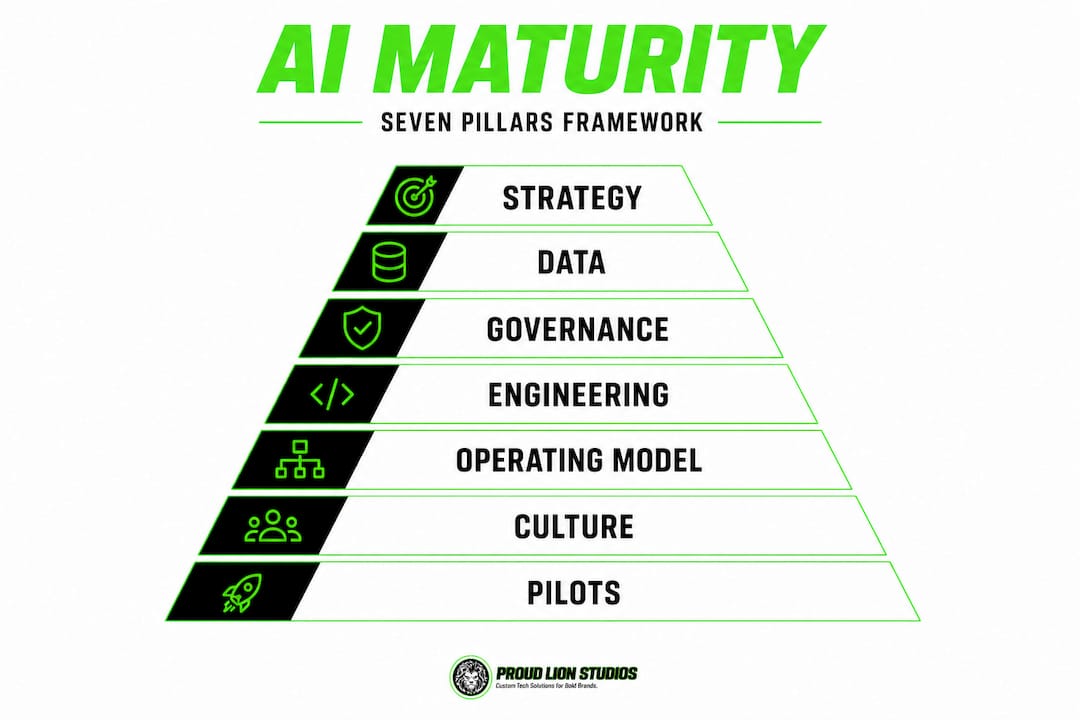
| Maturity pillar | Level 1: Exploring | Level 2: Developing | Level 3: Scaling |
|---|---|---|---|
| Strategy | Ad-hoc initiatives | Defined AI vision | Integrated with corporate strategy |
| Data | Siloed, inconsistent | Centralized pipelines | Real-time, governed data mesh |
| Governance | None or informal | Policies documented | Automated enforcement |
| Engineering | Manual processes | MLOps partially implemented | Full CI/CD for AI models |
| Operating model | Project-based | Center of excellence forming | Enterprise-wide AI function |
| Culture | Low AI literacy | Training programs underway | AI-native workflows adopted |
| Product/Value | No measurement | KPI tracking per pilot | Portfolio-level ROI reporting |
Running through this table in a structured workshop session with your leadership team typically surfaces three to five priority gaps within a single day. Those gaps become the first 90 days of your roadmap. Here is a practical sequence for that prioritization exercise:
- Score each pillar honestly on a 1 to 3 scale using cross-functional input.
- Identify the two pillars with the lowest scores.
- Map the business impact of improving each pillar by one level.
- Rank roadmap investments by impact-to-effort ratio.
- Set measurable milestones for each prioritized pillar with a named owner.
Insights from AI innovation in software development reinforce that engineering maturity specifically is often overestimated. Organizations frequently rate their engineering pillar as more mature than it is because they conflate having developers who know Python with having operational MLOps infrastructure.
Pro Tip: Use your maturity scores as a direct input to board-level investment conversations. Showing a board that your data pillar sits at Level 1 while your engineering team is ready for Level 3 workloads is a far more persuasive budget argument than a generic AI business case. A fintech AI case study illustrates how this exact approach unlocked multi-million dollar infrastructure investment that would otherwise have stalled in committee.
Choosing platforms and architectures for scalable, secure enterprise AI
Platform selection is where the gap between vendor demos and production reality becomes painfully visible. The selection criteria that matter most in enterprise settings are not about which model scores best on a public benchmark. They are about security posture, governance tooling, operational monitoring, compliance readiness, and the ability to scale workloads without manual intervention.

Microsoft's Cloud Adoption Framework provides architecture guidance for building AI workloads with enterprise-grade security, scalability, governance, and operational excellence. The framework spans design areas covering application design, data management, and operational excellence, and connects platform services like Azure AI Foundry, Azure OpenAI, and Azure Machine Learning with governance, monitoring, security, and networking practices. This is the kind of structured thinking enterprises should demand from every vendor conversation.
For organizations building more sophisticated automation, agentic architectures introduce new coordination challenges. These systems involve multiple autonomous components, each capable of taking actions, calling external tools, and influencing other agents. Microsoft's Azure Architecture Center describes multi-agent orchestration patterns to coordinate these autonomous components reliably, addressing the nondeterminism problem that makes agentic systems harder to govern than traditional software.
Key platform requirements to evaluate before committing:
- Data governance layer: Can the platform enforce data residency, access controls, and audit logging at the model input and output level?
- MLOps integration: Is model versioning, testing, and rollback automated, or does it require manual engineering work for every update?
- Security and compliance: Does the platform support your regulatory requirements out of the box, or do you need to build compliance controls on top?
- Observability: Can you monitor model drift, latency, cost per inference, and downstream business KPIs from a single dashboard?
- Vendor lock-in risk: What does migration look like if the platform provider changes pricing or deprecates a service?
A real consideration for CRM and ERP AI integration: legacy enterprise systems were not designed to interface with probabilistic AI outputs. Planning for translation layers, fallback logic, and human-in-the-loop checkpoints is not optional; it is what separates a successful integration from one that breaks customer-facing workflows.
Pro Tip: Before selecting a platform, decompose your requirements into four categories: data governance, security, MLOps, and compliance. Then run targeted proofs of concept against each category, not just a general demo. A system that performs well in a demo but fails your data governance requirements will cost you far more to fix in production.
Benchmarking and quantifying value: Assessing ROI for enterprise AI
The most misleading thing you can do when evaluating an AI system is trust a public leaderboard. Those rankings measure performance on standardized test sets that have little to do with your specific workflows, your data quality, or your user base. They are useful as a first filter, nothing more.
Serious enterprise evaluation treats public benchmarks as signals only. Production evaluation must cover the full system: the model, the retrieval augmented generation layer, any tool integrations, guardrails and safety filters, and the user interface. A model that ranks highly in isolation can still deliver poor results when those components interact poorly. Continuous monitoring for drift, regressions, and security risks is not a launch-day activity; it is an ongoing operational function.
On the ROI side, the numbers from structured deployments are compelling. Forrester's TEI study for Microsoft 365 Copilot reports a composite ROI of 116%, with benefits present value of $36.8 million, net present value of $19.7 million, and payback achieved in 10 months. Those figures represent a composite organization, but they reflect the kind of return that is achievable when deployment is paired with structured change management and workflow integration rather than installed and ignored.
"116% ROI. $36.8M in benefits PV. 10-month payback. These numbers only materialize when AI is integrated into workflows with clear KPIs, not deployed as a standalone feature." (Forrester TEI Study for Microsoft 365 Copilot)
The components your benchmarking framework should cover for any enterprise deployment include:
- Workflow-specific accuracy: How well does the system perform on your actual tasks, not generic benchmarks?
- System reliability: What is uptime, latency under production load, and failure recovery behavior?
- Cost per outcome: What does it cost per successful AI-assisted transaction, not per API call?
- Safety and compliance rates: What percentage of outputs require human review or fail guardrails?
- Business KPI delta: What changed in the specific operational metric you set out to improve?
Linking strategic AI automation to these measurement frameworks is the difference between having an AI program and having an AI advantage. The organizations seeing the highest returns are the ones running quarterly ROI reviews the same way they review financial performance.
The new direction: Outcome-focused workflow automation
The next wave of enterprise AI is not about better copilots. It is about platforms that commit to delivering workflow outcomes, not just assisting humans who then complete the workflow themselves.
Gartner predicts that by 2028, over half of enterprises will stop paying for assistive intelligence, including copilots and smart advisors, in favor of platforms that commit to workflow results. That shift has direct procurement and architecture implications for decisions being made right now.
The practical difference between assistive AI and outcome-focused automation is significant:
- Assistive AI: Suggests a contract summary; a human reviews and approves.
- Outcome AI: Processes contracts end to end, flags exceptions, routes approvals, and closes the loop in the system of record.
- Assistive AI: Recommends a response to a customer service ticket; an agent sends it.
- Outcome AI: Resolves the ticket autonomously within defined parameters, escalates edge cases, and updates CRM automatically.
- Assistive AI: Generates a first draft of a financial report; an analyst refines it.
- Outcome AI: Pulls live data, generates, validates, and distributes the report on schedule.
Conversational AI solutions are evolving rapidly along this continuum. The most advanced implementations are no longer chat interfaces layered on top of existing workflows. They are workflow engines with conversational front ends.
Pro Tip: When evaluating AI platforms for 2026 and beyond, ask vendors specifically what outcome guarantees they offer at the workflow level. Platforms that can only demonstrate assistive features without committing to end-to-end workflow results are already behind the market direction Gartner has identified. Prioritize business transformation with AI automation capabilities over feature-level comparisons.
What most enterprise AI guides miss
Most articles on enterprise AI spend their word count on model comparisons and feature lists. They skip the operational realities that determine whether an AI program actually delivers. Here is what we have seen consistently across client engagements.
First, platform selection done by vendor demo almost always leads to regret. The right approach is to decompose requirements into specific categories before any vendor conversation begins. What are your data residency constraints? What does your compliance team need for audit trails? What MLOps maturity do your engineers actually have, not aspirationally have? Those answers should drive the evaluation, not the demo.
Second, proof-of-concept pilots that succeed in isolation rarely scale. The reason is almost always governance, not technology. A pilot operates outside normal change management, data governance, and security review processes. When you try to scale it, those processes catch up with you and the deployment stalls. Building governance frameworks before the pilot is the counterintuitive but correct sequence.
Third, the "agentlake" reality is messier than vendor presentations suggest. Orchestrating multiple AI agents across different vendors, tool sets, and data sources introduces integration complexity that looks nothing like a controlled architecture diagram. The organizations handling this best are the ones building orchestration logic they control, not delegating it entirely to a single vendor platform.
Finally, the misconception that leaderboard rankings or live demos reflect production readiness is genuinely expensive. We have seen organizations shortlist models based entirely on public benchmark performance, only to find those same models underperform on their specific data distributions and task types. The scalable SaaS AI solutions that consistently deliver ROI are built on production-tested evaluation, not marketing-grade demonstrations.
Explore customized enterprise AI and automation solutions
Turning an AI roadmap into measurable operational results requires more than strategic alignment. It requires engineers who understand enterprise architecture, governance, and the practical realities of integrating AI into existing business systems.
At Proud Lion Studios, our UAE-based technical team builds custom AI workflows tailored to the specific operating models, compliance environments, and business outcomes our enterprise clients care about. From intelligent CRM/ERP AI workflow integration to full-scale agentic automation, we focus on production-ready solutions that pass real governance and ROI scrutiny. If you are ready to move from strategy to implementation, start with our AI project estimator to get a tailored scope and investment baseline for your specific use case.
Frequently asked questions
What is the difference between assistive AI and outcome-focused workflow automation?
Assistive AI supports tasks by offering suggestions or generating content for human review, while outcome-focused workflow automation commits to delivering end results and measurable business value autonomously. Gartner predicts that by 2028, over half of enterprises will favor outcome-focused platforms over assistive ones.
How can I measure my organization's AI maturity?
Use a formal maturity assessment scoring across strategy, data, governance, engineering, operating model, culture, and product/value pillars to baseline readiness and prioritize investments. Gartner's AI maturity model produces a prioritized roadmap that moves organizations from early pilots to measurable ROI.
Are public AI model leaderboards reliable for production use?
No, leaderboards are signals only and do not replace internal workflow-specific evaluations and continuous monitoring for drift and security risks. Production evaluation must include system-level metrics across the full stack, not just model performance in isolation.
What is the average ROI for enterprise Copilot deployments?
Forrester's TEI study reports a composite ROI of 116% and payback in 10 months for enterprise Copilot deployments, with benefits present value of $36.8 million for a composite organization.