

TL;DR:
- Most AI-blockchain projects fail due to architecture mismatches and insufficient validation.
- Hybrid on-chain and off-chain architectures, using oracles, balance transparency and practicality.
- Starting with a validated MVP and modular design reduces risks and supports scalable growth.
Most teams building at the intersection of AI and blockchain expect transformative results. What they get instead is complexity, cost overruns, and apps that never reach production scale. 73% of organizations attempt to combine these technologies, yet a striking number stall before delivering real business value. The problem is rarely the technology itself. It's the architecture decisions, the mismatch between use cases, and the failure to validate demand early. This guide gives you a clear-eyed look at how to build web applications that actually work at scale, using AI and blockchain the right way.
Table of Contents
- Evolving landscape: How blockchain and AI are transforming web application development
- Core architectures: Patterns for integrating AI and blockchain in web apps
- Pitfalls and real-world challenges of AI and blockchain web apps
- Building for scalable growth: From MVP to robust enterprise web applications
- Our perspective: Why most hybrid AI-blockchain web apps struggle—and what actually works
- How Proud Lion Studios empowers your next-generation web app
- Frequently asked questions
Key Takeaways
| Point | Details |
|---|---|
| Hybrid architectures win | Combining off-chain AI with on-chain smart contracts provides flexibility, performance, and compliance. |
| Start with MVP | Validate demand and technical feasibility early to avoid costly overbuilds and failed integrations. |
| Risk management is essential | Address oracle risk, AI errors, gas costs, and regulations from the start for successful projects. |
| Optimize for your context | Startups can move fast with low-code; enterprises should leverage modular, scalable approaches. |
Evolving landscape: How blockchain and AI are transforming web application development
The rules of web application development have shifted dramatically. Two forces are driving that shift: AI tooling that accelerates how software is built, and blockchain infrastructure that changes how software behaves at runtime. Together, they create a new category of application, one that is faster to build, more transparent by design, and capable of automating decisions that used to require human oversight.
On the AI side, the biggest change is in the development process itself. The Plan-Code-Review loop, where AI models help plan features, generate code, and review output, has become the dominant workflow for high-performing engineering teams. This AI coding stack has an economic impact equivalent to France's GDP in developer productivity gains. That is not a marginal improvement. It fundamentally changes what a small team can ship in a quarter.
Blockchain, meanwhile, brings something different: verifiability. When data or logic lives on-chain, it is transparent, tamper-resistant, and auditable by anyone. For industries like finance, supply chain, and healthcare, that property is not a nice-to-have. It is a competitive requirement. The future of web development increasingly depends on teams that can combine these two paradigms without creating systems that are brittle or prohibitively expensive to run.
Startups and enterprises approach this differently. Startups prioritize speed and flexibility. They want to ship a working product, learn from users, and iterate. Enterprises prioritize structure, compliance, and integration with existing systems. Both groups benefit from hybrid architectures, but they need different entry points and different risk tolerances.
"The teams that win in this space are not the ones chasing the most cutting-edge stack. They are the ones who match the right tool to the right problem, then execute with discipline."
| Dimension | Startup priority | Enterprise priority |
|---|---|---|
| Speed to market | High | Medium |
| Compliance and governance | Low initially | High from day one |
| Modularity | Flexible | Structured |
| Budget sensitivity | Very high | Moderate |
| AI tooling adoption | Aggressive | Gradual |
The AI innovation in software space is moving fast, but the fundamentals of good architecture have not changed. Clarity of purpose, modularity, and testability still determine whether a project succeeds or becomes a cautionary tale.
Core architectures: Patterns for integrating AI and blockchain in web apps
With a grasp of the shifting tech landscape, it is time to get hands-on. How do successful teams actually architect applications that use both AI and blockchain?
There are three primary patterns: on-chain, off-chain, and hybrid. On-chain AI means running model inference directly on the blockchain. It sounds elegant, but in practice it is slow, expensive, and limited to very lightweight models. Off-chain AI keeps model inference on traditional servers or cloud infrastructure, which is fast and cost-effective but loses the transparency benefits of blockchain. Hybrid is where most production systems land.
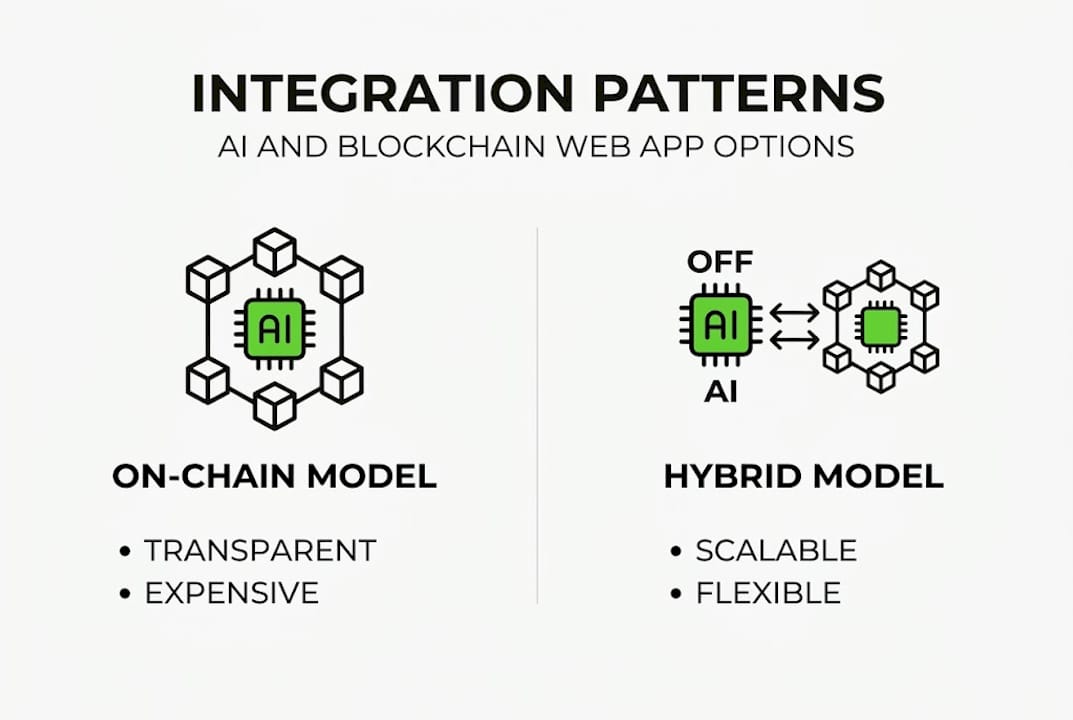
Hybrid architectures use off-chain AI via oracles to power on-chain smart contracts. An oracle, like Chainlink, acts as a trusted bridge. It takes AI output from off-chain systems and feeds it into on-chain logic in a verifiable way. This pattern preserves the transparency of blockchain while keeping AI inference practical and affordable.

| Architecture | Speed | Cost | Transparency | Best for |
|---|---|---|---|---|
| On-chain AI | Slow | Very high | Maximum | Narrow, critical decisions |
| Off-chain AI | Fast | Low | Minimal | Speed-sensitive features |
| Hybrid (oracle-based) | Moderate | Medium | High | Most production use cases |
For building mobile apps with AI and blockchain, the hybrid model is almost always the right starting point. It gives you the auditability that regulators and enterprise clients expect, without the gas cost penalties that make pure on-chain AI impractical.
When it comes to service architecture, the choice between a modular monolith and microservices matters more than most teams realize. Microservices offer flexibility and independent scaling, but they add operational overhead. A modular monolith is easier to reason about, test, and deploy, especially in early stages.
Pro Tip: Start with a modular monolith. Decompose into microservices only when you have a specific, proven scaling bottleneck. Premature decomposition is one of the most common and costly mistakes in web application development.
Understanding why Web3 matters for your product roadmap will help you decide which parts of your application actually benefit from decentralization, and which parts are better left on traditional infrastructure.
- Use hybrid architectures for most production deployments
- Rely on oracles like Chainlink for AI-to-blockchain data feeds
- Choose modular monoliths early, microservices later
- Keep AI inference off-chain unless transparency is a hard requirement
Pitfalls and real-world challenges of AI and blockchain web apps
With technical patterns established, it is equally vital to recognize why so many ambitious projects stall. The failure modes are specific, and they are avoidable if you know what to look for.
73% of organizations combine blockchain and AI, but many fail due to mismatched use cases and complexity. The most common failure is not a technical one. It is a product one: building a sophisticated system for a problem that did not need it.
Here are the critical risk factors, ranked by how often they derail projects:
- Oracle manipulation. If your smart contract relies on external data, that data feed becomes an attack surface. Compromised oracles can feed false data into on-chain logic, with real financial consequences.
- AI hallucinations in automated decisions. AI models sometimes produce confident but incorrect outputs. In a web app that automates decisions based on AI output, a hallucination is not just a bug. It is a liability.
- Gas cost overruns. On-chain computation is expensive. Teams that underestimate gas costs at the design stage often find their unit economics collapse at scale.
- Regulatory exposure. The EU AI Act and MiCA regulations are active and evolving. Building without compliance in mind is not a shortcut. It is a delayed penalty.
- Scope creep from over-integration. Adding blockchain and AI to every feature because it sounds innovative is a fast path to a system no one can maintain.
73% of AI-blockchain projects encounter significant integration challenges. Most could be avoided with earlier validation and tighter scope definition.
For scalable blockchain app strategies, the answer is almost always the same: validate first, build second. A well-scoped MVP that tests your core assumption is worth more than a fully integrated system built on an unproven hypothesis.
Pro Tip: Before committing to a full AI-blockchain integration, run a two-week spike. Build the riskiest component in isolation, test it against real data, and make your architecture decisions based on what you learn.
Building for scalable growth: From MVP to robust enterprise web applications
Understanding risks means you can now build for resilience and scale. The path from idea to production-ready web application follows a clear sequence, and skipping steps is where most teams get into trouble.
Start with an MVP. Not a prototype, not a proof of concept, but a minimal product with real users and real feedback loops. The MVP validates your core use case before you invest in the infrastructure to scale it. This is especially important when blockchain is involved, because the cost of changing on-chain logic after deployment is high.
For the technical stack, L2 chains like Polygon, combined with Chainlink oracles and microservices architecture, represent the current best practice for scalable AI-blockchain web apps. L2 chains reduce gas costs dramatically while maintaining security guarantees. Chainlink provides reliable, manipulation-resistant data feeds. Microservices let you scale individual components independently as load increases.
- Phase 1 (MVP): Single blockchain network, off-chain AI, monolithic backend, basic oracle integration
- Phase 2 (Growth): Introduce L2 chains, expand AI model coverage, modularize backend services
- Phase 3 (Scale): Multi-chain support, advanced oracle networks, full microservices, compliance layer
| Phase | Blockchain layer | AI integration | Architecture | Timeline |
|---|---|---|---|---|
| MVP | L1 testnet | Off-chain API | Monolith | 6-12 weeks |
| Growth | L2 (Polygon) | Oracle-fed models | Modular monolith | 3-6 months |
| Scale | Multi-chain | Agentic AI stack | Microservices | 6-18 months |
For startup growth strategies, the agentic AI coding stack is a force multiplier. AI agents that can plan, write, and review code autonomously let small teams punch well above their weight in terms of output quality and speed.
Enterprises have different priorities. They need audit trails, role-based access, and integration with legacy systems. But the underlying architecture principles are the same: modular, testable, and built to evolve. The difference is in governance layers and compliance tooling, not in the fundamental approach to combining AI and blockchain.
Our perspective: Why most hybrid AI-blockchain web apps struggle—and what actually works
Having laid out the technical landscape and tactical steps, here is our candid view from building and guiding actual web application projects.
Most teams that struggle with AI-blockchain integration are not failing because the technology is immature. They are failing because they are solving an architecture problem with more technology instead of better decisions. The oracle problem is a perfect example. You cannot fix a compromised data feed by adding more AI. You fix it with better oracle design, redundancy, and validation logic.
For startups, vibe coding and low-code platforms can deliver 80 to 90% of required functionality at a fraction of the cost and time. That is not a compromise. That is smart resource allocation. For enterprises, modular monoliths with gradual integration outperform big-bang microservices migrations almost every time.
The most dangerous mindset in this space is building for impressiveness rather than fitness for purpose. A system that uses five blockchain networks, three AI models, and a custom oracle is impressive on a whiteboard. It is a maintenance nightmare in production. The teams that consistently deliver value are the ones who ask "what is the simplest architecture that solves this problem reliably?" and then build that. Check out real-world mobile app builds for examples of this principle in action.
How Proud Lion Studios empowers your next-generation web app
Inspired to accelerate your web application project with proven AI and blockchain expertise? Here is how we can help.
At Proud Lion Studios, we work with startups and enterprises across multiple countries to design and build custom web applications that integrate AI and blockchain without the common pitfalls. Our team handles everything from blockchain development services and smart contract expertise to full-stack AI-powered solutions tailored to your business model. Whether you need a validated MVP in six weeks or a scalable enterprise platform built for compliance and growth, we scope each project around real outcomes, not templated packages. Reach out to start a conversation about your next build.
Frequently asked questions
What are the main risks of integrating AI and blockchain in web apps?
Oracle manipulation, AI hallucinations, high gas fees, and regulatory challenges like the EU AI Act are the primary risks teams face when building AI-blockchain web applications. Each risk is manageable with the right architecture and validation strategy.
How do oracles enable hybrid AI and blockchain web applications?
Oracles like Chainlink act as verified bridges, taking off-chain AI output and feeding it into on-chain smart contracts in a tamper-resistant way. This makes hybrid architectures both practical and auditable.
Why is on-chain AI rarely used in production web apps?
On-chain AI is slow and expensive because every computation incurs gas costs and latency, making it impractical for most real-world use cases beyond very narrow, lightweight decisions.
What is the MVP-first approach in web app development?
MVP-first means building the smallest possible product that tests your core assumption with real users before investing in full-scale infrastructure. For AI-blockchain apps, this approach helps you validate demand before committing to expensive on-chain architecture decisions.
Recommended
- Future of web development in 2026: AI, blockchain, edge
- Mobile Apps in Tech Startup Growth 2026 - Proud Lion Studios
- Build multiplayer games with blockchain and AI in 2026
- Blockchain mobile apps guide: build scalable solutions in 2026
- Verbeter webontwikkeling met AI: kansen voor het mkb
- The Future of Full-Stack Development | Rich Harrington