

TL;DR:
- Integrating AI and blockchain creates trustworthy, auditable, and adaptive systems that combine intelligent analytics with tamper-proof ledgers. This synergy enhances transparency, regulatory compliance, and real-time decision-making across industries like aerospace, healthcare, and finance. However, challenges like input trust, scalability, and governance require careful architectural discipline and industry-standard frameworks to ensure reliable deployment.
The integration of AI and blockchain is the process of combining blockchain's tamper-evident ledger with AI's intelligent analytics and automation to create systems that are simultaneously trustworthy, auditable, and adaptive. These two technologies solve each other's core weaknesses: blockchain lacks the ability to interpret or act on data intelligently, while AI lacks a reliable mechanism to prove its outputs are untampered. Together, they form what engineers and researchers increasingly call verifiable intelligent automation, a framework where decisions are both smart and cryptographically provable. Chainlink, BladeChain, and Anthropic's Model Context Protocol (MCP) are already demonstrating what this combination looks like in production.
Why integration of AI and blockchain matters for trust and transparency
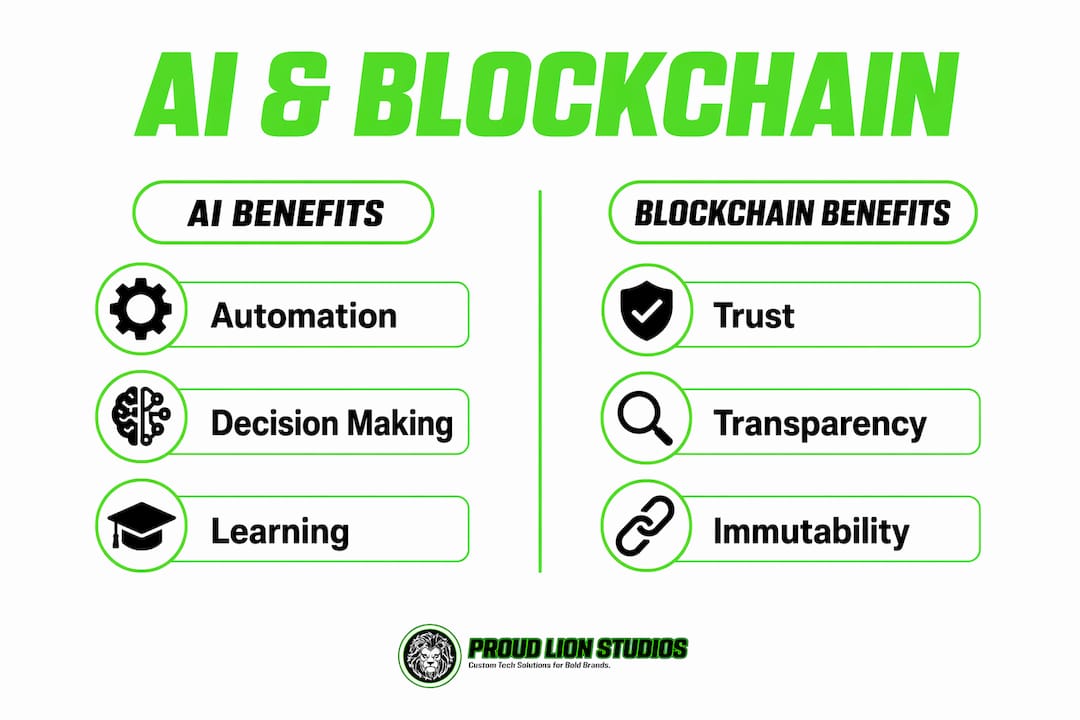
The most compelling reason to combine these technologies is the trust problem that AI alone cannot solve. AI systems struggle with data transparency, and blockchain's tamper-proof infrastructure directly addresses that gap by creating immutable records of what data entered a model, what the model produced, and when each event occurred. This matters enormously in regulated industries where auditability is not optional.

Blockchain's role here goes beyond simple record-keeping. When an AI model makes a decision, that decision can be logged to an immutable ledger with a cryptographic timestamp, making it verifiable by any authorized party without requiring them to trust the operator. This shifts accountability from opaque corporate assurances to mathematically verifiable proof.
The H33 Autonomous Trustless Standard formalizes this approach. It defines a verifiable AI certification framework that uses blockchain anchoring for continuous, machine-verifiable compliance. The standard includes governance proof, data separation, and audit permanence through Merkle-root blockchain anchors recorded at intervals of one hour or less. For any organization deploying AI in finance, healthcare, or aerospace, this kind of framework converts regulatory compliance from a manual audit exercise into an automated, continuous process.
BladeChain illustrates the practical payoff. The system applies immutable blockchain traceability to AI-driven aircraft engine blade inspections, capturing inspection data and AI model provenance so regulators can verify defect findings with precision. It demonstrated 100% life cycle completion, 26 operations per minute throughput, and tamper detection within 17 milliseconds. Those numbers represent a real aerospace safety system, not a proof of concept.
Pro Tip: When designing an AI-blockchain architecture, log AI model version identifiers on-chain alongside outputs. This lets auditors reconstruct exactly which model version produced a given result, which is critical for post-incident investigations.
Key benefits blockchain brings to AI systems include:
- Data provenance: Every input and output is timestamped and linked to a specific model version.
- Audit permanence: Records cannot be altered retroactively, satisfying regulatory requirements in finance and healthcare.
- Decentralized verification: Multiple parties can verify AI outputs without trusting a single operator.
- Compliance automation: Standards like H33 replace periodic manual audits with continuous cryptographic proof.
How does AI enhance blockchain for smarter automation and scalability?
Blockchain without AI is a rigid system. Smart contracts execute fixed logic: if condition A is true, execute action B. That works for simple token transfers but fails when the required logic is contextual, predictive, or adaptive. AI enables off-chain computation and adaptive decision-making that feeds results back into smart contracts, making blockchain applications dramatically more capable.
Here is how AI improves blockchain operations in practice:
- Adaptive smart contracts: AI models analyze market conditions, user behavior, or sensor data off-chain, then submit verified results to trigger on-chain actions. A DeFi protocol can adjust lending rates based on real-time risk scores rather than static thresholds.
- Transaction throughput optimization: AI predicts network congestion patterns and dynamically routes transactions to minimize fees and confirmation delays, improving user experience without changing the underlying protocol.
- Anomaly detection and security: Real-time AI analysis of blockchain transaction flows improves fraud detection and identifies suspicious patterns faster than rule-based systems. This is particularly valuable for exchanges and DeFi platforms where attack vectors evolve constantly.
- Autonomous agent execution: Anthropic's MCP enables Claude to interact programmatically with multiple blockchains, executing transactions like swaps and bridges across 50-plus chains including Ethereum, Solana, TRON, and Bitcoin. This is not a demo. It is a live system where a natural language AI agent manages cross-chain asset movement with full auditability.
- Predictive governance: AI models can analyze on-chain voting patterns and proposal outcomes to surface governance risks before they materialize, giving DAOs better decision-support tools.
Pro Tip: Keep AI computation off-chain and submit only cryptographic proofs on-chain. This preserves blockchain efficiency while maintaining verifiability. Systems that push raw AI computation on-chain typically hit scalability walls quickly.
The architectural principle behind all five of these improvements is the same: AI handles the intelligence, blockchain handles the verification. Neither technology tries to do the other's job.
What are real-world AI blockchain use cases across industries?
The following table maps the most mature AI and blockchain collaboration deployments by sector, showing what each technology contributes and what the combined system achieves.
| Industry | AI contribution | Blockchain contribution | Combined outcome |
|---|---|---|---|
| Aerospace | Defect detection in blade inspections | Immutable inspection logs via BladeChain | Regulator-verifiable AI findings with 17ms tamper detection |
| DeFi | Market strategy execution, risk scoring | Smart contract settlement, on-chain audit | Adaptive lending rates with transparent, auditable logic |
| Supply chain | Demand forecasting, route optimization | Provenance tracking, tamper-proof records | End-to-end visibility with AI-driven efficiency gains |
| Healthcare | Diagnostic AI, patient risk stratification | Encrypted, permissioned patient data records | Privacy-preserving AI insights with access audit trails |
| Cross-chain finance | Natural language transaction execution via Claude | Multi-chain settlement across TRON, Ethereum, Solana | Autonomous asset movement with full transaction auditability |
The aerospace and cross-chain finance examples deserve particular attention because they are already in production. BladeChain's system stores bulk inspection artifacts off-chain while anchoring cryptographic hashes on-chain, a design pattern that balances transparency with manageable blockchain storage. The TRON and Claude integration via Symbiosis shows that natural language interfaces to blockchain are no longer theoretical. A user can instruct an AI agent in plain English to execute a cross-chain swap, and the agent handles the entire transaction flow with a verifiable on-chain record.
Supply chain and healthcare applications are slightly earlier in maturity but follow the same architecture. AI processes the data that is too complex or voluminous for fixed rules, while blockchain provides the audit trail that regulators and partners require. For decision-makers evaluating enterprise AI and blockchain solutions, these production examples are the clearest evidence that the integration delivers measurable value.
What challenges arise when combining AI and blockchain?
The benefits are real, but so are the technical constraints. Decision-makers who skip this section tend to build systems that work in demos and fail in production.
- Input integrity is not solved by on-chain proofs alone. Blockchain verifies what ran and what was output, but verifying off-chain inputs requires separate trust layers such as the WYRIWE input trust mechanism. A blockchain record of an AI decision is only as trustworthy as the data that fed the model.
- Scalability and compute costs. AI inference is computationally expensive. Running it on-chain is impractical at scale. Architectures must separate execution environments carefully, keeping AI off-chain and using zero-knowledge proofs or cryptographic commitments to link results to the chain.
- Flexible but auditable workflows require deliberate design. Separating AI model execution, audit attestation, and input provenance capture into distinct layers is not automatic. Teams that conflate these concerns end up with systems that are either auditable but inflexible or flexible but opaque.
- AI-controlled transaction execution carries real risk. Autonomous agents executing blockchain transactions can make costly errors. Permissioning, rate limits, and human-in-the-loop checkpoints for high-value transactions are not optional safeguards. They are architectural requirements.
- Standardized protocols are still maturing. Anthropic's MCP represents progress toward standardized AI-to-blockchain communication, but the broader ecosystem lacks universal standards. Teams building today should design for protocol evolution, not lock-in.
Understanding these constraints upfront is what separates organizations that ship reliable systems from those that spend months debugging architectural decisions they made in week one. For a deeper look at how these challenges map to specific architectures, the scalable web app development guide covering AI and blockchain covers the tradeoffs in detail.
Key takeaways
The integration of AI and blockchain succeeds when blockchain handles verification and AI handles intelligence, with each layer designed and governed independently.
| Point | Details |
|---|---|
| Trust is the core driver | Blockchain's immutable logs make AI outputs verifiable, addressing the transparency gap AI alone cannot close. |
| AI unlocks blockchain flexibility | Adaptive smart contracts and autonomous agents like Claude via MCP extend blockchain beyond fixed-logic execution. |
| Production examples exist now | BladeChain in aerospace and TRON-Claude cross-chain transactions prove this is operational, not theoretical. |
| Input integrity needs separate handling | On-chain proofs verify execution, not inputs. Use mechanisms like WYRIWE to close the input trust gap. |
| Architecture discipline is non-negotiable | Separate AI execution, audit attestation, and input provenance into distinct layers from the start. |
Why I think most teams underestimate the governance layer
Working across AI and blockchain projects, the pattern I see most often is teams that invest heavily in the technical integration and almost nothing in the governance architecture. They get the cryptographic proofs right. They get the smart contract triggers right. Then they deploy an autonomous AI agent with broad transaction permissions and no rate limits, and the first edge case costs them real money or real regulatory exposure.
The H33 Autonomous Trustless Standard exists precisely because the industry recognized that technical correctness is not the same as trustworthy operation. Continuous audit trails, governance proof, and data separation are not bureaucratic overhead. They are what makes AI-blockchain systems safe to run in regulated environments at scale.
The other thing I would push back on is the assumption that this integration is primarily a Web3 story. The most durable applications I have seen are in industries like aerospace, healthcare, and logistics, where the value of an immutable, verifiable AI audit trail is immediately obvious to regulators and procurement teams. DeFi gets the headlines, but a BladeChain-style system for medical device inspection or pharmaceutical supply chain is where this technology will have its most lasting impact.
My advice to any decision-maker evaluating this space: start with the governance framework before you write a line of integration code. Define what needs to be auditable, who needs to verify it, and what the consequences of a verification failure are. The technical implementation will follow naturally from those answers.
— Amal
How Proudlionstudios helps you build AI-blockchain systems that work

Proudlionstudios is a Dubai-based technology studio with hands-on experience building production-grade blockchain and AI-enabled applications for startups and enterprises across multiple countries. The team covers the full stack: Web3 blockchain development, smart contract creation, AI agents, and process automation. Whether you are designing an auditable AI workflow for a regulated industry or building an autonomous agent that executes cross-chain transactions, Proudlionstudios builds to real business outcomes, not templated packages. Supported by the Aptos Foundation, the studio brings both technical depth and ecosystem credibility to every engagement. Reach out to discuss your project.
FAQ
What is the main reason to integrate AI and blockchain?
The primary reason is trust. Blockchain makes AI outputs tamper-proof and auditable, while AI makes blockchain systems adaptive and intelligent. Neither technology delivers its full value without the other.
How does AI improve smart contract functionality?
AI enables off-chain computation and adaptive decision-making that feeds verified results into smart contracts, allowing contracts to respond to complex, real-world conditions rather than fixed logical rules.
What is a real example of AI and blockchain working together?
BladeChain uses AI to detect defects in aircraft engine blades and records all inspection data and model provenance on an immutable blockchain, achieving tamper detection within 17 milliseconds and full lifecycle traceability.
What is Anthropic's MCP and why does it matter for blockchain?
Anthropic's Model Context Protocol allows AI agents like Claude to execute blockchain transactions across 50-plus chains including Ethereum, TRON, and Solana. It provides a standardized interface that makes AI-to-blockchain communication reliable and auditable.
What is the biggest technical challenge in AI-blockchain integration?
Input integrity is the most underestimated challenge. On-chain proofs verify that a model ran correctly, but they do not verify that the input data was valid. Separate mechanisms like WYRIWE are required to close that gap and build fully trustworthy systems.