
TL;DR:
- Building a validated core idea before developing blockchain or AI products prevents costly mistakes and misaligned features. An MVP tests essential hypotheses with real users to gather targeted feedback, especially crucial given the higher complexity of these technologies. Adopting a Build-Measure-Learn approach accelerates learning, reduces risks, and aligns development efforts with actual market demand.
Building a blockchain or AI product without validating your core idea first is one of the most expensive mistakes a startup or enterprise can make. Picture a well-funded team spending six months engineering a smart contract ecosystem, only to discover that users never needed on-chain functionality at all. That scenario plays out constantly in Web3 and AI development circles, burning through runway and trust simultaneously. This guide gives you a concrete, step-by-step process to launch MVPs that actually validate your assumptions before you commit to full-scale development.
Table of Contents
- What is an MVP and why does it matter for blockchain and AI?
- Prepare your MVP: Requirements, tools, and common pitfalls
- Step-by-step: Build, measure, and learn for high-impact MVPs
- Enterprise and startup MVPs: Hidden differences and risk mitigation
- Verification and scaling: Turning MVP lessons into real products
- The MVP playbook: What most guides get wrong about blockchain and AI MVPs
- Partner with experts for MVP development in blockchain and AI
- Frequently asked questions
Key Takeaways
| Point | Details |
|---|---|
| Define clear MVP goals | Start with a precise hypothesis and measure user data against meaningful criteria. |
| Use lean, iterative loops | Apply Build-Measure-Learn for rapid feedback and effective increment planning. |
| Tailor strategy by audience | Enterprise MVPs demand completeness and compliance, while startups can iterate faster. |
| Instrument and measure early | Collect actionable data from initial builds, especially for blockchain and AI MVPs. |
| Plan for scalability | Transform MVP results and lessons into robust, scalable digital platforms. |
What is an MVP and why does it matter for blockchain and AI?
A minimum viable product (MVP) is the simplest version of your product that can test your core hypothesis with real users. It is not a prototype. It is not a beta. It is a focused, deployable thing that answers one question: will people actually use this?
In blockchain and AI development, this definition carries extra weight. You are dealing with technologies that have longer setup cycles, steeper learning curves, and higher integration costs than standard web or mobile apps. Shipping too much too soon does not just waste money. It can permanently distort your feedback signal, because users respond to a cluttered product differently than they would to a clean, focused one.
The key benefits of building an MVP for blockchain and AI projects include:
- Early validation before expensive infrastructure is locked in
- Faster feedback loops that reveal whether on-chain features are truly necessary
- Cost reduction by deferring complex integrations until demand is confirmed
- Clearer pivot points based on real usage data rather than internal assumptions
- Stakeholder alignment around measurable goals rather than vague visions
The methodology that ties all of this together is the Build-Measure-Learn loop: build the smallest testable version, measure user behavior against success criteria, then decide whether to persevere or pivot. This process was originally articulated in Lean Startup thinking, and it remains the most reliable framework for high-uncertainty product development.
"The fastest way to test the hypothesis often means starting with an intentionally simple MVP like landing pages or prototypes, rather than building the final product." This approach is especially critical in blockchain and AI, where the final product can take months and significant capital to build properly.
The Lean Startup principles that inform modern MVP strategy emphasize iteration over perfection. You are not releasing a finished product. You are running a structured experiment to learn whether your assumptions about user behavior and market demand are correct.
Prepare your MVP: Requirements, tools, and common pitfalls
Once you understand the MVP's purpose, it's time to prepare strategically, selecting what to build, which tools to use, and how to steer clear of classic missteps.
Start with stakeholder mapping and hypothesis definition. Who is the user? What problem are you solving? What does success look like after 30 days? Every team member needs to answer those questions identically before a single line of code is written. Without a shared hypothesis, your Build-Measure-Learn cycle becomes noise.
For blockchain and AI MVPs specifically, you also need to decide early which components actually need to be on-chain or AI-powered, and which can be simulated or handled with simpler logic. The fastest-to-build hypothesis tests often involve mocking the complex parts while exposing users to the core value proposition. This is not cutting corners. It is smart sequencing.

Common tools for blockchain and AI MVPs, matched to development stage:
| Tool Category | Early MVP Stage | Growth Stage |
|---|---|---|
| Blockchain framework | Testnet deployment, mock wallets | Mainnet, full smart contracts |
| AI layer | Pre-trained APIs, rule-based logic | Custom models, fine-tuning |
| Backend | Serverless, Firebase | Dedicated infrastructure |
| Analytics | Basic event tracking | Custom dashboards, cohort analysis |
| UI/UX | Low-code or rapid prototyping tools | Custom-designed interfaces |
Here are the most common pitfalls teams fall into during MVP preparation:
- Over-engineering the blockchain layer: Writing production-grade smart contracts before knowing whether users want the feature at all
- No measurable success criteria: Launching without defining what "good" looks like for your hypothesis
- Delayed launches: Waiting for a perfect build when a rough version would generate better learning faster
- Ignoring data instrumentation: Shipping without tracking the exact user actions tied to your hypothesis
Reviewing your web app MVP requirements early in the planning phase helps you identify which features should be deferred and which are genuinely core. Similarly, examining MVP tools for mobile and blockchain gives you a clearer picture of what your development stack should look like at each stage.
Pro Tip: Instrument all critical user paths for data collection from day one. You cannot measure what you do not track, and adding analytics retroactively after launch means your first cycle of learning is incomplete. Decide what you will measure before you start building.
Step-by-step: Build, measure, and learn for high-impact MVPs
With your requirements in hand, you can move into the core of MVP development: executing the Build-Measure-Learn process, customizing steps for blockchain and AI environments.
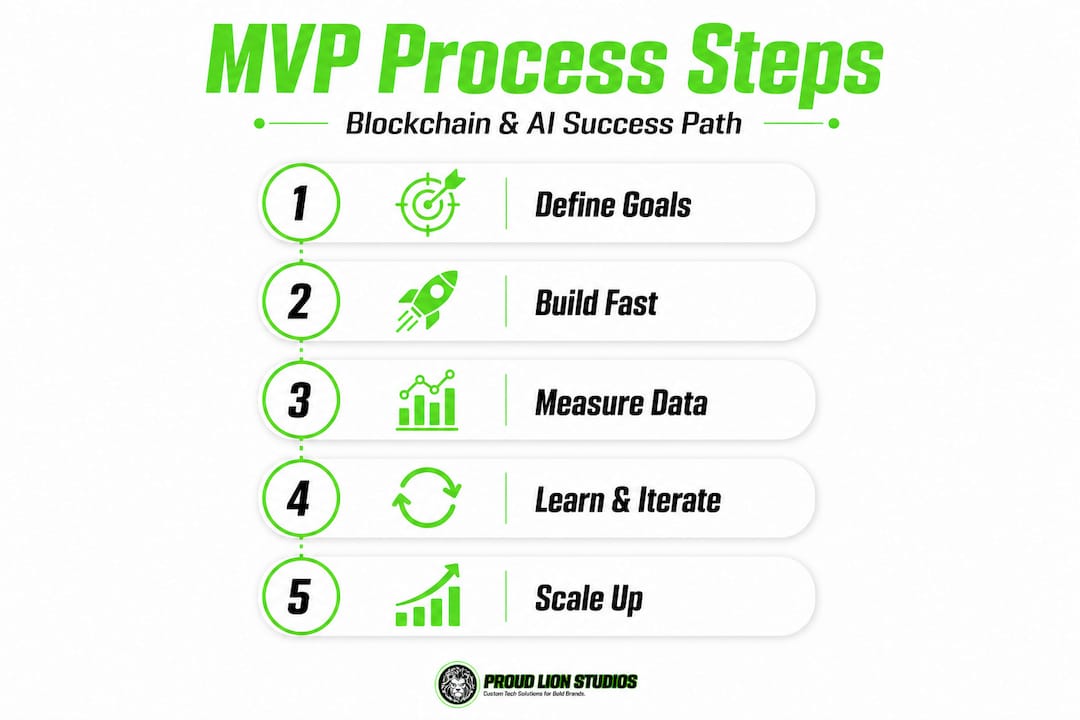
Here is the full process, adapted for technical complexity:
- Define your single core hypothesis. Write it as a testable statement: "Users will complete X action when offered Y value, which proves Z about demand." Keep it narrow.
- Identify the minimum set of features that tests the hypothesis. Cut everything else. If a feature does not directly reveal whether your hypothesis is true or false, defer it.
- Decide what stays off-chain for now. Unless your hypothesis is specifically about decentralized trust or tokenization, you can often simulate blockchain behavior with a centralized database during the first MVP cycle.
- Build and deploy to a real audience. Not just internal testers. Real users who have no stake in making the product look good.
- Measure using actionable metrics. Sign-ups, retention, specific in-app actions, wallet connections, AI query completion rates. Tie every metric to your hypothesis.
- Learn and decide: persevere or pivot. If the data supports your hypothesis, double down. If it does not, identify which assumption was wrong and run the next cycle with an adjusted hypothesis.
The following comparison highlights what on-chain vs. off-chain testing looks like during early MVP cycles:
| Validation Goal | Test Off-Chain First | Move On-Chain When |
|---|---|---|
| User interest in asset ownership | Simulated wallet UI | Demand is confirmed |
| Transaction trust and transparency | Server-side audit log | Compliance requires it |
| Smart contract logic | Mock contract responses | Contract behavior is validated |
| AI-powered recommendations | Pre-built API responses | Custom model accuracy is proven |
| Token incentive mechanics | Points or credits system | Token economics are designed |
For AI features specifically, plan for evaluation cycles that extend well beyond launch. AI models drift, user expectations evolve, and guardrails need ongoing tuning. Unlike a static web feature, your AI layer requires dedicated measurement infrastructure from the start. The fintech MVP build process offers a useful reference for how to structure these cycles when regulatory and data considerations are involved. For SaaS products, the scalable SaaS MVP steps lay out a comparable structure with platform-specific nuances.
Pro Tip: A lightweight MVP with five focused features will almost always outperform a fully featured release for validation purposes. Users cannot give you signal on ten things at once. Narrow your build, sharpen your learning.
Enterprise and startup MVPs: Hidden differences and risk mitigation
It's crucial to understand that not all MVP audiences and goals are alike. Building for startups versus for enterprise clients involves fundamentally different expectations, risk tolerances, and definitions of "viable."
For startups, the MVP is primarily a learning tool. Speed matters. Iteration is expected. Users understand they are testing something early, and the relationship between builder and user is often informal and direct. The priority is generating actionable signal as fast as possible, even if the product has rough edges.
For enterprises, the calculus is entirely different. A B2B buyer is evaluating your product as a potential operational dependency. They are asking questions about security, compliance, support agreements, and integration pathways from the very first demo.
A minimalist MVP can backfire in B2B enterprise contexts because enterprise "value" includes support, integrations, permissions, and compliance readiness. What looks lean to a startup team can look unfinished and risky to an enterprise procurement team.
Key differences between startup and enterprise MVP expectations:
- Startup buyers prioritize speed to insight, low cost, and flexibility
- Enterprise buyers prioritize security, compliance documentation, role-based permissions, and SLA commitments
- Technical due diligence is minimal for startups but rigorous for enterprises
- Value perception shifts: startups see an MVP as a starting point, enterprises see it as a preview of production readiness
- Decision cycles are weeks for startups and months for enterprises
This means your MVP strategy for an enterprise blockchain or AI product needs to include at least a credible compliance story, a support model, and documented integration pathways before you present it to a procurement team. Ignoring these elements does not make your MVP leaner. It makes it unsellable.
Understanding the full range of considerations when building enterprise blockchain MVPs is essential for teams that serve both market segments, because the same codebase may need to be packaged and presented very differently depending on who is buying.
Verification and scaling: Turning MVP lessons into real products
After collecting and analyzing feedback, it's time to act on those lessons and drive your MVP toward market-ready, scalable solutions.
The transition from MVP to full product is not a single event. It is a structured process that requires you to separate what you learned from what you still need to build.
- Audit your technical debt. An MVP is intentionally imperfect. Document every shortcut you took during the build phase, because those shortcuts become the refactoring backlog for your production build.
- Confirm your hypothesis was actually validated. Not just "users liked it" but "the data showed that X behavior occurred at a rate that supports our business model." This distinction matters enormously.
- Prioritize security and scalability reviews before moving blockchain components to mainnet or deploying AI models at scale.
- Separate hypothesis validation from platform upgrades. Just because your MVP proved demand does not mean you need to scale everything simultaneously. Stage your upgrades.
- Plan your data migration and user onboarding path from the MVP version to the full product, especially if your MVP used simulated or off-chain components that need to be replaced.
The specific mechanics of blockchain and AI MVPs include separating the learnable product hypothesis from on-chain and off-chain architecture complexity, instrumenting measurements early, and recognizing that AI introduces extra overhead through integration, evaluation, and guardrails that can shift scope even when code generation appears faster.
When you're ready to advance MVP to full product, treat it as a new project phase with fresh goals, not just a continuation of MVP development with a bigger budget.
Pro Tip: Never use your scaling phase to test new hypotheses. The scaling phase is for engineering confidence, not discovery. Keep your learning cycles and your build cycles separate to avoid muddying your data.
The MVP playbook: What most guides get wrong about blockchain and AI MVPs
Most MVP guides were written for consumer apps, and they transfer poorly to blockchain and AI projects. The standard advice is "ship fast, iterate, and don't overthink it." For a simple SaaS tool, that advice is reasonable. For a product involving smart contracts, token economics, or AI agents operating in sensitive domains, it can be genuinely dangerous.
The biggest hidden trap in blockchain and AI MVP development is confusing infrastructure complexity with viable features. Teams convince themselves that a certain level of decentralization or AI sophistication is the minimum requirement for their product to function. Often it is not. It is a comfort feature for the engineering team, not a validation requirement.
Real-world cases consistently show the same pattern: teams that try to scale MVPs post-launch without separating their learning cycles from their architecture decisions end up with products that are neither validated nor scalable. They have spent resources building complexity before confirming that users want the core value at all.
The specific nuances of blockchain and AI MVPs require you to acknowledge that AI integration, evaluation pipelines, and safety guardrails add overhead that does not disappear just because a code generator wrote the first draft. These are real costs that need to be planned for, not treated as afterthoughts.
Our view at Proud Lion Studios, based on working across blockchain, AI, and mobile product development: the teams that succeed fastest are the ones who treat their MVP as a measurement instrument, not a product launch. Every design decision should be evaluated against one criterion: does this help us learn faster? If a feature does not serve the learning goal, it does not belong in the MVP. That discipline, applied consistently, is what separates teams that validate and scale from teams that build and stall.
Partner with experts for MVP development in blockchain and AI
If you've read this far, you understand that launching an effective MVP in blockchain and AI requires more than a good idea. It requires the right architecture decisions, measurement discipline, and a team that has done it before across multiple industries and technology stacks.
At Proud Lion Studios, we help startups and enterprises design and build MVPs that actually validate what matters, using smart contracts, tokenization, AI agents, and scalable web and mobile infrastructure. Supported by the Aptos Foundation and operating with a fully UAE-based technical team, we bring hands-on experience to every project. Whether you need to map your requirements, select the right tools, or accelerate from MVP to full product, explore our portfolio and service pages to see how we approach each stage of development with precision and purpose.
Frequently asked questions
What makes MVP development different for blockchain and AI solutions?
Blockchain and AI MVPs require early architectural decisions, careful measurement, and extra validation cycles because technical overhead is higher than in conventional software development, including on-chain vs. off-chain separation, AI evaluation pipelines, and guardrail design.
How fast should you aim to launch an MVP using blockchain or AI?
As fast as your hypothesis allows. Lean Startup guidance recommends starting with prototypes or proof-of-concept builds rather than full-featured products, because early signal is more valuable than early completeness.
Are MVPs risky for enterprise B2B products?
Yes, significantly. A too-minimal MVP can be rejected outright by enterprise buyers if it lacks integrations, compliance documentation, or permissions, since B2B evaluators assess operational readiness from the very first demo.
Which measurements matter most during MVP evaluation?
Focus on the metrics most directly tied to your core hypothesis. Actionable metrics like sign-ups, retention rates, and specific user actions tied to blockchain or AI features give you cleaner signal than vanity metrics like total page views or downloads.