
TL;DR:
- Dubai has established a leading ecosystem for crypto, blockchain, and AI through strategic policies and infrastructure.
- Enterprise blockchain in Dubai is advancing with hybrid architectures that enhance trust, compliance, and operational flexibility.
- The regulatory landscape is highly structured, requiring thorough compliance and understanding of licensing processes.
Enterprise blockchain is no longer experimental. 67% of Fortune 1000 firms are projected to adopt blockchain by 2026, and Dubai is already ahead of that curve. While other global cities are still debating policy frameworks, the UAE has built an entire ecosystem around crypto, blockchain, and AI integration. For tech entrepreneurs and business leaders in the region, this shift isn't a future trend to monitor. It's a live opportunity to capture right now. This article breaks down Dubai's regulatory landscape, the real mechanics of blockchain-AI integration, and the practical applications already generating results across industries.
Table of Contents
- How Dubai became a leader in crypto innovation
- The essentials: Crypto, blockchain, and AI integration explained
- Regulatory landscape: Licensing, compliance, and risk in Dubai
- Practical adoption: Real-world applications and Dubai case studies
- The uncomfortable truths most experts won't tell you about crypto deployment in Dubai
- Accelerate your crypto vision with Dubai's leading experts
- Frequently asked questions
Key Takeaways
| Point | Details |
|---|---|
| Dubai’s crypto leadership | Dubai is a global leader in crypto adoption and blockchain innovation, hosting 750+ crypto firms at DMCC. |
| Integrated AI-blockchain solutions | New platforms like Khwarizmi Chain let companies digitize processes and boost supply chain transparency. |
| Clear but rigorous regulations | VARA makes Dubai’s crypto legal landscape structured and safe for innovative business projects. |
| Proven practical applications | Sectors like real estate, logistics, and healthcare are seeing tangible value from blockchain-AI integrations. |
How Dubai became a leader in crypto innovation
Dubai didn't stumble into crypto leadership. It engineered it. Through deliberate policy, infrastructure investment, and a regulatory environment designed to attract global talent, the UAE turned itself into one of the most compelling places on earth to build a blockchain business.
The DMCC Crypto Centre now hosts over 750 crypto companies, making it one of the largest dedicated crypto hubs in the world. That concentration isn't accidental. Dubai offers zero corporate tax on qualifying income, a strategic geographic position between East and West, and a government that treats blockchain as critical national infrastructure rather than a compliance headache.
| Factor | Dubai advantage |
|---|---|
| Regulatory clarity | VARA provides dedicated virtual asset oversight |
| Tax environment | Zero corporate tax on qualifying crypto income |
| Talent access | Global and regional tech talent pool |
| Infrastructure | Dedicated free zones like DMCC and DIFC |
| Government support | National blockchain strategy backed by policy |
International entrepreneurs consistently choose Dubai for three reasons: speed of setup, regulatory predictability, and market access. The UAE sits at the crossroads of markets in South Asia, Africa, and Europe, giving blockchain businesses a genuinely global reach from day one.
The blockchain impact on UAE businesses is already visible across sectors from real estate to logistics. And what makes Dubai particularly interesting in 2026 is how it's becoming a testbed for blockchain-AI integration at the enterprise level. The UAE blockchain adoption study covering 108 research papers confirms that combined blockchain-AI deployments are producing measurably stronger outcomes in data security, process efficiency, and ecosystem trust.
"Dubai isn't just adopting blockchain. It's building the infrastructure that will define how blockchain and AI work together at scale."
For leaders evaluating where to build or expand, the question isn't whether Dubai is a serious crypto destination. It clearly is. The real question is how to position your product within this ecosystem before the window of first-mover advantage closes. Understanding enterprise blockchain in 2026 is the starting point for that positioning.
Key reasons Dubai leads in crypto innovation:
- Dedicated regulatory body (VARA) with clear licensing pathways
- World-class free zones designed for crypto and fintech companies
- Government-backed national blockchain strategy
- Active community of 750+ crypto firms within a single hub
- Strong Arabic-language AI development driving regional tech leadership
The essentials: Crypto, blockchain, and AI integration explained
These three terms get used interchangeably, but they mean different things and serve different functions. Getting this right matters because how you architect your product depends entirely on understanding where each technology fits.
Blockchain is a distributed ledger that records transactions in a tamper-resistant way. Crypto refers to digital assets that run on blockchain networks. AI is the intelligence layer that processes data, identifies patterns, and makes decisions. The integration of all three creates something more powerful than any one alone.
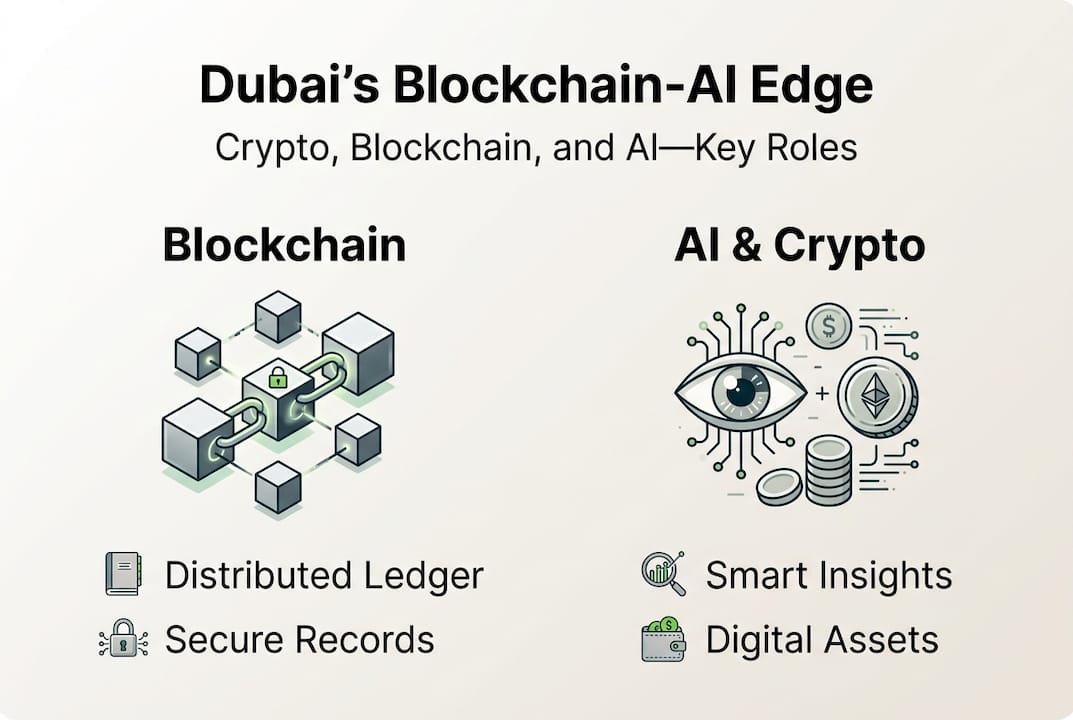
The core problem AI faces is trust. AI models make decisions based on data, but that data can be manipulated, and the decision-making process is often opaque. Blockchain addresses AI's trust issues by creating an immutable audit trail for data inputs and model outputs, making AI systems more verifiable and accountable.
| Setup type | Best for | Trade-off |
|---|---|---|
| Public blockchain | Transparency, decentralization | Slower, less control |
| Permissioned blockchain | Enterprise compliance, speed | Centralized governance |
| Hybrid setup | Regulatory alignment + openness | More complex to build |
In Dubai, hybrid setups are gaining traction fast. A company might use a public chain for token issuance while running internal processes on a permissioned chain for speed and compliance. Khwarizmi Chain by BCAI is a strong local example: a customizable blockchain-AI ecosystem built specifically to digitize real-world processes across UAE industries.
How blockchain and AI work together in practice:
- Data recorded on-chain becomes a verified input for AI models
- AI analyzes patterns across supply chain, identity, or financial data
- Smart contracts execute decisions automatically based on AI outputs
- Every action is logged immutably for audit and compliance
- The result is a system that is both intelligent and verifiable
For Dubai businesses, the most active use cases include RWA tokenization with AI, supply chain transparency, and digital identity verification. Real-world asset (RWA) tokenization means converting physical assets like real estate or commodities into digital tokens on a blockchain, making them tradable and programmable.
Pro Tip: If you're evaluating chain architecture, start with your compliance requirements first, then choose your chain type. A hybrid setup gives you the most flexibility for scaling across regulated markets without sacrificing performance.
Regulatory landscape: Licensing, compliance, and risk in Dubai
Dubai's regulatory framework for virtual assets is one of the most structured in the world. VARA Dubai (the Virtual Assets Regulatory Authority) oversees all crypto-related activity in the emirate, and its two-stage licensing process is the gateway for any serious crypto venture.
Stage 1: Approval to Incorporate. This is the initial green light from VARA to establish your entity. You'll need to submit your business plan, proof of capital, and compliance framework. VARA evaluates your team's fit and the viability of your proposed activity.
Stage 2: Full VASP License. VASP stands for Virtual Asset Service Provider. This stage requires a fully operational compliance program, including anti-money laundering (AML) controls, risk management policies, and alignment with CARF (Crypto Asset Reporting Framework) standards.
| Requirement | Details |
|---|---|
| Minimum capital | Varies by activity type |
| AML/CFT program | Mandatory and audited |
| CARF alignment | Required for international reporting |
| Compliance officer | Must be UAE-qualified |
| Ongoing reporting | Regular submissions to VARA |
The VARA Rulebooks are detailed and regularly updated. Reading them isn't optional. They cover everything from marketing restrictions to custody requirements, and enforcement is active.
What entrepreneurs must prioritize:
- Engage a UAE-qualified legal advisor before submitting any application
- Build your compliance infrastructure before you need it, not after
- Map your token classification early (utility vs. security matters enormously)
- Budget for a 6 to 12 month licensing timeline
- Document your risk management framework in detail from day one
Pro Tip: If your project involves utility tokens rather than securities, you may qualify for a faster Category 2 licensing pathway under VARA. This can reduce your timeline significantly, but only if your token structure is clearly documented and your use case is unambiguous. Get this classification right before you file.
Practical adoption: Real-world applications and Dubai case studies
The most convincing argument for blockchain-AI integration isn't theoretical. It's the results already being generated across Dubai's economy.
In real estate, RWA tokenization is allowing fractional ownership of high-value properties, making Dubai's property market accessible to a broader global investor base. The Dubai RWA tokenization case is a live example of how tokenization infrastructure is being built and deployed for real transactions.

In supply chain, blockchain-AI combinations are solving longstanding problems around provenance and fraud. Blockchain-AI integration across 108 empirical studies consistently shows improvements in data integrity, traceability, and operational efficiency across logistics and manufacturing sectors.
In healthcare and identity, blockchain is being used to create tamper-resistant credential systems. Digital identity verification on-chain removes the need for repeated document submission and reduces fraud risk significantly.
Sectors seeing rapid blockchain-AI adoption in Dubai:
- Real estate and property investment
- Trade finance and cross-border payments
- Healthcare data and patient identity
- Government services and digital credentials
- Logistics and supply chain management
- Energy and sustainability tracking
On the AI side, the UAE is building serious regional capability. Falcon-H1 Arabic from Abu Dhabi's Technology Innovation Institute outperforms models twice its size and competes directly with GPT-4o on Arabic natural language processing tasks. This matters because it means Dubai-based products can now leverage world-class AI that actually understands the region's language and cultural context.
The combination of strong AI capability and robust blockchain infrastructure makes Dubai uniquely positioned to build products that work natively for the Middle East and North Africa market while meeting global compliance standards.
The uncomfortable truths most experts won't tell you about crypto deployment in Dubai
Here's what the conference panels and pitch decks leave out. Most enterprise leaders underestimate how complex regulatory compliance actually is in practice. VARA's rulebooks are thorough, and enforcement is real. The gap between reading the requirements and actually building a compliant system is wider than most teams expect.
The public versus permissioned chain debate also has a hidden cost. Permissioned chains create trade-offs between control and decentralization that surface at the worst possible moment, usually when you're trying to scale or integrate with a partner's system. Choosing your architecture based on marketing appeal rather than operational reality is a costly mistake.
Blockchain doesn't automatically fix AI's trust problem either. It creates an audit trail, but if the data going into the chain is bad, the output is still bad. Garbage in, garbage out, just with better documentation.
What actually works is building with adaptive frameworks from the start. That means designing your compliance layer before your product layer, choosing your chain architecture based on your actual regulatory environment, and treating real deployment lessons as more valuable than theoretical best practices. The teams succeeding in Dubai right now are the ones who prioritize operational flexibility over technical elegance.
Accelerate your crypto vision with Dubai's leading experts
Building a blockchain or AI product in Dubai requires more than a great idea. It requires a team that understands the regulatory environment, the technical architecture, and the regional market dynamics all at once.
At Proud Lion Studios, we work with product innovators and enterprise leaders across the UAE and beyond to design, build, and launch crypto-AI solutions that are compliant, scalable, and built for real outcomes. Whether you need blockchain development experts to architect your smart contract infrastructure, RWA and DApp solutions to bring your tokenization vision to life, or AI-powered agents to automate your business processes, our UAE-based team is ready to build alongside you. Let's turn your vision into a working product.
Frequently asked questions
How long does it take to get a Dubai crypto business license?
VARA licensing typically takes 6 to 12 months, covering both the Approval to Incorporate and the Full VASP License stages. Your timeline depends heavily on the completeness of your compliance documentation at submission.
What are the top use cases for blockchain and AI in Dubai?
Leading applications include supply chain transparency, RWA tokenization, digital identity, and credential verification. Khwarizmi Chain's use cases span all of these areas, reflecting the breadth of what blockchain-AI integration can address in the region.
How do Dubai's crypto regulations compare globally in 2026?
VARA's rulebooks and active enforcement place Dubai among the most proactive regulatory environments in the world, with CARF alignment ensuring compatibility with international reporting standards.
What makes Dubai-built AI models like Falcon-H1 competitive?
Falcon-H1 Arabic delivers top-tier accuracy for Arabic NLP tasks while running efficiently at a smaller model size, making it a practical choice for regional product development without sacrificing performance.