

TL;DR:
- Multi-chain development involves deploying blockchain applications across multiple independent networks for broader reach and resilience. It requires careful architecture choices, such as independent, messaging-based, or intent-routing models, to balance operational complexity and user experience. Effective security and user experience depend on disciplined chain selection, chain abstraction tools, and planning for cross-chain messaging from the start.
Multi-chain development is the practice of deploying blockchain applications across multiple independent blockchain networks simultaneously to maximize reach, reliability, and user access. The crypto ecosystem is highly fragmented, with no single blockchain holding more than approximately $45 billion in total value locked as of Q1 2026. That fragmentation makes multi-chain architecture not a luxury but a practical requirement for any serious protocol. Understanding multi-chain development means understanding how to distribute smart contracts, assets, and user activity across several networks while managing the real costs of doing so.
What is multi-chain development and how does it differ from cross-chain?
Multi-chain means parallel deployments running independently on different blockchains. Cross-chain means those deployments can communicate, transfer assets, or share state with each other. The two concepts are related but not the same, and confusing them leads to bad architecture decisions.
Think of it this way. A multi-chain wallet holds assets on Ethereum, Solana, and Aptos without those chains ever talking to each other. A cross-chain bridge, by contrast, moves tokens from one chain to another by passing messages between them. Multi-chain is about distribution. Cross-chain is about interaction.
Developers choose between three approaches depending on their product goals:
- Independent multi-chain deployment. The same smart contract logic runs on separate chains with no shared state. Each chain operates as its own silo. This works well for NFT collections or token launches targeting different user bases.
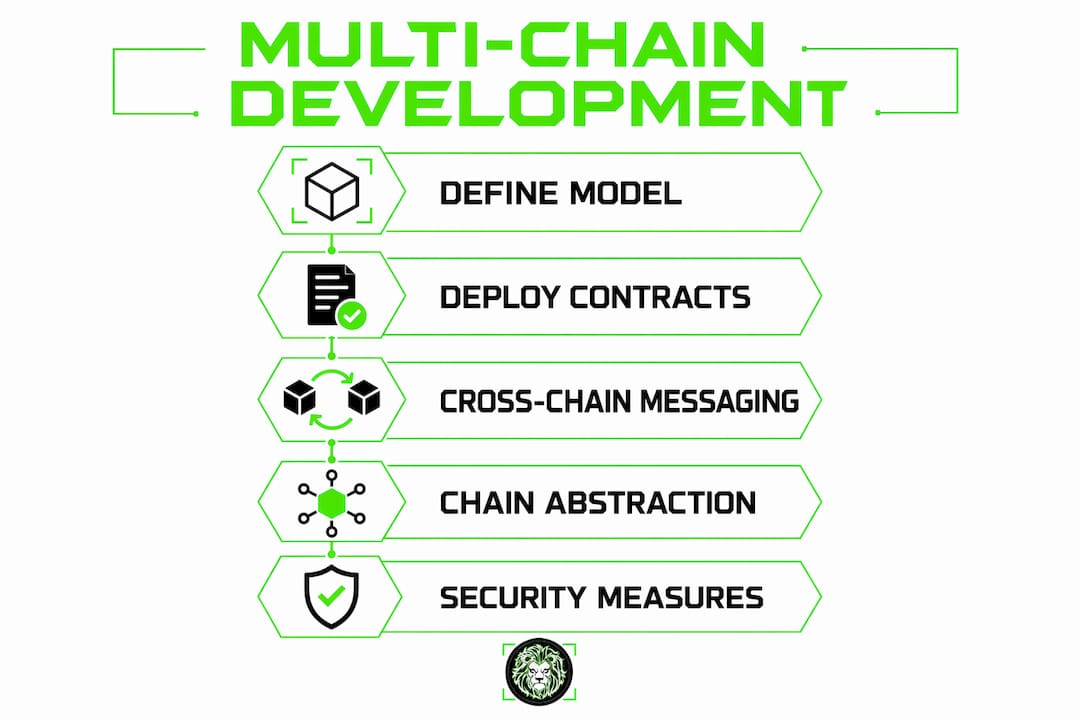
- Cross-chain messaging architecture. Contracts on different chains communicate through a messaging layer. This enables unified liquidity pools and synchronized state across networks.
- Hybrid approach. Independent deployments on most chains, with cross-chain messaging connecting the highest-volume networks. Most mature DeFi protocols use this model.
A fourth concept worth knowing is chain abstraction. Chain abstraction middleware hides network complexity from the end user entirely. The user signs one transaction and the underlying infrastructure routes it to the correct chain automatically.
Pro Tip: If your product requires shared liquidity across chains, plan for cross-chain messaging from day one. Retrofitting it later is expensive and introduces new attack surfaces.
What are the benefits and challenges of multi-chain development in 2026?
Multi-chain deployment gives protocols access to user bases and liquidity pools that no single chain can provide alone. No blockchain commands the entire market, so distributing across networks is the most direct path to broad market coverage.
The benefits are concrete:
- Broader user reach. Users on Ethereum, BNB Chain, and Avalanche each represent distinct communities. A protocol deployed on all three captures all three.
- Resilience. If one chain suffers congestion, an exploit, or a governance crisis, deployments on other chains continue operating.
- Incentive capture. Many chains offer grants and liquidity mining programs to attract new protocols. Multi-chain deployment lets teams capture multiple incentive programs simultaneously.
The challenges are equally real. Liquidity fragmentation is the most common pitfall. Deploying identical contracts on five chains without cross-chain messaging creates five separate liquidity pools. Each pool is shallower than a single unified pool would be, which increases slippage and degrades user experience.
"The winning strategy in 2026 is disciplined cross-chain design: one clear trust model and one recoverable system are more practical than deploying everywhere." — Startupik, 2026
Security risk compounds with every additional chain. Bridge-mediated transfers frequently reach hundreds of millions of USD in daily volume, with cumulative volumes across major bridge networks exceeding tens of billions of USD. That scale makes bridges a primary target for exploits. Every bridge integration adds a new trust assumption to your security model.
Chain-switching fatigue is a real UX problem too. Users who must manually switch networks, acquire gas tokens, and approve transactions on each chain abandon products quickly. The operational complexity of monitoring, upgrading, and securing contracts across many chains also grows non-linearly with each new deployment.

What are the main architectural models for multi-chain applications?
Three architectural models cover most real-world multi-chain deployments. Each has distinct trade-offs.
| Model | How it works | Strengths | Trade-offs |
|---|---|---|---|
| Independent deployments | Same contract logic deployed separately per chain | Simple, no cross-chain risk | Fragmented liquidity, no shared state |
| Messaging-based architecture | Contracts communicate via a cross-chain messaging layer | Unified state, shared liquidity | Added complexity, bridge risk |
| Intent-based routing | User declares intent; infrastructure routes to optimal chain | Best UX, minimal chain-switching | Newer pattern, less tooling maturity |
Many DeFi protocols in 2026 deploy native smart contracts across 3 to 6 distinct blockchain networks as a practical balance between operational complexity and market reach. Going beyond six chains rarely improves outcomes and significantly increases maintenance burden.
Chain abstraction middleware sits above all three models and improves the user experience regardless of which architecture you choose. MetaMask Connect Multichain enables single-session multi-ecosystem connectivity, letting users approve all chain connections at once rather than switching networks manually. This removes one of the biggest friction points in multi-chain applications.
Deployment pipelines for multi-chain smart contracts require careful tooling. Hardhat and Foundry both support multi-chain deployment scripts, but teams need to manage separate RPC endpoints, block explorers, and verification services for each network. A centralized deployment registry that tracks contract addresses, versions, and upgrade histories across chains is not optional. It is a prerequisite for safe operations.
Pro Tip: Use a unified deployment manifest that stores every contract address, chain ID, and deployment block in one version-controlled file. This single source of truth prevents the "which address is live on which chain?" confusion that causes incidents.
For developers building blockchain apps step by step, the architectural decision should come before writing a single line of contract code. Changing from independent deployments to a messaging-based model after launch requires a full migration.
How can developers address security and UX concerns in multi-chain development?
Security in multi-chain systems requires a layered approach. A single security model applied uniformly across all chains is not sufficient because each chain has different finality guarantees, validator sets, and consensus mechanisms.
Follow these steps to build a defensible multi-chain security posture:
- Audit every contract independently per chain. A contract that is safe on Ethereum may behave differently on a chain with faster block times or different EVM opcodes. Chain-specific audits are not redundant. They are necessary.
- Apply decentralized monitoring. Decentralized, multi-layered monitoring protocols are now the industry standard for preventing bridge failures and catastrophic asset loss. Use independent monitoring networks rather than a single centralized alert system.
- Minimize bridge surface area. Every bridge integration is a trust assumption. Limit bridge usage to the highest-value flows and prefer battle-tested messaging layers over newer, unaudited options.
- Build incident response playbooks per chain. Each chain has different upgrade mechanisms, governance processes, and emergency pause capabilities. Document and test your response procedure for each network before you need it.
- Implement cross-chain replay protection. Transactions signed for one chain must not be replayable on another. Use chain IDs in all signature schemes and verify them on-chain.
For UX, chain abstraction is the most effective tool available. MetaMask Connect Multichain has become a best practice precisely because it removes manual wallet and gas token switching, which is the primary cause of chain-switching fatigue. Users should never need to know which chain they are on.
Pro Tip: Abstract gas payments using a paymaster or gas sponsorship service. Requiring users to hold native gas tokens on every chain they interact with is the fastest way to lose them at the onboarding step.
For a deeper look at securing blockchain applications, the principles of least privilege, formal verification, and continuous monitoring apply directly to multi-chain contexts.
What are real-world applications and future trends in multi-chain blockchain development?
Multi-chain deployment is already the default for the most active protocols in production. The pattern shows up across several categories:
- DeFi lending protocols deploy on 3 to 6 chains to capture liquidity from different user communities while maintaining independent risk parameters per chain.
- Multi-chain stablecoins issue on Ethereum, Solana, Tron, and other networks simultaneously, with cross-chain messaging maintaining consistent supply and redemption guarantees.
- NFT marketplaces deploy on multiple chains to serve collectors who hold assets on different networks, with cross-chain listings becoming a standard feature.
- Gaming applications use multi-chain architecture to separate high-frequency in-game transactions on low-cost chains from high-value asset ownership recorded on more secure networks.
The future direction for multi-chain ecosystems points toward permissionless interoperability with proof-of-stake security models. Interchain applications built on this model allow any chain to communicate with any other without requiring centralized coordination. That removes the trust bottleneck that makes current bridge architectures vulnerable.
The latest blockchain development trends confirm that developer tooling is converging around intent-based routing and chain abstraction as the dominant patterns for new multi-chain applications. Protocols that build on these patterns now will have a significant head start as the tooling matures.
The strategic lesson from 2026 is clear. Broad chain coverage without disciplined architecture creates more problems than it solves. Focused deployment on the right chains, with the right messaging layer, and with chain abstraction for users, is the model that scales.
Key Takeaways
Multi-chain development succeeds when disciplined chain selection, cross-chain messaging, and chain abstraction work together as a unified architecture rather than independent decisions.
| Point | Details |
|---|---|
| Define your model first | Choose between independent, messaging-based, or intent-routing architecture before writing contract code. |
| Target 3–6 chains strategically | Most DeFi protocols deploy to 3–6 chains as the practical balance between reach and operational complexity. |
| Solve liquidity fragmentation early | Without cross-chain messaging, parallel deployments create isolated liquidity pools that hurt user experience. |
| Layer your security | Audit per chain, use decentralized monitoring, and build incident response playbooks for each network. |
| Abstract complexity from users | Chain abstraction tools like MetaMask Connect Multichain remove gas and network-switching friction at the UX layer. |
Why disciplined chain selection beats maximum coverage
I have watched teams deploy to a dozen chains in the first month and spend the next year firefighting. The instinct makes sense. More chains means more users, right? In practice, each new chain multiplies your security surface, your monitoring overhead, and your upgrade coordination burden. The math rarely works out in favor of broad coverage.
The teams I have seen succeed with multi-chain architecture share one trait. They treat chain selection as a product decision, not a technical one. They ask which chains their actual users are on, which chains offer the liquidity depth their protocol needs, and which chains have the security properties their risk model requires. Then they deploy to those chains and only those chains.
Liquidity fragmentation is the silent killer of multi-chain protocols. A protocol with $10 million in liquidity split across ten chains is functionally worse than a protocol with $10 million on one chain. Cross-chain messaging solves this, but only if you plan for it from the start. Retrofitting a messaging layer into a live protocol is one of the hardest engineering problems in this space.
Chain abstraction genuinely changes the calculus for user experience. When users do not have to think about which chain they are on, the entire category of chain-switching complaints disappears. That is not a minor UX improvement. It is a fundamental shift in how users relate to multi-chain applications.
My honest recommendation: start with two or three chains, get the architecture right, and expand deliberately. The protocols that will define the next cycle are the ones that built for correctness first and coverage second.
— Amal
Proud Lion Studios builds multi-chain blockchain applications
Proud Lion Studios works with startups and enterprises that need multi-chain blockchain applications built correctly from the ground up. The team handles everything from smart contract architecture and cross-chain messaging integration to security audits and deployment pipelines across multiple networks.

If you are planning a DeFi protocol, an NFT marketplace, or any application that needs to operate across multiple blockchains, Proud Lion Studios brings the technical depth to do it right. The studio's blockchain development services cover the full stack, from initial architecture decisions through to production deployment and ongoing security monitoring. You can also explore the team's smart contract development capabilities for multi-chain contract design and deployment.
FAQ
What is multi-chain development in simple terms?
Multi-chain development is the practice of deploying a blockchain application on multiple separate blockchain networks at the same time. Each deployment runs independently, giving the application access to users and liquidity on every chain it supports.
How is multi-chain different from cross-chain?
Multi-chain refers to parallel deployments on distinct blockchains with no required interaction between them. Cross-chain refers to mechanisms that allow those deployments to communicate, transfer assets, or share state across networks.
How many chains should a DeFi protocol deploy on?
Most DeFi protocols in 2026 deploy on 3 to 6 chains as a practical balance between market reach and operational complexity. Deploying on more chains without a clear user or liquidity rationale increases risk without proportional benefit.
What is the biggest security risk in multi-chain development?
Bridge vulnerabilities represent the highest-risk attack surface in multi-chain systems. Cross-chain bridge-mediated transfers reach hundreds of millions of USD in daily volume, making bridges a primary target. Decentralized, multi-layered monitoring is the current industry standard for mitigating this risk.
What is chain abstraction and why does it matter?
Chain abstraction is middleware that hides network-switching complexity from users, allowing them to interact with multiple blockchains from a single interface. Tools like MetaMask Connect Multichain implement this pattern and directly reduce chain-switching fatigue in multi-chain applications.