
TL;DR:
- Launching multiplayer games in 2026 requires integrating networking, AI, and blockchain from the start to meet player expectations and scalability demands.
- Effective planning involves choosing the right platform, backend services, and infrastructure, preventing costly late-stage rework and operational failures.
- Operational resilience through chaos testing and observability is crucial to sustain complex systems months after launch.
Launching a multiplayer game in 2026 is a fundamentally different challenge than it was five years ago. Game development now demands that you ship networking, AI-driven systems, and blockchain integrations together, not in sequence. Players expect real-time matchmaking, fraud-resistant economies, and personalized experiences from day one. If your backend can't handle 150,000 concurrent users at launch or your mobile client chokes on a network resume event, you lose players fast and permanently. This guide walks through every critical step, from planning your infrastructure to combining AI and blockchain for features that actually move the needle.
Table of Contents
- What you need before you build: prerequisites and planning
- Step 1: Setting up your multiplayer foundation
- Step 2: Optimizing mobile performance and rendering
- Step 3: Integrating blockchain for payments and scale
- Step 4: Combining AI and blockchain for next-gen features
- What most guides miss about shipping innovative game systems
- Take your game to the next level with expert integration
- Frequently asked questions
Key Takeaways
| Point | Details |
|---|---|
| Plan with platform services | Rely on proven multiplayer services to simplify complex backend features. |
| Prioritize mobile networking | Handle mobile lifecycle events and edge cases early to avoid player frustration. |
| Optimize for scale | Aim for performance benchmarks like <200 draw calls to ensure smooth gameplay on all devices. |
| Balance UX and blockchain | Integrate fast payments and on-chain activity while maintaining immediate in-game responsiveness. |
| Combine AI with smart contracts | Use off-chain AI with callback models to deliver advanced, trustworthy features in next-gen games. |
What you need before you build: prerequisites and planning
Starting with a clear understanding of what is required sets you up for smooth implementation. The first mistake most studios make is treating multiplayer, AI, and blockchain as features to bolt on after the core game is built. They're not. They're infrastructure, and infrastructure decisions made late cost you months of rework.
Before writing a single line of networking code, map out which backend services you'll build versus integrate. Xbox Live standardized core online multiplayer building blocks, including identity, friends, matchmaking, messaging, voice, and achievements, reducing the need for studios to build these systems from scratch. That's the baseline expectation now. Your players already use platforms that deliver this, so you need to match it or beat it.
Core requirements to confirm before building:
- Networking stack: UDP or WebSocket-based transport, with relay fallback for NAT traversal
- Platform selection: iOS, Android, PC, or cross-platform from day one
- Backend APIs: authentication, matchmaking, leaderboards, and real-time communication
- Blockchain readiness: wallet integration, smart contract deployment environment, and RPC node access
- AI infrastructure: off-chain compute capacity and model serving endpoints
- Team coverage: dedicated roles for backend, client-side networking, and DevOps
When you're building multiplayer games with blockchain and AI layers, the team structure matters as much as the tech stack. You need someone who understands both blockchain game applications and real-time networking, not just one or the other.
| Requirement | Build it yourself | Integrate existing service |
|---|---|---|
| Identity and authentication | High effort, full control | Recommended for most teams |
| Matchmaking | Medium effort | Recommended unless highly custom |
| Blockchain payments | Low-medium effort with SDKs | Recommended for speed |
| AI personalization | High effort | Depends on model complexity |
| Real-time voice/chat | Very high effort | Almost always integrate |
Pro Tip: Lock in cross-platform compatibility requirements before writing any platform-specific code. Retrofitting cross-platform support after the fact is one of the most expensive mistakes in mobile game design.
For a deeper look at the full Web3 architecture picture, the Web3 game development guide covers the blockchain layer in detail.
Step 1: Setting up your multiplayer foundation
With planning complete, it's time to establish the technology foundation for robust multiplayer. The networking layer is where most mobile games fail silently. Players drop, reconnect, or switch networks constantly on mobile, and your game needs to handle every transition without corrupting game state.

Mobile and web multiplayer UX depends heavily on networking lifecycle handling, including suspend and resume events, and requires initializing networking before calling any networking or security APIs. That means your startup sequence matters as much as your steady-state logic.
Step-by-step networking setup:
- Initialize the network stack before any game logic runs. Register callbacks for connectivity changes immediately.
- Monitor readiness by polling or listening for network-ready events before attempting matchmaking or session creation.
- Handle edge cases including NAT traversal failures, relay fallback triggers, and partial disconnects.
- Manage lifecycle transitions by pausing active sessions on suspend and cleanly reinitializing on resume.
- Clean up correctly by releasing all socket handles, canceling pending requests, and notifying other players on exit.
NAT and reachability issues often require relay fallback and phase-specific timeouts, with different values for startup versus steady-state, plus logging and chaos testing to catch rare failures before launch.
Packet loss and delay testing are not optional. A game that works perfectly on a stable connection but breaks on a 3G network with 5% packet loss will generate the worst reviews you've ever read.
| Connection state | Common error type | Best practice |
|---|---|---|
| Initializing | Timeout before network ready | Queue all API calls until ready event fires |
| NAT traversal | Peer unreachable | Trigger relay fallback automatically |
| Steady-state | Packet loss spike | Implement sequence numbers and retransmit logic |
| Suspend/resume | Stale session state | Teardown on suspend, reinitialize on resume |
| Cleanup | Leaked socket handles | Enforce cleanup in all exit paths, including crashes |
Pro Tip: Run chaos testing by randomly killing connections, simulating high latency, and forcing NAT failures in your QA environment. Issues that only appear under stress will absolutely appear in production.
For production-grade implementations, our AAA multiplayer services cover the full stack. You can also read more about building secure multiplayer games with AI and blockchain layers. Delivering seamless web and mobile experiences starts at the networking layer, not the UI.
Step 2: Optimizing mobile performance and rendering
After the multiplayer core is stable, optimizing for performance ensures a polished user experience on all devices. Mobile hardware is more powerful than ever, but the gap between a smooth 60fps experience and a stuttering mess is still surprisingly narrow.
For mobile rendering throughput, instancing, object pooling, and data-oriented design approaches like ECS and DOTS are commonly used to reduce CPU and GPU overhead. A practical performance budget targets under 200 draw calls and under 100,000 vertices on mid to high-end device profiles.
Key optimization techniques:
- GPU instancing: Render hundreds of identical objects in a single draw call instead of issuing one per object. Critical for crowd scenes, projectiles, and environmental details.
- Object pooling: Pre-allocate game objects at startup and recycle them instead of instantiating and destroying during gameplay. Garbage collection spikes are a major frame-rate killer on mobile.
- ECS/DOTS architecture: Separate data from behavior to improve cache efficiency. This is especially valuable when you have hundreds of AI-controlled units running simultaneously.
- Staggered updates: Don't update all AI agents and physics objects every frame. Update a quarter of them per frame in rotation. Players rarely notice, and your frame budget drops dramatically.
- LOD (Level of Detail) management: Swap high-poly models for low-poly versions at distance thresholds. Combine with occlusion culling to avoid rendering objects the camera can't see.
Performance stat: Staying under 200 draw calls per frame on mobile is the difference between a game that runs on 60% of your target devices and one that runs on 90%.
Catching performance problems at this stage prevents the worst-case scenario: a game that ships fine on flagship devices but crashes or stutters on the mid-range hardware that most of your players actually own. For teams building AI-powered mobile apps, these same principles apply to the AI inference layer running on-device.
Step 3: Integrating blockchain for payments and scale
With core performance tuned, securely scaling your user base and payment features through blockchain ensures reliability during real-world traffic spikes. Blockchain integration in games is not just about NFTs. It's about verifiable ownership, fraud-resistant economies, and payment infrastructure that works across borders without chargebacks.
Blockchain-based payment processing can complete within 2 to 3 seconds and support 150,000 peak concurrent online users when paired with optimized cloud infrastructure. That's a real production benchmark, not a theoretical ceiling.
Step-by-step blockchain integration:
- Choose your chain based on transaction speed, cost, and developer ecosystem. Compare options carefully before committing.
- Set up wallet authentication as your identity layer. Wallet-based login removes the need for traditional account systems and gives players true ownership.
- Deploy smart contracts for in-game economies, item ownership, and payment processing. Audit them before going live.
- Connect your game client to the chain via RPC endpoints. Use a managed node provider to avoid running your own infrastructure early on.
- Handle latency gracefully by showing optimistic UI updates while waiting for on-chain confirmation. Don't make players stare at a spinner for 3 seconds.
| Blockchain platform | Avg. transaction speed | Peak user handling | Best for |
|---|---|---|---|
| Aptos | Under 1 second | Very high | Fast-paced games, microtransactions |
| Ethereum L2s | 1 to 3 seconds | High | Established ecosystems, DeFi integration |
| Solana | Under 1 second | High | High-frequency in-game events |
| BNB Chain | 3 to 5 seconds | Medium-high | Broader DeFi ecosystem access |
Pro Tip: Use proven cloud networking and load balancing in front of your blockchain nodes. The bottleneck is rarely the chain itself. It's the RPC layer between your game server and the chain.
Common pitfalls to avoid:
- Long settlement lag displayed to users without optimistic UI feedback
- Storing large game state on-chain (expensive and slow; use off-chain storage with on-chain hashes)
- Skipping blockchain transaction security audits before launch
- Designing mobile on-chain flows that require multiple wallet confirmations per action
Our Web3 gaming services cover this full stack. For a platform comparison, the Aptos vs Ethereum for games breakdown is worth reading before you commit. You can also explore the blockchain benefits for mobile in more depth.
Step 4: Combining AI and blockchain for next-gen features
Once core systems are in place, the final step is integrating smart, adaptable, and secure advanced features. The real power of combining AI and blockchain isn't in either technology alone. It's in what they enable together: game systems that are both intelligent and verifiably fair.
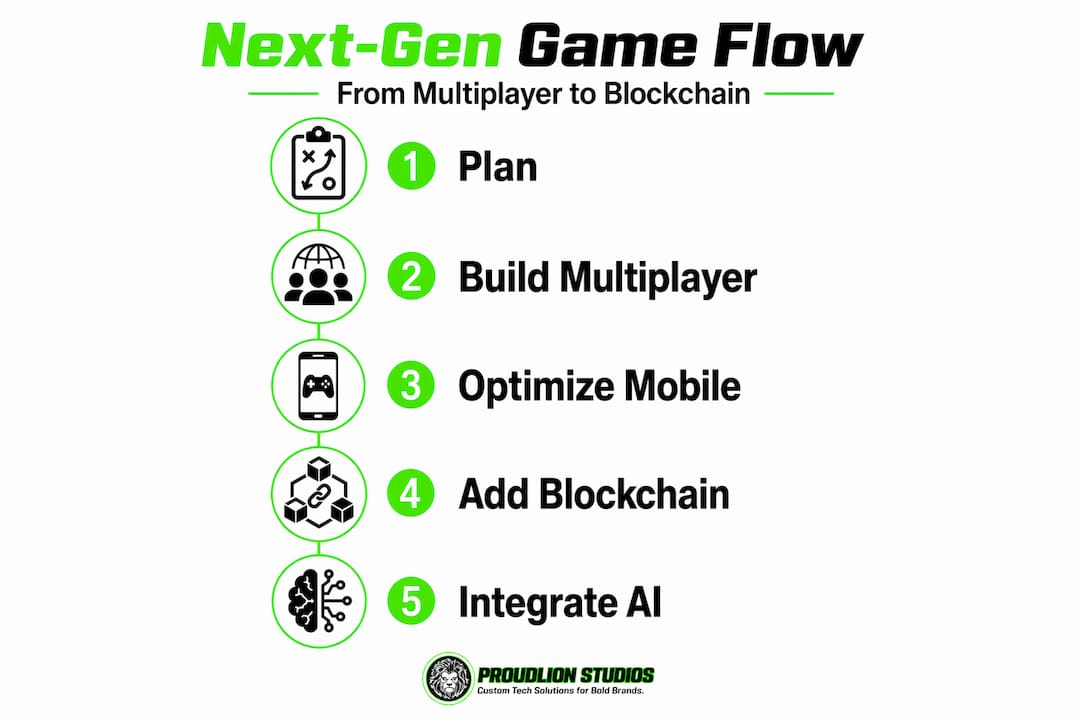
AI and blockchain can be combined via asynchronous off-chain AI calls coordinated with smart contracts. A callback mechanism lets smart contracts request AI computation and receive results to update both on-chain and off-chain game state. This architecture keeps expensive AI computation off-chain while preserving the trust guarantees of the blockchain.
Use cases worth building:
- Dynamic world events: AI generates event parameters off-chain, smart contracts trigger and record outcomes on-chain
- Fraud prevention: AI flags suspicious transaction patterns, smart contracts enforce automatic restrictions
- Real-time personalization: AI adjusts difficulty, loot tables, or NPC behavior based on player history, with outcomes logged on-chain for transparency
- Verifiable random number generation: AI-seeded randomness verified through on-chain commit-reveal schemes
- Player reputation systems: AI scores player behavior, smart contracts gate access to premium features based on reputation
Separating development-time AI (training, model iteration) from operations-time AI (live inference, player-facing decisions) is critical. Teams that conflate the two end up with models that are impossible to update without a full deployment cycle.
Pro Tip: Build your AI callback architecture so the smart contract emits an event, your off-chain AI agent listens for it, computes the result, and posts it back. This keeps your contracts simple and your AI layer independently updatable.
Watch out for: Smart contract gas limits that prevent complex state updates from AI results, coordination lags between off-chain agents and on-chain state, and model drift that changes game balance without anyone noticing.
For teams building scalable AI and blockchain apps, this architecture is the foundation. The AI-driven business models framework is also worth reviewing for the operational side.
What most guides miss about shipping innovative game systems
Most articles on game development stop at the code. They show you a networking snippet, a smart contract template, and a diagram of an AI pipeline, then call it done. What they skip is the operational reality of keeping these systems alive in production.
The biggest bottleneck we see isn't the initial integration. It's what happens three months after launch when a mobile OS update breaks your lifecycle handling, a spike in concurrent users exposes a race condition in your blockchain settlement logic, or your AI model starts producing outputs that subtly break game balance. None of these show up in a tutorial.
The teams that ship successfully treat chaos testing as a first-class discipline, not a pre-launch checkbox. They simulate edge failures, messy mobile contexts like backgrounding mid-match, and live rollback scenarios during every sprint, not just before release. They also maintain explicit operational checklists that cover network cleanup, blockchain node health, and AI model performance as living documents updated with every iteration.
There's also a harder lesson about iterative multiplayer development: the teams that win aren't the ones who built the most sophisticated system on day one. They're the ones who built the most observable system. Logging, alerting, and the ability to roll back a smart contract or swap an AI model without a full client update are worth more than any architectural elegance.
Pro Tip: Add an operational checklist to every sprint review. Cover network cleanup paths, blockchain node latency, and AI output monitoring as standard items, not afterthoughts.
Take your game to the next level with expert integration
Building multiplayer, AI, and blockchain systems in parallel is genuinely hard. Getting the architecture right from the start saves months of rework and protects your launch window. Proud Lion Studios has shipped production systems across all three layers, from real-time multiplayer backends to on-chain economies and live AI integrations.

Our team of blockchain development experts works alongside your studio to design and deploy systems that hold up under real player load. From smart contract solutions built for gaming economies to full multiplayer backend architecture, we build for production, not prototypes. You can also explore our NFT portfolio to see what we've shipped. If you're ready to move faster without sacrificing reliability, let's talk.
Frequently asked questions
How do I manage cross-platform multiplayer connections?
Use platform-level shared services for identity, matchmaking, and messaging to ensure consistency across devices. Xbox Live standardized these building blocks precisely because rebuilding them per platform is unsustainable.
What are best practices for handling network lifecycle on mobile games?
Always clean up networking on suspend and reinitialize on resume, and only interact with the API when the network is confirmed ready. Networking lifecycle handling is the single most common source of silent failures in mobile multiplayer.
How can I reduce latency for blockchain transactions in my game?
Leverage cloud networking and load balancing to keep your RPC layer fast, and use optimistic UI updates to hide on-chain wait times from players. Blockchain-based payment processing can reach 2 to 3 seconds with properly optimized cloud infrastructure.
What's the typical performance budget for mobile game rendering?
Aim for under 200 draw calls and 100,000 vertices per frame on modern mid-to-high-end mobile hardware. Mobile rendering targets this budget to keep CPU and GPU overhead manageable across device tiers.
How do smart contracts interact with AI in games?
Use off-chain agents to run AI computations and post results back to smart contracts for on-chain state updates. Smart contracts can request AI computation via a callback mechanism, keeping your contracts simple and your AI layer independently maintainable.