

TL;DR:
- Secure blockchain applications employ layered defenses, including smart contract best practices, key management, and node security, to prevent exploits. Continuous monitoring and pre-planned incident response are essential to effectively detect and contain security incidents. Most failures result from preventable mistakes, emphasizing the importance of ongoing security discipline throughout development and deployment.
A secure blockchain application integrates defense-in-depth strategies spanning code-level best practices, infrastructure safeguards, and continuous monitoring to protect assets and ensure operational integrity. This secure blockchain application guide covers every layer of protection you need, from smart contract design patterns to node hardening and incident response. The industry recorded $905.4 million lost across 122 smart contract incidents in 2025 alone. That figure confirms one truth: blockchain security is not a feature you add at the end. It is the architecture you build from day one.
What are the best practices for securing smart contracts?
The Checks-Effects-Interactions (CEI) pattern is the primary defense against reentrancy attacks, which caused $905.4 million in losses across 122 incidents in 2025. CEI requires that every function first validates inputs (Checks), then updates internal state (Effects), and only then calls external contracts (Interactions). Reversing this order is the single most common mistake that lets attackers drain funds mid-execution.
Secure smart contract practices go well beyond CEI. Here is the layered approach every development team should follow:
- Validate all inputs. Reject unexpected values at the function entry point before any state change occurs.
- Use battle-tested libraries. OpenZeppelin's SafeERC20 and its access control modules handle edge cases that custom code routinely misses.
- Apply formal verification. Formal verification provides mathematical assurance that contracts behave exactly as intended, catching logic errors that manual review misses.
- Run static analysis. Tools like Slither and MythX scan bytecode and source code for known vulnerability patterns before deployment.
- Commission multiple audits. A single audit report is not a safety certificate. 70% of major exploits still occur in audited contracts, which means audits must be one layer within a broader strategy.
- Design for upgradeability carefully. Proxy and upgradeability patterns introduce storage and selector clash bugs that require careful implementation and thorough testing before any upgrade goes live.
Pro Tip: Treat your audit strategy as a pipeline, not a checkpoint. Run Slither on every pull request, schedule a full third-party audit before mainnet deployment, and add a runtime monitoring layer post-launch. No single tool catches everything.
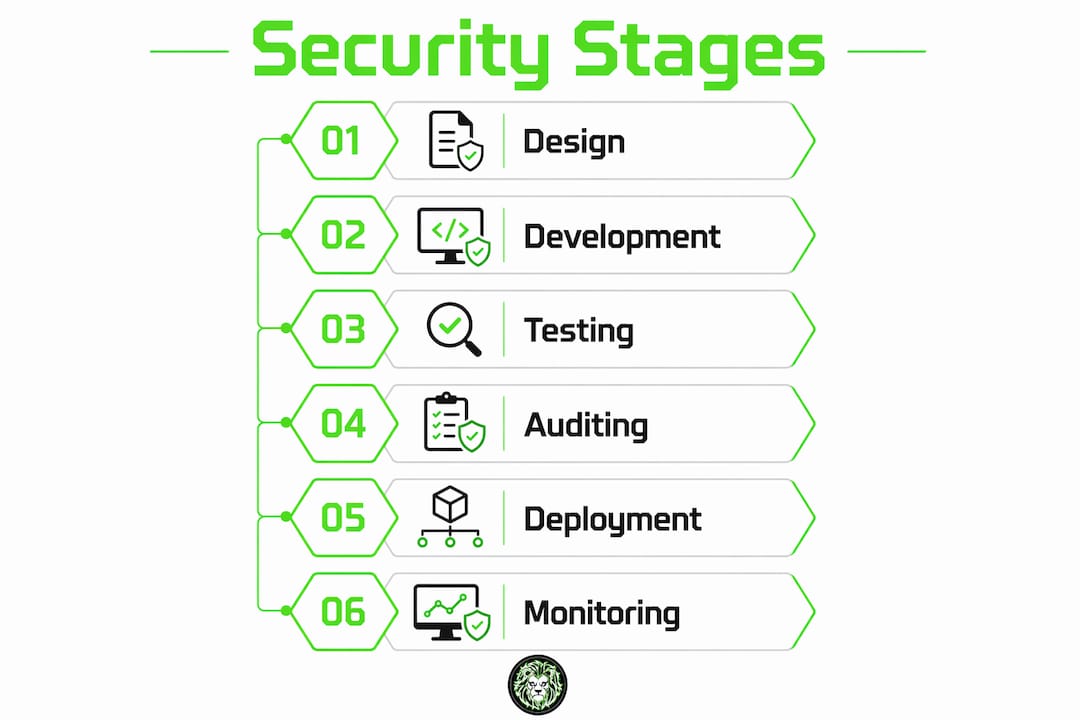
Smart contract security is continuous across design, development, testing, auditing, deployment, and post-deployment monitoring phases. Teams that treat it as a one-time gate consistently underestimate their exposure.
How to manage blockchain keys and wallets to minimize asset exposure
Private key security is the foundation of any blockchain application development guide. Lose a key, and no amount of smart contract hardening matters. Hardware security modules (HSMs), multi-signature wallets, and strict access controls are the three pillars of sound key management.

The recommended asset distribution is clear: 90% of digital assets should sit in cold storage rather than hot wallets. Cold storage removes private keys from internet-connected systems entirely, eliminating the largest class of online attack vectors. The remaining 10% in hot wallets covers operational liquidity only.
Recommended wallet security measures for any production deployment:
- Multi-signature wallets. Require M-of-N approvals for high-value transactions. A 3-of-5 multi-sig means no single compromised key can authorize a transfer.
- Hardware security modules. HSMs store and use private keys inside tamper-resistant hardware, preventing key extraction even if the host system is compromised.
- Role-based access control. Assign signing authority based on job function. Developers should never hold production signing keys.
- Key rotation policies. Key management requires planning for rotation and recovery procedures to mitigate risks from lost or compromised keys.
- Cold storage for reserves. Use air-gapped hardware wallets from vendors like Ledger or Trezor for long-term asset storage.
Pro Tip: Map your wallet architecture before you write a single line of contract code. Decide which operations need multi-sig, which need HSM signing, and which can use a standard EOA. Retrofitting wallet security after launch is expensive and error-prone.
For a broader look at securing digital assets across your infrastructure, the principles of physical and logical separation apply equally to blockchain key storage.
What infrastructure and node security measures are vital?
Blockchain node security is the layer most development teams neglect. A compromised node can feed false data to your application, intercept transactions, or disrupt consensus participation. Node security requires network segmentation, access controls, transaction monitoring, and anomaly detection to prevent these outcomes.
Concrete infrastructure measures for secure decentralized applications:
- Network segmentation. Place blockchain nodes on isolated network segments. Block direct internet access to RPC ports and expose only what load balancers and API gateways require.
- Access control lists. Restrict RPC access to known IP ranges. Unauthenticated public RPC endpoints are a common entry point for denial-of-service and data manipulation attacks.
- Transaction monitoring. Deploy tools like Prometheus to track node performance metrics and flag anomalous transaction volumes in real time.
- Performance benchmarking. Hyperledger Caliper measures throughput and latency under load, helping teams identify bottlenecks before they become security incidents.
- SIEM integration. Feed node logs into a Security Information and Event Management platform like Splunk or IBM QRadar. This maps blockchain events to established frameworks like NIST CSF and ISO 27001.
Reliable RPC infrastructure is also critical for contract deployment atomicity, emergency pause execution, and forensic capability after an incident. If your RPC layer fails during an active attack, you lose the ability to respond. Redundant RPC providers and failover configurations are not optional for production systems.
Organizations must map decentralized blockchain architectures to compliance standards like SOC 2, ISO 27001, and NIST CSF. Compliance alignment is not just a regulatory checkbox. It forces you to document controls, assign ownership, and test defenses on a schedule.
How to implement continuous security monitoring and incident response
Deployment is not the finish line. Continuous monitoring with the ability to pause contracts in real time is what separates teams that contain attacks from teams that lose everything. On-chain monitoring tools watch for unusual transaction patterns, large unexpected withdrawals, and function calls that should not occur in normal operation.
The table below compares the primary monitoring approaches available to blockchain development teams:
| Approach | Primary Tool | Strength | Best For |
|---|---|---|---|
| On-chain event monitoring | OpenZeppelin Defender | Automated alerts and contract pausing | DeFi protocols and token contracts |
| Node-level metrics | Prometheus + Grafana | Infrastructure health and throughput | Permissioned and public chains |
| Static analysis (CI/CD) | Slither, MythX | Pre-deployment vulnerability detection | All contract types |
| SIEM integration | Splunk, IBM QRadar | Cross-system correlation and compliance | Enterprise blockchain deployments |
| Performance benchmarking | Hyperledger Caliper | Load and stress testing | High-throughput applications |
Good incident response practices include audit logging, forensic readiness, and blockchain-specific procedures. Audit logs must be immutable and timestamped. Forensic readiness means your team can reconstruct the sequence of on-chain events within hours of an incident, not days.
Automated circuit breakers are the most underused tool in blockchain incident response. OpenZeppelin Defender and similar platforms let you define conditions that automatically pause a contract when suspicious activity is detected. This buys your team time to assess and respond without manual intervention.
Pro Tip: Write your incident response runbook before you deploy. Define who has pause authority, what thresholds trigger an alert, and what the first 30 minutes of response look like. Teams that improvise during an active exploit consistently make it worse.
Which common mistakes lead to blockchain security failures?
Most blockchain security failures trace back to a short list of repeatable errors. Leaving administrative functions unprotected and mismanaging roles causes the majority of access control vulnerabilities that lead to major losses. The good news is that every mistake on this list is preventable.
Common pitfalls and their fixes:
- Unprotected admin functions. Any function that can mint tokens, upgrade contracts, or withdraw funds must require multi-sig approval and role-based access control. Apply OpenZeppelin's
AccessControlorOwnable2Stepto every privileged function. - Improper role assignments. Granting broad permissions during development and forgetting to restrict them before mainnet is a recurring failure. Audit every role assignment as part of your pre-deployment checklist.
- Over-reliance on a single audit. Smart contract audits are not a guarantee. They are one layer within a multi-layered security approach. Treat each audit as a point-in-time snapshot, not a permanent certificate.
- Upgradeability proxy bugs. Proxy patterns like UUPS and Transparent Proxy introduce storage collision risks. Test every upgrade path in a forked mainnet environment before execution.
- Neglecting node and infrastructure security. Teams that harden contracts but leave RPC endpoints open and nodes unmonitored create a different attack surface. Security must cover the full stack.
For a practical pre-launch review, the Web3 development checklist from Proud Lion Studios covers both security and optimization steps in one structured workflow.
Key takeaways
Securing a blockchain application requires layered defenses across smart contract code, key management, node infrastructure, and continuous post-deployment monitoring.
| Point | Details |
|---|---|
| CEI pattern prevents reentrancy | Apply Checks-Effects-Interactions in every function to block the attack class behind $905.4 million in 2025 losses. |
| Cold storage protects reserves | Keep 90% of digital assets in cold storage and use multi-sig wallets for all high-value transactions. |
| Audits are one layer, not the answer | 70% of exploits hit audited contracts, so pair audits with static analysis and runtime monitoring. |
| Node security closes the infrastructure gap | Segment networks, restrict RPC access, and integrate node logs with a SIEM platform for full visibility. |
| Incident response must be pre-planned | Write runbooks and configure automated contract pausing before deployment, not during an active attack. |
The security mindset most teams get wrong
I have reviewed enough blockchain projects to spot the pattern immediately. Teams invest heavily in a pre-launch audit, get a clean report, and then treat security as resolved. Six months later, they are dealing with an exploit that the audit never covered because the threat model changed after deployment.
The uncomfortable truth is that blockchain security is a practice, not a project phase. The compliance landscape reinforces this. SOC 2, ISO 27001, and NIST CSF all require continuous control testing, not one-time assessments. Mapping your blockchain architecture to these frameworks forces a discipline that most teams resist until they need it.
The balance between security and usability is also harder than it looks. A 5-of-7 multi-sig on every transaction sounds secure until your operations team is waiting 48 hours to execute a routine payment. I have seen teams loosen controls under operational pressure, and that is exactly when attackers find their window. The right architecture defines tiered approval thresholds upfront, so security and speed coexist by design rather than by compromise.
Collaboration between developers, project managers, and security specialists is what actually closes gaps. Developers know the code. Project managers know the timelines. Security specialists know the attack patterns. None of them alone builds a secure system. The teams that get this right treat security review as a shared responsibility from the first sprint, not a handoff at the end.
— Amal
How proud lion studios builds security into every blockchain project

Proud Lion Studios approaches blockchain development with security as a first-class requirement, not an afterthought. The Dubai-based team integrates smart contract auditing, multi-sig wallet architecture, and node security hardening directly into the development lifecycle for every client engagement. Whether you are building a DeFi protocol, an NFT marketplace, or a permissioned enterprise chain, the studio's blockchain development services deliver production-ready applications built to withstand real-world attack vectors. For projects requiring smart contract security from design through deployment, Proud Lion Studios provides end-to-end coverage tailored to your compliance requirements and technical stack. Reach out to discuss your project's security architecture today.
FAQ
What is the CEI pattern in smart contract security?
The Checks-Effects-Interactions (CEI) pattern is the primary defense against reentrancy attacks. It requires contracts to validate inputs, update state, and only then call external addresses, preventing attackers from re-entering a function before state is finalized.
How much of a project's assets should be in cold storage?
Security best practices recommend keeping 90% of digital assets in cold storage. This removes the majority of funds from online attack vectors, with only operational liquidity held in hot wallets.
Are smart contract audits enough to secure a blockchain app?
No. 70% of major exploits still occur in audited contracts. Audits are one layer within a multi-layered strategy that must also include static analysis, runtime monitoring, and incident response planning.
What tools are used for blockchain node security monitoring?
Prometheus monitors node performance metrics, while Hyperledger Caliper benchmarks throughput and latency. Both integrate with SIEM platforms like Splunk to provide cross-system visibility aligned with frameworks like NIST CSF and ISO 27001.
What should a blockchain incident response plan include?
A solid plan defines who holds pause authority, what on-chain conditions trigger automated alerts, and the first steps your team takes within 30 minutes of a detected exploit. Audit logging and forensic readiness are required components for post-incident analysis.