

TL;DR:
- Web3 shifts control from centralized platforms to user-owned assets and trustless, blockchain-based systems.
- Core Web3 infrastructure includes blockchains, smart contracts, and decentralized applications (dApps).
- Security risks like smart contract bugs and 51% attacks require thorough audits and security-first development.
Many tech leaders dismiss Web3 as a buzzword, but the specific vocabulary behind it is where real strategic advantage lives. If you're building a blockchain product, launching an NFT marketplace, or designing a decentralized application, the terms you use and understand directly shape your architecture, legal exposure, and user experience. Misreading "ownership" in a Web3 context versus a Web2 context, for example, can break your entire token model. This guide cuts through the noise and gives you precise, actionable definitions for the terms that matter most, organized the way builders and entrepreneurs actually need them.
Table of Contents
- Understanding the Web3 paradigm: From Web2 to decentralization
- Key Web3 infrastructure terms: Blockchain, smart contracts, and dApps
- Ownership, governance, and incentive terms: NFTs, DAOs, and gas
- Security and network risks in Web3: From accounts to 51% attacks
- A practical perspective: What most guides miss about mastering Web3 terminology
- Build better blockchain solutions with expert support
- Frequently asked questions
Key Takeaways
| Point | Details |
|---|---|
| Web2 vs Web3 | Web3 brings user ownership, decentralization, and trustless systems, in sharp contrast to Web2's centralized platforms. |
| Technical terms clarified | Understanding blockchain, smart contracts, and dApps is crucial for building in the decentralized era. |
| Ownership and governance | NFTs, DAOs, and gas fees are key to asset management, community direction, and transaction cost control. |
| Mitigating security risks | Web3 security terms like 51% attack and contract vulnerabilities must be mastered to protect your project. |
Understanding the Web3 paradigm: From Web2 to decentralization
To understand Web3 vocabulary, you first need to understand what changed. Web2 is the internet most of us built on: centralized platforms like Google, Meta, and AWS that own your data, control access, and extract value from your users. Web3 flips this. As Ethereum describes it, Web3 is a decentralized internet vision using blockchains, cryptocurrencies, and NFTs to give users direct ownership, contrasting sharply with Web2's centralized control.
This shift is not just philosophical. It changes how you design systems. In Web2, an "account" means a username and password stored on a company's server. In Web3, an account is a cryptographic key pair that only the holder controls. "Ownership" in Web2 means a license agreement. In Web3, it means an on-chain record that no platform can revoke.
Here's a quick comparison to anchor these differences:
| Concept | Web2 | Web3 |
|---|---|---|
| Identity | Username/password | Cryptographic wallet address |
| Ownership | Platform license | On-chain token or NFT |
| Payments | Banks and processors | Native cryptocurrency |
| Trust | Centralized authority | Smart contract code |
| Access | Permissioned by platform | Permissionless by default |
Three features define the Web3 paradigm for builders:
- Decentralization: No single entity controls the network or data.
- Native payments: Value transfers happen at the protocol level, no middlemen.
- Trustless interactions: Rules are enforced by code, not by institutions.
"The most important mental shift in Web3 is realizing that 'trust' is no longer a social contract. It's a mathematical one."
Why does this matter for your project? Because if you're future-proof with Web3 thinking in mind, every architectural decision flows from these three principles. You can explore a deeper breakdown in our Web3 explained for tech guide, or review the blockchain success basics for startup-specific context. Getting the paradigm right before writing a single line of code saves months of rework.
Key Web3 infrastructure terms: Blockchain, smart contracts, and dApps
After grasping the macro-shift to decentralization, let's decode the infrastructure that makes Web3 possible.
A blockchain is, at its core, a public, shared database of transactions distributed across network computers, made immutable through cryptographic linking of each block to the one before it. Each "block" contains a batch of transactions and a "hash," which is a unique fingerprint generated from the block's data. Change any data, and the hash changes, breaking the chain. This is why blockchains are tamper-resistant, not just tamper-proof.

Here's how the core infrastructure terms relate:
| Term | Definition | Why it matters for builders |
|---|---|---|
| Blockchain | Distributed, immutable ledger | Foundation for all on-chain logic |
| Smart contract | Self-executing code on-chain | Automates rules without intermediaries |
| dApp | Decentralized application | Frontend off-chain, backend on-chain |
| EVM | Ethereum Virtual Machine | Executes smart contract bytecode |
| EOA | Externally Owned Account | User-controlled wallet address |
A smart contract is self-executing code deployed on a blockchain, triggered automatically when predefined conditions are met. Think of it as a vending machine: insert the right input, get the guaranteed output, no human needed. For your project, this means you can automate royalty payments, token distributions, or access control without a backend server.
A dApp (decentralized application) combines a traditional frontend (React, Next.js, etc.) with smart contracts as the backend. The logic lives on-chain. The UI lives off-chain. This distinction matters because your frontend can go down, but the contract keeps running.
The EVM (Ethereum Virtual Machine) is the runtime environment that executes smart contracts across all EVM-compatible chains, including Polygon, BNB Chain, and Avalanche. Writing EVM-compatible code means your contracts can deploy across multiple networks.
For a deeper look at the blockchain revolution and how it reshapes development, or to understand decentralized apps in practice, those resources will give you the technical grounding to move faster.
- Deploy your smart contract to a testnet first.
- Verify contract source code on a block explorer.
- Test all edge cases before mainnet launch.
- Use audited libraries like OpenZeppelin whenever possible.
Pro Tip: The EVM processes every operation deterministically across thousands of nodes. This means a bug in your smart contract is not just a bug. It's a permanent, publicly exploitable vulnerability. Always audit before deploying to mainnet. See our guide on building blockchain apps for a step-by-step deployment framework.
Ownership, governance, and incentive terms: NFTs, DAOs, and gas
With the technical building blocks covered, it's crucial to unpack how ownership, governance, and protocol mechanics are defined in Web3.
NFTs (Non-Fungible Tokens) are blockchain-based tokens where each unit is unique and non-interchangeable. The ERC-721 standard defines the mechanics that enforce this uniqueness at the contract level. Every NFT has a token ID that maps to a specific owner address. Smart contracts enforce transfer rules, royalty splits, and access permissions automatically. For entrepreneurs, NFTs are not just digital art. They are programmable ownership certificates for any asset.
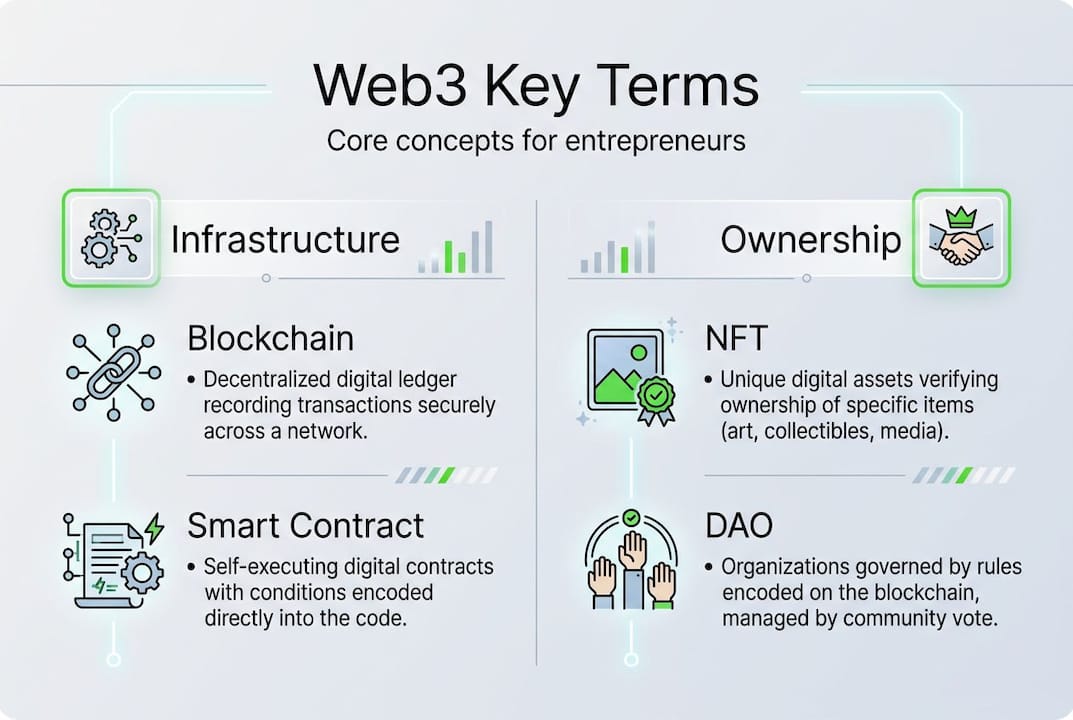
A DAO (Decentralized Autonomous Organization) is a smart contract-governed entity with token-based voting that replaces traditional corporate governance with on-chain rules. Token holders vote on proposals, and outcomes execute automatically. The degree of actual decentralization varies widely. Some DAOs are fully on-chain. Others use off-chain signaling with manual execution. Know which model your project uses before you promise "decentralized governance" to your community.
Key ownership and governance concepts at a glance:
- NFT: Unique on-chain token representing provable ownership of a digital or physical asset.
- DAO: Governance structure where rules and decisions are encoded in smart contracts.
- Token voting: Holders of governance tokens vote on protocol changes proportionally.
- ERC-721: The Ethereum standard that defines how NFTs are created and transferred.
- Reentrancy: A smart contract vulnerability where external calls can re-enter a function before it finishes, draining funds.
Gas is the fee for EVM computation and storage, paid in the network's native cryptocurrency. Every transaction, contract deployment, and state change costs gas. Fees fluctuate with network congestion. During peak demand, a single transaction can cost more than the value being transferred. This is not a minor UX issue. It's a product design constraint.
Statistic to know: During the 2021 NFT boom, average Ethereum gas fees peaked at over $60 per transaction, pricing out retail users entirely and pushing volume to Layer 2 networks.
Pro Tip: Design your dApp's gas strategy early. Batch transactions, use Layer 2 networks like Arbitrum or Optimism, and consider gasless relayer patterns to improve accessibility. Our Web3 development checklist covers gas optimization in detail, and our Web3 for startup growth guide shows how smart fee design directly impacts retention.
Security and network risks in Web3: From accounts to 51% attacks
Owning and governing assets is only as powerful as the security supporting them. Let's explore the vulnerabilities you must know.
A 51% attack occurs when a single entity controls more than 50% of stake or nodes to reverse transactions or double-spend funds. On smaller proof-of-work chains, this is a real and documented threat. Ethereum's shift to proof-of-stake significantly raised the cost of such an attack, but newer or smaller chains remain exposed.
The most critical security terms for your project:
- Reentrancy attack: A malicious contract repeatedly calls back into your contract before the first execution completes, draining balances. The 2016 DAO hack lost $60 million this way.
- DoS (Denial of Service): Flooding a contract with calls or exploiting gas limits to freeze functionality.
- Private key exposure: If a user's private key is compromised, all assets in that EOA are permanently lost. There is no password reset.
- EOA vs. contract account: EOAs are user-controlled wallets. Contract accounts are code-controlled. Confusing the two leads to broken access control logic.
- Public key vs. private key: Your public key is your address. Your private key is your signature authority. Never log, store, or transmit private keys.
"In Web3, you don't just ship software. You ship financial infrastructure. The future of blockchain demands that security is treated as a first-class product requirement, not an afterthought."
The security landscape is evolving fast. New attack vectors emerge with every new primitive, from flash loan exploits to oracle manipulation. Review the Ethereum blockchain glossary regularly and build security reviews into every sprint, not just at launch.
A practical perspective: What most guides miss about mastering Web3 terminology
Most Web3 glossaries give you definitions. What they don't give you is context. The real reason projects fail is not that founders don't know what a smart contract is. It's that they don't recognize when a smart contract is the wrong tool, or when their DAO structure creates legal liability, or when their gas model will kill user adoption before the product even launches.
True fluency in Web3 terminology means understanding the tradeoffs embedded in each term. "Decentralized" is not always better. "Trustless" does not mean risk-free. "Immutable" means your bugs are permanent too.
Our experience building across blockchain, NFT, and dApp projects shows that the teams who move fastest are those who treat terminology as a decision-making framework, not a vocabulary test. When your whole team speaks the same precise language, architecture discussions become faster, security reviews become sharper, and investor conversations become more credible.
Stay current. The ecosystem rewrites its own glossary every 18 months. Make it a habit to revisit foundational resources and track how terms like "layer 2" or "modular blockchain" are evolving in practice. That's how you stay future-proof in a space that never stops moving.
Build better blockchain solutions with expert support
If you're ready to apply these insights and launch your own Web3 project, here's where to start.
Understanding Web3 terminology is the foundation, but translating that knowledge into a production-ready product requires the right technical partner. At Proud Lion Studios, we work with startups and enterprises to design and build blockchain solutions that are secure, scalable, and user-ready from day one.
Whether you're building Web3 games, deploying smart contract solutions, or launching a platform with NFT and dApp expertise, our UAE-based team brings hands-on experience across every layer of the Web3 stack. We don't do templates. We build to your specific architecture, token model, and growth goals. Reach out to us and let's turn your Web3 knowledge into a real product.
Frequently asked questions
What are the most important Web3 terms for entrepreneurs?
Core terms include blockchain, smart contract, dApp, DAO, NFT, gas, and EVM. These form the backbone of any Web3 project, covering user ownership and automated execution across decentralized systems.
How do smart contracts power Web3 apps?
Smart contracts are self-executing code on blockchain that automate processes without intermediaries, making dApps secure and trustless by design.
Why do gas fees change and why are they important?
Gas fees reflect the cost of EVM computation and fluctuate with network congestion, directly impacting user experience and the economic viability of your application.
What risks should new Web3 projects watch for?
The most common risks are smart contract bugs, reentrancy attacks, and 51% attack exposure on smaller chains. Robust auditing and security-first design practices are non-negotiable before mainnet deployment.