

Most founders hear "Web3" and picture speculative tokens and volatile markets. That picture is incomplete. In Dubai alone, PRYPCO Mint has already tokenized Dh18.5M in real estate stakes, and the DIFC Courts now handle over $2.1 billion in claims value tied to digital asset disputes. These are not experiments. They are live business operations running on blockchain infrastructure. This guide breaks down exactly how Web3 solutions drive growth, where they deliver real efficiency gains, and how UAE startups can move from curiosity to deployment.
Table of Contents
- How Web3 solutions power business growth
- Practical Web3 use cases in the UAE and globally
- How Web3 works: Core mechanics explained
- Benefits, challenges, and the real limits of Web3
- How to get started: A framework for UAE startups
- Accelerate your Web3 journey with expert help
- Frequently asked questions
Key Takeaways
| Point | Details |
|---|---|
| Scalability and Network Growth | Web3 solutions let startups expand globally and scale fast without huge infrastructure costs. |
| UAE Leads with Innovation | UAE startups benefit from advanced tokenization, stablecoin payroll, and supportive regulations. |
| Understand Web3 Mechanics | Smart contracts and tokens automate trust and create new business models. |
| Weigh Benefits Versus Limits | Web3 brings unique advantages—but it's crucial to consider complexity, cost, and regulatory fit. |
| Start Smart, Leverage Resources | Use expert frameworks and local rules to launch successful Web3 projects in the UAE. |
How Web3 solutions power business growth
The core promise of Web3 is not decentralization for its own sake. It is the removal of bottlenecks that slow down traditional business models. When you remove a central server, a central authority, or a central intermediary, you also remove the single point of failure that can take your whole operation offline.
Understanding why Web3 matters starts with recognizing how it changes the economics of growth. Traditional tech companies scale by buying more servers, hiring more staff, and negotiating with more vendors. Web3 startups scale by building communities that have a direct financial stake in the network's success. That is a fundamentally different growth engine.
Web3 startups grow faster because decentralized infrastructure enables global scalability without heavy investment in servers, and community-driven token economies create network effects that compound over time. A token holder is not just a customer. They are an advocate, an investor, and a co-builder.
Here is what that looks like in practice for UAE startups:
- DeFi platforms let you offer financial services to users in 100 countries without a banking license in each jurisdiction
- NFT marketplaces create new revenue streams from digital ownership and creator royalties
- Smart contracts automate agreements between parties, cutting legal overhead and processing time
- Blockchain-based supply chains give buyers verifiable proof of product origin, which is a major competitive advantage in luxury and food sectors
"The startups winning in Web3 are not the ones chasing token prices. They are the ones using blockchain infrastructure to solve real coordination problems between multiple parties who do not fully trust each other."
If you are building a Web3 startup, the question is not whether blockchain is relevant to your industry. The question is which specific inefficiency in your business model it can eliminate first.
Practical Web3 use cases in the UAE and globally
The UAE has become one of the most active testbeds for real-world Web3 applications. The government's regulatory clarity, combined with a high concentration of capital and international talent, makes it an ideal environment to deploy these solutions at scale.

Stablecoin payroll, tokenized gold, property stakes trading, and digital vaults for legacy assets are all live in the UAE right now. Companies like Everyrealm are already paying global teams in stablecoins, which eliminates currency conversion fees and cross-border transfer delays.
| Use case | Business benefit | UAE example |
|---|---|---|
| Stablecoin payroll | Instant global payments, no FX fees | Everyrealm via Toku |
| Tokenized real estate | Fractional ownership, lower entry barrier | PRYPCO Mint (Dh18.5M tokenized) |
| Tokenized gold | 24/7 trading, no physical storage risk | Dubai gold market integrations |
| Digital vaults | Secure asset custody and legacy management | Tejouri on Hedera |
| Staking platforms | Passive yield for token holders | Jungle Vault dApp |
The Tejouri case study is particularly instructive. Tejouri built a digital vault on the Hedera network that lets families store and transfer valuable assets securely, with full auditability. It is a Web3 solution solving a very human problem: making sure your assets reach the right people after you are gone.
For real estate, PRYPCO Mint tokenized Dh18.5M in property stakes, opening Dubai's property market to investors who previously could not afford full unit purchases. Our own tokenization services and the Tokenify project follow this same model, helping businesses convert real-world assets into tradeable digital tokens.
Pro Tip: If you are exploring staking as a revenue model, look at how a staking dApp can reward your community while increasing token lock-up, which reduces sell pressure and stabilizes your token economy.
How Web3 works: Core mechanics explained
You do not need to be a developer to understand the mechanics that make Web3 valuable. Three components do most of the heavy lifting: smart contracts, tokenization, and Layer 2 scaling.
Here is how they connect:
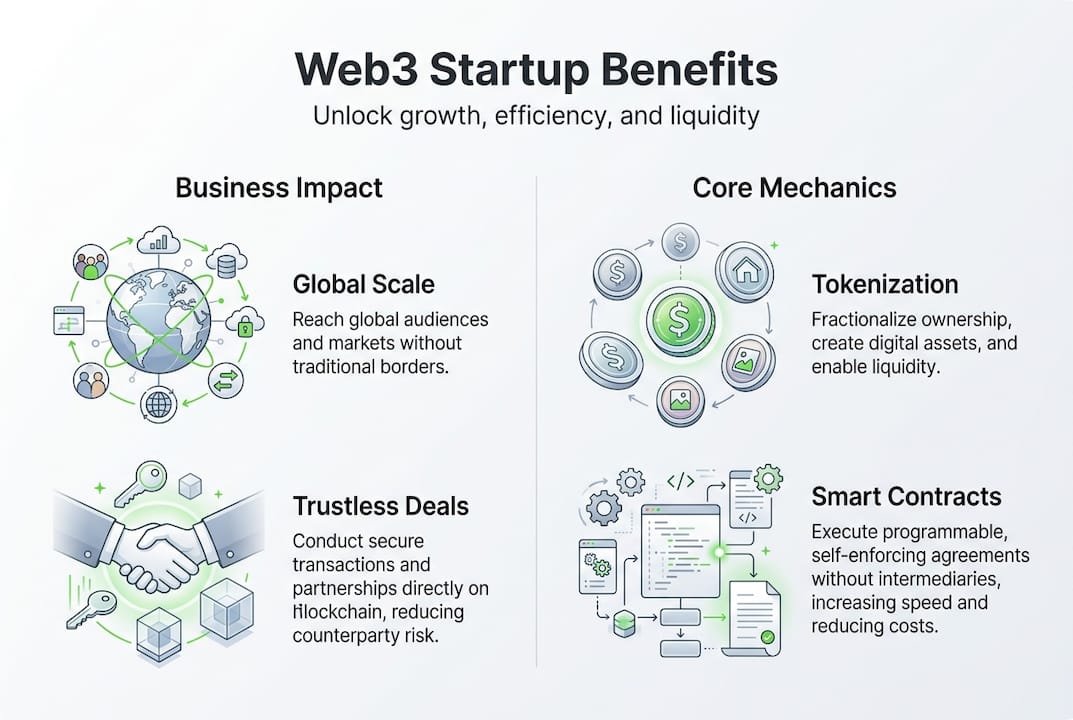
- Smart contracts are self-executing programs stored on a blockchain. When pre-set conditions are met, the contract executes automatically. No lawyer, no bank, no delay. A smart contract can release payment the moment a shipment is confirmed, or distribute royalties the instant a digital asset is resold.
- Tokenization converts ownership rights in any asset, whether property, gold, equity, or intellectual property, into a digital token on a blockchain. That token can be bought, sold, or fractionalized. A $1 million property can become 1 million tokens worth $1 each, making it accessible to a much wider pool of investors.
- Layer 2 scaling solves the cost and speed problem. Base-layer blockchains like Ethereum can be slow and expensive. Layer 2 solutions like Polygon process up to 7,000 transactions per second at $0.01 per transaction, making micro-payments and high-frequency operations commercially viable.
These three components work together. A tokenized asset is governed by a smart contract, and the transactions happen on a Layer 2 network to keep costs low. That is the full stack of a modern Web3 technology deployment.
Pro Tip: When evaluating a blockchain for your project, always check the transaction cost at your expected volume. A platform that costs $0.01 per transaction at 1,000 daily transactions costs $3,650 per year. At 100,000 daily transactions, that becomes $365,000. Layer 2 choices matter enormously at scale.
Our tokenization and dApp services are built with this cost-efficiency in mind, using the right chain for the right use case rather than defaulting to whatever is most popular.
Benefits, challenges, and the real limits of Web3
Web3 is not the right answer for every problem. Being honest about that is what separates serious builders from hype chasers. Here is a clear breakdown of where it wins and where it struggles.
The real advantages:
- True ownership: Users hold their own assets in self-custody wallets. No platform can freeze or confiscate them.
- Censorship resistance: Transactions recorded on a public blockchain cannot be altered or deleted by any single party.
- Trustless operations: Two parties who have never met can transact without a trusted intermediary, because the code enforces the rules.
- Programmable money: Payments can be conditional, automated, and composable with other financial protocols.
| Factor | Web2 | Web3 |
|---|---|---|
| Data ownership | Platform owns user data | User owns their data |
| Intermediaries | Required (banks, platforms) | Optional or eliminated |
| Censorship resistance | Low | High |
| Transaction speed | Fast | Improving with L2 |
| User experience | Polished | Still maturing |
| Gas fees | None | Variable (low on L2) |
Web3 faces real hurdles including complex user experience, scalability limits on base-layer chains, and high gas fees during network congestion. Wallet setup alone loses a significant percentage of new users before they ever interact with a product.
"Decentralization is the right tool when you have multiple parties who do not fully trust each other and need a shared source of truth. For a single-company internal database, it is almost always overkill."
A detailed look at Web3 pros and cons shows that the technology fits best in multi-party environments: supply chains, financial markets, real estate transactions, and creator economies. For a simple internal CRM or a single-company inventory system, a traditional database is faster, cheaper, and easier to maintain. The Web2 vs Web3 comparison is not about which is better overall. It is about which is better for your specific problem.
How to get started: A framework for UAE startups
Moving from interest to deployment does not require a full pivot. Most successful Web3 integrations start as a single feature or pilot program layered onto an existing business model.
Here is a practical framework:
- Identify the coordination problem. Where in your business do multiple parties need to share data or value without fully trusting each other? That is your best entry point for Web3.
- Check regulatory fit. The UAE's VARA (Virtual Assets Regulatory Authority) and ADGM (Abu Dhabi Global Market) both provide clear frameworks for tokenization, stablecoin payments, and digital asset custody. Operating within a free zone gives you regulatory advantages that most global markets cannot match.
- Choose your chain based on use case. Real estate tokenization may suit a public chain like Ethereum or Aptos. A private supply chain audit may suit a permissioned network. Do not let chain loyalty drive a technical decision.
- Start with a minimum viable product. A single smart contract automating one payment workflow is a real Web3 deployment. You do not need a full token economy on day one.
- Plan for UX from the start. The biggest drop-off in Web3 products happens at onboarding. Abstract the wallet complexity wherever possible. Use account abstraction or custodial wallets for non-crypto-native users.
Pro Tip: UAE free zones like DIFC and ADGM allow you to issue tokenized securities and run stablecoin payrolls with regulatory cover. If you are targeting global talent or international investors, this is a genuine competitive advantage over startups based in less regulated markets.
If you are ready to explore what this looks like for your specific business, talk to our team about a Web3 readiness assessment tailored to your industry and the UAE regulatory environment.
Accelerate your Web3 journey with expert help
Knowing the framework is one thing. Building it with the right technical partner is what separates a successful launch from a costly rebuild six months later. Proud Lion Studios works with UAE startups and enterprises to design, build, and deploy Web3 solutions that are grounded in real business outcomes, not theoretical architecture.
Our blockchain development services cover everything from smart contract auditing to full dApp deployment. If tokenization is your priority, our tokenization and dApp team has hands-on experience with real-world asset projects in the UAE market. We also handle crypto payment integration for businesses ready to accept stablecoins or build payroll systems that work across borders. Every solution is built by our UAE-based technical team, with full awareness of VARA and ADGM compliance requirements. Book a free consultation to map your first Web3 milestone.
Frequently asked questions
What types of businesses benefit most from Web3 solutions?
Web3 is ideal for startups needing secure, trustless multi-party transactions, fractional asset ownership, or global community engagement. Decentralized infrastructure enables global scalability without heavy server investment, making it especially powerful for cross-border and community-driven models.
How does tokenization add value to UAE startups?
Tokenization lets startups unlock liquidity by converting assets like property or gold into digital shares that are easy to trade and invest in. PRYPCO Mint tokenized Dh18.5M in Dubai real estate stakes, proving the model works at commercial scale.
Are there regulatory advantages for Web3 in the UAE?
Yes. UAE free zones like VARA and ADGM offer clear, enforceable rules for tokenization, stablecoin payrolls, and digital asset custody, giving UAE-based startups a compliance edge over peers in less regulated markets.
What are the main challenges with adopting Web3?
Complex user experience, scalability limits on base-layer chains, and variable gas fees remain key obstacles. However, UX hurdles and gas fees are improving rapidly with Layer 2 solutions and account abstraction tools that simplify onboarding for non-technical users.