

Many tech leaders believe AI in mobile apps is merely hype, a buzzword without tangible returns. That misconception costs startups and enterprises real competitive advantage. AI genuinely transforms mobile applications by personalizing user journeys, automating support, and surfacing actionable insights from vast data streams. This article clarifies how AI enhances user engagement through personalization and improves operational efficiency via automation. You will learn practical integration methods, strategic benefits, and proven frameworks to deploy AI features that deliver measurable business outcomes in 2026.
Table of Contents
- Understanding AI's role in mobile apps today
- Key AI features powering mobile app innovation
- Challenges and considerations when integrating AI in mobile apps
- Strategic steps to apply AI for impactful mobile app outcomes
- How Proud Lion Studios helps you leverage AI in mobile apps
- What is the role of AI in mobile apps?
Key takeaways
| Point | Details |
|---|---|
| AI transforms mobile apps | Enhances user experience and automates operations through intelligent personalization and predictive analytics. |
| Strategic integration matters | Successful deployment requires clear planning around AI capabilities, data quality, and user privacy. |
| Common use cases deliver value | Chatbots, recommendation engines, and predictive maintenance solve real pain points for startups and enterprises. |
| Challenges are manageable | Data privacy, model bias, and integration complexity can be mitigated with rigorous testing and interdisciplinary teams. |
| Future trends shape competition | Edge AI, natural interfaces, and advanced analytics define competitive advantage in 2026. |
Understanding AI's role in mobile apps today
AI technologies have moved from experimental features to core mobile app infrastructure. Machine learning algorithms analyze user behavior patterns to predict preferences. Natural language processing powers chatbots and voice assistants that understand context and intent. Computer vision enables image recognition for augmented reality experiences and document scanning.
These capabilities deliver concrete benefits. Personalized user experiences increase engagement by surfacing relevant content and features based on individual usage patterns. Predictive analytics forecast user needs before they articulate them, reducing friction in workflows. Automated support through intelligent chatbots resolves common queries instantly, freeing human agents for complex issues.
Typical AI features include recommendation engines that suggest products or content, voice assistants that enable hands-free interaction, and sentiment analysis that gauges user satisfaction from feedback. These features create operational advantages. Data-driven decisions replace guesswork when you analyze usage patterns and conversion funnels. Reduced manual tasks lower costs as automation handles repetitive processes. Scalability improves because AI systems handle growing user bases without proportional increases in support staff.
Pro Tip: Start with AI features addressing your most pressing user pain points for better return on investment. Solve real problems before adding advanced capabilities.
The shift toward AI blockchain game tech in 2026 reflects how startups combine multiple technologies for competitive differentiation. AI becomes the intelligence layer that makes apps adaptive rather than static.
Key AI features powering mobile app innovation
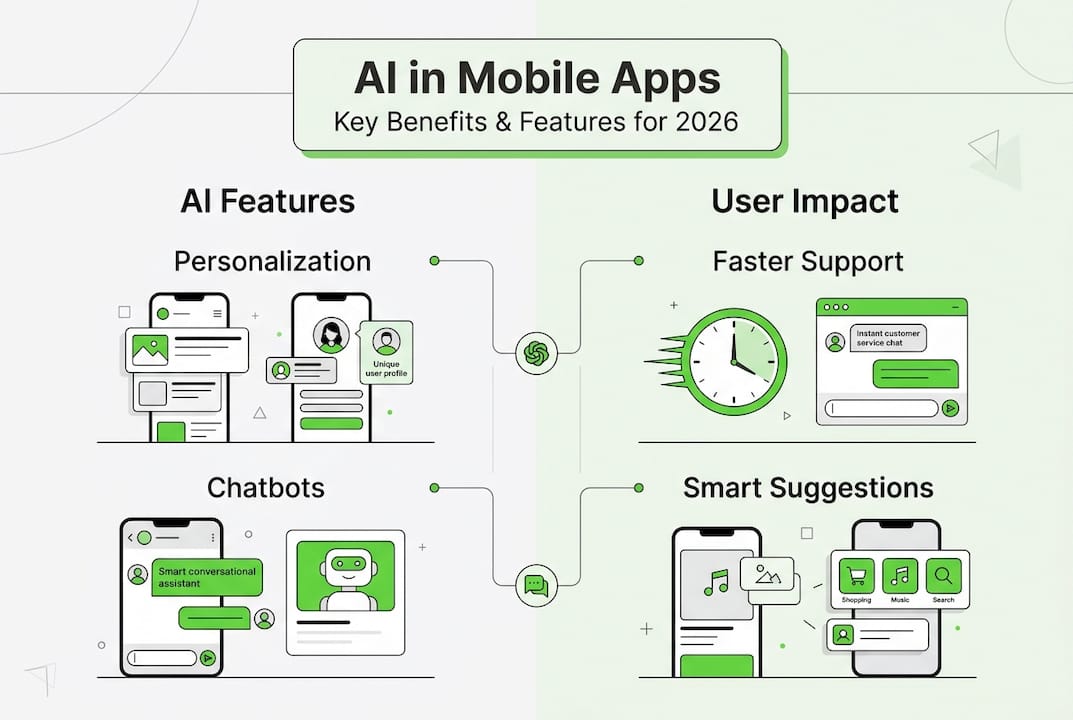
Personalization engines tailor content, notifications, and interface elements to individual users. These systems analyze browsing history, purchase patterns, and interaction timing to create unique experiences. AI-driven personalization and predictive analytics lead user retention metrics because they make apps feel intuitive.
Chatbots handle customer inquiries, troubleshoot issues, and guide users through complex processes. Advanced versions understand context across conversation threads and escalate to human agents when needed. Image recognition features enable visual search, document processing, and augmented reality overlays. Users snap photos to identify products, scan receipts for expense tracking, or overlay furniture in their living rooms.

Predictive analytics forecast user churn, optimal notification timing, and inventory needs. These insights drive proactive interventions that improve satisfaction and revenue. The following table compares major AI features:
| Feature | Primary Use Case | User Impact | Implementation Complexity |
|---|---|---|---|
| Personalization | Content and product recommendations | High engagement and conversion lift | Medium to high |
| Chatbots | Customer support and onboarding | Instant resolution and reduced support costs | Low to medium |
| Image recognition | Visual search and AR experiences | Novel interactions and convenience | High |
| Predictive analytics | Churn prevention and demand forecasting | Proactive retention and inventory optimization | Medium to high |
Integrating these features presents challenges. Data quality issues arise when training datasets contain biases or gaps, leading to inaccurate predictions. Model training demands computational resources and expertise in algorithm selection. User privacy concerns grow as apps collect behavioral data, requiring transparent consent mechanisms and secure storage. Regulatory compliance with data protection laws adds legal complexity.
Common integration obstacles include:
- Insufficient labeled training data for supervised learning models
- Latency issues when processing AI computations on device versus cloud
- Model drift as user behavior evolves over time
- Balancing personalization with user privacy expectations
- Integration complexity with existing app architecture
Successful implementations prioritize one or two features initially. Personalization drives engagement metrics when you have sufficient user data. Chatbots improve support efficiency immediately, even with basic natural language understanding. Startup growth strategies for 2026 emphasize focused AI deployments over attempting comprehensive coverage.
Challenges and considerations when integrating AI in mobile apps
Data privacy remains the foremost concern. Users increasingly scrutinize how apps collect, store, and utilize personal information. AI models require substantial data to train effectively, creating tension between functionality and privacy. Regulations like GDPR and evolving frameworks demand explicit consent, data minimization, and user rights to deletion.
Model bias introduces ethical risks. Training data reflecting historical prejudices produces AI systems that perpetuate discrimination. Facial recognition algorithms showing lower accuracy for certain demographics illustrate this problem. Startups must audit datasets and test models across diverse user segments to identify and correct biases.
Integration complexity challenges technical teams. AI components often require specialized infrastructure, different from traditional app backends. Real-time inference demands low latency, pushing computation to edge devices or optimized cloud endpoints. Maintaining model performance as user bases grow requires monitoring pipelines and retraining schedules.
Integrating AI demands careful data management and ethical considerations to comply with regulations and protect user trust. Enterprises need interdisciplinary teams combining AI expertise with mobile development skills. Data scientists design and train models. Mobile engineers integrate inference engines into apps. Product managers define use cases that balance capability with user expectations.
Mitigation strategies include:
- Rigorous testing across diverse user scenarios and edge cases
- Transparency in communicating what data AI features use and why
- Legal compliance reviews before launching AI-powered features
- Continuous monitoring of model performance and user feedback
- Fallback mechanisms when AI predictions fail or produce unexpected results
Pro Tip: Prioritize scalable AI solutions that adapt as your app and data evolve. Avoid tightly coupled architectures that require complete rebuilds when updating models.
Another consideration involves cost management. Training sophisticated models consumes significant compute resources. Cloud inference charges scale with usage, impacting margins for high-volume apps. Balancing accuracy with computational efficiency becomes critical. Techniques like model quantization and pruning reduce resource demands while maintaining acceptable performance.
User experience design must account for AI unpredictability. Unlike deterministic code, AI models sometimes produce unexpected outputs. Interfaces need graceful error handling and clear explanations when AI features fail. Users should understand they interact with AI and have options to override automated decisions.
Strategic steps to apply AI for impactful mobile app outcomes
A phased AI implementation strategy maximizes benefits while controlling costs and risks. Successful integration follows a structured approach rather than ad hoc experimentation.
- Assess needs by identifying specific user pain points or operational inefficiencies AI could address. Gather data on current performance metrics to establish baselines. Prioritize use cases with clear success criteria and measurable impact.
- Select AI technology matching your use case and constraints. Evaluate pre-trained models versus custom development. Consider on-device processing for privacy and latency versus cloud-based solutions for computational power. Review vendor options and open-source frameworks.
- Develop an MVP focusing on one core AI feature. Build minimal infrastructure to test feasibility and gather initial user feedback. Implement monitoring to track model performance and user engagement with the AI feature.
- Iterate with user data by analyzing how real users interact with AI capabilities. Refine models based on actual usage patterns rather than assumptions. Expand features incrementally as you validate value and learn implementation lessons.
- Scale infrastructure and capabilities as user adoption grows. Optimize model performance and reduce inference costs. Add complementary AI features that build on proven foundations.
Critical considerations at each phase include data availability, team expertise, and budget constraints. Early phases require smaller investments but deliver learning. Later phases demand more resources but benefit from validated approaches.
The following table shows typical timelines, costs, and expected impact:
| Phase | Timeline | Estimated Cost | Expected Impact |
|---|---|---|---|
| Needs assessment | 2 to 4 weeks | $5,000 to $15,000 | Clear roadmap and prioritized use cases |
| Technology selection | 2 to 3 weeks | $3,000 to $10,000 | Optimal tech stack and vendor partnerships |
| MVP development | 8 to 12 weeks | $30,000 to $80,000 | Functional AI feature and initial user feedback |
| Iteration cycle | 4 to 6 weeks per cycle | $15,000 to $40,000 | Improved accuracy and user satisfaction |
| Scaling | 12 to 16 weeks | $50,000 to $150,000 | Production-ready system and expanded capabilities |
Continuous evaluation refines AI capabilities aligned with business goals. Establish key performance indicators like engagement lift, support cost reduction, or conversion rate improvement. Review metrics monthly to identify optimization opportunities. Retrain models quarterly or when performance degrades to maintain accuracy as user behavior evolves.
Successful AI integration requires executive sponsorship and cross-functional collaboration. Product teams define requirements. Engineering builds infrastructure. Data science develops models. Legal ensures compliance. Marketing communicates value to users. This coordination prevents silos that slow progress.
The future of mobile apps 2026 frameworks emphasize iterative development over big-bang launches. Start small, validate assumptions, then expand. This approach reduces risk and builds organizational capability progressively.
How Proud Lion Studios helps you leverage AI in mobile apps
You have learned how AI transforms mobile applications and the strategic steps for integration. Executing this vision requires specialized expertise across AI, mobile development, and user experience design. Proud Lion Studios delivers tailored solutions for startups and enterprises seeking to implement AI-powered mobile apps that drive measurable business outcomes.

Our Dubai-based team combines deep experience in mobile app development iOS Android with cutting-edge AI capabilities. We guide you from needs assessment through production deployment, ensuring your AI features solve real user problems. Our approach integrates blockchain development and smart contract development when projects benefit from decentralized architectures.
Pro Tip: Leveraging expert teams accelerates AI adoption and reduces common pitfalls like poor model performance or integration failures.
We emphasize custom solutions over templates, focusing on your specific business context and user needs. Our client portfolio spans multiple countries, delivering scalable products that future-proof operations. Explore our services to join enterprises already benefiting from intelligent mobile solutions.
What is the role of AI in mobile apps?
What is the role of AI in mobile apps?
AI enhances user experience by personalizing content, predicting needs, and automating interactions within mobile applications. It improves operational efficiency through intelligent analytics, automated support, and process optimization. Core AI technologies like machine learning, natural language processing, and computer vision power features ranging from recommendation engines to voice assistants.
How can startups effectively integrate AI into their mobile apps?
Startups should begin with targeted AI features that solve specific user pain points rather than attempting comprehensive AI coverage. Prioritize use cases with clear success metrics and available training data. Partnering with experienced development teams accelerates implementation and helps avoid common pitfalls around data quality, model performance, and integration complexity.
What are the main challenges of deploying AI in mobile applications?
Data privacy concerns require transparent consent mechanisms and secure storage practices to maintain user trust. Ethical considerations around model bias demand rigorous testing across diverse user segments. Integration complexity challenges teams to balance real-time performance with computational constraints. Ongoing testing and user feedback loops help identify and resolve issues before they impact satisfaction.
What future trends should enterprises watch regarding AI in mobile apps?
Edge AI enables on-device processing for improved privacy and reduced latency, making real-time features more responsive. Natural user interfaces powered by advanced language models create conversational experiences that feel intuitive. AI-powered analytics deliver deeper insights from user behavior, enabling proactive optimizations. Enterprises must maintain adaptability and invest in continuous innovation to capitalize on these evolving capabilities.
Recommended
- Build mobile apps with AI, blockchain & game tech in 2026 - Software & Web3 Development in Dubai | Proud Lion Studios
- Build mobile apps with AI, blockchain & game tech in 2026
- Mobile apps in tech: startup growth strategies for 2026 - Software & Web3 Development in Dubai | Proud Lion Studios
- Mobile apps in tech: startup growth strategies for 2026