
TL;DR:
- Building scalable apps requires a disciplined approach to layered architecture, separation of concerns, and proactive infrastructure setup. Implementing multi-tenant patterns and embedding reliability targets early ensures growth without degradation. Cloud automation and monitoring strategies enable efficient onboarding, cost management, and fault prevention at scale.
Scalable app development is the process of designing and building applications that maintain performance and reliability as user demand grows. Most apps fail at scale not because of bad code, but because of architectural decisions made in the first sprint that nobody revisited. This guide covers the architectural principles, multi-tenant patterns, reliability engineering practices, and cloud infrastructure strategies that product managers and tech entrepreneurs need to build applications that grow without breaking. The frameworks here draw from Android Developers architecture guidance, AWS multi-tenant patterns, and Google SRE reliability principles.
What architectural principles underpin scalable app development?
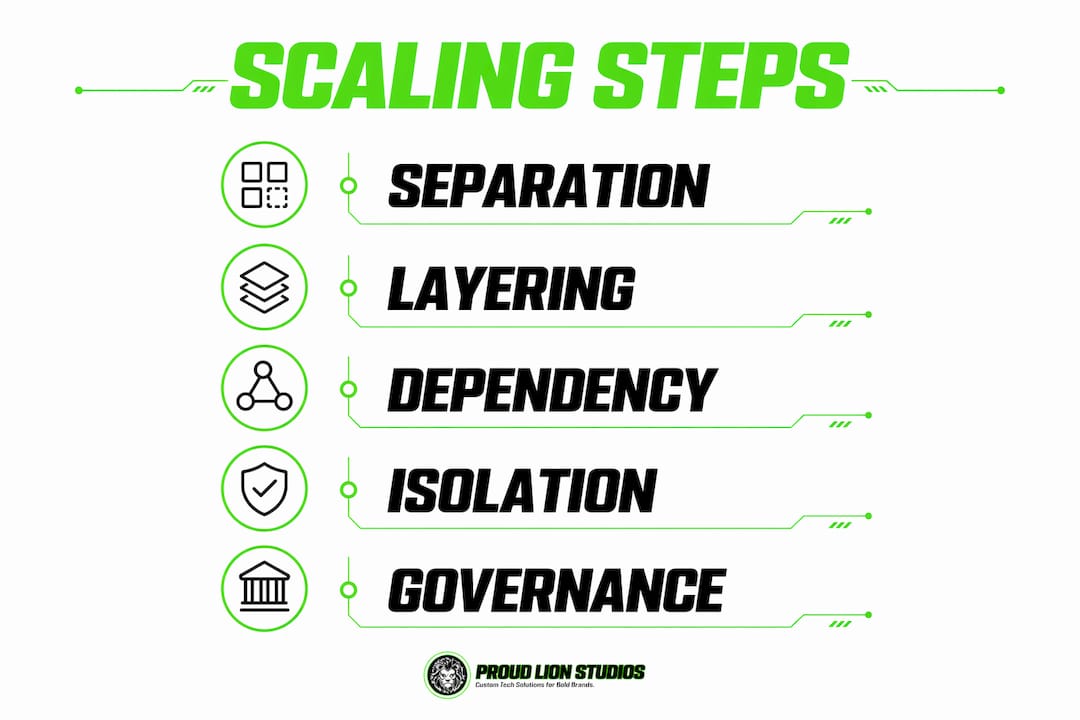
Separation of concerns is the single most important architectural principle for building apps that scale. It means each part of your codebase handles one responsibility, so changes in one layer do not cascade into failures elsewhere. Android Developers define this as the foundation of any maintainable, scalable app, recommending at least two distinct layers with clear boundaries between them.

Layered architecture divides your app into three functional zones: the UI layer, the domain layer, and the data layer. The UI layer renders state and captures user input. The domain layer holds business logic, independent of any framework. The data layer manages sources like APIs, databases, and caches. This separation means you can swap a REST API for GraphQL in the data layer without touching a single line of UI code.
Unidirectional data flow (UDF) is the pattern that keeps state predictable across all three layers. Events flow down from the UI, state flows back up from the data layer, and every component reacts to state changes rather than issuing direct commands. UDF eliminates entire categories of bugs that appear at scale, particularly race conditions in concurrent environments.
Adaptive layouts and data-driven UI complete the picture for mobile app scalability. When your UI responds to data rather than hardcoded conditions, it adapts to phones, tablets, foldables, and desktop windows without a rewrite. State holders like ViewModel preserve UI state across configuration changes such as screen rotations or window resizes, which matters enormously when your app runs on hundreds of device types.
- Define explicit module boundaries using Gradle modules or Swift Package Manager packages.
- Keep domain logic free of Android or iOS framework imports so it can be tested in isolation.
- Use dependency injection frameworks like Hilt or Dagger to manage component lifecycles.
- Treat the data layer as a single source of truth, never letting the UI layer write directly to a database.
Pro Tip: Model your dependency graph before writing a line of code. If a module depends on more than three others, it is doing too much. Split it.
How can multi-tenant architectures enable scalable onboarding?
Multi-tenant architecture is the design pattern where a single infrastructure instance serves multiple customers, called tenants, while keeping their data and compute isolated. For SaaS founders and product managers, this pattern is the difference between onboarding ten customers a week and onboarding ten thousand. The key insight from AWS hybrid multi-tenant patterns is that infrastructure setup and tenant onboarding must be completely decoupled.
AWS structures its hybrid multi-tenant architecture around a four-level hierarchy:
- Tiers define the service class, such as free, standard, or enterprise, and carry all the configuration for that class.
- Cells are isolated compute and network units within a tier, each serving a bounded set of tenants.
- Infrastructure groups bundle the shared resources that cells within a tier consume.
- Tenants are onboarded by assigning them to an existing cell, with no new infrastructure provisioned at that moment.
This structure means pre-wiring downstream dependencies at tier creation reduces infrastructure setup steps by roughly 80%. All the network routing, IAM roles, and service connections exist before the first tenant arrives. Adding a new customer becomes a configuration operation, not an engineering project.
| Scaling lever | When to use it | Effect |
|---|---|---|
| Vertical scaling | Single cell hitting CPU or memory limits | Increases capacity without architectural change |
| Add a new cell | Tenant count per cell approaches threshold | Isolates load, protects existing tenants |
| Add an infrastructure group | Multiple cells need shared resource expansion | Scales shared services without per-cell duplication |
| Add a new tier | New pricing or service class required | Enables differentiated offerings with separate SLAs |
Tenant isolation at the compute and network routing level means one tenant's resource spike cannot degrade another's experience. This is not just a reliability feature. It is a commercial one, because enterprise customers will not sign contracts without guaranteed isolation.
Pro Tip: Set tenant resource thresholds at 70% of cell capacity, not 100%. Triggering a new cell at 100% means your existing tenants already experienced degradation before you acted.
What reliability engineering practices support scalability?
Google's SRE practices define reliability at scale as an engineering discipline, not an operational one. The distinction matters. Operational reliability is reactive: you fix things when they break. Engineering reliability is proactive: you define what "broken" means before it happens, then build systems that detect and respond to it automatically.
Service Level Objectives (SLOs) are the quantified targets that make this possible. An SLO might state that 99.9% of API requests must complete within 200 milliseconds over a 30-day window. The error budget is the inverse: 0.1% of requests may fail or be slow. When the error budget is healthy, teams can ship aggressively. When it is depleted, all releases pause until reliability recovers. This mechanism aligns product velocity with system stability in a way that no amount of process documentation can replicate.
Progressive rollouts reduce the blast radius of every release. Rather than deploying to all users simultaneously, you release to 1%, then 5%, then 25%, monitoring error rates and latency at each stage. Automated CI/CD pipelines with blue/green or canary deployment strategies formalize this process, integrating testing and scanning gates that must pass before the next stage unlocks.
"Engineering reliability is embedded into every stack layer and decision for serving billions of users without failure." — Google SRE evolution, USENIX
STAMP and STPA methods extend reliability engineering beyond component failure analysis. System-Theoretic Process Analysis models the entire system as a set of control relationships, identifying hazardous control actions before they cause incidents. For apps serving millions of users, this approach catches failure modes that traditional fault-tree analysis misses entirely.
- Define SLOs for every user-facing API before launch, not after the first outage.
- Run blameless postmortems after every incident and publish findings to the full engineering team.
- Build isolation boundaries between services so a failure in one does not cascade to others.
- Use SRE principles to embed reliability targets into architecture reviews, not just incident response.
Pro Tip: Treat your error budget as a product metric, not a technical one. Show it on the same dashboard as revenue and user growth so leadership understands the cost of shipping too fast.
How to build a secure and scalable cloud infrastructure for your app?
The AWS Enterprise Landing Zone pattern is the production-ready multi-account architecture that large-scale applications use as their cloud foundation. It separates workloads into distinct AWS accounts by environment (development, staging, production) and function (security, networking, shared services), so a misconfiguration in one account cannot compromise another.
| Infrastructure component | Purpose | Scalability benefit |
|---|---|---|
| Multi-account structure | Workload isolation by environment and function | Blast radius containment across teams and services |
| Centralized logging | Aggregated CloudTrail, VPC flow logs, and application logs | Single pane for audit, debugging, and anomaly detection |
| Service Control Policies (SCPs) | Governance guardrails across all accounts | Prevents configuration drift as team size grows |
| Automated CI/CD pipelines | Standardized deployment across all environments | Consistent, repeatable releases at any scale |
| Multi-region replication | Active-active or active-passive across AWS regions | Geographic resilience and latency reduction |
Centralized logging and tag policies create the cost transparency that product managers need when scaling. Without tags on every resource, AWS bills become unreadable at scale. With them, you can attribute infrastructure spend to specific features, teams, or tenants, which turns cloud cost from a fixed overhead into a variable you can manage.
Serverless services like AWS Lambda and container orchestration via Amazon ECS or EKS handle traffic spikes without manual intervention. You pay for compute only when it runs, and the platform scales instances automatically. For apps with unpredictable traffic patterns, this is significantly more cost-effective than provisioning for peak load on dedicated servers.
Pro Tip: Deploy your scalable web app monitoring stack before your application stack. Observability is not a feature you add later. It is the foundation everything else runs on.
What are common pitfalls and troubleshooting strategies when scaling apps?
The most common scalability bottleneck is not infrastructure. It is state management in the UI layer. When developers store application state in UI components rather than dedicated state holders, configuration changes like screen rotations destroy that state. ViewModel-based state preservation solves this, but only if it is adopted from the start, not retrofitted after users report data loss.
Onboarding delays in multi-tenant systems almost always trace back to infrastructure provisioning being coupled to tenant creation. If your system spins up new databases or network resources per tenant at signup, you have a scaling ceiling. Decoupling setup from onboarding, as the AWS hybrid pattern demonstrates, transforms a multi-week engineering operation into a configuration-only task.
Monitoring tenant-specific metrics like memory usage, latency, and error rates is the early warning system that prevents reactive firefighting. Establish baselines during tenant onboarding and alert on deviations above 20% to catch misconfigurations before they affect the broader user base. Without per-tenant visibility, you are debugging production with a blindfold on.
- Audit your dependency graph quarterly. Circular dependencies are the silent killer of modular architectures.
- Profile memory allocation under load before each major release, not just after incidents.
- Use feature flags to decouple deployment from release, so you can ship code without activating features.
- Review system design fundamentals to identify architectural gaps before they become production incidents.
Pro Tip: Capacity planning is not a one-time exercise. Run a quarterly review of your scaling thresholds against actual growth curves. The cost of over-provisioning is far lower than the cost of an outage at a growth inflection point.
Key takeaways
Scalable app development requires architectural discipline, tenant isolation, reliability targets, and cloud governance to work together from day one.
| Point | Details |
|---|---|
| Separation of concerns | Define clear layer boundaries in UI, domain, and data to prevent cascading failures at scale. |
| Multi-tenant decoupling | Pre-wire infrastructure at tier creation so tenant onboarding becomes configuration-only, not engineering work. |
| SLOs and error budgets | Quantify reliability targets before launch so teams can balance release velocity against system stability. |
| Enterprise Landing Zone | Use multi-account AWS architecture with centralized logging and SCPs to govern infrastructure as it grows. |
| Proactive monitoring | Establish per-tenant baselines at onboarding and alert on deviations to catch problems before users do. |
Why I stopped treating scalability as a future problem
Most teams I have worked with treat scalability as something to address after product-market fit. The logic sounds reasonable: why over-engineer before you know what you are building? The problem is that the architectural decisions made in week one are the hardest to undo in month eighteen. I have seen teams spend more engineering time refactoring a tightly coupled monolith than it would have taken to define proper layer boundaries at the start.
The SRE approach changed how I think about this. Reliability is not a feature you bolt on. It is a set of constraints you design around. Defining SLOs before launch forces a conversation about what the product actually promises users, which is a product conversation as much as an engineering one. Teams that skip this step end up with implicit reliability expectations that nobody agreed to and nobody can measure.
Cloud infrastructure has made proactive design more accessible than ever. The AWS Enterprise Landing Zone pattern, which would have required months of custom work five years ago, is now a well-documented reference architecture with automation tooling. The barrier to building correctly from the start is lower than the barrier to fixing it later. That asymmetry should inform every architectural decision you make in 2026.
If you are building a decentralized application or a SaaS platform, the principles here apply regardless of stack. Separation of concerns, tenant isolation, and reliability targets are not framework-specific. They are the discipline that separates apps that survive growth from apps that collapse under it.
— Amal
Build your scalable app with Proudlionstudios

Proudlionstudios is a Dubai-based technology studio that builds production-grade applications for startups and enterprises across blockchain, AI, and mobile platforms. The team has delivered blockchain development services for clients across multiple countries, applying the same architectural principles and cloud infrastructure patterns covered in this guide. Whether you are building a multi-tenant SaaS platform, a decentralized application, or a high-performance mobile product, Proudlionstudios designs for scale from the first sprint. Explore how the studio's engineering approach can accelerate your project at proudlionstudios.com.
FAQ
What is scalable app development?
Scalable app development is the practice of designing applications so they maintain performance and reliability as user load, data volume, and feature complexity increase. It relies on architectural patterns like layered architecture, separation of concerns, and multi-tenant infrastructure to handle growth without full rewrites.
What are the core steps for building a scalable app?
Define layer boundaries (UI, domain, data), adopt unidirectional data flow, decouple tenant onboarding from infrastructure provisioning, set SLOs before launch, and deploy on a multi-account cloud foundation with centralized logging and automated pipelines.
How does multi-tenant architecture help scale apps?
Multi-tenant architecture lets a single infrastructure instance serve thousands of customers by isolating compute and network resources per tenant. Pre-wiring dependencies at tier creation, as the AWS hybrid pattern demonstrates, reduces infrastructure setup steps by roughly 80% and makes onboarding a configuration task rather than an engineering one.
What SRE practices matter most for app scalability?
Service Level Objectives, error budgets, progressive rollouts, and blameless postmortems are the four SRE practices that most directly support scalability. Google's SRE evolution shows that embedding reliability targets into architecture decisions, rather than treating them as operational concerns, is what enables serving at massive scale.
How do I choose between serverless and container-based infrastructure for scaling?
Serverless services like AWS Lambda suit unpredictable or spiky traffic because they scale to zero and charge only for execution time. Container orchestration via Amazon ECS or EKS suits workloads with consistent traffic or stateful services that need finer control over runtime environments. Review your SaaS architecture plan to match infrastructure choice to your actual traffic profile.