
TL;DR:
- Scalable app development ensures applications perform reliably and cost-effectively as user demand and data grow.
- It is a strategic investment that protects revenue, brand reputation, and operational stability during scaling.
Scalable app development is defined as the practice of building applications that maintain performance, reliability, and cost efficiency as user loads, data volumes, and feature sets grow. For tech entrepreneurs and product managers, why scalable app development matters comes down to one fact: applications that cannot scale become liabilities the moment growth arrives. AWS Auto Scaling, DORA metrics, and BCG's shared ontology research each confirm that scalability is not a technical preference. It is a financial and operational strategy that determines whether your product survives its own success.
Why scalable app development matters for operational reliability
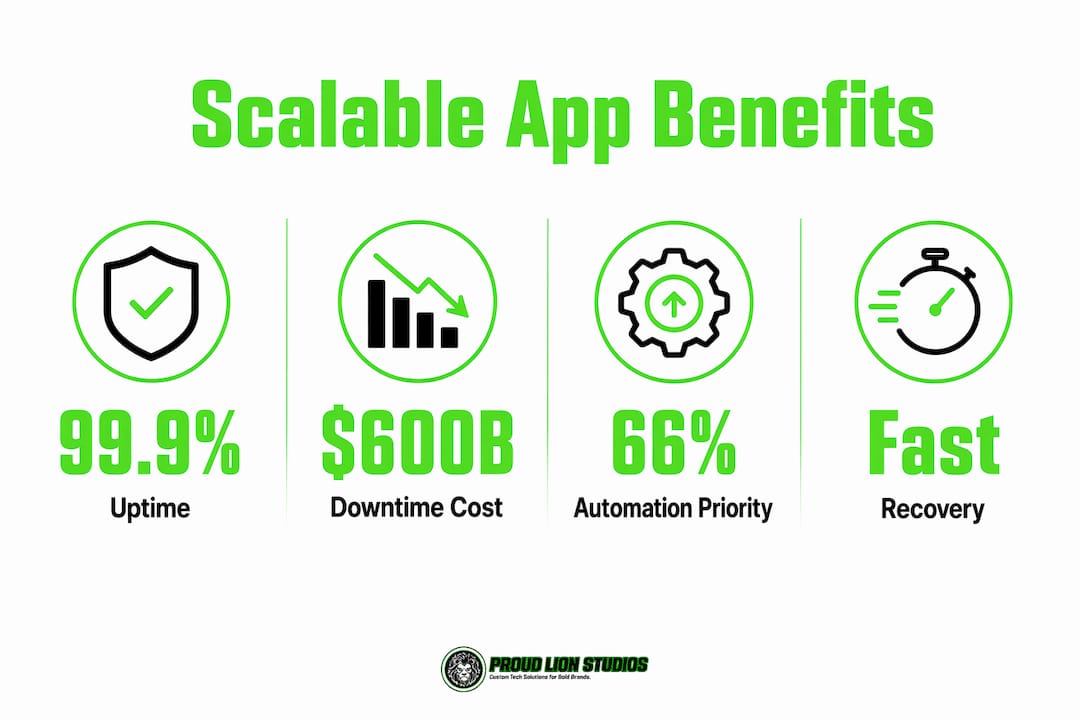
Unplanned downtime is the most direct financial consequence of building an application that cannot handle growth. Global 2000 companies lose $600 billion annually to unplanned downtime, with losses running at $15,000 per minute and an average stock price drop of 3.4% per incident. That number means a single major outage can erase months of revenue growth and permanently damage customer trust.
The connection between scalability and downtime is direct. Applications built without scalable architecture hit capacity ceilings during demand spikes, triggering cascading failures that are expensive and slow to recover from. A retail app that collapses during a flash sale, or a SaaS platform that degrades during a product launch, does not just lose that day's revenue. It loses the customers who experienced the failure.
Scalable app development is a core financial risk strategy, not just a technical quality standard. It protects revenue, brand equity, and shareholder value from the compounding costs of service failures.
66% of ITOps leaders now prioritize automation to reduce human error, which remains the leading cause of downtime. This means the scalability conversation has moved beyond infrastructure capacity into observability and automated recovery. Applications that expose internal health signals through structured logging, distributed tracing, and real-time alerting give engineering teams the visibility to catch problems before users do.
Pro Tip: Design your application to fail gracefully. Circuit breakers, retry logic, and fallback responses keep your app functional under partial failure conditions. Recovery speed matters as much as prevention.

Scalability failures often stem from operational debt accumulation: manual deployment processes, fragile release pipelines, and missing observability. These are not infrastructure problems. They are design and practice problems that compound over time.
How cloud auto-scaling controls costs under variable demand
AWS Auto Scaling is the most widely deployed mechanism for matching infrastructure capacity to real-time demand. It adjusts compute resources dynamically so you pay for what you use, not what you might need. For product managers watching unit economics, this distinction matters enormously.
The practical benefit is twofold. First, you avoid paying for idle capacity during low-traffic periods. Second, you avoid service degradation during demand spikes because capacity expands automatically before users feel the impact. AWS recommends utilization targets between 40% and 70% to balance cost efficiency with headroom for sudden load increases. Targeting 90% utilization looks cheap on a dashboard until a traffic spike arrives and your application has no room to breathe.
| Scaling strategy | Best use case |
|---|---|
| Target tracking | Maintain a specific CPU or request metric automatically |
| Step scaling | Respond to threshold breaches with defined capacity increments |
| Predictive scaling | Use historical patterns to pre-provision before anticipated peaks |
| Scheduled scaling | Handle known events like product launches or seasonal traffic |
The retail and streaming industries demonstrate this most clearly. A streaming platform serving a new series release can see traffic multiply within minutes. Without auto-scaling capacity management, the engineering team faces a choice between over-provisioning expensive infrastructure year-round or risking outages during peak moments. Auto-scaling eliminates that trade-off entirely.
Pro Tip: Set scale-in cooldown periods carefully. Scaling down too aggressively after a spike can leave your application under-resourced if demand rebounds quickly. Test your thresholds against realistic traffic simulations before going live.
The broader principle here applies beyond AWS. Whether you use Google Cloud's managed instance groups, Azure's virtual machine scale sets, or Kubernetes horizontal pod autoscaling, the logic is identical. Capacity should follow demand, not anticipate it with expensive guesswork.
Why shared semantic foundations determine AI scalability
Most product teams treat scalability as a compute and infrastructure problem. BCG's research identifies the deeper bottleneck: data semantics and integration complexity. Without a shared semantic foundation, connecting systems generates exponential overhead that eventually makes scaling impossible regardless of how much infrastructure you add.
The math is stark. Connecting four systems through point-to-point integrations requires twelve separate connections. Add a fifth system and you need twenty. With a shared ontology, each new system requires only one connection to the shared layer. This is why integration complexity grows exponentially without semantic consistency, while a data-centric model scales linearly. For AI-powered applications, this distinction determines whether your models improve with scale or degrade under it.
The practical implications for product teams building AI features include:
- Consistent entity definitions across services prevent AI models from receiving contradictory inputs that produce unreliable outputs or hallucinations.
- Reusable semantic layers allow AI models trained on one domain to transfer knowledge to adjacent domains without retraining from scratch.
- Digital twins built on shared ontologies can simulate real-world behavior accurately because every connected system speaks the same data language.
- Reduced integration debt means engineering teams spend time building features rather than maintaining brittle data pipelines between systems.
The true scalability bottleneck for most AI-integrated applications is organizational data semantics, not compute capacity. Shifting to a data-centric design model early in development prevents the kind of technical debt that forces expensive rewrites at scale. For entrepreneurs building platforms that will eventually incorporate AI features, this is the architectural decision that determines long-term viability. You can read more about this challenge in the context of AI ROI and strategy.
How delivery practices support scalable, stable app growth
Architecture decisions determine what your application can handle. Delivery practices determine how reliably you can change it. DORA metrics, developed through research across thousands of software teams, provide the clearest framework for measuring delivery scalability.
Elite teams achieve:
- Deployment frequency: Multiple deployments per day, reducing the size and risk of each individual change.
- Change failure rate: Between 0% and 15%, meaning the vast majority of releases reach production without incident.
- Mean time to recovery (MTTR): Under one hour, so when failures occur, they are contained and resolved before most users notice.
The Batch Size Paradox is the counterintuitive insight here. Most teams assume that deploying less frequently reduces risk because each release is more thoroughly tested. Smaller, frequent releases actually reduce risk because each change is smaller, easier to understand, and faster to roll back if something goes wrong. Large releases accumulate risk. Small releases distribute it.
The architectural practices that support this delivery model are specific. Modularity allows teams to deploy components independently without touching unrelated parts of the system. Feature flags decouple deployment from release, letting you ship code to production before activating it for users. Trunk-based development with automated testing and feature flags reduces the blast radius of any single failure, preventing large outages during periods of rapid growth.
Observability ties all of this together. Teams that instrument their applications with distributed tracing, structured logs, and real-time dashboards can identify the source of a failure in minutes rather than hours. This capability is what separates teams that scale confidently from teams that treat every deployment as a risk event. For a deeper look at how these practices connect to product velocity, the scalable innovation framework at Proudlionstudios covers the organizational side of this challenge.
Pro Tip: Invest in observability infrastructure before you need it. Retrofitting distributed tracing and structured logging into a production system under load is significantly harder than building it in from the start.
Scalable architectures handle more users, data, and change without requiring frequent rewrites. The teams that achieve this do so by treating delivery practices as a first-class engineering concern, not an afterthought.
Key takeaways
Scalable app development succeeds when infrastructure, data semantics, and delivery practices are designed together from the start, not patched in after growth exposes their absence.
| Point | Details |
|---|---|
| Downtime is a financial crisis | Unplanned outages cost Global 2000 companies $600 billion annually, making scalability a revenue protection strategy. |
| Auto-scaling cuts infrastructure waste | AWS-style dynamic capacity management eliminates idle costs and prevents degradation during demand spikes. |
| Semantic foundations determine AI scale | BCG research shows point-to-point integrations grow exponentially; shared ontologies keep complexity linear. |
| DORA metrics measure delivery health | Elite teams deploy frequently with low failure rates and sub-hour recovery, reducing release risk at scale. |
| Observability is non-negotiable | Building in distributed tracing and structured logging from day one prevents costly retrofits under production load. |
The scalability decision you make on day one
I have watched product teams make the same mistake repeatedly. They build fast, ship fast, and defer scalability decisions until growth forces the issue. By that point, the cost of fixing the architecture is measured in months of engineering time and millions in lost revenue, not sprint cycles.
The uncomfortable truth is that scalability is not a feature you add later. It is a set of decisions embedded in your data model, your deployment pipeline, and your infrastructure configuration from the first line of production code. Teams that treat it as a day-one concern ship faster at scale, not slower. The DORA research makes this clear: high-performing teams achieve both speed and stability simultaneously. The trade-off between moving fast and staying reliable is a false choice created by poor architectural foundations.
What I find most underappreciated is the semantic layer problem BCG identified. Entrepreneurs building AI-powered products focus on model quality and compute costs. Almost none of them think about whether their data architecture can support the integrations their AI will eventually need. That oversight creates the kind of technical debt that does not show up until you are trying to scale from ten integrations to fifty, and suddenly your AI outputs are inconsistent and your engineering team is spending 70% of their time on data plumbing.
The product managers and founders who build durable companies treat scalability as a financial discipline. They ask: what does it cost us per hour if this fails? What does it cost us to fix this architecture in two years versus now? Those questions lead to better decisions than any technical framework I have seen. Start with the web app scalability principles that connect infrastructure choices to business outcomes, and build from there.
— Amal
Build scalable apps with Proudlionstudios
Proudlionstudios builds applications designed to grow with your business, not against it. The Dubai-based team specializes in mobile app development for iOS and Android, with architecture decisions made for performance at scale from the first sprint. For teams building on blockchain, Proudlionstudios delivers smart contract development and blockchain platforms that handle growing transaction volumes without redesign. Every engagement is custom, not templated, because scalability requirements differ by industry, user base, and growth trajectory.

If your product roadmap includes AI integration, high-traffic mobile features, or decentralized infrastructure, Proudlionstudios has the technical depth to build it right the first time. Contact the team to discuss your scalability requirements.
FAQ
What is scalable app development?
Scalable app development is the practice of building applications that maintain performance and reliability as user loads, data volumes, and feature complexity increase. It combines infrastructure design, delivery practices, and data architecture to support growth without requiring full system rewrites.
How does scalability reduce financial risk?
Unplanned downtime costs Global 2000 companies $600 billion annually, with losses of $15,000 per minute. Scalable architecture prevents the capacity failures that cause outages, directly protecting revenue and brand equity.
What is AWS Auto Scaling and why does it matter?
AWS Auto Scaling dynamically adjusts cloud capacity to match real-time demand, eliminating idle infrastructure costs and preventing service degradation during traffic spikes. It is the primary mechanism for cost-efficient capacity management in cloud-native applications.
Why do DORA metrics matter for scalable development?
DORA metrics measure deployment frequency, change failure rate, and recovery time. Elite teams deploy frequently with low failure rates, proving that scalable delivery practices improve both speed and stability rather than forcing a trade-off between them.
What is a shared ontology and why does it affect AI scalability?
A shared ontology is a common semantic framework that defines how data entities are named and related across systems. Without one, connecting four systems requires twelve point-to-point integrations; with one, it requires four. This reduction in integration complexity is what allows AI-powered applications to scale without exponential technical debt.