

Public blockchains give you open participation and censorship resistance at the cost of speed and privacy; private blockchains give you speed, control, and compliance at the cost of decentralization. Choose public when trustlessness and composability matter more than throughput. Choose private when regulatory obligations and known participants matter more than open access. Most serious enterprise projects, though, end up somewhere in between.
TL;DR:
- Public blockchains rely on cryptoeconomic consensus mechanisms like Proof of Work or Proof of Stake, which secure networks through economic costs for attacks, making censorship difficult.
- Private blockchains operate with known validators using faster consensus protocols like PBFT, providing higher throughput and deterministic finality, but sacrificing decentralization.
- Hybrid models combine private execution layers with public anchoring, offering speed and privacy benefits while still enabling external verification and auditability.
- The choice between public, private, or hybrid depends on specific needs for trust, compliance, speed, and decentralization, not on which is technically better.
- Proper architecture planning includes early scope definition, regulatory mapping, security reviews, and external legal and compliance considerations before development.
Table of Contents
- Public vs Private Blockchain: The Core Definitions
- How Do Consensus and Governance Actually Differ?
- Security, Trust, and the Real Risk Trade-offs
- Performance, Finality, and What They Actually Cost
- Privacy, Compliance, and Regulatory Fit
- Which Use Cases Actually Fit Which Model?
- Hybrid Architectures: Getting the Best of Both
- What Should Architects Actually Check Before Building?
- What the Trade-offs Actually Mean for Your Decision
- Ready to Build the Right Chain for Your Business?
- Sources
- FAQ
Public vs Private Blockchain: The Core Definitions
The public vs private blockchain distinction comes down to one question: who is allowed to participate? A public blockchain is permissionless. Anyone can join, read the ledger, submit transactions, and help validate them under pseudonymous identities, with no central authority granting access. A private blockchain is permissioned. A single organization or a defined group controls who can join, what they can see, and how the network operates.
That single design choice cascades into everything else, from consensus mechanics to who bears legal liability when something goes wrong. According to Chainlink's comparison of public and private blockchains, public networks are transparent by default, while private networks offer controlled transparency built around administrator-granted access.
A third category sits between the two: consortium blockchains, run by a coalition of organizations rather than one operator or an open crowd. Think of a group of banks or shipping companies jointly running validator nodes. No single member controls the network, but membership is still closed to outsiders.
The practical taxonomy breaks down like this:
- Public/permissionless: open participation, pseudonymous identities, community-driven governance (Bitcoin, Ethereum)
- Private/permissioned: restricted participants, known and vetted validators, centralized or near-centralized operator control
- Consortium/permissioned: shared governance among a fixed group of trusted organizations
- Hybrid: private execution layers that anchor proof of their state onto a public chain for external verification
Understanding where a project falls on this spectrum before writing a single line of smart contract code saves months of rearchitecting later.
How Do Consensus and Governance Actually Differ?
The technical machinery behind permissionless vs permissioned networks explains almost every downstream trade-off architects wrestle with. It's not a style choice. It's the engine.
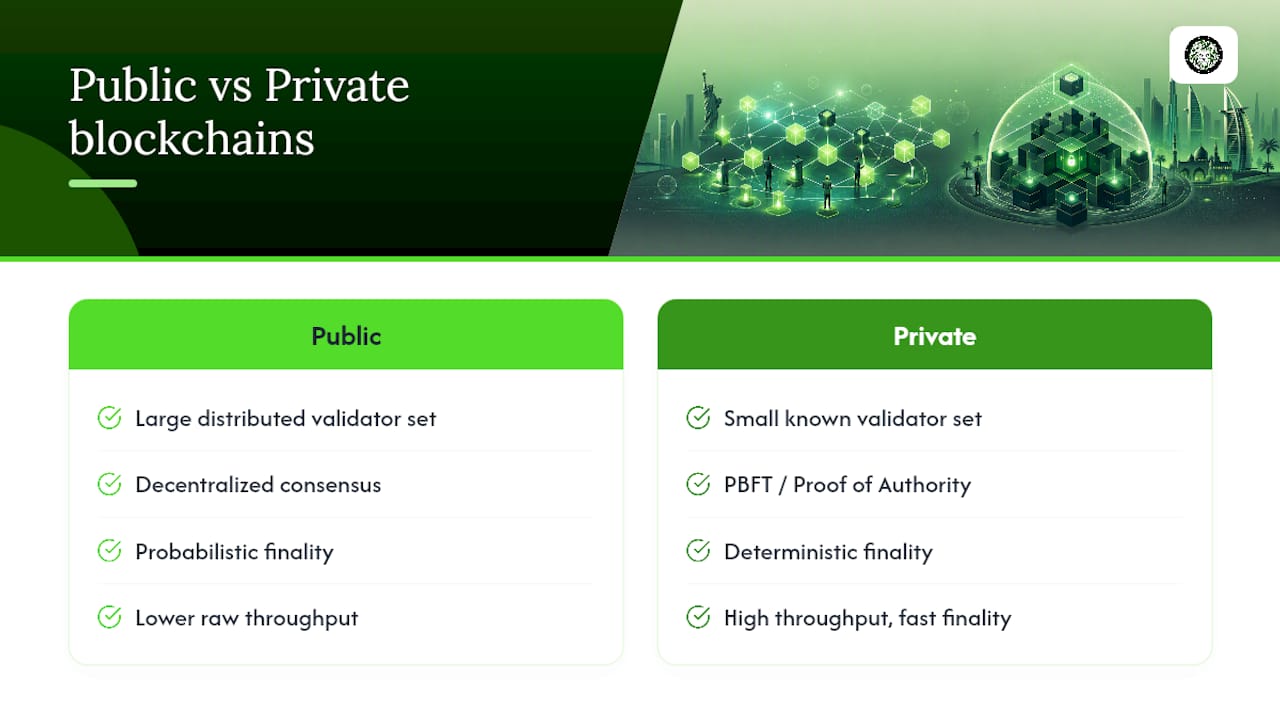
- Consensus mechanism. Public chains rely on cryptoeconomic consensus like Proof of Work or Proof of Stake, where anonymous, globally distributed node operators compete or stake capital to validate blocks. Private chains typically run Practical Byzantine Fault Tolerance (PBFT) or Proof of Authority, where a small set of pre approved validators simply agree on the next block. Chainlink notes that this shift from global coordination to a known validator set is precisely why permissioned networks post higher throughput and lower latency.
- Validator identity and accountability. Public validators are pseudonymous; bad behavior is punished through slashing stakes or losing mining rewards, an economic deterrent rather than a legal one. Private validators are known entities, often bound by service agreements, which means accountability runs through contracts and reputational risk instead of cryptoeconomics.
- Governance and upgrades. Public chains change through community proposals, developer consensus, and sometimes contentious forks, a slow but resistant-to-capture process. Private and consortium chains change when the operator or member coalition agrees, which is faster but concentrates power in fewer hands.
That last point deserves a second look, because it is where "advantages of private blockchains" and "risks of private blockchains" turn out to be the same coin. Faster governance is genuinely useful for enterprises that need to patch a bug or update business logic overnight. It also means a single operator, or a small consortium acting in concert, can rewrite the rules with far less friction than a public chain's stakeholders ever could.
Security, Trust, and the Real Risk Trade-offs
Public blockchains earn trust through cost, not permission. Attacking Bitcoin or Ethereum means outspending or out-staking a globally distributed network, an expense that scales into the billions for chains with real value locked. That cost creates censorship resistance: no government, company, or hacker can quietly rewrite history without controlling a majority of the network's economic weight.
Private blockchains earn trust through gatekeeping. Because every validator is known and vetted, incident response is dramatically faster. If something goes wrong, the operator can pause the network, roll back a bad transaction, or revoke a bad actor's access within minutes rather than waiting on community consensus. The Ethereum Foundation's own analysis of public and private blockchains points out that this control comes at a price: private networks trade away some of the trustlessness that makes public cryptoeconomics work, which raises the risk of collusion or unilateral rule changes by whoever holds the keys.
This is exactly why enterprise private-chain deployments rarely run on code alone. According to the Blockchain Research Lab's working paper on public versus private blockchains, private and consortium networks typically pair their technical controls with legal contracts, service level agreements, and external arbitration clauses to recreate guarantees that public networks get for free through game theory. In other words, when there's no cryptoeconomic penalty for misbehaving, someone has to sign a contract instead.
For a technology lead evaluating risk tolerance, the question isn't "which is more secure" in the abstract. It's whether your threat model includes a hostile outside world (favor public) or a need for rapid internal correction among trusted parties (favor private).
Performance, Finality, and What They Actually Cost
Throughput numbers explain why so many enterprises default to private chains for high-volume workloads. A permissioned network running PBFT or Proof of Authority can finalize transactions in a second or two because a small, known validator set just needs to agree, not coordinate with thousands of anonymous nodes across the globe. Public base layers, by contrast, were built to prioritize decentralization over raw speed, which shows up directly in fees and confirmation times during periods of congestion.
That gap has narrowed. Layer 2 rollups, sidechains, and sharding now let public networks batch thousands of transactions off the main chain and settle them in bulk, cutting both cost and wait time while still inheriting the base layer's security guarantees. Alchemy's overview of permissionless vs permissioned blockchains frames rollups and interoperability layers as the tools that let architects borrow strengths from both models instead of picking one and living with its limits forever.
Finality matters just as much as speed for anything touching real settlement. Public chains offer probabilistic finality that strengthens over time (a transaction six confirmations deep is safer than one confirmation deep). Private chains, with their smaller validator sets, typically achieve deterministic finality within a single block. For a payments platform processing thousands of transactions an hour, that difference dictates whether you can safely tell a customer "this is done" the moment a block closes, or whether you need to build in a waiting period. Get this wrong at the design stage and you'll be retrofitting settlement logic under pressure later.
Privacy, Compliance, and Regulatory Fit
Regulated industries rarely have the option to put customer data in plain sight, which is exactly the problem public blockchains create by default. Every transaction on a public ledger is visible to anyone who wants to look. That transparency is the point for auditability, but it's a liability the moment personally identifiable information or contract terms end up on-chain permanently and irreversibly.
Permissioned networks solve this with access control baked into the protocol layer. Chainlink observes that administrators on private networks can grant and revoke read and write permissions per participant, which lets a hospital network, for instance, share treatment records with authorized providers only, while keeping the same data invisible to everyone else on the network.
The safest pattern for public deployments that still need some transparency is to keep sensitive data off-chain entirely and record only a cryptographic hash or reference on the ledger. The chain proves a record existed and wasn't altered, without ever exposing the underlying data.
A working compliance checklist for either model should cover:
- KYC/AML controls at the point of onboarding, whether enforced by a permissioning layer or an off-chain identity provider
- Audit trails that satisfy your specific regulator, not a generic "blockchain is transparent" assumption
- Data residency and PII handling rules, especially for anything touching health or financial records
- Contractual backstops covering what happens when the technical system and the legal agreement disagree
Pro Tip: Never assume "on a blockchain" satisfies a compliance requirement on its own. Regulators care about who can access data, how long it's retained, and who's accountable, not which consensus algorithm you picked.
Which Use Cases Actually Fit Which Model?
Mapping a business problem to the wrong chain type is one of the most expensive mistakes a project can make, usually discovered six months into development when compliance or performance requirements collide with the architecture. Chainlink's guidance is direct on this: private blockchains suit enterprise and government applications needing regulatory compliance and data privacy, while public blockchains suit decentralized finance, NFT marketplaces, and anything that depends on open composability.
- Public fits: DeFi protocols, public provenance tracking for luxury goods or art, open token ecosystems where third-party developers need to build without permission
- Private fits: internal interbank settlement, supply-chain data sharing that requires confidentiality between competitors, electronic health records shared across a defined provider network
- Consortium fits: industry utilities where several organizations need shared infrastructure but no single member should control it, like trade finance platforms jointly run by multiple banks
- Hybrid fits: situations needing both public auditability and private data control, such as a private supply-chain ledger that periodically publishes proof to a public chain
Public networks already anchor real economic activity at scale. Plasma's comparison of public and private blockchains notes that public chains power large composable markets like DeFi precisely because openness lets protocols plug into each other without permission, something a walled-off private network structurally cannot offer. Enterprises chasing that same composability without giving up compliance is exactly why hybrid architecture has become the default recommendation rather than the exception.
Hybrid Architectures: Getting the Best of Both
Anchoring is the simplest hybrid pattern in production today. A private network processes and stores sensitive transaction data internally, then periodically writes a cryptographic hash of that state to a public chain. Anyone can verify the private ledger hasn't been tampered with, without ever seeing the underlying records. It's proof without exposure.

Rollups and sidechains flip that pattern around: they let a public network's security guarantees extend outward while execution happens somewhere faster and cheaper. A project can run its core logic on a permissioned execution layer and settle final state on a public chain, capturing speed and privacy on one side, and censorship-resistant settlement on the other. Our guide to blockchain interoperability for developers breaks down how these patterns connect in practice.
Bridges, which move assets or data between chains, are the weakest link in most hybrid designs. They've been the target of some of the largest exploits in blockchain history, because they concentrate value and trust into a single piece of connecting infrastructure. Any hybrid design should treat bridge security as a first-class requirement, not an afterthought bolted on after the core architecture ships. Our breakdown of why interoperability matters covers the design questions worth answering before a single bridge contract goes live. For teams surveying what's already built in this space, the Web3 directory of protocols and tooling is a useful starting map.
What Should Architects Actually Check Before Building?
The studio has built blockchain solutions ranging from smart contract suites to NFT marketplaces, supported by grants and experience with notable projects in the industry. That work has surfaced a consistent pattern: teams that skip early scoping pay for it in rewrites.
Before committing to a chain model, run through this checklist:
- Define the proof-of-concept scope narrowly. Test the riskiest assumption first, not the easiest feature to build.
- Map every regulatory requirement your data touches before choosing where that data lives.
- Run a security review on validator permissions and bridge contracts before mainnet, not after.
- Plan your integration points (APIs, oracles, existing systems) as part of the architecture, not as an afterthought.
Building this in-house makes sense when you already have blockchain-specific engineering talent on staff. Most teams don't, and that gap is where a specialist studio earns its fee.
What the Trade-offs Actually Mean for Your Decision
The honest synthesis is that "which blockchain is better" is the wrong question. Public chains win on censorship resistance and composability; private chains win on speed, privacy, and regulatory fit. Most real projects need pieces of both, which is why hybrid anchoring and rollup patterns have moved from niche technique to default recommendation.
If there's one thing worth pushing back on, it's the instinct to pick a chain model before defining what governance failure would actually cost you. A private network's speed advantage means nothing if the operator can quietly change the rules under pressure from a single stakeholder. Run a scoped proof of concept first, align your compliance and governance requirements with legal counsel before writing contract code, and let the technical architecture follow from those constraints rather than the other way around.
— Amal
Ready to Build the Right Chain for Your Business?
Choosing between public, private, and hybrid architecture isn't a decision you make once and forget. It's one that determines your compliance posture, your operating costs, and how fast you can ship features for years afterward. Proud Lion Studios approaches this the way the trade-offs above demand: scoping the real business requirement first, then matching it to the chain model that actually fits, instead of defaulting to whatever's trendy.

Our blockchain development service covers everything from consortium network design to public-chain integration, with a fully UAE-based technical team handling delivery end to end. If your project centers on contract logic specifically, our smart contract development team builds and audits the suite with frontend integration starting at $20,000. Hiring outside help makes the most sense when your project involves cross-chain integrations, heavy compliance requirements, or a timeline that doesn't allow for a six-month internal learning curve. Request a scoping conversation and get a concrete recommendation on architecture before you commit engineering hours to the wrong model.
Sources
For deeper technical grounding beyond this guide, Chainlink's public vs. private blockchain explainer covers consensus and access-control mechanics in detail. The Ethereum Foundation's original blog post remains the clearest early articulation of the trust trade-offs. The Blockchain Research Lab working paper offers the most rigorous academic treatment of hybrid governance models.
- Public vs. Private Blockchains — Chainlink
- On Public and Private Blockchains — Ethereum Foundation Blog
- Public Versus Private Blockchains — Blockchain Research Lab (working paper)
FAQ
What Is a Private Blockchain?
A private blockchain is a permissioned network where a single organization or a defined group controls who can join, validate transactions, and view data. Access is restricted to vetted participants, unlike a public blockchain where anyone can join, as Chainlink explains.
Can You Give an Example of a Private Blockchain?
Hyperledger Fabric is a widely used example, often deployed by enterprises for supply chain tracking or interbank settlement where participants need confidentiality. Businesses also build custom permissioned networks tailored to specific compliance needs, which Proud Lion Studios designs through its blockchain development service.
What Are the Four Types of Blockchain?
The four recognized types are public (permissionless, open to anyone), private (permissioned, restricted to vetted participants), consortium (jointly governed by a defined group of organizations), and hybrid (combining private execution with public auditability through anchoring or rollups).
Can You Give an Example of a Public Blockchain?
Bitcoin and Ethereum are the two most widely recognized public blockchains, both open to anyone and secured through cryptoeconomic consensus rather than a central operator. Both support open participation without any gatekeeping authority, which is why they anchor most DeFi and NFT activity today.
Which Blockchain Is Better, Public or Private?
Neither is universally better. Public blockchains suit projects that need censorship resistance and open composability, while private blockchains suit enterprises with strict compliance and privacy requirements, and many production systems now combine both through hybrid architecture.