
TL;DR:
- Blockchain oracles are services that supply verified off-chain data to smart contracts, enabling interaction with real-world information. Their design balance between decentralization, data freshness, and security influences the trustworthiness and resilience of decentralized applications. Proper oracle selection and architecture are crucial to mitigate manipulation risks and ensure the integrity of blockchain-based systems.
A blockchain oracle is a service that fetches, verifies, and delivers off-chain data to smart contracts, making it the only mechanism by which a blockchain can act on real-world information. Without oracles, smart contracts on Ethereum, Aptos, or any other chain are isolated systems that can only read data already written to their own ledger. Chainlink, the most widely adopted decentralized oracle network, currently secures over $93 billion in total value locked across DeFi protocols and has facilitated $27 trillion in cumulative transaction value as of April 2026. That scale tells you everything about how central oracle infrastructure has become to the entire decentralized economy. Understanding blockchain oracles explained properly means grasping both the technical mechanics and the trust assumptions baked into every data feed your contracts consume.
Why do blockchains need oracles, and what is the oracle problem?
Blockchains are deterministic systems. Every node in the network must reach the same result when executing the same transaction, which means every input to that execution must be identical across all nodes at the moment of processing. That constraint is what makes blockchains trustworthy. It is also what makes them blind to the outside world.

A smart contract cannot call an external API during execution. If it could, different nodes might receive different responses due to network latency, API downtime, or data drift, and consensus would break. Blockchain determinism requires that external data be committed on-chain before execution, not fetched live during it. Oracles solve this by acting as a pre-execution data layer, writing verified external values to the chain so every node reads the same input.
This creates what the industry calls the oracle problem, a set of challenges that includes:
- Centralization risk: A single oracle operator becomes a trusted third party, reintroducing the exact counterparty risk that blockchains are designed to eliminate.
- Data manipulation: A compromised or dishonest oracle can feed false prices, weather data, or event outcomes directly into contracts holding real value.
- Liveness failures: If a centralized oracle goes offline, every contract depending on it halts or executes on stale data.
- Source quality: Even a perfectly honest oracle faithfully relays garbage if its underlying data source is manipulated.
The oracle problem is not a solvable bug. It is a fundamental design constraint that every oracle architecture must manage through decentralization, cryptographic verification, and economic incentives rather than eliminate entirely.
How do blockchain oracles work?
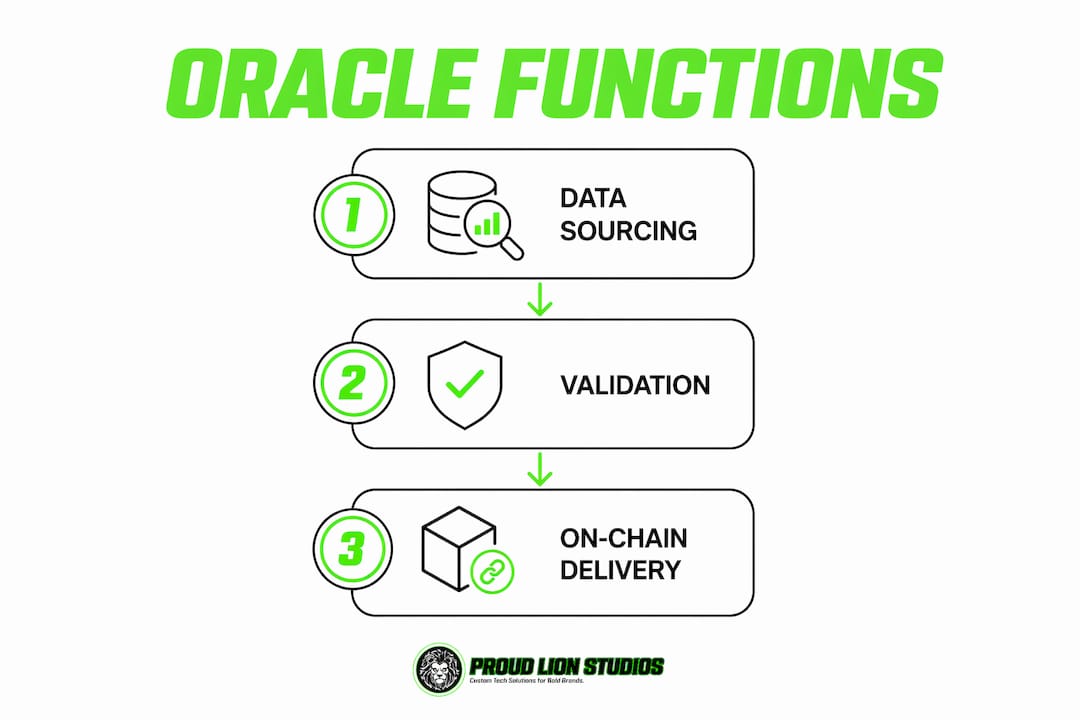
Every oracle, regardless of design, performs three core functions: data sourcing, validation, and on-chain delivery. Where oracle architectures diverge is in how they handle each step and when they trigger delivery.
Push oracles monitor external data continuously and write updates to the chain proactively. Chainlink's price feeds use a dual-trigger mechanism: a new value is pushed when the price deviates by 0.5% or when 3,600 seconds elapse without an update, whichever comes first. This guarantees freshness but generates constant on-chain transactions, which means continuous gas costs regardless of whether any contract actually reads the feed.
Pull oracles flip the model. Data is prepared and signed off-chain, then fetched and verified on-chain only when a contract explicitly requests it. Pyth Network uses this approach, allowing protocols to pull a price update at the exact moment of execution rather than paying to maintain a live feed. Push versus pull involves a direct trade-off between data freshness and gas efficiency, and the right choice depends entirely on your application's latency tolerance.
- Data sourcing: Nodes independently query multiple data providers, exchanges, or APIs to prevent any single source from dominating the result.
- Validation and aggregation: Nodes sign their individual responses cryptographically, and the network aggregates them using median or weighted averaging to filter outliers.
- On-chain delivery: The aggregated, signed result is submitted to a smart contract, which verifies the signatures before accepting the value.
Pro Tip: When integrating an oracle feed, always check the heartbeat interval and deviation threshold for that specific feed. A feed with a 1-hour heartbeat is unsuitable for a liquidation engine that needs sub-minute price accuracy.
What are the types of blockchain oracles?
Understanding oracle classification by data source, delivery model, and trust architecture is the first step toward matching the right tool to your security requirements. The differences are not cosmetic. They determine your attack surface.
| Oracle type | Data source | Trust model | Typical use case | Key risk |
|---|---|---|---|---|
| Centralized | Single API or operator | Trusted third party | Low-stakes automation | Single point of failure |
| Decentralized (DON) | Multiple independent nodes | Cryptographic + economic | DeFi price feeds, derivatives | Source-level manipulation |
| Hardware/IoT | Physical sensors | Device attestation | Supply chain, insurance | Sensor tampering |
| Cross-chain | On-chain data from another network | Relay or light client | Interoperability, bridging | Relay compromise |
| Compute oracle | Off-chain computation | Trusted execution environment | Verifiable randomness, ML inference | TEE vulnerabilities |
Centralized oracles were the default in early DeFi. Protocols relied on admin keys to update price feeds, which created serious security flaws that attackers exploited repeatedly. Decentralized oracle networks (DONs) emerged as the mandatory evolution, distributing trust across dozens of independent node operators with economic stakes in honest behavior.
Hardware oracles introduce a different trust layer entirely. A temperature sensor feeding crop insurance data or a GPS device reporting shipment location cannot be verified by cryptography alone. Device attestation, tamper-evident hardware, and redundant sensor networks are the tools used here, and the security assumptions are fundamentally different from software oracles.
Reputation-based models track node performance over time and weight responses accordingly. Staking models require nodes to lock collateral that gets slashed for provably dishonest behavior. Economic incentives align node behavior with network integrity in both cases, but staking provides harder guarantees because the penalty is automatic and on-chain.
What are the security risks in blockchain oracles?
Oracle manipulation caused over $400 million in losses in DeFi in 2022 alone, and OWASP ranked it the second-highest smart contract vulnerability in 2025. The attack surface is wider than most developers realize.
The most common attack vector is price oracle manipulation via flash loans. An attacker borrows a large sum within a single transaction, uses it to move the price on a thin liquidity pool that a target protocol uses as its oracle source, executes a profitable action against the manipulated price, and repays the loan before the block closes. The oracle reported a real price from a real source. The source itself was manipulated.
Key security risks every developer must evaluate:
- Single-source dependency: Any protocol reading price from one DEX pool or one API endpoint is one flash loan away from catastrophic loss.
- Stale data: Feeds with long heartbeat intervals can be exploited during high-volatility periods when the on-chain price diverges significantly from real market value.
- Centralized oracle compromise: Centralized oracles represent a single point of failure, and a compromised operator can drain every protocol that trusts their feed.
- Source-level manipulation: Even a fully decentralized oracle faithfully relays false data if underlying data sources are compromised. Oracles are transport layers, not truth arbiters.
Decentralized oracle networks defend against these vectors through cryptographic aggregation, where no single node can unilaterally influence the result, and through economic security mechanisms like staking and slashing that make dishonest behavior financially irrational. For blockchain security best practices, the minimum standard is using a DON with at least 15 to 20 independent nodes, volume-weighted median aggregation, and circuit breakers that pause execution when price moves exceed defined thresholds.
Pro Tip: Never use a single DEX spot price as your oracle source. Always use a time-weighted average price (TWAP) or a DON feed aggregated from multiple centralized and decentralized exchanges.
Practical applications and oracle innovations in 2026
The scale of oracle adoption in 2026 makes the technology impossible to treat as a niche concern. Chainlink's CCIP processed $18 billion in cross-chain messaging volume in March 2026 alone, demonstrating that oracles now power not just data feeds but the entire cross-chain communication layer. For a deeper look at why interoperability matters at this scale, the Web3 interoperability guide from Proudlionstudios covers the broader context.
| Application domain | Oracle function | Example protocol or use case |
|---|---|---|
| DeFi lending | Real-time collateral pricing | Aave, Compound |
| Derivatives | Settlement price feeds | dYdX, Synthetix |
| Parametric insurance | Weather and event triggers | Etherisc |
| Real-world asset tokenization | NAV and yield data feeds | Ondo Finance |
| Cross-chain messaging | Verified state relay | Chainlink CCIP |
| Gaming and NFTs | Verifiable randomness | Chainlink VRF |
| Supply chain | IoT sensor data | Morpheus Network |
Real-world asset tokenization is the fastest-growing oracle use case in 2026. Tokenized Treasury bills, real estate, and private credit funds all require continuous NAV feeds, yield data, and compliance status updates that can only come from off-chain sources. Without oracles, none of these assets can function on-chain. The same logic applies to parametric insurance, where a smart contract pays out automatically when a verified weather event occurs, eliminating the claims adjustment process entirely.
Gaming applications use Chainlink VRF (Verifiable Random Function), a specific oracle type that generates cryptographically provable randomness. This matters because on-chain randomness is trivially manipulable by miners or validators who can see pending transactions. VRF delivers randomness that neither the protocol nor the oracle operator can predict or manipulate, which is the only acceptable standard for loot boxes, NFT trait generation, or competitive matchmaking.
Key takeaways
Blockchain oracles are the infrastructure layer that determines whether a smart contract can interact with reality or remains confined to on-chain data alone.
| Point | Details |
|---|---|
| Oracles solve a fundamental constraint | Blockchains cannot fetch live external data; oracles pre-commit verified off-chain values before execution. |
| Push vs. pull models involve real trade-offs | Push feeds guarantee freshness at higher gas cost; pull models save cost but introduce latency. |
| Oracle type determines your attack surface | Centralized oracles create single points of failure; DONs distribute trust through cryptography and staking. |
| Manipulation is the top financial risk | Oracle attacks caused over $400 million in losses in 2022; TWAP feeds and DONs are the defense. |
| Applications extend well beyond DeFi | Oracles power tokenized assets, parametric insurance, cross-chain messaging, and verifiable gaming randomness. |
Why oracle design decisions matter more than most developers admit
Most developers treat oracle selection as a checkbox. Pick Chainlink, add the feed address, ship the contract. That approach has cost the industry hundreds of millions of dollars, and the losses keep coming because the lesson keeps getting skipped.
The part that gets underweighted is source quality. I have seen protocols spend weeks auditing their smart contract logic and zero hours auditing the data sources their oracle aggregates. A DON with 21 nodes all pulling from the same three data providers is not meaningfully more secure than a centralized oracle. The decentralization is real at the transport layer and illusory at the source layer.
The push versus pull decision also gets treated as a performance detail when it is actually a security decision. Pull oracles require your contract to verify the freshness and signature of the data at execution time. If you skip that verification to save gas, you have just created a stale-data vulnerability. The blockchain development guide from Proudlionstudios covers this pattern in the context of broader smart contract architecture.
The future of oracle design is moving toward more specialized networks. General-purpose price feeds will coexist with application-specific oracles built for IoT attestation, AI inference verification, and cross-chain identity. Developers who understand the trust model behind each type will build systems that hold up. Those who treat oracles as commodity infrastructure will keep learning expensive lessons.
— Amal
Build oracle-powered blockchain solutions with Proudlionstudios
Proudlionstudios builds production-grade blockchain systems from its UAE-based technical team, with hands-on experience in smart contract development, DeFi protocol architecture, and oracle integration across Ethereum, Aptos, and EVM-compatible chains. Whether you need a lending protocol with secure price feeds, a tokenized asset platform requiring real-world data, or a cross-chain application using Chainlink CCIP, the team designs systems where oracle security is built into the architecture from day one, not patched in after an audit. Explore Proudlionstudios' smart contract development services or the tokenization and DApp services to see how oracle-enabled solutions get built for real business outcomes.
FAQ
What are blockchain oracles in simple terms?
A blockchain oracle is a service that delivers verified external data to a smart contract, allowing it to execute based on real-world inputs like prices, weather events, or sports results. Without an oracle, a smart contract can only access data already stored on its own blockchain.
How does Chainlink work as an oracle?
Chainlink operates as a decentralized oracle network where independent node operators independently fetch data, sign their responses cryptographically, and submit aggregated results on-chain. The network uses economic incentives including staking and slashing to keep node operators honest.
What is the oracle problem in blockchain?
The oracle problem refers to the fundamental challenge of introducing external data into a deterministic blockchain without breaking consensus or creating a trusted third party. Any single oracle operator becomes a centralized point of failure, which contradicts the trustless design of smart contracts.
What is the difference between push and pull oracles?
Push oracles write data to the chain proactively based on time or deviation triggers, guaranteeing freshness at the cost of continuous gas fees. Pull oracles deliver data on demand when a contract requests it, reducing gas costs but introducing slight latency.
Can decentralized oracles be manipulated?
Decentralized oracle networks are significantly harder to manipulate than centralized ones, but they are not immune. If the underlying data sources feeding all nodes are compromised or manipulated via flash loans, even a DON will relay false data faithfully, which is why source diversity and TWAP feeds remain critical defenses.