
TL;DR:
- Blockchain development involves designing, building, and maintaining decentralized applications, emphasizing security, structured phases, and automation from the start. Teams must validate their use case, choose suitable tools, and follow a structured seven-phase process, including smart contract coding, testing, auditing, and post-launch operations. Incorporating security best practices and automation tools like Chainlink Automation and Gelato is crucial for reliable, scalable blockchain projects.
Blockchain development is the process of designing, building, and deploying decentralized applications, smart contracts, and distributed networks across a phased development workflow. Done right, it produces systems that are tamper-resistant, transparent, and programmable. Done wrong, it produces expensive failures. This guide walks you through every phase of the process, from validating your idea to maintaining a live network, with the tools, security practices, and automation strategies that define production-grade work in 2026.
What prerequisites and tools do you need before starting blockchain development?
Before writing a single line of Solidity or Rust, you need to confirm three things: the right skills, the right tools, and a validated reason to use blockchain at all.
Skills that actually matter
Solidity is the dominant language for Ethereum-compatible contracts. Rust powers Solana and Near Protocol. JavaScript and TypeScript handle frontend and scripting layers. You do not need to master all of them before starting, but you need fluency in at least one smart contract language and one general-purpose language. Understanding consensus mechanisms, public and private key cryptography, and how gas fees work is non-negotiable. These concepts shape every architectural decision you will make.
The core development toolchain
| Tool | Primary Use | Best For |
|---|---|---|
| Hardhat | Testing, deployment scripting | Ethereum, EVM chains |
| Foundry | Fast testing, fuzzing | Solidity-heavy projects |
| OpenZeppelin | Audited contract libraries | Security-first development |
| Truffle | Contract compilation, migration | Legacy EVM projects |
| Remix IDE | Browser-based prototyping | Beginners, quick tests |
Foundry and Hardhat are the two most widely adopted frameworks for Ethereum development in 2026, offering efficient testing, deployment scripting, and contract verification. Foundry's speed advantage in test execution makes it the preferred choice for teams running large fuzz test suites.
Validating the use case before writing code
Feasibility assessment is the critical first step to avoid unnecessary complexity. Decision-makers must confirm that decentralization and immutable data integrity are genuinely required before committing to a blockchain architecture. If a traditional database solves the problem, use one. Blockchain adds overhead. It earns that overhead only when trustless coordination, auditability, or tokenization is central to the product.
Pro Tip: Before scoping your project, ask one question: does this system require multiple parties who do not trust each other to agree on shared data? If the answer is no, blockchain is probably the wrong tool.
What are the step-by-step phases of blockchain development?
Blockchain development follows seven structured phases, each requiring distinct tasks and expert involvement. Skipping or compressing any phase increases the risk of costly rework or security breaches post-launch.

Phase 1: Discovery and planning. Define the product vision, identify stakeholders, and validate the use case. Map out tokenomics if your project involves a native token. Document the technical requirements and set a realistic timeline. This phase produces the specification that every subsequent decision references.
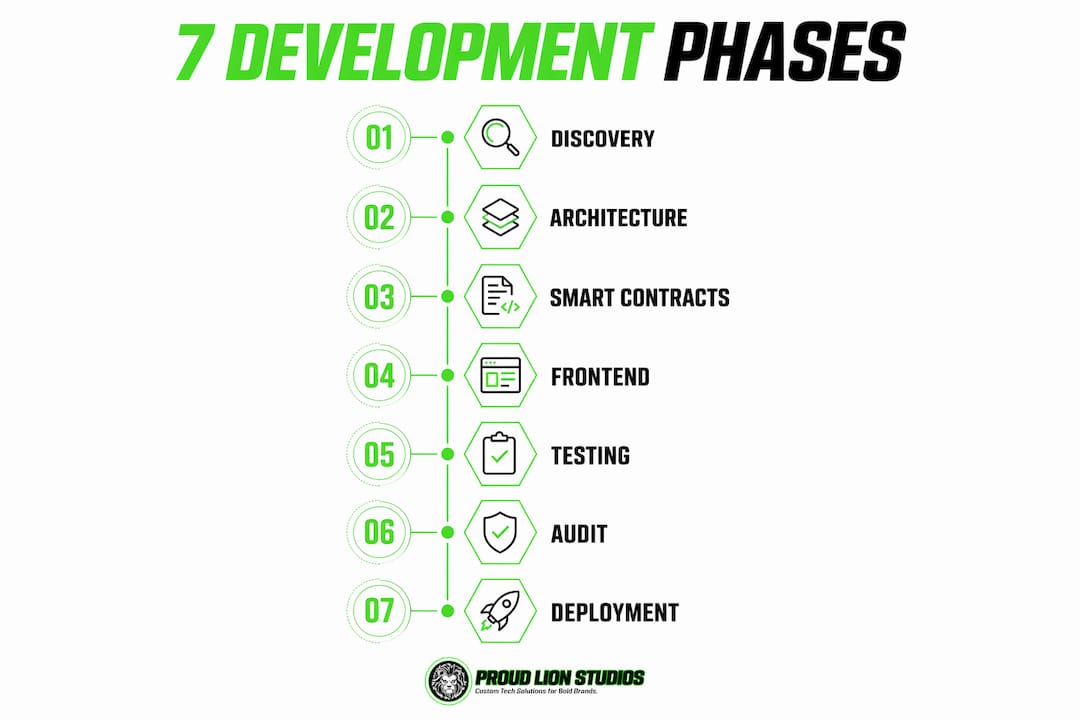
Phase 2: Architecture design. Choose between public, private, or consortium networks. Select your consensus mechanism. The consensus mechanism choice directly impacts scalability, security, and operational cost, so this decision deserves more time than most teams give it. Proof of Stake suits most new projects for its energy efficiency and validator economics. Design your data model and plan all third-party integrations at this stage.
Phase 3: Smart contract development. Write contract logic in Solidity or Rust. Use OpenZeppelin's audited libraries for standard functionality like ERC-20 tokens or access control rather than writing from scratch. Write unit tests for every function before moving to integration testing. Conduct internal code review with at least one developer who did not write the code.
Phase 4: Frontend and backend development. Build the user interface using React or Next.js. Connect it to the blockchain through libraries like ethers.js or viem. Build backend APIs for off-chain data storage, user authentication, and event indexing. The Graph is the standard tool for indexing on-chain events and serving them to frontends efficiently.
Phase 5: Testing and quality assurance. Run unit tests, integration tests, and fuzz tests. Automated tools like Slither, MythX, and Foundry improve security through static analysis, fuzzing, and unit testing throughout development. Deploy to a testnet such as Sepolia or Goerli and simulate real user behavior. Do not treat testnet deployment as a formality.
Phase 6: Security audit. Engage a third-party auditor before mainnet deployment. Smart contract vulnerabilities cause 70% of blockchain project failures, making external audits mandatory, not optional. Firms like Trail of Bits, OpenZeppelin, and Certik specialize in this work. Address every finding before proceeding.
Phase 7: Deployment and maintenance. Deploy to mainnet using a verified deployment script. Set up monitoring with tools like Tenderly or Defender. Plan for upgrades using proxy patterns if your contracts need to evolve. Post-launch maintenance accounts for up to 40% of total development budget, so budget for it from day one.
Pro Tip: Never deploy to mainnet on a Friday. If something breaks, you want your full team available to respond immediately.
How to ensure security and reliability in blockchain development?
Security in blockchain is not a feature you add at the end. It is a discipline you practice from the first line of code.
Common vulnerabilities and how to prevent them
Reentrancy attacks remain the most destructive vulnerability class in the ecosystem. The 2016 DAO hack, which drained roughly $60 million worth of Ether, exploited a reentrancy flaw. The Checks-Effects-Interactions pattern prevents this by requiring that all state changes happen before any external calls. Avoiding tx.origin for authentication prevents phishing-style exploits where a malicious contract tricks your contract into thinking a trusted address initiated the call.
The most common vulnerabilities you need to address are:
- Reentrancy: Always update state before making external calls.
- Integer overflow/underflow: Use Solidity 0.8.x or OpenZeppelin's SafeMath.
- Access control flaws: Implement role-based access with OpenZeppelin's AccessControl.
- Oracle manipulation: Use decentralized oracles like Chainlink with time-weighted average prices.
- Unchecked return values: Always handle return values from external calls explicitly.
Why automated analysis is not enough
Formal audits catch subtle bugs that automated tools and manual reviews miss. Static analysis tools like Slither flag known patterns quickly, but they cannot reason about complex business logic or multi-contract interactions the way an experienced auditor can. Treat automated tools as a first filter, not a final check.
"A smart contract audit is not a luxury for well-funded projects. It is the minimum viable safety check for any contract holding real value."
Pro Tip: Run Slither on every pull request as part of your CI/CD pipeline. Catching issues early costs a fraction of what a post-audit rewrite costs.
What tools and best practices optimize the blockchain development workflow?
A well-structured blockchain development workflow separates teams that ship on time from those that spend months debugging production issues.
The modern toolchain by workflow layer
| Layer | Tool | Key Benefit |
|---|---|---|
| Build and test | Foundry, Hardhat | Fast compilation, fuzz testing |
| Security analysis | Slither, MythX | Automated vulnerability detection |
| Contract libraries | OpenZeppelin | Audited, reusable components |
| Event indexing | The Graph | Efficient on-chain data queries |
| Automation | Chainlink Automation, Gelato | Condition-based triggers, auto-retry |
| Monitoring | Tenderly, OpenZeppelin Defender | Real-time alerts, transaction simulation |
Moving beyond cron jobs for automation
Script-based automation is being replaced by stateful, event-driven agent frameworks that offer self-healing and failover capabilities. A cron job that fires a transaction every hour cannot handle network congestion, failed transactions, or changing on-chain conditions. Platforms like Gelato and Chainlink Automation provide condition-based triggers and automatic retries, which are non-negotiable for production systems. This shift is one of the most significant blockchain automation tips for teams moving from prototype to production.
Post-launch operations and governance
Maintenance is not passive. Gas optimization, security patches, and contract upgrades require ongoing engineering attention. If your project includes a governance token, build the governance module before launch, not after. Retrofitting on-chain governance is significantly harder than designing it in from the start. For teams building decentralized apps, reading a blockchain mobile apps guide that covers scaling considerations will save significant rework in later phases.
Pro Tip: Use OpenZeppelin Defender's Relayer to manage transaction signing keys in production. Storing private keys in environment variables on a server is a security risk that auditors will flag immediately.
Key takeaways
Blockchain development succeeds when security, structured phasing, and modern automation are treated as non-negotiable requirements from day one, not afterthoughts.
| Point | Details |
|---|---|
| Validate before building | Confirm decentralization is genuinely needed before committing to blockchain architecture. |
| Follow all seven phases | Skipping discovery, audit, or maintenance planning creates expensive failures post-launch. |
| Security is built in, not bolted on | Use Checks-Effects-Interactions, OpenZeppelin libraries, and third-party audits on every project. |
| Automate with agents, not scripts | Chainlink Automation and Gelato replace fragile cron jobs with resilient, condition-based execution. |
| Budget for maintenance | Post-launch operations consume up to 40% of total project cost and require dedicated planning. |
What I've learned from watching blockchain projects succeed and fail
I have seen technically capable teams ship broken products because they treated the security audit as a box to check rather than a genuine quality gate. The pattern is consistent: a team builds fast, skips thorough testing, gets a surface-level audit, deploys, and then watches an exploit drain the contract within weeks. The cost is not just financial. It destroys user trust in a space where trust is already hard to earn.
The other mistake I see constantly is underestimating maintenance. Developers budget for building and launch, then discover that gas optimization, monitoring, and upgrade management consume a significant portion of ongoing engineering capacity. The 40% post-launch cost figure is not an exaggeration. It reflects the reality of operating a live system on a public network where every transaction costs money and every vulnerability is public.
My strongest advice for anyone starting out: read the blockchain security essentials guide before writing your first contract. Security knowledge shapes how you write code, not just how you review it. And adopt event-driven automation from the start. Retrofitting it onto a system built around cron jobs is painful work that most teams delay until something breaks in production.
The teams that succeed treat the blockchain integration workflow as an engineering discipline with the same rigor as aerospace or financial software. That mindset is the real differentiator.
— Amal
Build your blockchain project with Proudlionstudios
Proudlionstudios is a Dubai-based technology studio with a fully UAE-based technical team that has delivered Web3 solutions across multiple countries. The studio specializes in blockchain development services that cover every phase described in this guide, from feasibility assessment and architecture design through smart contract coding, security audits, and post-launch maintenance. For projects requiring token-based economies or decentralized applications, the team also provides smart contract development with audit-ready code and deployment support. Proudlionstudios builds to real business outcomes, not templated packages. If you are ready to move from concept to production, their team is the right starting point.
FAQ
What is blockchain development step by step?
Blockchain development is a seven-phase process covering discovery, architecture design, smart contract coding, frontend and backend development, testing, security audit, and deployment with ongoing maintenance. Each phase has distinct deliverables and requires specific tools and expertise.
How long does blockchain development take?
A production-ready blockchain application typically takes three to nine months depending on complexity, team size, and audit timelines. Security audits alone can add two to six weeks to the schedule.
Why do smart contracts need a security audit?
Smart contract vulnerabilities cause 70% of blockchain project failures, and external auditors catch subtle logic flaws that automated tools miss. Deploying without a third-party audit exposes any value held in the contract to preventable exploits.
What is the best language for smart contract development?
Solidity is the standard for Ethereum and EVM-compatible chains, while Rust is used for Solana and Near Protocol. Most new projects targeting the largest developer ecosystem start with Solidity and OpenZeppelin's audited libraries.
What are the best blockchain automation tools in 2026?
Chainlink Automation and Gelato are the leading platforms for production-grade blockchain automation, offering condition-based triggers and automatic transaction retries that replace fragile script-based cron jobs.