

TL;DR:
- Blockchain interoperability connects independent networks for data exchange and asset transfer without a unified architecture. It is crucial for enabling cross-chain applications, reducing security risks, and expanding functionalities like smart contract execution and messaging. Developers should focus on secure protocols, atomic transfers, and standardized architectures to build scalable multi-chain systems in 2026.
Blockchain interoperability is defined as the architectural framework that enables independent blockchain networks to communicate, exchange arbitrary data, and transfer value without requiring a unified network architecture. Without it, Ethereum, Solana, and every other chain operate as isolated silos. Developers building multi-chain applications in 2026 face a fragmented ecosystem where assets, logic, and users are spread across dozens of networks. Understanding how cross-chain communication actually works, where it fails, and how to build for it correctly is the difference between shipping a product that scales and one that breaks under real conditions.
What is blockchain interoperability and why does it matter?
Blockchain interoperability is the capability that lets two or more independent chains exchange data and execute logic across their boundaries. The industry term you will encounter most often is "cross-chain interoperability," and it goes well beyond simply reading another chain's state.

The distinction between compatibility and interoperability is worth getting right early. Compatibility is foundational, but interoperability enables richer interactions like remote smart contract execution. A chain can be compatible with another by sharing a token standard, yet still be unable to trigger a function on that chain. Interoperability closes that gap.
The importance of blockchain interoperability shows up clearly in real product decisions. A DeFi protocol that lives only on one chain cannot access liquidity from another. An NFT marketplace that cannot read ownership records from a different network cannot offer cross-chain trading. Every isolated chain is a ceiling on what developers can build.
Cross-chain bridges and protocols like CCIP standardize how tokens, messages, or both move across public and private chains. That standardization is what makes multi-chain application design practical rather than a custom engineering project for every new chain pair.
What are the main categories of blockchain interoperability?
Interoperability covers four distinct categories, each enabling a different class of developer use case. Treating them as one concept leads to architectural mistakes.
- Asset interoperability covers the movement of tokens and native assets between chains. The most common example is wrapping ETH for use on a non-Ethereum chain. This is the category most developers encounter first, and it is also the most frequently exploited.
- Data interoperability allows one chain to read or verify state from another. This powers cross-chain oracles, identity systems, and reputation protocols where a credential issued on one network must be recognized on another.
- Smart contract interoperability enables a contract on Chain A to trigger execution on Chain B. This is the category that separates basic bridges from full cross-chain application platforms. A lending protocol that liquidates a position on one chain based on a price feed from another depends entirely on this capability.
- Messaging interoperability handles arbitrary data packets between chains. It underpins governance systems where a vote on one chain changes a parameter on another, and cross-chain notification systems where events on one network trigger responses elsewhere.
Each category introduces its own security surface. Asset interoperability carries custody risk. Data interoperability depends on the honesty of the data source. Smart contract interoperability inherits the security assumptions of both chains involved. Messaging interoperability is only as reliable as the transport layer carrying the packets.
How does blockchain interoperability technically work?
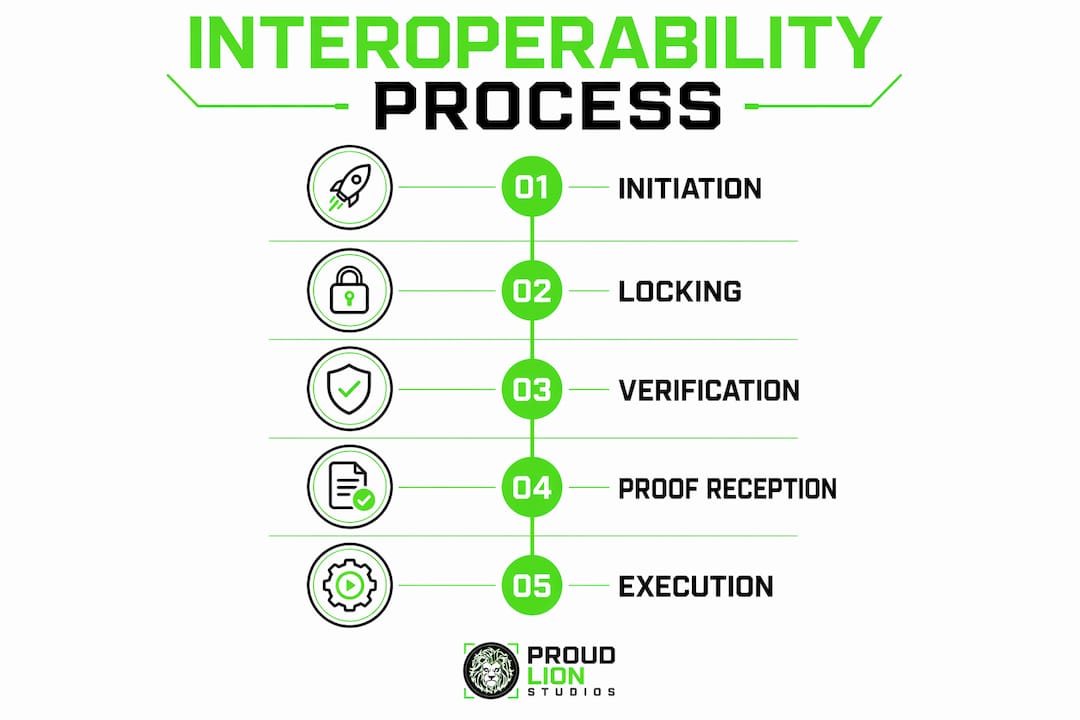
The standard cross-chain process follows five steps. Understanding each step tells you exactly where things go wrong and why.
- Initiation. A user or contract on the source chain submits a cross-chain request. This could be a token transfer, a function call, or a message payload. The request is recorded on-chain and picked up by the interoperability protocol.
- Locking. The source chain locks or burns the asset or state being transferred. Locking holds the original asset in a contract. Burning destroys it, with the expectation that an equivalent is minted on the destination chain. The choice between these two models has significant security implications.
- Verification. The protocol confirms that the source-chain event actually happened. This step uses decentralized oracles, relayers, or cryptographic proof mechanisms. Failures mostly occur during verification, and those failures have produced the largest losses in cross-chain history.
- Proof reception. The destination chain receives and validates the proof of the source-chain event. The format and trust model of this proof varies by protocol. Some use optimistic assumptions with a challenge window. Others use zero-knowledge proofs for trustless verification.
- Execution. The destination chain mints, unlocks, or executes based on the verified proof. If the proof is invalid or the execution logic has a bug, assets can be lost permanently.
Pro Tip: Never assume that a successful lock on the source chain guarantees execution on the destination chain. Always design your application to handle failed or delayed cross-chain messages explicitly, including refund paths and timeout logic.
Transaction finality differences between chains create a specific risk here. A chain with probabilistic finality can reorganize after a cross-chain message has already been processed on the destination chain. Bridges handle this by adding delay periods or multi-stage verification before releasing funds. Skipping that delay to improve user experience is one of the most common causes of bridge exploits.
What are the key challenges in blockchain interoperability?
The challenges in blockchain interoperability are not primarily technical limitations. They are security and coordination problems that compound as the number of connected chains grows.
- Transaction finality variance. Different chains reach finality at different speeds and with different guarantees. A bridge connecting a probabilistic chain to a deterministic one must account for reorg risk on the probabilistic side. Multi-stage verification mechanisms are the standard response, but they add latency.
- The n-squared bridge problem. Every new chain added to a mesh of direct bridges requires connections to every existing chain. Security risks grow exponentially with the number of chains, because each bridge is an independent attack surface. Ten chains in a full mesh require 45 bridges. Each bridge is a separate audit, a separate deployment, and a separate risk.
- Bridge vulnerabilities. The verification step is where most exploits occur. Bridges that rely on small validator sets or off-chain multisigs are particularly exposed. A compromised validator can forge proofs and drain locked assets.
- Lack of standardized protocols. Standardized cross-chain communication protocols are still maturing. Without them, every integration is custom, every audit covers different code, and every upgrade is a migration project.
"Modular cross-chain messaging protocols centralize security audits and reduce the n-squared attack surface by routing all cross-chain traffic through a single, well-audited messaging layer rather than a web of bilateral bridges."
The architectural answer to the n-squared problem is a hub-and-spoke model using a modular messaging protocol. Instead of each chain connecting directly to every other chain, all chains connect to a shared messaging layer. That layer gets one deep security audit. New chains plug into the hub rather than building bilateral connections to every existing participant.
How can developers design interoperable blockchain apps in 2026?
The goal for developers in 2026 is chain abstraction, where the underlying network is invisible to the end user. A user should be able to interact with a dApp without knowing or caring which chain holds their assets at any given moment.
Pro Tip: Build your cross-chain logic around programmable token transfers that bundle value and message data atomically. Separating the token transfer from the instruction message creates a race condition where the token arrives but the instruction is lost, leaving funds stranded.
Programmable token transfers solve a specific and common failure mode. When a token transfer and its accompanying instruction travel as separate messages, the instruction can fail while the token succeeds. The result is an orphaned asset with no recovery path. Atomic bundling eliminates that failure mode by design.
For protocol selection, the right choice depends on your security requirements and the chains you need to support.
| Approach | Best for | Key tradeoff |
|---|---|---|
| Optimistic verification | Lower latency, cost-sensitive apps | Challenge window adds delay; requires fraud proof monitoring |
| Zero-knowledge proof verification | High-value transfers, trustless requirements | Higher compute cost; proof generation adds latency |
| Modular messaging protocol | Multi-chain apps needing one audit surface | Dependency on the hub protocol's security |
| Direct bilateral bridge | Simple two-chain token transfers | Does not scale; each new chain requires a new bridge |
Emerging cross-chain standards simplify developer experience through abstraction and modularity. Using an established protocol rather than building a custom bridge gives you a pre-audited security model, a community of developers who have already found the edge cases, and upgrade paths that do not require migrating all your users. For most teams, the build-your-own-bridge approach is not a competitive advantage. It is a liability.
For a deeper look at cross-chain benefits for Web3 products, the technical process flow maps directly to the architectural decisions you will make when choosing a protocol. Pairing that with a secure blockchain development approach from the start reduces the rework that comes from retrofitting security onto a live system.
Key takeaways
Blockchain interoperability requires four functional categories, a five-step verification process, and modular security architecture to work safely at scale.
| Point | Details |
|---|---|
| Four interoperability categories | Asset, data, smart contract, and messaging interoperability each serve distinct developer use cases. |
| Verification is the critical step | Most cross-chain exploits occur during proof verification, not during locking or execution. |
| N-squared security risk | Each new chain in a direct-bridge mesh multiplies attack surfaces; use a hub-and-spoke protocol instead. |
| Atomic programmable transfers | Bundle token value and message data together to prevent orphaned assets on failed cross-chain calls. |
| Chain abstraction is the target | The best interoperability implementations make the underlying network invisible to the end user. |
Where blockchain interoperability is heading
The conversation around blockchain interoperability has matured significantly. A few years ago, the dominant question was whether cross-chain communication was even possible at a production level. Now the question is which security model to trust and how to build user experiences that do not expose the underlying complexity.
My honest view is that most teams underestimate the verification step. They treat it as a solved problem because a protocol handles it, without understanding the trust assumptions baked into that protocol. A decentralized oracle network and a three-of-five multisig both "verify" cross-chain events, but they carry completely different risk profiles. Developers who do not read the security documentation for the protocol they are integrating are taking on risk they cannot quantify.
The shift toward seamless multi-chain environments is real and accelerating. Users increasingly expect to interact with Web3 applications without managing multiple wallets, bridging assets manually, or paying gas on chains they did not choose. That expectation puts pressure on developers to abstract all of that complexity into the application layer.
Open standards are the only path to doing that at scale. Proprietary bridges create lock-in and concentrate risk. Modular, audited messaging protocols distribute that risk and give the ecosystem a shared foundation to build on. The teams that will ship the best cross-chain products in the next two years are the ones investing in understanding those standards now, not waiting until they need to integrate a new chain and discovering the limitations of their current architecture.
— Amal
Proud Lion Studios and cross-chain development

Proud Lion Studios builds blockchain development solutions for startups and enterprises that need cross-chain functionality built correctly from the first line of code. The Dubai-based team covers smart contract development, multi-chain integration, and tokenization and dApp architecture across public and private chains. Every project is built to client specifications rather than templated packages, which matters when your interoperability requirements do not fit a standard mold. Proud Lion Studios is backed by the Aptos Foundation and serves clients across multiple countries. If your next product depends on chains talking to each other reliably, the team has the architecture experience to make that work.
FAQ
What is blockchain interoperability in simple terms?
Blockchain interoperability is the ability of separate blockchain networks to communicate, share data, and transfer assets without a shared infrastructure. It is the technical capability that makes multi-chain applications possible.
How does blockchain interoperability work at a technical level?
Cross-chain communication follows five steps: initiation, locking, verification, proof reception, and execution. The verification step carries the most risk and is where most bridge exploits occur.
What are the biggest challenges in blockchain interoperability?
The main challenges are transaction finality differences between chains, bridge vulnerabilities in the verification layer, and the n-squared security problem that grows with each new chain added to a direct-bridge network.
What is the difference between blockchain compatibility and interoperability?
Compatibility means two chains can recognize each other's token standards or data formats. Interoperability goes further by enabling active cross-chain smart contract execution and arbitrary message passing between chains.
What are examples of blockchain interoperability in practice?
Common examples include cross-chain token bridges, multi-chain DeFi protocols that access liquidity across networks, cross-chain governance systems, and NFT platforms that verify ownership records from multiple chains.