

TL;DR:
- Web3 interoperability enables independent blockchain networks to exchange data, assets, and state seamlessly, preventing ecosystem fragmentation. It reduces developer complexity, enhances user experience, and unlocks capital efficiency by connecting liquidity pools, assets, and protocols across multiple chains. Prioritizing secure, standards-based cross-chain architecture from the start is essential to avoid costly vulnerabilities and fully realize Web3's decentralized promise.
Web3 interoperability is defined as the capability that allows independent blockchain networks to exchange data, assets, and state without requiring users or developers to abandon one ecosystem for another. Without it, every chain operates as a closed system, and the promise of a decentralized internet fragments into dozens of incompatible silos. Protocols like Chainlink CCIP, the Inter-Blockchain Communication protocol (IBC), and W3C Decentralized Identifiers (DIDs) are the technical foundations making cross-chain communication real in 2026. Understanding why interoperability matters is not a theoretical exercise. For blockchain developers, tech entrepreneurs, and businesses building on Web3, it determines whether your product reaches one chain's users or the entire decentralized ecosystem.
Why use interoperability in Web3: the fragmentation problem
The core problem interoperability solves is siloed blockchain networks that cannot share data, liquidity, or logic. Ethereum holds billions in DeFi liquidity. Solana processes transactions at high speed. Cosmos connects sovereign chains. But without cross-chain communication, a user on Ethereum cannot access a lending protocol on Avalanche without manually bridging assets, managing multiple wallets, and accepting significant friction at every step.
This fragmentation creates four concrete problems for builders and users:
- Fragmented liquidity pools. Capital locked on one chain cannot serve demand on another, which raises slippage and reduces yield opportunities for traders and protocols alike.
- Isolated user experiences. Users must manage separate wallets, gas tokens, and interfaces for each chain, which drives abandonment and limits adoption.
- Developer complexity. Building a multi-chain application without interoperability standards means writing custom integrations for every network, multiplying audit surface and maintenance cost.
- Blocked composability. DeFi protocols that cannot communicate across chains cannot compose with each other, which limits the financial primitives developers can build.
The distinction between multi-chain and cross-chain approaches matters here. A multi-chain strategy deploys separate instances of the same app on different networks. A cross-chain strategy uses interoperability protocols so one application can interact with multiple chains natively. The second approach is architecturally superior for capital efficiency and user experience.
Pro Tip: When scoping a new Web3 product, map which chains hold your target liquidity and users before choosing a deployment strategy. Cross-chain architecture costs more upfront but eliminates the compounding maintenance burden of isolated deployments.

How interoperability works: protocols, standards, and architecture
Interoperability is not a single technology. It is a stack of protocols, standards, and architectural patterns that work together.
The two protocol categories developers encounter most are Cross-Chain Communication Protocols (CCCPs) and Cross-Blockchain Communication Protocols (CBCPs). CCCPs handle message passing between specific chains with defined trust assumptions. CBCPs, like IBC, aim for generalized communication across any compliant chain.
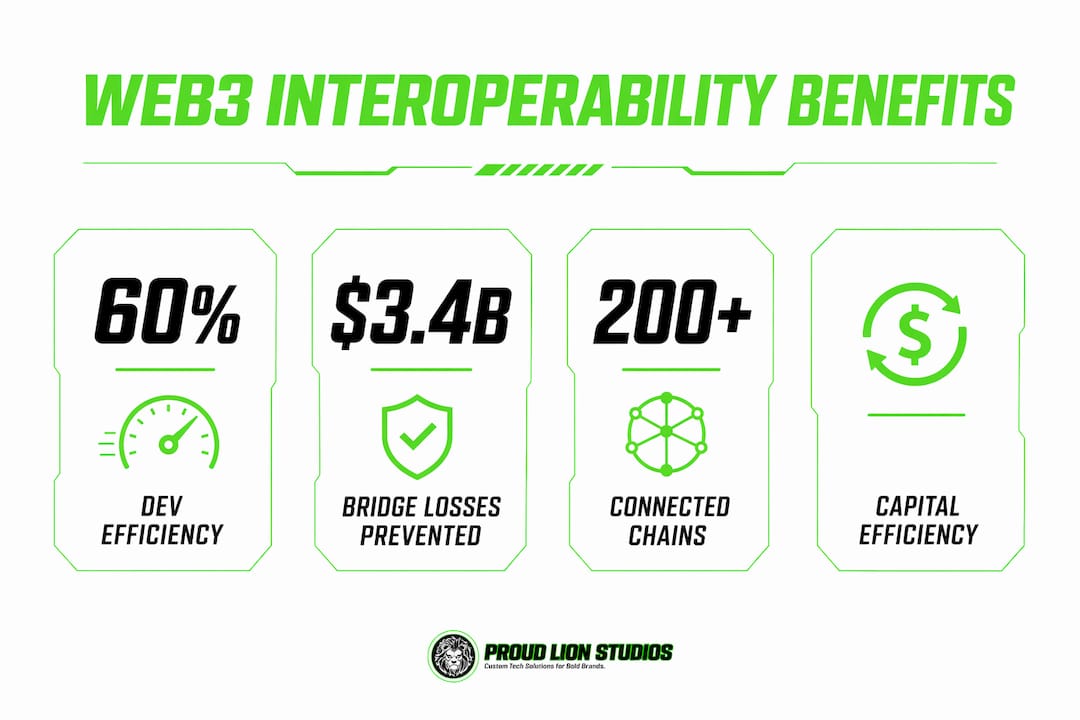
The Inter-Blockchain Communication protocol, maintained in the ibc-go repository, connects over 200 sovereign chains and supports tokens, messages, and application logic. IBC achieves this by encoding all data as byte arrays, which means any chain can send any payload as long as both ends implement the IBC specification. This design makes IBC one of the most extensible cross-chain standards available today.
Chainlink's Cross-Chain Interoperability Protocol (CCIP) takes a different approach. It uses General Message Passing (GMP) to allow smart contracts on one chain to trigger logic on another. CCIP adds a Risk Management Network as a secondary validation layer, which addresses one of the most common failure modes in cross-chain systems: compromised relay logic.
Hub-and-spoke architecture is the dominant pattern for interoperable smart contracts. Each chain runs a spoke contract with a shared interface. A central hub contract, or a messaging layer like CCIP, routes calls between spokes. This reduces the number of direct chain-to-chain integrations from O(n²) to O(n), which is a significant reduction in complexity as the number of supported chains grows.
For identity, W3C DID v1.1 lists interoperability as a primary design goal. DIDs allow a user to prove identity across centralized and decentralized systems using the same credential, without reissuance. Verifiable Credentials built on DIDs can be presented to any verifier that supports the W3C standard, regardless of which blockchain issued them.
The table below summarizes the primary protocols and their key properties:
| Protocol | Primary use case | Trust model |
|---|---|---|
| IBC (Cosmos) | Token and message transfer across sovereign chains | Light client verification |
| Chainlink CCIP | Cross-chain smart contract calls and token transfers | Decentralized oracle network + Risk Management Network |
| W3C DID v1.1 | Decentralized identity and credential portability | Standards-based, method-agnostic |
Pro Tip: For production deployments, use the Web3 development checklist to audit your interoperability layer before launch. The relay and verification components are the highest-risk surfaces in any cross-chain system.
What are the real benefits for developers, users, and businesses?
The benefits of Web3 interoperability are concrete and measurable across three groups.
For developers, interoperability standards reduce integration work significantly. Instead of writing custom bridge logic for each chain pair, a developer using IBC or CCIP writes to a single interface and gains access to every connected network. This also reduces audit scope, since the interoperability layer itself is audited by the protocol team rather than each application team independently.
For users, the improvement is in experience. Abstracting multi-chain complexity means a user interacts with a single application while the protocol handles routing across Ethereum, Arbitrum, Polygon, or any other connected chain behind the scenes. This is the difference between a product that feels like a consumer app and one that feels like a developer tool.
For businesses, the advantages include:
- Unified liquidity access. Connecting liquidity pools across chains reduces slippage and improves capital efficiency, which directly affects protocol revenue and user retention.
- Asset and token portability. Tokenized real-world assets, NFTs, and stablecoins can move across ecosystems without reissuance, which opens new distribution channels.
- Business model expansion. A protocol that operates on five chains serves five communities of users and liquidity providers simultaneously, multiplying growth surface without multiplying infrastructure cost proportionally.
- Faster time to market. Shared standards mean less custom development per chain, which compresses product cycles for teams building across multiple networks.
Capital efficiency is the core driver behind interoperability adoption in DeFi. Moving assets securely across chains reduces liquidity fragmentation and increases yield opportunities for every participant in the ecosystem.
Security and operational considerations in Web3 interoperability
Security is where interoperability's promise meets its hardest constraints. Cross-chain bridges have lost over $3.4 billion to exploits by mid-2025, making the bridge layer the single most attacked surface in Web3. The losses are not random. They concentrate in systems that rely on centralized validators, privileged off-chain signers, or optimistic relay models without adequate fraud-proof windows.
"Interoperability failures most often occur in the middle verification layer due to validator or logic inconsistencies, underscoring the need for trusted assumptions and rigorous audits." — DAIC Capital, DeFi Bridge Security
The interoperability trilemma frames the core design tension: trustlessness, extensibility, and generalizability cannot all be maximized simultaneously. Early bridge designs prioritized speed and extensibility, which meant sacrificing trustlessness. The result was a series of exploits that drained hundreds of millions from protocols that appeared technically sound on the surface.
Decentralized, trust-minimized architectures address this directly. IBC uses light client verification, which means each chain independently verifies the state of the other without relying on a trusted third party. CCIP adds a secondary Risk Management Network that monitors for anomalous activity and can pause transfers. Both approaches increase security at the cost of some latency and extensibility.
Operationally, the ibc-relayer documentation reveals that production cross-chain systems must handle packet retries, finality delays, and concurrent message management. These are not edge cases. They are routine operational requirements that teams frequently underestimate during development.
Pro Tip: Treat your interoperability layer as a first-class security boundary. Commission a dedicated audit of your relay and verification logic before any mainnet deployment. The OpenZeppelin deposit-flow audit framework is a strong reference for structuring that review.
Practical applications and future outlook
The importance of interoperability in Web3 becomes clearest when you look at where it is already deployed at scale.
Aave uses cross-chain governance and token standards to maintain unified markets across Ethereum, Polygon, Arbitrum, and other networks. The GHO stablecoin is designed to operate across chains using interoperable minting and burning logic, which allows Aave to manage a single monetary policy across fragmented deployments. This is a direct application of interoperability to capital efficiency at protocol scale.
Tokenized real-world assets represent the next major frontier. Financial institutions tokenizing bonds, real estate, or commodities need those assets to move across chains to reach the broadest pool of buyers. Without interoperability, a tokenized bond on Ethereum cannot be purchased by a buyer whose custodian operates on a permissioned chain. With it, the asset is accessible to any compliant participant regardless of their chain preference.
Identity reuse via interoperable DIDs is gaining traction in enterprise contexts. A user who completes KYC on one platform can present a Verifiable Credential to any other platform that accepts the W3C standard, eliminating redundant verification and reducing onboarding friction across the ecosystem.
The comparison below shows how current and emerging interoperability use cases differ in maturity:
| Use case | Current maturity | Primary protocol |
|---|---|---|
| Cross-chain token transfers | Production | IBC, CCIP, LayerZero |
| Cross-chain smart contract calls | Production | CCIP, IBC |
| Decentralized identity portability | Early adoption | W3C DID v1.1 |
| Tokenized RWA cross-chain delivery | Emerging | CCIP, custom bridges |
| Cross-chain governance | Limited production | Aave GHO, Compound |
Standardization is the next inflection point. The industry is moving toward universal messaging standards that reduce the fragmentation between competing interoperability protocols. When that convergence happens, the cost of building cross-chain applications will drop significantly, and the barrier to enterprise adoption will lower with it.
Key takeaways
Web3 interoperability is the foundational layer that determines whether decentralized applications serve one chain's users or the entire multi-chain ecosystem, and ignoring it at the design stage costs far more to fix later.
| Point | Details |
|---|---|
| Fragmentation is the core problem | Siloed chains trap liquidity and users, reducing capital efficiency and product reach. |
| Protocol choice defines security | IBC uses light client verification; CCIP adds a Risk Management Network. Choose based on your trust model. |
| Bridge security is the highest risk | Over $3.4 billion lost to bridge exploits by mid-2025; audit relay and verification logic before launch. |
| Benefits span all stakeholders | Developers gain simpler integrations, users get single-app multi-chain access, businesses unlock new markets. |
| Standards are converging | W3C DID v1.1 and CCIP represent the direction toward universal, auditable interoperability layers. |
Interoperability is the architecture decision you cannot defer
I have worked with enough blockchain teams to recognize a pattern: interoperability gets treated as a phase-two problem. The reasoning is understandable. You want to ship fast, prove the product on one chain, and add cross-chain support later. The problem is that retrofitting interoperability into a live protocol is not a feature addition. It is a re-architecture. The data model, the smart contract interfaces, the identity layer, and the security model all need to be designed with cross-chain communication in mind from the start.
The security reality reinforces this. The $3.4 billion in bridge losses did not happen because teams were careless. They happened because teams underestimated the complexity of the verification layer and shipped before that layer was hardened. The interoperability trilemma is real, and every design choice you make in favor of speed or extensibility is a choice you make against trustlessness. That trade-off needs to be explicit and documented, not implicit and discovered during an incident.
What I find most underappreciated is the business model opportunity. Protocols that operate across five chains do not just serve five times the users. They access five times the liquidity, which compounds yield, reduces slippage, and creates network effects that single-chain competitors cannot replicate. Aave's multi-chain expansion is not a technical exercise. It is a market capture strategy enabled by interoperability.
The teams that will define Web3 in the next three years are the ones treating interoperability as a first-class design requirement today, not a migration project for later. Build the interfaces right the first time. Audit the relay layer before launch. Choose protocols with decentralized verification. The compounding returns on that discipline are significant.
— Amal
Build interoperable Web3 applications with Proudlionstudios

Proudlionstudios builds Web3 applications where interoperability is a design requirement, not an afterthought. The Dubai-based team has delivered smart contract solutions and cross-chain architectures for startups and enterprises across multiple markets, with Aptos Foundation backing and a fully UAE-based technical team. Whether you are building a DeFi protocol that needs unified liquidity across chains, a tokenized asset platform requiring cross-chain asset delivery, or a Web3 application demanding secure blockchain development from the ground up, Proudlionstudios delivers production-grade solutions tailored to your architecture and security requirements.
FAQ
What is Web3 interoperability?
Web3 interoperability is the ability of independent blockchain networks to exchange data, assets, and application state securely without requiring users to leave one ecosystem for another. Protocols like IBC and Chainlink CCIP are the primary technical implementations in production today.
Why is interoperability vital in Web3?
Interoperability solves the fragmentation problem that traps liquidity and users on isolated chains, reducing capital efficiency and limiting application reach. Without it, Web3 applications serve one chain's audience instead of the entire decentralized ecosystem.
What are the biggest interoperability challenges in Web3?
The primary challenge is security in the verification and relay layer, where over $3.4 billion in losses have occurred through mid-2025. The interoperability trilemma, balancing trustlessness, extensibility, and generalizability, means every design choice involves explicit security trade-offs.
How does IBC differ from Chainlink CCIP?
IBC uses light client verification to connect sovereign chains permissionlessly, with over 200 chains connected via the ibc-go implementation. Chainlink CCIP uses a decentralized oracle network plus a secondary Risk Management Network, making it well-suited for EVM-compatible chains requiring General Message Passing.
How does interoperability improve the developer experience in Web3?
Interoperability standards let developers write to a single interface and access every connected network, rather than building custom bridge logic per chain. This reduces audit scope, compresses development cycles, and allows teams to focus on application logic instead of infrastructure integration. For practical guidance on Web3 UX design, abstracting multi-chain complexity at the product layer is the direct result of solid interoperability architecture underneath.