

TL;DR:
- The NFT market is now $34.1 billion, emphasizing its maturity beyond being a trend.
- Successful business NFT use focuses on utility, such as loyalty, authenticity, and engagement.
- Most NFT failures stem from speculation and lack of ongoing value, highlighting the importance of utility.
Most businesses either dismiss NFTs as a faded trend or chase them blindly after seeing headlines about million-dollar digital art sales. Both approaches miss the point entirely. The NFT market reached $34.1B in 2025, with gaming accounting for 38% of volume, art generating $4.1B, and sports collectibles pulling in $2.7B. That is not a dying market. It is a maturing one, and the businesses that will win are those who understand the technology well enough to use it strategically, not just speculatively.
Table of Contents
- What is an NFT? Technology foundations and practical meaning
- The real business value: Branding, digital assets, and customer engagement
- Analyzing the risks: Market volatility, legal pitfalls, and lessons from failed giants
- Practical steps for launching successful NFT projects
- Why most businesses miss NFT value—and what actually works
- Accelerate your NFT strategy with expert partners
- Frequently asked questions
Key Takeaways
| Point | Details |
|---|---|
| NFTs need real utility | Branded NFTs only succeed when they offer tangible value or access, not just collectibility. |
| Smart contract choices matter | Selecting the right standards and auditing contracts is vital for technical and legal compliance. |
| Most projects fail on execution | Learning from high-profile failures prevents costly mistakes and improves ROI. |
| Phygital and loyalty solutions win | Combining digital ownership with real-world benefits creates lasting customer engagement and revenue. |
What is an NFT? Technology foundations and practical meaning
Now that you know the stakes and potential rewards, let's clarify what NFTs really are at a technical and practical level.
An NFT, or non-fungible token, is a unique digital record stored on a blockchain. Unlike Bitcoin or Ether, which are interchangeable (one Bitcoin equals another), each NFT is one of a kind. That uniqueness is what creates digital scarcity, and digital scarcity is what gives NFTs their value in ownership, branding, and access control.
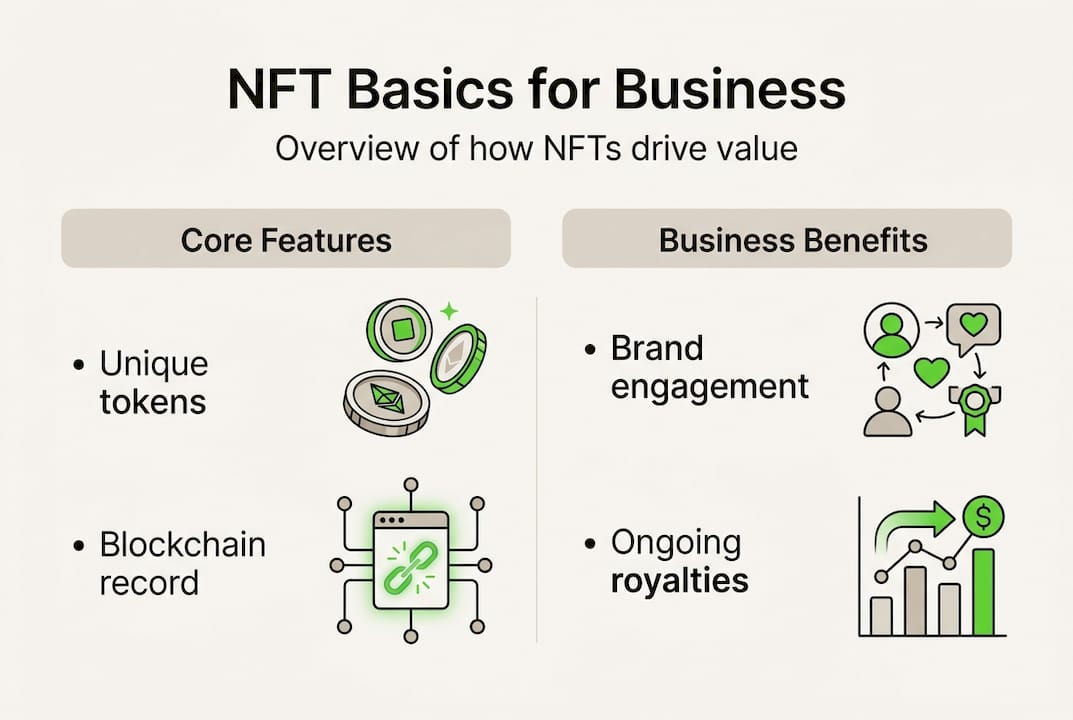
The technical foundation most NFTs run on is the ERC-721 standard, which defines how unique tokens are created, transferred, and verified on the Ethereum blockchain. When you mint an NFT, you are essentially writing a permanent record to the blockchain that says: this specific token exists, it has a unique ID, and here is who owns it.
Metadata is what links that token to something meaningful, like an image, a video, a piece of music, or a membership credential. Metadata can be stored on-chain (directly in the blockchain, permanent and immutable) or off-chain (on external servers like IPFS). On-chain storage is more secure and permanent, but more expensive. Off-chain is cheaper, but introduces a risk: if the server goes down, the linked content disappears.
Royalties are where things get really interesting for businesses. The ERC-2981 royaltyInfo standard allows smart contracts to signal royalty information to NFT marketplaces, specifying who receives payment and how much whenever a token is resold. This creates a passive revenue stream that does not exist in traditional digital asset sales.
| Feature | On-chain storage | Off-chain storage |
|---|---|---|
| Permanence | Permanent | Depends on server |
| Cost | Higher gas fees | Lower cost |
| Security | Maximum | Moderate |
| Best for | High-value assets | Large media files |
Pro Tip: If you are minting NFTs for enterprise use, consider deploying on Polygon or Base instead of Ethereum mainnet. Both chains are EVM-compatible (meaning your smart contracts work the same way), but transaction fees are a fraction of the cost, making large-scale minting financially viable. You can explore how NFT technology works in practice before committing to a chain.
The real business value: Branding, digital assets, and customer engagement
With the technical basics in place, let's explore how you can actually use NFTs to build business value and connect with customers.
The most powerful shift in thinking is moving away from NFTs as speculative art and toward NFTs as programmable business tools. Utility-driven NFTs that offer gated content, loyalty rewards, or exclusive access consistently outperform pure collectibles in terms of customer retention and revenue sustainability.
Token-gated experiences are one of the most practical applications right now. A brand can issue NFTs that act as membership passes, granting holders access to exclusive content, early product launches, or VIP events. Shopify already supports token-gated storefronts natively, and integrating NFT ownership data into your CRM workflows lets you personalize customer journeys in ways that loyalty points simply cannot match.
Phygital NFTs, a term combining physical and digital, are another high-value strategy. A luxury brand can pair a physical product with an NFT certificate of authenticity. A sports team can sell a jersey alongside an NFT that unlocks exclusive video content and event access. This bridges the gap between tangible goods and digital engagement.

| NFT strategy | Revenue model | Customer value | Risk level |
|---|---|---|---|
| Art-only collectibles | One-time sale | Speculative | High |
| Utility/loyalty passes | Recurring engagement | Ongoing access | Low-Medium |
| Phygital products | Product + digital bundle | Tangible + digital | Low |
| Gaming assets | In-game economy | Play-to-earn | Medium |
Here are the most practical business use cases for NFTs in 2026:
- Loyalty programs: Replace points with tradeable NFT passes that appreciate in value
- Digital certificates: Verify authenticity of products, credentials, or warranties
- Event ticketing: Eliminate fraud and enable secondary market royalties
- Gaming assets: Create player-owned in-game items with real-world value
- Music and media: Allow fans to co-own releases and share in streaming revenue
- Real estate tokenization: Fractionalize property ownership for broader investor access
Connecting crypto payment integration to your NFT storefront removes friction for Web3-native buyers, while keeping traditional payment options open for mainstream audiences. The businesses seeing the best results are those treating NFTs as one layer in a broader growth strategy, not as a standalone product.
Analyzing the risks: Market volatility, legal pitfalls, and lessons from failed giants
While opportunities are compelling, understanding the downside and past failures is critical to making smart NFT moves.
The most sobering statistic in the NFT space is this:
95% of NFTs minted have become effectively worthless after their initial sale, with projects losing the majority of their floor price within months of launch.
This is not a reason to avoid NFTs. It is a reason to understand exactly why projects fail. The pattern is consistent: hype-driven launches with no underlying utility, no community strategy, and no long-term roadmap.
Nike's RTFKT acquisition is the most high-profile cautionary tale. Despite massive brand recognition and early enthusiasm, Nike shut down RTFKT in early 2024 after failing to build sustainable engagement beyond the initial collector community. The NFL's partnership with Dapper Labs faced similar issues, with digital collectibles losing significant value and generating legal friction.
What went wrong in both cases? The products were treated as collectibles first and customer experiences second. When speculation dried up, there was nothing left to hold the community together.
Legal risks are equally serious. Here are the critical issues every business must screen for before launching:
- Intellectual property: Ensure you own or have licensed every element of your NFT content
- Securities law: Depending on structure, NFTs may be classified as securities in your jurisdiction
- Anti-money laundering (AML): NFT marketplaces face increasing AML scrutiny globally
- VAT and tax obligations: NFT sales may trigger VAT in the UAE, EU, and other regions
- Consumer protection: Misleading claims about NFT value or utility can result in fraud liability
- Smart contract vulnerabilities: Unaudited contracts have been exploited for millions in losses
For businesses operating in the UAE, the regulatory environment is evolving quickly. Staying aligned with future-proof Web3 practices from the start saves costly retrofitting later.
Practical steps for launching successful NFT projects
Now that you've seen the risks, here's a proven pathway to executing NFT projects that actually deliver business results.
Success in NFTs is not about moving fast. It is about moving deliberately. Here is a step-by-step framework that works:
- Define your utility first: Before designing a single asset, answer: what does holding this NFT actually give the user? Access, rewards, ownership, or community? The answer shapes everything else.
- Choose the right blockchain: For most enterprise use cases, Polygon or Base offer the best balance of cost, speed, and ecosystem support. Match your chain to your audience.
- Design the smart contract architecture: Decide on token standards (ERC-721 for unique assets, ERC-1155 for semi-fungible batches), royalty structures using ERC-2981 for interoperability, and access control logic.
- Audit your contracts: Never deploy unaudited smart contracts to mainnet. A single vulnerability can drain your entire project treasury.
- Build compliance in from day one: Work with legal counsel familiar with your jurisdiction's NFT regulations, especially around AML, VAT, and securities classification.
- Launch with community, not just marketing: The projects that sustain value are those with active communities. Discord, token-gated forums, and real-world events all contribute.
- Integrate with existing systems: Connect NFT ownership data to your CRM, loyalty platform, or e-commerce stack for maximum customer value.
Phygital and loyalty-driven NFTs consistently deliver the strongest ROI for enterprises because they create ongoing touchpoints rather than one-time transactions. Gaming is another standout category, and understanding NFT integration in mobile gaming can open entirely new monetization channels for product studios.
Pro Tip: Before signing with any NFT development partner, ask to see their smart contract audit reports and previous deployment history on mainnet. A partner who cannot provide these should not be handling your enterprise-grade NFT solutions.
Why most businesses miss NFT value—and what actually works
With best practices in mind, let's reflect on what separates failed NFT fads from true value-creation opportunities.
Here is the uncomfortable truth: most businesses approach NFTs the same way they approached social media in 2010. They see a trend, copy what celebrities are doing, and wonder why it does not work for them. Celebrity and speculation models collapse because they are built on attention, and attention is the most volatile resource in digital markets.
The businesses building lasting value with NFTs are the ones where the technology is nearly invisible to the end user. The best NFT loyalty program does not feel like an NFT program. It feels like a premium membership with real benefits. The best phygital product does not require customers to understand blockchain. It just works, and it delivers something they cannot get elsewhere.
Gaming, loyalty ecosystems, and supply chain verification are where NFTs prove their worth quietly and consistently. These use cases do not generate headlines, but they generate revenue and retention. If your NFT strategy requires explaining what an NFT is to your customer, you may need to rethink the strategy. The goal is value, not education. Businesses that want scalable NFT solutions should start by asking what problem they are solving, then work backward to the technology.
Accelerate your NFT strategy with expert partners
Ready to launch or scale your NFT strategy? Here's how your business can benefit from proven expertise.
Building a successful NFT project requires more than minting tokens. It requires smart contract architecture, compliance planning, marketplace integration, and a clear utility roadmap. Getting any one of these wrong is expensive.
At Proud Lion Studios, we specialize in end-to-end blockchain development and custom tokenization and NFT solutions built for real business outcomes, not templates. From ERC-721 smart contract deployment to phygital product integration and loyalty platform design, our UAE-based team handles the full stack. You can also explore our own successful NFT projects to see what enterprise-grade execution actually looks like in practice.
Frequently asked questions
What makes an NFT different from a digital image or file?
NFTs use the ERC-721 standard to record unique ownership on a blockchain, meaning each token has a verifiable, tamper-proof owner. A regular digital file can be copied infinitely with no way to prove which copy is the original or who owns it.
How do NFT royalties actually work for businesses?
The ERC-2981 royaltyInfo function tells marketplaces who receives a royalty and how much on each secondary sale, but actual enforcement depends on whether the marketplace chooses to honor it. Most major platforms do, making it a reliable passive revenue tool for creators and brands.
Why have so many NFT projects failed despite huge market growth?
Most failed projects were built on speculation rather than utility, so once buyer interest faded, there was no reason to hold the token. 95% of minted NFTs lost essentially all their value because the underlying projects offered no ongoing benefit to holders.
Should my business focus on phygital or purely digital NFTs?
Phygital and loyalty-driven NFTs consistently outperform pure digital collectibles for enterprise use cases because they tie blockchain ownership to tangible, ongoing value. Unless you are operating in a market where digital art or collectibles have a proven audience, utility-first is the safer and more profitable path.