
TL;DR:
- Future-proofing a business with AI involves building adaptive systems that learn and improve over time. It requires documenting workflows, focusing on strategic AI bets, and creating architecture that avoids vendor lock-in. Leadership must embed AI as a core strategic capability to sustain competitive advantage over the long term.
Future-proofing a business with AI is defined as building adaptive, continuously learning systems rather than installing static tools and hoping they hold. AI foundation models update every 4–6 weeks, which makes any fixed implementation obsolete before it matures. The real goal is adaptive readiness: the capacity to sense change, absorb it, and improve because of it. Business leaders who understand this distinction stop chasing the perfect AI setup and start building the organizational muscle to keep pace with AI-driven business growth over the long term.
What foundational prerequisites are essential to future proof a business with AI?
Workflow documentation is the unglamorous prerequisite that determines whether AI succeeds or stalls. Converting tacit tribal knowledge into structured, machine-legible Standard Operating Procedures (SOPs) is the single most important step before any automation begins. Without documented processes, AI systems inherit human inconsistency at machine speed. The result is a "garbage in, garbage out" failure that no model upgrade will fix.

A thorough workflow audit answers two questions for every task: should AI do this, and could AI do this? Systematic workflow audits prevent over-automation and surface the highest-value AI opportunities inside your existing operations. Leaders who skip this step often automate the wrong things first, then wonder why their pilots do not scale.
Three more prerequisites matter before you write a single line of AI implementation code:
- Proprietary data inventory. Your internal data is your competitive moat. Catalog what you own, where it lives, and how clean it is. AI models trained or fine-tuned on your data outperform generic models on your specific problems.
- Measurable business goals. Define success in numbers before deployment. "Improve customer response time by 40%" is a goal. "Use AI to improve customer experience" is a wish.
- Governance and training frameworks. Assign clear ownership of AI outputs. Train cross-functional teams on data literacy so AI decisions are understood, not just accepted.
Pro Tip: Before selecting any AI tool, map your five most time-intensive workflows on a single page. If you cannot describe a process in writing, an AI system cannot execute it reliably.
How to select AI use cases that drive long-term business impact
The most common AI implementation mistake is running too many pilots at once. Most AI projects fail by spreading resources thinly across a dozen simultaneous experiments, producing inconclusive results and exhausted teams. The fix is concentration, not expansion.
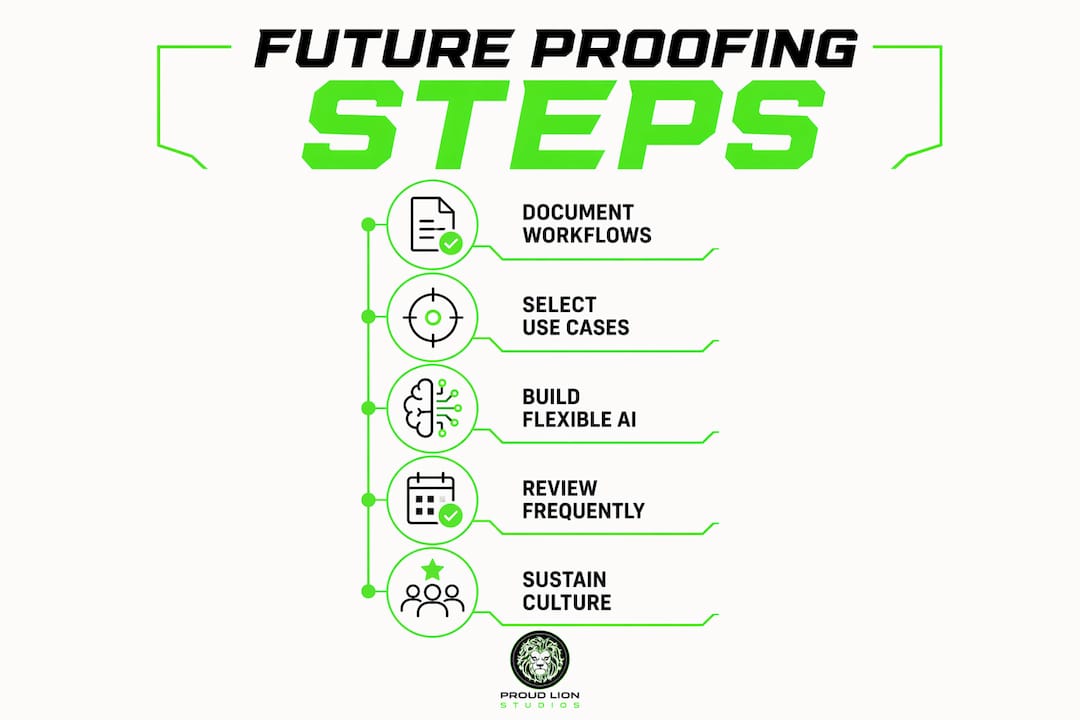
Companies winning with AI focus on 3–5 strategic bets with board-level support, proprietary data investment, and rebuilt workflows. Each bet targets a business outcome that changes the economics of a core function. That is a fundamentally different ambition than automating a single task.
A disciplined selection process follows four steps:
- Identify economic levers. Which functions, if changed by 20%, would materially shift revenue or cost? Start there, not with the easiest automation.
- Run pilots on real production data. Synthetic or sample data produces misleading results. Test AI against the messy, incomplete data your business actually generates.
- Set binary success metrics before launch. Define a clear pass/fail threshold. If the pilot does not hit the metric within a defined window, stop it and redirect resources.
- Design for scale from day one. Use API-based integration, write documentation as you build, and assume the system will need to handle ten times the initial volume. An enterprise AI roadmap built around this principle avoids the costly rebuilds that kill ROI.
The exit timeline data makes the case for discipline even stronger. 94% of firms need more than six months to exit a failing AI project, and 76% estimate needing over a year. That means a bad bet costs you a year of runway. Choosing carefully at the start is not caution. It is capital efficiency.
Pro Tip: Score each candidate use case on three dimensions: data availability, process documentation quality, and measurable business impact. Only pursue use cases that score high on all three.
How to build a flexible AI architecture that avoids vendor lock-in
Static architecture is the fastest way to make an AI investment obsolete. When a foundation model updates or a vendor changes its pricing, businesses locked into a single platform face a painful choice: absorb the disruption or rebuild from scratch. The answer is an architecture designed for portability from the beginning.
The core principle is building a proprietary semantic layer. Proprietary semantic layers integrate your unique organizational data with AI agents in a way that is model-agnostic. When the underlying model changes, your data layer and workflows remain intact. You swap the engine without rebuilding the car.
The table below compares two architecture approaches on the dimensions that matter most for long-term AI resilience:
| Dimension | Single-vendor dependency | Modular orchestration layer |
|---|---|---|
| Model flexibility | Low. Locked to one provider's update cycle. | High. Swap models without disrupting workflows. |
| Data portability | Restricted. Data often lives inside vendor systems. | Full. Data stays in your own infrastructure. |
| Cost exposure | High. Pricing changes affect entire operation. | Controlled. Costs distributed across components. |
| Adaptation speed | Slow. Vendor roadmap dictates your timeline. | Fast. You integrate updates on your own schedule. |
Frameworks like 5P and TRIPS give teams a structured method to assess AI updates every 4–6 weeks and decide what to integrate, what to monitor, and what to ignore. These frameworks prevent both under-reaction (missing a capability that matters) and over-reaction (chasing every new model release). For leaders exploring AI tools for enterprises, evaluating tools against these architecture criteria is a practical starting point.
High-performing AI organizations build feedback loops where each deployment improves the next. Every interaction generates data. That data refines the model. The refined model produces better outputs. Over 18–24 months, this compounding effect creates an advantage that competitors without the same data history cannot replicate quickly.
What organizational culture and leadership practices enable sustained AI adaptation?
Technology alone does not produce AI resilience. The organizations that sustain AI-driven competitive advantage treat AI as a core strategic posture, not a quarterly project. Leadership must align AI integration as a multi-year commitment with CEO accountability for AI risks and outcomes. When AI sits in the IT department with no board-level sponsor, it stays a pilot forever.
The cultural practices that separate adaptive organizations from stalled ones include:
- Parallel workforce redesign. Rebuilding workflows and retraining people must happen alongside technology deployment, not after it. Teams that understand why AI is changing their work adopt it faster and flag problems earlier.
- Data literacy investment. Every manager who makes decisions should understand how AI models produce outputs and where they fail. This is not a technical skill. It is a judgment skill.
- Rapid experimentation as a norm. Treating volatility as a strength rather than a threat changes how teams respond to AI updates. Organizations that practice fast iteration cycles treat each model update as an opportunity to test, not a disruption to manage.
- Embedded AI accountability. Assign a named owner to every AI deployment. Ownerless AI systems drift, degrade, and eventually fail silently.
Organizations that treat AI as an embedded, continuously improving capability rather than a separate tool build compounding advantages. The businesses that will lead their industries in five years are not the ones with the most AI tools today. They are the ones building the organizational habits to keep learning faster than their competitors.
Key takeaways
Business resilience with AI requires adaptive readiness, proprietary data ownership, concentrated bets, modular architecture, and leadership accountability working together as a system.
| Point | Details |
|---|---|
| Document workflows first | Convert all processes into machine-legible SOPs before any AI automation begins. |
| Concentrate your bets | Run 3–5 high-impact AI initiatives with board support rather than many scattered pilots. |
| Build a modular architecture | Use a proprietary semantic layer and orchestration layer to avoid vendor lock-in. |
| Design feedback loops | Structure each deployment to generate data that improves the next one. |
| Anchor AI at the leadership level | Assign CEO accountability and redesign workforce in parallel with technology adoption. |
The uncomfortable truth about AI readiness I keep seeing ignored
Most business leaders I work with arrive with the same question: "Which AI tool should we buy?" That is the wrong question, and answering it directly does them a disservice.
The organizations I have seen get the most out of AI are not the ones with the biggest budgets or the most advanced models. They are the ones that spent three months documenting their workflows before touching a single AI product. That unglamorous work is what separates a successful deployment from a six-figure pilot that quietly gets shelved.
The other pattern I see consistently is the "pilot forever" trap. A team runs a promising experiment, gets excited, and then launches four more pilots before the first one is validated. Resources fragment. Momentum dies. The original pilot never reaches production. The fix is not more discipline in theory. It is a written rule: no new pilot starts until the current one either ships or is formally killed.
The shift from "future-proofing" to adaptive readiness is not just semantic. It changes what you measure, what you build, and who owns the outcomes. Static future-proofing asks, "Are we protected?" Adaptive readiness asks, "Are we learning faster than the market is changing?" The second question is harder to answer and far more valuable to pursue. For leaders ready to move beyond static frameworks, the work starts with honest answers to that second question.
— Amal
How Proud Lion Studios builds AI systems designed to last
Proud Lion Studios works with startups and enterprises across multiple countries to build AI and blockchain systems that are designed for adaptation, not just deployment. The Dubai-based team builds bespoke orchestration layers that keep your proprietary data portable and your workflows model-agnostic, so a foundation model update does not force a rebuild. Their blockchain development services complement AI integration by adding verifiable, tamper-resistant data infrastructure that strengthens the proprietary data layer every adaptive AI strategy depends on. If your business needs a technical partner that builds for real outcomes rather than templated packages, Proud Lion Studios is worth a direct conversation.
FAQ
What does it mean to future-proof a business with AI?
Future-proofing a business with AI means building adaptive systems that continuously sense, learn, and improve rather than deploying static tools. Because AI foundation models update every 4–6 weeks, the goal is organizational readiness, not a one-time implementation.
Why do most AI pilots fail to scale?
Most AI pilots fail because resources are spread across too many simultaneous experiments with no clear success metrics. Deloitte research shows 94% of firms need more than six months to exit a failing AI project, making concentrated, well-defined bets far more cost-effective.
What is a proprietary semantic layer and why does it matter?
A proprietary semantic layer integrates your unique organizational data with AI agents in a model-agnostic structure. It lets you switch underlying AI models without disrupting your workflows, which is the primary defense against vendor lock-in.
How often should a business review its AI architecture?
A business should review its AI architecture every 4–6 weeks to align with foundation model update cycles. Frameworks like 5P and TRIPS provide structured methods for deciding which updates to integrate and which to monitor.
What role does leadership play in AI-driven business resilience?
CEO and board-level sponsorship is the single strongest predictor of sustained AI success. Without executive accountability, AI initiatives remain isolated pilots rather than embedded organizational capabilities that compound advantage over time.