

TL;DR:
- Building a secure Web3 startup requires understanding decentralization limitations and governance risks.
- Specialized skills like smart contract auditing and security are essential before development.
- Prioritize rapid testnet iteration, security audits, and address functional user needs over decentralization ideals.
Building a Web3 startup in 2026 means confronting security vulnerabilities, decentralization trade-offs, and governance risks that have no equivalent in traditional software. Most founders know blockchain is powerful, but far fewer understand the specific failure points that collapse promising projects before they reach mainnet. Smart contract exploits alone have drained billions from well-funded protocols. This guide gives you a structured framework covering foundational concepts, team preparation, step-by-step development, and real-world troubleshooting so you can move from concept to launch without the most common, costly mistakes.
Table of Contents
- Web3 fundamentals: What every startup must know
- Preparation: Skills, team, and tools needed for Web3 startup development
- Step-by-step: Developing your first Web3 product
- Troubleshooting and common mistakes in Web3 builds
- What most founders get wrong: The real cost of scaling Web3 startups
- Ready to launch? Partner with experts for full-scope Web3 development
- Frequently asked questions
Key Takeaways
| Point | Details |
|---|---|
| Decentralization trade-offs | True decentralization is rare—most startups need pragmatic choices for growth and security. |
| Team and tool essentials | A blend of technical, security, and governance skills is non-negotiable for building Web3 startups. |
| Stepwise execution matters | Structured, tested releases with security as a core principle minimize project failure risk. |
| Avoid classic mistakes | Neglecting edge cases or security checks can undermine even the best-planned Web3 product. |
| Scale with expert help | Partnering with seasoned Web3 developers accelerates launch and improves your odds of success. |
Web3 fundamentals: What every startup must know
Web3 refers to a class of internet applications built on decentralized infrastructure, primarily blockchains, where users control their data and assets rather than relying on centralized intermediaries. For startups, this creates genuine opportunities: programmable money, transparent governance, and user ownership. But it also introduces constraints that many founders underestimate.
The most dangerous misconception is that deploying on a blockchain automatically makes your product decentralized. Decentralization is often illusory due to stake concentration, VC token control, and infrastructure centralization through cloud providers. A protocol may run smart contracts on Ethereum while all its nodes are hosted on AWS in a single region. That is not decentralization in any meaningful operational sense.
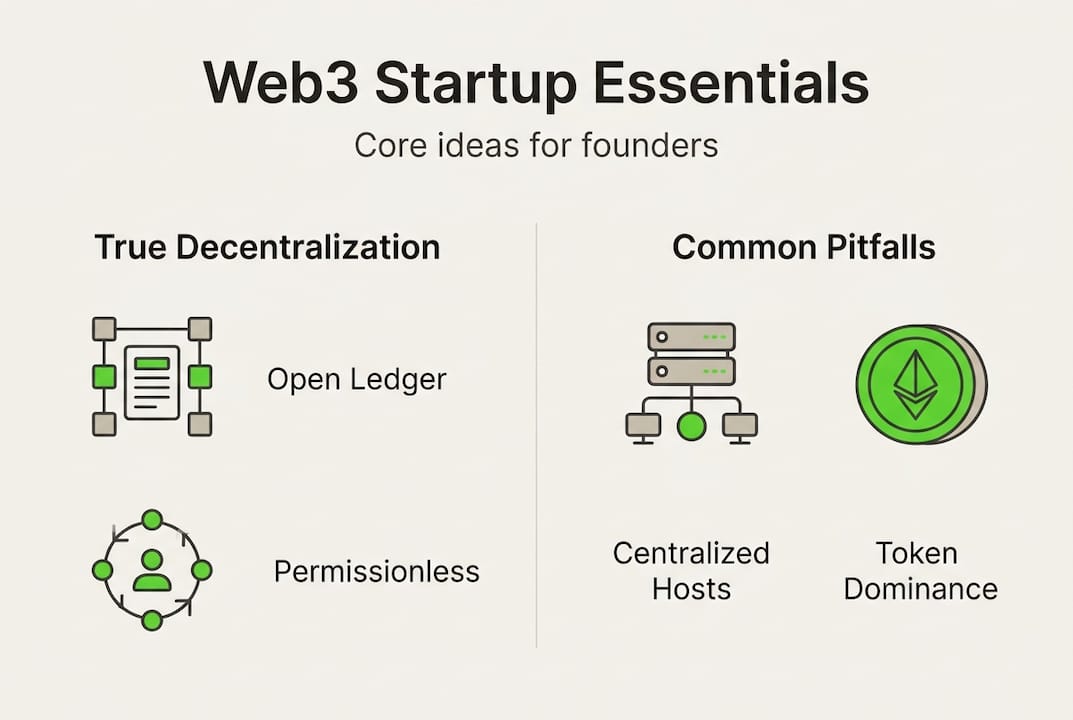
The Nakamoto Coefficient is the most practical tool for measuring real decentralization. It counts the minimum number of entities needed to compromise a system. A coefficient of 3 means three parties could collude and control your network. Most production protocols score far lower than founders realize. Understanding this early shapes how you design governance and token distribution.
Before writing your first line of code, internalize these three structural Web3 risks:
- Infrastructure centralization: Most dApps rely on RPC providers like Infura or Alchemy. If those services go down, your "decentralized" app goes offline.
- VC token dominance: When venture funds hold a majority of governance tokens, decentralized voting becomes theater. Early investors can override community decisions.
- On-chain governance failures: Poorly designed proposal mechanisms allow flash loan attacks or low-quorum governance hijacks that redirect protocol funds.
"The promise of Web3 is genuine, but the architecture must back it up. Founders who skip the governance design phase are building a decentralized front end over a centralized back end."
For web3 essentials for founders, the priority is understanding that you are making deliberate trade-offs, not eliminating centralization entirely. Review blockchain basics to establish a working vocabulary before your team begins technical scoping.
Preparation: Skills, team, and tools needed for Web3 startup development
Knowing the underlying structures is just the beginning. Next, it is vital to assemble the right mix of expertise and choose suitable tools. Here is what every serious founder needs before a single sprint starts.

The technical skill set for a Web3 build is narrower and more specialized than a standard SaaS product. Your team needs people who understand both what the code does and what it cannot safely do. Critical edge case risks include reentrancy attacks, front-running exploits, and oracle manipulation, and these must be treated as first-class concerns from day one.
Core skills your team must cover:
- Smart contract development: Proficiency in Solidity or Rust depending on your target chain
- Security auditing: Ability to identify reentrancy patterns, integer overflow, and access control gaps
- Gas optimization: Understanding of EVM opcodes and calldata cost reduction
- Tokenomics design: Modeling supply schedules, vesting, and incentive alignment
- Compliance and legal: Jurisdiction-specific token classification and KYC/AML requirements
- UX for decentralized apps: Wallet connection flows, transaction confirmation states, and error handling for rejected transactions
| Role | Key skill | Recommended tool |
|---|---|---|
| Smart contract developer | Solidity, Rust | Hardhat, Foundry |
| Security auditor | Vulnerability analysis | Slither, MythX |
| Governance advisor | DAO design, tokenomics | Snapshot, Tally |
| Backend/infra engineer | Node management, RPC | Alchemy, Infura |
| Product owner | User research, roadmap | Figma, Linear |
For framework choices, Ethereum remains the most audited and widely supported. Polkadot offers parachain flexibility for custom runtimes. Solana trades auditability for throughput. Your chain choice should follow your use case, not trends.
Pro Tip: Schedule your security audit before mainnet deployment, not after. Many founders treat audits as a launch formality. In reality, audit findings routinely require architectural changes. Building audit time into your development sprint saves weeks of emergency rework. Review security best practices and check the full integration guide to structure your build sequence correctly.
Step-by-step: Developing your first Web3 product
With the essentials in place, you are ready to move from planning to execution. Here is how to build your first Web3 solution with confidence.
- Ideation and scope definition: Define the specific user problem and identify where blockchain adds genuine value versus where a traditional database would be cheaper and faster.
- Prototyping: Build a non-blockchain prototype first to validate UX assumptions. Wallet friction is real. Test with non-crypto users early.
- Smart contract development: Write modular contracts with clearly separated logic, access control, and upgrade patterns. Keep contracts small and auditable.
- Testnet deployment: Deploy to a public testnet (Sepolia for Ethereum, Devnet for Solana). Run load tests and simulate adversarial behavior.
- Security audit: Engage a specialized auditor. Key edge cases including reentrancy, access control failures, and oracle manipulation must be actively mitigated before going live.
- Mainnet launch: Use a phased rollout with protocol-level caps on TVL (total value locked) during the first weeks.
- User feedback loop: Instrument your dApp with on-chain analytics and off-chain user research. Iterate governance and UX based on real behavior.
| Chain | Throughput | Ecosystem maturity | Best for |
|---|---|---|---|
| Ethereum | ~15 TPS | Very high | DeFi, NFTs, governance |
| Solana | ~65,000 TPS | High | High-frequency apps |
| Custom L2 | Variable | Medium | App-specific scaling |
Pro Tip: Automate fuzz testing using tools like Echidna or Foundry's built-in fuzzer. Feed randomized inputs to your contracts to surface edge cases that manual review misses, especially around BigInt handling and re-entrant call sequences.
The Web3 workflow steps that consistently succeed in 2026 share one trait: fast, iterative testnet cycles over lengthy waterfall builds. Familiarize your team with key terminology so that sprint communication stays precise and decision-making stays fast.
Troubleshooting and common mistakes in Web3 builds
Even with a solid process, mistakes happen. Here is how to spot and address typical Web3 development failures before they undermine your project.
The most frequently recurring problems in Web3 builds fall into predictable patterns:
- Inadequate smart contract testing: Unit tests alone are insufficient. Formal verification and fuzz testing catch the edge cases that unit tests never reach.
- Underestimating infrastructure centralization: Assuming your RPC provider will never fail is a single point of failure by another name. Build fallback node endpoints.
- Poor access control design: Overly permissioned admin keys create centralization backdoors. Use multi-sig wallets and timelocks on all privileged functions.
- Ignoring gas optimization: Poorly optimized contracts spike user transaction costs and kill adoption. Benchmark gas usage against competitors before launch.
- No monitoring for blockchain reorganizations: Reorgs can invalidate recent transactions. Your backend must handle confirmation depth and reorg detection.
Edge case failures around reentrancy, front-running, and access controls consistently destroy projects that skip defensive coding practices. Use the checks-effects-interactions pattern religiously. Never trust external contract calls made before state updates are finalized.
Warning: Security lapses remain the number one startup killer in Web3. Over $3.8 billion was lost to exploits in 2022 alone, with reentrancy and access control failures accounting for the largest share of losses.
For ongoing verification, cross-reference your build against a structured dApp troubleshooting guide. If you are planning to grow your user base aggressively, start thinking about scalability with blockchain infrastructure design early, because retrofitting scalability is expensive and risky.
What most founders get wrong: The real cost of scaling Web3 startups
Here is the opinion most Web3 consultants will not say out loud: over-indexing on idealistic decentralization is the most expensive mistake a startup can make in 2026.
Absolute decentralization is a myth in production systems. Stake concentration, infrastructure dependencies, and VC token control are present in virtually every major protocol. Founders who spend 80% of their energy chasing perfect decentralization often ship unusable products with no real user base.
What actually drives growth is transparent governance, functional UX, and security credibility. Users do not leave a platform because its Nakamoto Coefficient is 12 instead of 20. They leave because the wallet experience is broken, gas fees are unpredictable, or their funds were compromised. Focus your first 18 months on solving the functional problems that matter to real users. Decentralization can improve gradually through progressive governance handoff, which is the model that successful protocols actually follow. Read more on future-proofing with Web3 to see how this plays out at scale.
Ready to launch? Partner with experts for full-scope Web3 development
If you are serious about building a Web3 solution that scales, consider collaborating with experts who have done it before. The mistakes covered in this guide are not theoretical. They are patterns we see repeatedly in projects that arrive at our door after a painful rebuild.

At Proud Lion Studios, our UAE-based team covers everything from blockchain development services and smart contract expertise to tokenization and dApps. We handle smart contract auditing, token architecture, compliance strategy, and full-stack product builds under one roof. Whether you are pre-seed or scaling post-launch, we offer structured engagement models that fit your stage. Reach out today to explore how we accelerate your go-to-market without the guesswork.
Frequently asked questions
What are the biggest risks in Web3 startup development?
The main risks include smart contract vulnerabilities, centralized infrastructure dependencies, and governance or access control failures. Reentrancy, oracle manipulation, and centralization risks are the most commonly exploited weaknesses in production protocols.
How can I verify if my Web3 product is truly decentralized?
Measure your protocol's Nakamoto Coefficient and audit token distribution for VC or infrastructure provider dominance. True decentralization requires tracking these metrics continuously, not just at launch.
What skills are essential for a Web3 startup team?
Prioritize smart contract auditing, secure coding practices, blockchain development, and governance strategy. Security audit expertise is non-negotiable because a single vulnerability can erase all product value overnight.
Why does scaling a Web3 solution require trade-offs?
Absolute decentralization fails in practice because stake concentration and infrastructure centralization are structural realities. Functional growth means balancing decentralization ideals with usability and operational reliability.
What is the fastest way for startups to launch a secure Web3 app?
Iterate rapidly on testnets, enforce strict security protocols from the first sprint, and commission an independent audit before mainnet deployment. Security audits and staged releases consistently prevent the critical failures that derail launches at the worst possible moment.
Recommended
- Web3 explained for startups: blockchain success guide
- Master the Web3 integration process: a complete startup guide
- What is Web3? A 2026 guide for tech entrepreneurs
- Why use Web3 solutions? Unlock startup growth & efficiency
- Why startups struggle to be seen online: the SEO mistakes to fix first - Gregg King SEO