

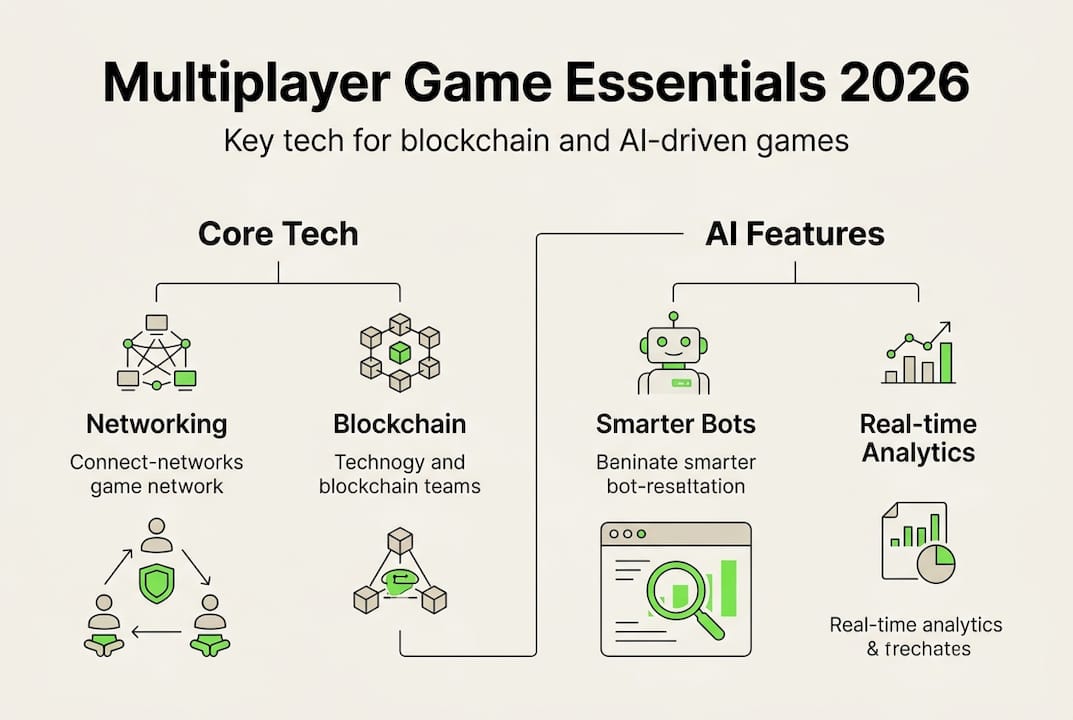
Scaling a multiplayer game while keeping it secure, fair, and economically compelling is one of the hardest problems in modern game development. Players now expect real ownership of their assets, lag-free sessions with thousands of concurrent users, and intelligent NPCs that adapt to their behavior. Blockchain and AI are no longer experimental additions. They are practical tools that solve real infrastructure and experience problems when applied correctly. This guide walks you through every layer of the stack, from defining your requirements to testing at scale, so you can ship a multiplayer title that stands out in a crowded market.
Table of Contents
- Defining your multiplayer game requirements
- Choosing the right backend: Frameworks, cloud, and networking
- Integrating blockchain for player ownership and economies
- Leveraging AI for smarter multiplayer experiences
- Testing, monitoring, and optimizing your game
- Why most multiplayer innovation falls short—and how to break through
- Turn innovation into reality with Proud Lion Studios
- Frequently asked questions
Key Takeaways
| Point | Details |
|---|---|
| Plan requirements first | Clear project goals help you choose technology and avoid costly mistakes. |
| Choose your backend wisely | Networking frameworks differ significantly in security, scalability, and real-time performance. |
| Adopt blockchain seamlessly | Modern blockchain tech delivers ownership and economies with less friction than old models. |
| Leverage AI for scale | AI enables better game content, NPC intelligence, and testing efficiency when integrated thoughtfully. |
| Test and verify thoroughly | Comprehensive testing and monitoring ensure your game scales securely and delivers a great player experience. |
Defining your multiplayer game requirements
With those challenges clear, let's outline exactly what you need for a successful multiplayer title. Before you write a single line of networking code, you need to map your requirements with precision. The genre of your game, your target platform, expected player count, and tolerance for latency all determine which technology stack will actually work for you.
A real-time battle royale with 100 players demands sub-50ms tick rates and dedicated server authority. A turn-based strategy game with 10 concurrent players can tolerate much more relaxed constraints. These are not the same problem, and treating them as such is one of the most common and costly mistakes teams make.
Client-authoritative architectures hand movement and state control to the player's device. This is faster to build but opens serious cheating vectors. Dedicated server solutions process all authoritative state on your infrastructure, which is more expensive but far more secure. For any game with competitive play or real-money assets, dedicated servers are not optional.
AAA multiplayer scaling demands that you answer these questions before you prototype, not after.
| Requirement | Low complexity | High complexity |
|---|---|---|
| Player count | Under 50 | 500 or more |
| Latency tolerance | 200ms or more | Under 50ms |
| Persistence | Session only | Cross-session economy |
| Anti-cheat | Basic | Server-authoritative |
| Blockchain integration | None | Wallet, NFT, economy |
| AI features | Static NPCs | Adaptive, procedural |
- Define your minimum viable feature set before evaluating any framework
- Separate "must have" from "nice to have" to control scope
- Identify your peak concurrent user target and build your stress tests around it
- Decide on server authority model before choosing a networking library
Tests show that Mirror handles 4000 objects with lower bandwidth use, while Unity NGO delivers better frame time scaling and more consistent latency under heavy load. Knowing which tradeoff matters for your game is the whole game.
Pro Tip: Write a one-page requirements document listing your genre, platforms, peak player count, anti-cheat stance, and integration needs before you evaluate any backend. This single step eliminates at least half of the technology options immediately and saves weeks of wasted prototyping.
Choosing the right backend: Frameworks, cloud, and networking
Once requirements are clear, the next step is selecting a backend that fits your project's needs. The networking framework you choose will define your ceiling for performance, security, and scalability. Getting this wrong means expensive rewrites six months into production.
Mirror vs Unity NGO breaks down to this: Mirror uses lower bandwidth and handles high object counts efficiently, but its peak frame time climbs under extreme load. Unity NGO stacks objects better, supports Relay NAT traversal natively, and delivers more consistent latency at scale. Neither is universally superior. The right choice depends on your object density and session architecture.
Photon and PlayFab are mature, cloud-hosted solutions that handle matchmaking, lobbies, and relay out of the box. They are excellent for teams that want to ship fast without managing server infrastructure. The tradeoff is less control over custom game logic and higher per-user costs at scale.

One common mistake is reaching for Firebase. Its document-based model lacks the game-specific primitives like lobbies and real-time state sync that multiplayer games require. You can work around it, but you will spend more time fighting the tool than building your game.
For teams building web3-enabled backends or integrating AI-powered networking, the backend selection becomes even more critical because both layers add latency and complexity.
- Prototype your core loop with two or three framework candidates
- Stress-test each candidate at your peak concurrent user target
- Measure bandwidth, frame time, and latency under simulated cheat conditions
- Evaluate cloud hosting costs at projected scale
- Select the framework that best fits your security and performance tradeoffs
Statistic callout: Frame time under high object load is a real differentiator. NGO's consistent frame time scaling means your game stays smooth when the lobby fills up, which directly affects player retention and review scores.
Integrating blockchain for player ownership and economies
With your backend chosen, it's time to add cutting-edge features like player-owned assets and economies. Blockchain integration is not about slapping a wallet onto an existing game. It is about redesigning ownership so that players have genuine, verifiable control over their in-game assets.
There are three primary approaches to wallet integration in games today. First, standard wallet connection requires players to install and manage a wallet app, which creates friction. Second, zkLogin lets players authenticate using existing social accounts while a zero-knowledge proof manages the wallet behind the scenes. Third, sponsored transactions let your studio pay the gas fees on behalf of players, removing the most common onboarding barrier entirely.
- Wallet integration: Direct connection for crypto-native audiences
- zkLogin: Social login with invisible wallet creation for mainstream players
- Sponsored transactions: Studio pays gas fees to eliminate player friction
- Nestable NFTs: Assets that contain other assets, enabling dynamic item evolution
Blockchain enables true ownership and dynamic assets, as demonstrated by Super-B on Sui, which uses parallel transaction execution and Walrus-based storage to deliver verifiable item ownership without visible friction. Reaper Actual on Tezos Etherlink takes a different approach, building a persistent first-person shooter where players own their weapons, skins, and progression data outright.
Centralized game economies give studios full control but players zero ownership. Decentralized economies give players real stakes in the game world, which drives longer retention and higher lifetime value when designed well.
The key insight from both examples is that blockchain game integration works best when the technology is invisible to the player. The experience should feel like a great game first. The ownership layer is a feature, not the product. Teams building game economies need to model token sinks and faucets carefully to avoid inflation that destroys player trust. Web3 multiplayer examples show that sustainable economies require the same rigor as any live service game.
Pro Tip: Use sponsored transactions from day one. The single biggest drop-off point in Web3 game onboarding is asking a new player to fund a wallet before they have experienced any value. Remove that barrier and your conversion rates will reflect it.
Leveraging AI for smarter multiplayer experiences
With blockchain in place, you can use AI to deliver next-gen player experiences and optimize your game's operation. AI in multiplayer games is not a single feature. It is a layer of intelligence that can touch procedural content, NPC behavior, matchmaking, and quality assurance simultaneously.
Here is how to slot AI into your development pipeline effectively:
- Procedural map generation: Use AI models to generate level layouts, loot distributions, and environmental variation at runtime, reducing content production costs and increasing replayability
- Adaptive NPCs: Train behavior models on player data so enemies and companions respond dynamically rather than following scripted trees
- Matchmaking optimization: Apply machine learning to balance skill, latency, and session fill rates simultaneously
- Automated QA testing: Deploy AI agents to simulate player behavior at scale, surfacing edge cases and exploits before launch
The honest reality is that AI integration in multiplayer excels in procedural generation and NPC behavior but remains fragmented across the development ecosystem. Tools are evolving fast, but standardization is still catching up. Read more about AI in game development to understand where the ecosystem is heading.
The main challenges you will face when integrating AI:
- Inconsistent tooling across engines and platforms
- Latency introduced by inference calls during live sessions
- Lack of standardized training data pipelines for game-specific behavior
- Difficulty reproducing AI-driven bugs in QA environments
Explore AI agent solutions and review best AI agent types to understand which agent architecture fits your game's specific needs.
Pro Tip: Stand up a sandboxed environment that mirrors your production network conditions before deploying any AI feature. Inference latency that is invisible in a local test can cause noticeable hitches in a live session with 200 players.
Testing, monitoring, and optimizing your game
The final piece is ensuring everything works in the wild and can scale as your playerbase grows. Testing a multiplayer game with blockchain and AI layers is fundamentally different from testing a single-player title. You are validating three interconnected systems simultaneously, and a failure in any one of them can cascade into the others.
State reconciliation and prediction are critical for low-latency perception, and anti-cheat requires dedicated servers to be effective. This means your test plan must include adversarial scenarios, not just happy-path load tests.
| Tool category | Example tools | What to measure |
|---|---|---|
| Load testing | Gatling, k6, custom bots | Concurrent users, tick rate degradation |
| Telemetry | Datadog, Grafana | Latency, error rates, session drops |
| Blockchain auditing | Certik, MythX | Smart contract vulnerabilities |
| AI behavior checks | Custom replay tools | NPC decision consistency, inference time |
| Anti-cheat validation | Server-side replay | Unauthorized state changes |
- Run baseline load tests at 50%, 100%, and 150% of your peak concurrent user target
- Simulate cheat attempts including speed hacks, position spoofing, and transaction replay attacks
- Test blockchain transaction failure paths and verify rollback behavior
- Replay recorded sessions through your AI systems to check for behavioral drift
- Automate regression tests for every known exploit before each release
Review mobile testing best practices if your title targets mobile platforms, as device fragmentation adds another dimension to your test matrix. Your multiplayer optimization strategy should treat testing as a continuous process, not a pre-launch gate.
Pro Tip: Automate tests for your five most common exploit scenarios and run them on every build. Manual cheat testing is inconsistent and misses regressions. Automation catches the same issue every time.
Why most multiplayer innovation falls short—and how to break through
Here is the uncomfortable truth that most development teams avoid: technology does not create competitive advantage. Thoughtful execution does. We see teams adopt blockchain because it is trending, bolt on AI because investors expect it, and ship a product that is technically impressive but experientially broken.
General multiplayer backends like Photon and PlayFab are mature and scalable for a reason. They have been stress-tested by thousands of titles. Firebase and early Web3 infrastructure, without custom engineering, introduce real-time performance risks that mature backends solved years ago. AI hype is real, but the developer ecosystem still lags behind the marketing.
The teams that break through are not the ones with the most advanced tech stack. They are the ones who integrate player-owned asset strategies and AI features in ways that players actually feel. Invisible technology, seamless ownership, and adaptive experiences that reward skill and loyalty. That is the bar. Everything else is just infrastructure.
Turn innovation into reality with Proud Lion Studios
Ready to leap from roadmap to reality? Building a multiplayer game that integrates blockchain and AI at production quality requires more than good documentation. It requires a team that has shipped these systems before and knows where the real problems hide.
Proud Lion Studios works with game developers and publishers to design, build, and scale multiplayer titles from concept to launch. Our AAA multiplayer teams handle architecture, networking, and live operations. Our blockchain integration experts build ownership systems that players trust. Our AI gaming solutions deliver adaptive experiences that keep players engaged. If you are building something ambitious, let's talk about what it takes to ship it right.
Frequently asked questions
What makes blockchain valuable in multiplayer games?
Blockchain enables true ownership of in-game assets and supports dynamic economies with features like sponsored transactions and zkLogin that remove onboarding friction for mainstream players.
Why is Firebase not ideal for real-time multiplayer?
Firebase's document-based model lacks game-specific primitives like lobbies and real-time state sync, making it a poor fit for multiplayer without significant custom infrastructure investment.
Should I choose Mirror or Unity NGO for multiplayer networking?
Mirror handles high-object games more efficiently on bandwidth, while Unity NGO delivers better frame time consistency and Relay NAT support under heavy concurrent load.
How does AI add value to multiplayer game development?
AI powers procedural content generation, adaptive NPC behavior, and scalable automated testing, though integration remains fragmented due to evolving tooling and the lack of standardized pipelines across game engines.