
Most organizations should buy AI for commodity tasks, build only where proprietary data creates a measurable edge, and default to a hybrid "buy and boost" model everywhere in between. The right call hinges on four levers: how fast you need value, whether your data is truly exclusive, your regulatory exposure, and the real three to five year cost of ownership. A structured decision path removes the guesswork from that call.
TL;DR:
- Buying AI is most suitable for commodity tasks with mature vendors, predictable costs, and quick deployment, often within weeks.
- Building AI makes sense only when proprietary data significantly outperforms general models and the organization can commit to a multi-year development and maintenance timeline.
- Hybrid approaches, such as boosting vendor foundation models with your proprietary data, offer a balanced solution for differentiating workflows without full build costs.
- Organizations should conduct a rigorous, six-step decision process including cost analysis, feature mapping, and KPI measurement before choosing to build, buy, or hybridize.
- Post-launch, AI systems incur ongoing costs for maintenance, monitoring, and updates, which are often underestimated and can outweigh initial development or purchase expenses.
Table of Contents
- What Is the Build vs. Buy AI Decision Path?
- When Does Buying Make Sense?
- When Does Building Make Sense?
- What Is the Buy, Boost, Build Framework?
- How Do You Run a Reproducible Decision Framework?
- What Do Model Maintenance and Observability Really Cost?
- What Talent and Governance Does This Require?
- How Proud Lion Studios Approaches This Decision
- What This Framework Gets Right That Most Advice Misses
- Build Faster With a Team That Knows Both Sides
- Sources
- FAQ
What Is the Build vs. Buy AI Decision Path?
Executives don't need another philosophical debate about build vs buy AI. They need a fast, repeatable way to sort a real project into one of three lanes: buy, build, or hybrid.
Here's the 60-second version. Run these checks in order, and stop as soon as one gives you a clear answer.
- Time to value. Do you need something live in under 3 months? If yes, buy. If you have 3 to 12 months and the task is somewhat differentiating, hybrid is usually the play. Anything past 12 months only makes sense if you're building a genuine long-term moat.
- Data exclusivity. Does performance depend on data your competitors can't access, replicate, or license? If no, a vendor's model was likely trained on comparable or better data than you can assemble alone. If yes, that's your strongest argument for building.
- Regulatory and audit constraints. Do you operate under data residency rules, sector-specific audit requirements, or explainability mandates that off-the-shelf tools can't satisfy? If a vendor can't produce the compliance documentation you need, buying gets riskier fast, regardless of cost.
- Strategic differentiation test. Would owning this capability change your competitive position in a way customers or investors would notice? Most internal tools fail this test. Most core product features pass it.
Turn those four checks into a scorecard for your next AI project review:
- Score 1 to 5 on time pressure, data exclusivity, compliance burden, and differentiation value.
- Any single score of 5 on data exclusivity or differentiation typically overrides a low score elsewhere.
- Two or more scores below 3 across the board points to buy.
- A mixed scorecard, which is the most common outcome, points to hybrid.
Treat this as a five-minute exercise at the start of every AI initiative, not a one-time strategic review. The decision framework from KPMG makes a similar point: the smarter question usually isn't build or buy, but which layers you need to own outright.
When Does Buying Make Sense?
Buying wins when the capability is commodity, the vendor is mature, and speed matters more than ownership. Standard tasks like document summarization, semantic search, basic classification, and transcription are solved problems. Dozens of vendors compete on price and reliability for exactly these use cases, and building your own version rarely beats what's already on the market.
The practical advantages go beyond speed:
- Predictable, usage-based or subscription pricing you can model in a budget cycle.
- A pilot that can go live in weeks rather than quarters.
- Vendor teams whose entire job is patching, scaling, and securing the product.
- Support contracts and SLAs that shift operational risk off your team.
Before you sign anything, audit vendor maturity directly. Ask for uptime history, security certifications (SOC 2, ISO 27001), and documented incident response times. A vendor that dodges these questions is telling you something.
Watch for hidden costs that don't show up in the sales deck: custom connector development, data migration, renewal price escalations once you're dependent on the platform, and the switching cost of vendor lock-in. Our enterprise AI platform guide breaks down what to demand from vendors before committing.
Pro Tip: Negotiate a data portability clause before signing, not after. Ask exactly what format your data exports in and whether the vendor charges for extraction. This single clause determines how painful switching will be in year two.
When Does Building Make Sense?
Building earns its cost only when proprietary data measurably beats what a vendor's general-purpose model can deliver. If your historical transaction data, sensor logs, or customer interaction records give you a performance edge no off-the-shelf model can replicate, that's a real argument for ownership. If your data looks like everyone else's in your industry, it isn't.
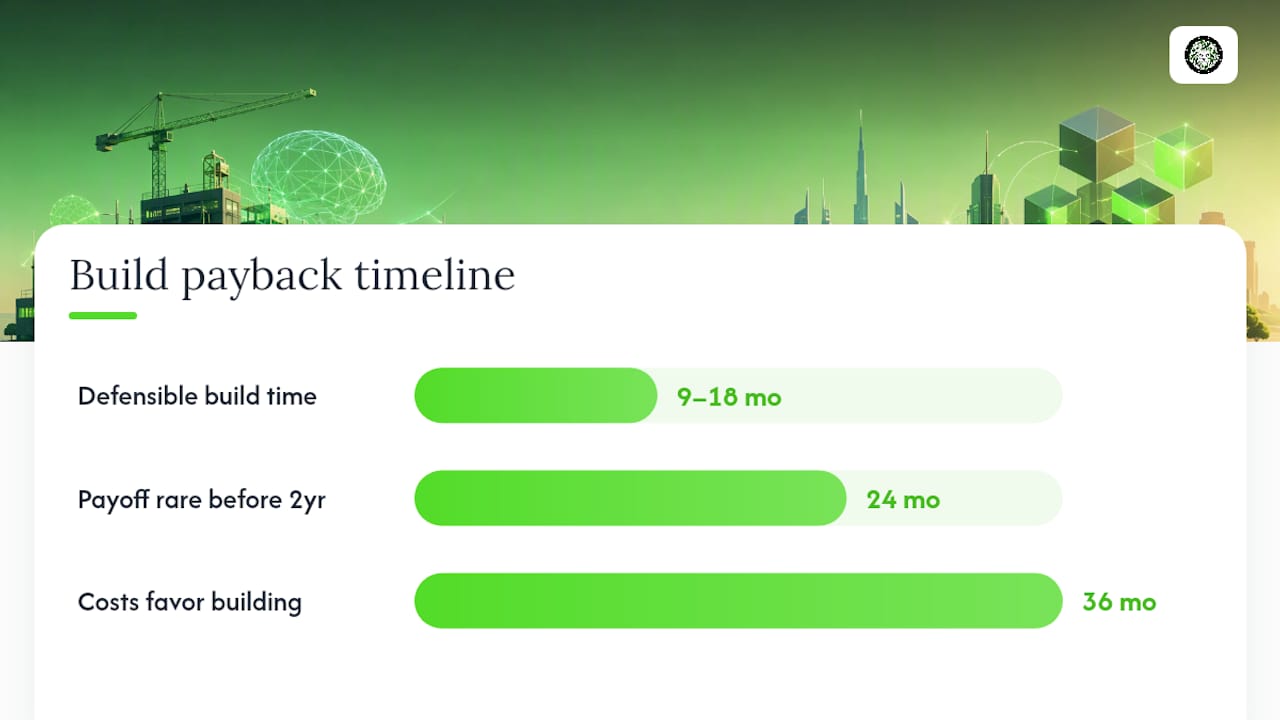
Timeline economics matter too. Custom builds rarely pay off inside the first two years once you account for engineering time, infrastructure, and iteration cycles. The cost curve tends to favor building only from around year three onward, once usage volume is high enough that per-transaction vendor fees would have exceeded what you spent building in-house.
What most leaders underestimate is what happens after launch, not before it:
- Model drift requires ongoing monitoring and periodic retraining.
- An evaluation harness needs to run on every model or prompt change to catch regressions before users do.
- Data pipelines need the same maintenance discipline as any production software system.
- Domain shifts in your business (new products, new markets) require the model to be retrained, not just re-deployed.
Consulting and advisory sources consistently flag maintenance debt, not the initial build, as the most underestimated cost of owning an AI system. Teams budget for the sprint that ships the model and forget to budget for the years of upkeep after.
Realistic timelines for a defensible custom build run 9 to 18 months from discovery to stable production, depending on data readiness and team size. If your organization can't commit to that runway plus ongoing maintenance staffing, hybrid is the more honest answer.
What Is the Buy, Boost, Build Framework?
The buy, boost, build framing, popularized in MIT Sloan's research, gives you a third option between the extremes. You buy the foundation model or platform, then boost it with your proprietary data and orchestration logic instead of building or fine-tuning from scratch.
Boosting typically means layering retrieval-augmented generation (RAG), prompt engineering, and domain-specific adapters on top of a vendor's base model. RAG lets the system pull from your internal documents and databases at query time, so the model reasons over your proprietary content without ever being retrained on it. Databricks' comparison of RAG and fine-tuning found that this combination satisfies most enterprise use cases at a fraction of fine-tuning's cost.
This pattern works because it separates two different problems: general language competence, which vendors have already solved at massive scale, and domain specificity, which only you can provide.
Watch for hidden costs when layering solutions:
- Integration work between your data systems and the vendor's API surface.
- Ongoing prompt maintenance as the vendor updates its underlying model.
- Data pipeline costs to keep the retrieval index current.
Boosting beats full fine-tuning or ownership whenever your differentiation lives in the data and workflow, not in the underlying language capability itself.
How Do You Run a Reproducible Decision Framework?
A six-step process turns the build vs buy AI question from a debate into a documented decision. Run this as a structured workshop with product, engineering, and finance in the room together.
- Discovery interviews. Talk to the people who'll actually use the system. Define success in terms of business KPIs, not model accuracy scores. What does "working" look like to a customer service lead or a claims processor?
- Feature-level mapping. Break the project into individual features and label each one commodity or critical. A chatbot's intent recognition might be commodity; its ability to reference your proprietary pricing logic is critical.
- Constraint map. Document security requirements, compliance obligations, data residency rules, and hard deadlines. This step alone eliminates options that looked viable on a spreadsheet but fail a legal review.
- TCO worksheet. Build a three-year cost comparison that includes engineering salaries and opportunity cost, not just vendor invoices or cloud compute. A rigorous TCO model has to account for the engineers you'd otherwise deploy elsewhere, a detail advisory frameworks flag as the single most common omission.
- Pilot plan. Set explicit success metrics and rollback criteria before you start, not after results come in. A sensible pilot order: spike with RAG on real proprietary data first, measure against business KPIs, add validation and human review, then only evaluate fine-tuning if the KPI lift justifies it.
- Go/no-go threshold. Decide in advance what score or outcome triggers a full commitment versus a pivot to a different lane.
Advisory data suggests roughly 60% of build vs buy decisions become clear-cut once teams apply rigorous criteria like these. Our enterprise AI roadmap guide walks through the pilot and operating model steps in more detail.
What Do Model Maintenance and Observability Really Cost?
The bill for an AI system doesn't stop at launch. It shifts from a project cost to an operating cost, and most organizations underestimate that shift.
Maintenance debt shows up in several recurring forms:
- Pipeline upkeep as source systems change schema or format.
- Drift monitoring to catch when model performance degrades against real-world data.
- Prompt maintenance every time an underlying vendor model updates.
- Regression testing before any change reaches production.
Production AI systems need the same observability discipline as any critical software: dashboards tracking latency and error rates, alerting when outputs fall outside expected ranges, and an on-call rotation that actually understands the model, not just the infrastructure around it. Teams that skip a continuous evaluation harness tend to discover regressions from angry users instead of automated checks.
Vendor costs carry their own long tail. Usage-based pricing scales with adoption, which is good news until a successful rollout triples your monthly bill. Customization fees and renewal negotiations, once you're dependent on a platform, tend to favor the vendor. Build a 3 to 5 year TCO scenario that assumes usage growth, at least one renewal cycle, and the ongoing engineering hours needed to keep integrations current. Our AI integration workflow guide and DLH.io's connector documentation both walk through where integration costs typically hide.
What Talent and Governance Does This Require?
Whichever lane you pick, someone has to own it after launch. Building typically needs an ML engineer, a data engineer, and a site reliability engineer (SRE) dedicated at least part-time to the system. Buying still needs a product owner and a compliance owner tracking vendor terms and audit obligations.
Retention risk matters here more than most roadmaps acknowledge. Engineers who spend a year maintaining a mediocre in-house model instead of shipping product features represent a real opportunity cost, one that rarely appears on a budget line.
Governance needs apply regardless of path:
- Explainability documentation for any AI-driven decision affecting customers.
- Audit trails showing what data fed which output.
- Clear data residency answers for any regulator who asks.
Organizations with a named executive sponsor and a dedicated evaluation process tend to see builds succeed; those where "AI" is everyone's part-time job tend to see them stall.
Pro Tip: Before greenlighting a build, ask who covers the on-call rotation in month 14, after the launch excitement fades. If nobody has an answer, you're not ready to build yet.
How Proud Lion Studios Approaches This Decision
Proud Lion Studios treats the buy vs build question as an engineering discipline, not a sales pitch. A typical engagement runs through discovery, a working prototype or spike, a clear decide point, then build and operate.
- Discovery: map your data, constraints, and the specific KPI a solution needs to move.
- Spike: a fast prototype using RAG or a domain adapter on top of an existing model, tested against your actual data.
- Decide: a joint go/no-go based on measured results, not projected ones.
- Ship and operate: production deployment with monitoring and retraining plans built in from day one, not bolted on later.
The studio recommends boosting a vendor foundation whenever a client's differentiation lives in proprietary data or workflow logic rather than raw model capability. Full custom builds get recommended only when the data and timeline genuinely justify the operational commitment, and buying outright gets recommended honestly when a client's use case is a solved problem. Our team has shipped AI chat and conversational tools built on exactly this layered pattern.
What This Framework Gets Right That Most Advice Misses
The build vs buy AI debate has been framed as a binary for years, and that framing is the biggest source of bad decisions. Most executives I've watched agonize over this choice were really arguing about which layer of the stack to own, not whether to own anything at all. Once you separate the foundation model from the differentiation logic sitting on top of it, the anxiety mostly disappears.
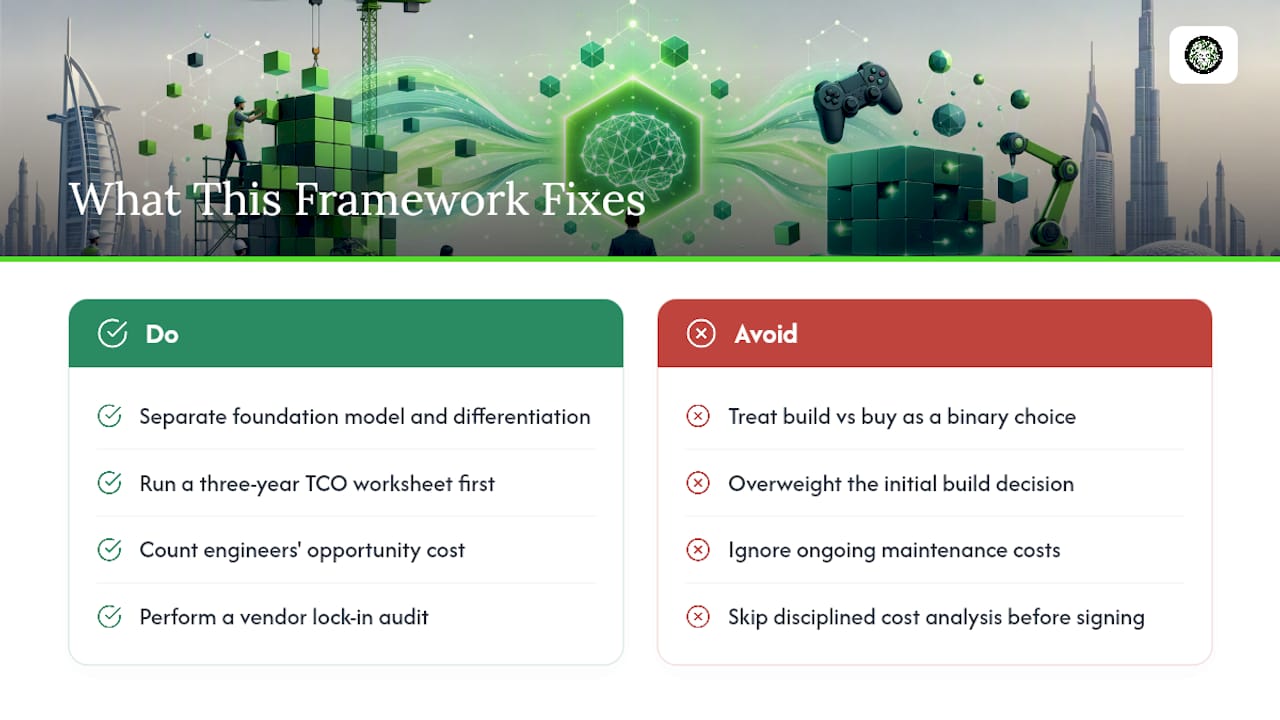
Conventional advice tends to overweight the build decision and underweight the maintenance decision. Nobody sells consulting hours for "keep doing what you're already doing," so external advisors often push toward ambitious custom builds that look impressive in a board deck and become nobody's job eighteen months later.
Prioritize the TCO worksheet before anything else. Not the vendor demo, not the architecture diagram, the actual three-year cost model including the engineers you'd pull off other work. Most organizations that regret a build skipped this step. Most that regret a buy skipped the vendor lock-in audit. Either mistake is avoidable with roughly a day of disciplined analysis before you write a line of code or sign a contract.
— Amal
Build Faster With a Team That Knows Both Sides
Deciding between build, buy, and hybrid is only half the work. Executing it without months of trial and error is where most internal teams stall. Proud Lion Studios builds custom AI agents, machine learning models, and automation layered directly on proven foundations, so you get the speed of buying with the differentiation of building.
If your team is weighing a build vs buy AI decision right now, the fastest way to de-risk it is a short discovery call and a working prototype, not another slide deck. Proud Lion Studios can scope a pilot spike against your actual data in weeks, show you real performance numbers, and hand you a clear recommendation before you commit engineering headcount to a multi-year build. Start with a conversation about your custom blockchain and AI development needs, and get a straight answer about whether your project belongs in the buy, boost, or build lane.
Sources
- The Evolution of Build Vs Buy | KPMG
- Buy, boost, or build? Choose your path to generative AI | MIT Sloan
FAQ
What Is Build vs Buy in AI Strategy?
Build vs buy is the decision of whether to develop a custom AI capability in-house or purchase an existing vendor product. Most organizations land on a hybrid: buying a foundation model or platform, then boosting it with proprietary data.
What Is the 30% Rule in AI?
If you've seen it referenced for a specific budget or performance threshold, treat it as one firm's internal guideline rather than an established industry benchmark.
Is Building AI Software Free?
No. Even open-source models and frameworks carry real costs: engineering time, infrastructure, data preparation, and ongoing maintenance like drift monitoring and retraining. The "free" part of open-source AI is the license, not the total cost of ownership.
What Does It Mean to Build AI?
Building AI means developing a custom model, agent, or automation system tailored to your data and workflows rather than licensing an existing product. It typically requires dedicated ML and data engineering talent, a multi-month to multi-year timeline, and a long-term commitment to maintenance and observability after launch.
When Should a Company Choose Hybrid Over Pure Build or Buy?
Choose hybrid when you need speed but also have proprietary data or workflow logic that a generic vendor model can't replicate. Buying the foundation and boosting it with RAG or domain adapters typically delivers most of the differentiation of a full build at a fraction of the cost and timeline.