
TL;DR:
- Blockchain security extends beyond tamper-resistant ledgers to encompass consensus risks, smart contract vulnerabilities, key management, and operational governance. Continuous threat modeling, layered controls, and disciplined operational practices are essential to prevent human-related failures and ecosystem evolution from compromising security. Implementing comprehensive, ongoing security programs ensures resilient protection for blockchain systems beyond initial audits.
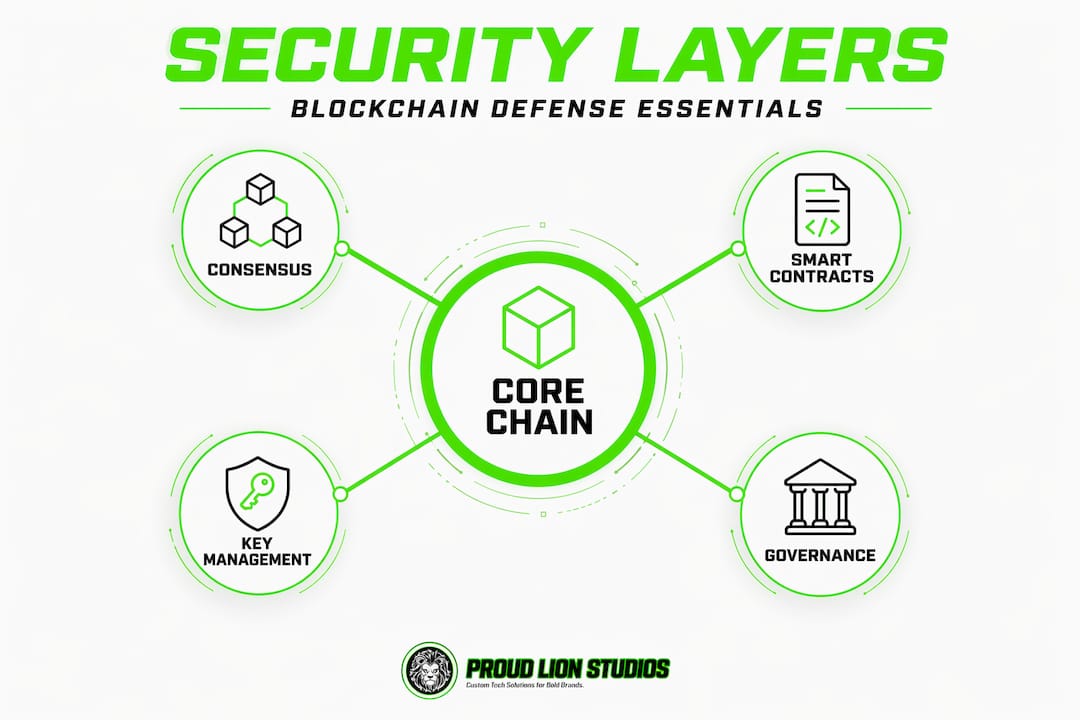
Most developers building on blockchain assume the technology's cryptographic design handles security for them. It does not. Blockchain security essentials cover far more than tamper-resistant ledgers. Real-world losses from smart contract exploits, compromised private keys, and social engineering attacks confirm that tamper resistance alone is insufficient without layered security controls at every level. This guide covers the core security domains every developer, security professional, and IT manager must understand: consensus architecture risks, smart contract vulnerabilities, wallet and key management, and the operational discipline that keeps everything together.
Table of Contents
- Key takeaways
- Blockchain security essentials: consensus architecture risks
- Smart contract security best practices
- Wallet and key management
- Operational security and governance
- My take on why most blockchain security fails in practice
- How Proudlionstudios builds security into every blockchain project
- FAQ
Key takeaways
| Point | Details |
|---|---|
| Consensus risks are protocol-specific | Model 51% attack thresholds and MEV manipulation based on your specific protocol, not generic assumptions. |
| Smart contract audits are not enough | Combine static analysis, fuzzing, and formal verification with continuous post-deployment monitoring. |
| Key management determines real-world security | Tiered wallet hardening and MPC controls prevent the key compromise that drives most digital asset losses. |
| Operational and governance controls matter | Social engineering, supply chain, and upgrade governance risks sit outside smart contract code and must be managed separately. |
| Security is continuous, not a one-time check | Treat your blockchain security checklist as a living program, not a pre-launch task to close out. |
Blockchain security essentials: consensus architecture risks
The security model of any blockchain starts at the consensus layer. Understanding what your protocol assumes, and where those assumptions break down, is foundational to every other blockchain security best practice you apply.
Proof of Work and Proof of Stake are the two dominant consensus models, and each carries specific threat profiles. In PoW networks, an attacker who controls the majority of hash rate can rewrite recent transaction history. In PoS networks, the threshold depends on the percentage of staked tokens, not raw compute power. Consensus attack thresholds are protocol-dependent, which means copying a security posture from one chain to another without protocol-specific threat modeling is a real mistake many teams make.
Beyond majority attacks, Maximal Extractable Value introduces a subtler risk. MEV describes the ability of miners or validators to reorder, insert, or exclude transactions within a block to extract profit. In DeFi contexts, MEV can drain user value through front-running and sandwich attacks without any code vulnerability being exploited. It is a structural feature of permissionless ordering, not a bug.
Here are the key consensus-level risks and corresponding mitigation strategies:
- 51% and long-range attacks: Use networks with sufficient economic security for your use case. For private chains, audit the distribution of validators or miners regularly.
- MEV front-running: Use commit-reveal schemes, private mempools, or threshold decryption to reduce transaction ordering exploitability.
- Eclipse attacks: Peer diversity and strict inbound connection policies protect nodes from being isolated and fed false data.
- Time manipulation: Avoid on-chain timestamp dependence for critical logic. Use block number as a proxy with appropriate confirmation thresholds.
| Consensus risk | Primary mechanism | Mitigation approach |
|---|---|---|
| 51% attack | Hash/stake majority takeover | Choose high-security networks; monitor validator concentration |
| MEV extraction | Transaction reordering by validators | Commit-reveal, private mempool, MEV-aware protocol design |
| Eclipse attack | Network-level peer isolation | Diverse peer connections, node monitoring |
| Long-range attack | Historical chain rewrite in PoS | Checkpointing, finality guarantees |
Pro Tip: When doing a blockchain vulnerability assessment for a new chain deployment, do not start with smart contract code. Start by mapping the consensus model and identifying the exact economic threshold an attacker would need to reach to compromise it.
Smart contract security best practices
Smart contracts are where most high-profile exploits happen because they combine programmable logic, irreversibility, and public accessibility in one place. The OWASP Smart Contract Top 10 for 2026 catalogs the critical vulnerability classes developers must address, including access control failures, business logic bugs, oracle manipulation, flash loan attacks, and proxy implementation flaws.

Ethereum.org recommends implementing access control through patterns like Ownable and role-based access, combined with "require(), assert(), and revert()` statements that enforce preconditions and protect privileged functions. The core principle is that any public function can be called by a hostile actor at any time. Your contract should behave correctly even in the worst-case caller scenario.
Reentrancy attacks remain dangerous because unchecked external calls can allow a malicious contract to recursively drain funds before state updates complete. The fix is the checks-effects-interactions pattern: update state variables before making any external call, never after.
Your testing strategy needs multiple layers:
- Static analysis tools (Slither, MythX) catch common patterns like reentrancy, integer overflow, and unauthorized access before deployment.
- Fuzz testing sends random or adversarial inputs to surface edge cases that manual review misses.
- Formal verification mathematically proves that a contract behaves according to its specification, which matters for high-value protocol logic.
- Manual code review from someone unfamiliar with the codebase catches logic errors that automated tools routinely miss.
- On-chain monitoring watches live contract behavior for anomalous patterns post-deployment, particularly around balance changes and privileged calls.
Smart contract audits are supplementary, not a substitute for secure development practices. Teams that treat an audit as a certification rather than an additional review tend to ship vulnerabilities that were introduced after the audit scope closed.
Pro Tip: Add the Proudlionstudios Web3 development checklist to your pre-deployment process. Running through a structured checklist before mainnet catches context-specific issues that generic audits often overlook.
Wallet and key management
Key compromise drives most digital asset losses, which makes wallet architecture and key management the most operationally critical piece of blockchain safety measures. Most security teams spend 80% of their review time on smart contracts and 20% on key management. Those numbers should be closer to equal.
Tiered wallet hardening is the standard approach:
- Cold wallets store the majority of assets offline, air-gapped, with physical access controls. Industry guidance recommends 90 to 95% of holdings in cold storage.
- Warm wallets are connected infrequently for periodic settlement and batch transactions. They use hardware security modules (HSMs) and require multi-person authorization.
- Hot wallets handle day-to-day operations and hold only what is needed for immediate transactions. Access is tightly scoped and monitored.
Multi-party computation (MPC) distributes key shares across multiple parties or devices so no single point holds a complete private key. This removes the catastrophic single-key risk that makes traditional hot wallets so dangerous. MPC is distinct from multisignature wallets, though both reduce single-point exposure through different cryptographic mechanisms.
| Protection method | What it prevents | Operational complexity |
|---|---|---|
| Hardware wallet (HSM) | Physical and remote key extraction | Low to medium |
| MPC key sharing | Single-point compromise | Medium to high |
| Multisig authorization | Unauthorized transactions | Medium |
| Shamir's Secret Sharing | Backup loss or single-custodian failure | Medium |
For recovery, Shamir's Secret Sharing splits a master secret into multiple shares where a defined threshold (e.g., 3 of 5 shares) is needed to reconstruct it. No single person can recover the key alone, which protects against both insider threats and personal compromise.
Pro Tip: Document your incident response runbook before you deploy to mainnet, not after. Define who has authority to trigger a freeze, how to rotate compromised keys, and what communication goes to users within the first 24 hours. Decisions made under pressure without a plan are how small incidents become catastrophic ones.
Operational security and governance
Blockchain's tamper resistance does not protect you from phishing attacks against a developer with admin access, a compromised CI/CD pipeline injecting malicious code, or a governance vote manipulated by concentrated token holders. These are the risks that live outside smart contract code, and they are the ones that take mature teams by surprise.
Social engineering is the most underrated attack vector in blockchain projects. A single developer tricked into signing a malicious transaction or approving a fraudulent upgrade proposal can undo all the on-chain security work your team has done. Training and process controls are not optional extras; they are core blockchain safety measures.
On the governance side, upgrade mechanisms deserve as much scrutiny as the contracts themselves. Timelocks give the community time to review and respond to proposed changes before they execute. Voting weight concentration creates governance attack surfaces where a whale or a coordinated group can push through malicious upgrades. Ongoing governance review should include auditing upgrade permissions, proxy admin keys, and the processes that control them.
Key operational controls to integrate into your security program:
- Automated on-chain monitoring: Watch for large balance changes, unusual function calls, and price oracle deviations in real time.
- Supply chain hygiene: Pin dependency versions, verify package checksums, and audit third-party libraries before integration.
- Off-chain data controls: Sensitive data should never go on-chain. Use cryptographic commitments or zero-knowledge proofs when you need to prove something without revealing it.
- Post-quantum readiness: NIST finalized post-quantum standards (FIPS 203, 204, 205) are relevant for long-lived key pairs and should factor into your cryptographic planning today.
Continuous threat modeling that covers both Web2 infrastructure and blockchain-specific risks is what separates a point-in-time security review from a real security program. Exploit classes that did not exist at launch appear post-deployment. Your monitoring and response capabilities need to catch them.
Pro Tip: Schedule a red team exercise focused specifically on your governance path, not your smart contracts. Ask: what would it take to pass a malicious proposal? The answer will identify your real governance risk faster than any audit.
My take on why most blockchain security fails in practice
I've reviewed enough blockchain projects to know where they consistently fail. It is almost never the cryptography. The chain handles that part well. What breaks is the human layer.
Teams audit their contracts thoroughly and then hand admin key access to a single developer's personal hardware wallet. They build sophisticated multisig controls and then configure them with thresholds low enough that two compromised devices can authorize a drain. I've seen projects lose funds not because of code vulnerabilities, but because their incident response plan was a shared doc that nobody had updated since the testnet phase.
The counterintuitive insight I keep coming back to is this: audits represent a point-in-time snapshot, but the ecosystem around your contracts keeps evolving. A new integration, an oracle price feed change, or a token the protocol interacts with getting its permissions altered can create vulnerabilities in code that auditors cleared six months ago. The security work does not stop at deployment.
What actually works is treating blockchain security the same way mature enterprises treat information security generally: as an ongoing program with threat modeling, monitoring, response drills, and periodic reassessment. The teams building secure, scalable blockchain solutions are not the ones with the most sophisticated code. They are the ones with the most disciplined operational culture.
If you take one thing from this: the importance of blockchain security cannot be captured in a pre-launch checklist. It lives in the team's habits, processes, and willingness to keep questioning their assumptions after go-live.
— Amal
How Proudlionstudios builds security into every blockchain project
Proudlionstudios brings together security-focused blockchain development with the operational depth to back it up. The Dubai-based team builds smart contracts with security review integrated into the development cycle, not added as an afterthought. Every engagement combines code-level defense with deployment architecture that accounts for wallet management, access controls, and upgrade governance from day one.

Whether you are building a DeFi protocol, an NFT marketplace, or a tokenized asset platform, the team at Proudlionstudios applies the same defense-in-depth principles covered in this guide. Their blockchain development services include vulnerability-aware architecture design, smart contract development, and tokenization across Web3 ecosystems. Teams that want to build with security baked in, rather than bolted on, can reach out directly to start a consultation.
FAQ
What are blockchain security essentials?
Blockchain security essentials are the layered controls that protect a blockchain system across its consensus layer, smart contract code, wallet and key management, and operational governance. No single measure provides complete protection without the others.
How do you secure a blockchain application against smart contract attacks?
Use secure access control patterns, apply require() and revert() checks, follow the checks-effects-interactions pattern to prevent reentrancy, and combine static analysis, fuzz testing, and manual review before deployment. Continuous monitoring after deployment catches new exploit patterns that emerge from ecosystem changes.
Why is key management so critical in blockchain security?
Key compromise is the leading cause of digital asset losses. Even audited smart contracts provide no protection if an attacker gains control of an authorized private key. Tiered cold/warm/hot storage, MPC, and HSMs reduce the risk of any single key being enough to authorize a malicious transaction.
What is a blockchain vulnerability assessment?
A blockchain vulnerability assessment is a structured review of threat vectors across the consensus layer, smart contract logic, wallet infrastructure, and operational controls. It goes beyond code auditing to include governance risks, social engineering exposure, and infrastructure security relevant to the specific protocol and deployment environment.
How often should a blockchain security checklist be reviewed?
A blockchain security checklist should be treated as a living document reviewed after every major protocol upgrade, integration change, or ecosystem event that affects dependencies. At minimum, run a formal security review quarterly and after any significant change to access control or upgrade logic.