

API rate limiting caps how many requests a client can make in a given window to protect uptime, cost, and fairness across users. The strongest production baseline pairs a token bucket algorithm with layered, per-endpoint and per-tenant limits, centralized state in Redis backed by Lua scripts for atomic checks, and standard 429 responses with Retry-After headers. This article walks through the algorithms, the architecture, the response contract, and the operational discipline that separates a rate limiter that survives launch day from one that doesn't.
TL;DR:
- Using layered per-endpoint and per-tenant token bucket algorithms with Redis Lua scripts ensures atomic checks and maintains high request accuracy under load.
- Implementing comprehensive RateLimit headers and Retry-After responses equips clients to self-throttle and reduces unnecessary 429 rejections.
- Selecting meaningful keys based on authenticated identity and combining them with endpoint-specific details prevents over-restriction in NAT-reliant networks.
- Monitoring rejection patterns, latency, and quota exhaustion helps optimize rate limits and detect over-constraining or abuse early.
- Most successful production limiters should start with a staged rollout, load testing, and deliberate failure-mode planning to survive traffic spikes and outages.
Table of Contents
- Why API Rate Limiting Protects Availability and Your Bottom Line
- Token Bucket vs Leaky Bucket vs Fixed and Sliding Windows
- Choosing Keys and Layering Limits Without Surprising Anyone
- Building the Architecture: Gateway, Middleware, and Redis
- Sending 429s, Retry-After, and Headers Clients Can Trust
- Monitoring, Testing, and Knowing When Your Limits Are Wrong
- Where Proud Lion Studios' Engineering Experience Fits
- The Fairness Question Behind Every Rate Limit
- Designing Client Applications to Handle Limits Gracefully
- A Practical Rollout Checklist and the Mistakes That Keep Repeating
- Get Production-Ready Rate Limiting Built Into Your Backend
- Sources
- FAQ
Why API Rate Limiting Protects Availability and Your Bottom Line
Rate limiting exists because unmanaged traffic eventually breaks something, whether that's your database connection pool, a third-party billing API you pay per call, or the trust of paying customers stuck behind a noisy free-tier neighbor. A single misconfigured client script hammering an endpoint at 500 requests per second can cascade into timeouts across every downstream service that shares the same connection pool.
Rate limiting solves three distinct problems, and conflating them is where a lot of teams go wrong:
- Availability protection: caps prevent one client or one bug from starving resources that every other client depends on.
- Abuse mitigation: throttling slows credential stuffing, scraping, and low-grade DDoS attempts without requiring a full web application firewall.
- Cost and monetization control: metered downstream APIs (payment processors, LLM providers, SMS gateways) charge per call, so limits keep spend predictable and let you sell tiered access as a product feature.
That third point matters more than most engineering teams give it credit for. Tiered rate limits aren't just defensive. They're a monetization lever. A free tier capped at 100 requests per hour and a paid tier at 10,000 creates a natural upgrade path that product teams can sell without writing a line of new feature code.
Token Bucket vs Leaky Bucket vs Fixed and Sliding Windows
Four algorithms dominate production rate limiting, and each makes a different trade-off between burst tolerance, accuracy, and memory cost.
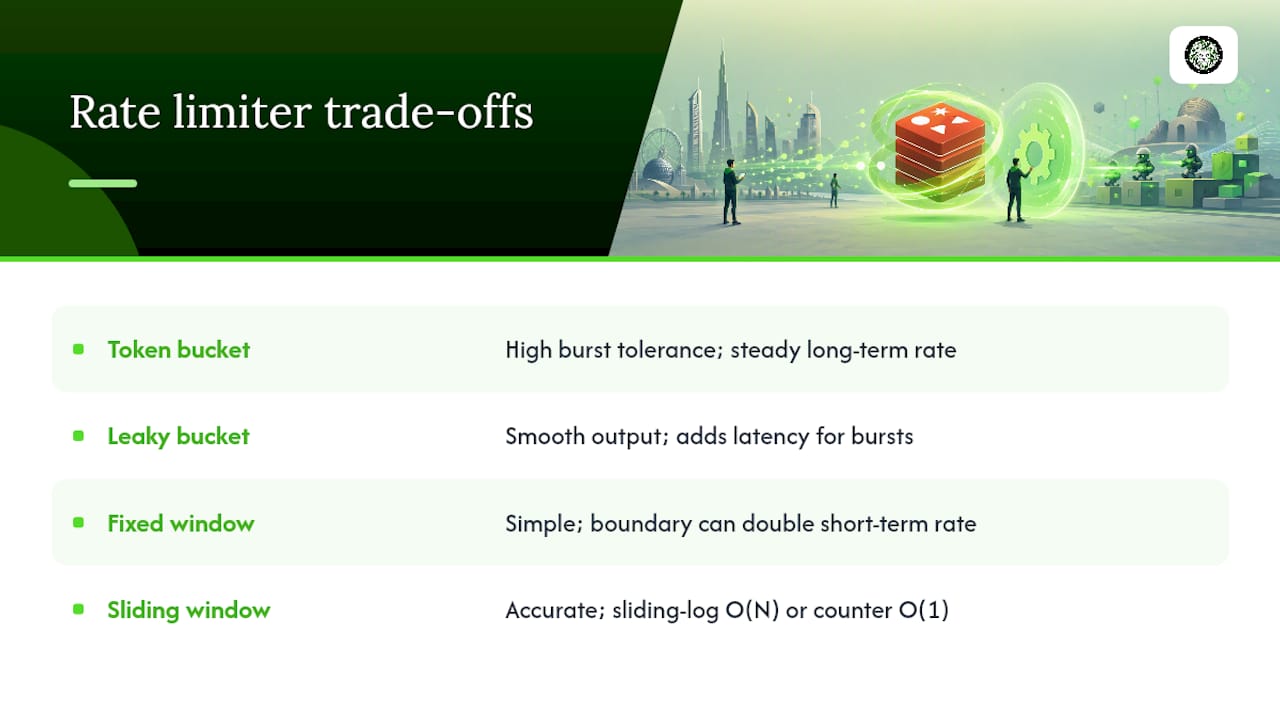
Token bucket is the default choice for most public APIs, and for good reason. A bucket holds a maximum number of tokens, refills at a steady rate, and each request consumes one token. When the bucket runs dry, requests get rejected until it refills. This lets legitimate clients burst (a mobile app syncing after being offline, for instance) without penalty, while still enforcing a hard average rate over time. Comparative testing shows token bucket allows temporary spikes in requests per second that a stricter algorithm would reject outright.
Leaky bucket flips the priority. Requests queue up and drain at a constant rate, like water leaking from a hole in a bucket regardless of how fast it's poured in. This produces smooth, predictable output, which matters when the downstream system genuinely cannot absorb a burst, such as a legacy mainframe or a metered third-party API with strict per-second caps. The cost is added latency for bursty clients, since excess requests wait in queue instead of executing immediately.
Fixed window counters are the simplest to implement: count requests in a clock-aligned window (say, 0 to 60 seconds) and reset at the boundary. The flaw is the boundary itself. A client can send a full quota's worth of requests at 0:59 and another full quota at 1:01, doubling the effective rate in a two-second span.
Sliding window approaches fix that. A sliding log tracks every request timestamp for perfect accuracy but costs O(N) memory per key, which gets expensive at scale. A sliding window counter approximates the exact log using two adjacent window counts, delivering near-exact accuracy at O(1) memory, which is why it's become the practical standard for Redis-backed limiters handling millions of keys.
Choosing Keys and Layering Limits Without Surprising Anyone
Picking the wrong key to rate limit on breaks the whole system before the algorithm even matters. IP-based limiting sounds intuitive until you remember that corporate networks, mobile carriers, and CGNAT setups can put thousands of legitimate users behind a single public IP. Limit by IP alone and you'll throttle an entire office building because one employee's script misbehaved.
- Key on the authenticated identity first. An API key, OAuth client ID, or tenant ID gives you a stable identity that survives NAT and proxy layers. Fall back to IP only for unauthenticated endpoints like login or signup.
- Combine keys for precision. A composite key like
api_key:routelets you cap a single client's hits to/searchseparately from/checkout, so heavy read traffic on one endpoint doesn't eat into the quota for a sensitive one. - Set tiers by plan, not by guesswork. Free tier, pro tier, and enterprise tier each get distinct limits, and endpoint-specific caps should differ by resource cost: authentication and search endpoints get tighter caps, product listing or read-only endpoints get more generous ones.
- Define precedence explicitly. When a request matches a global limit, a tenant limit, and an endpoint limit simultaneously, the narrowest applicable limit wins. Document this rule, because it's the first thing an on-call engineer will need at 2 a.m.
- Compute remaining quota consistently. Whatever layer rejects the request should be the one whose remaining count you report back to the client. Reporting the wrong layer's count is a common source of confusing client-side bugs.
Building the Architecture: Gateway, Middleware, and Redis
Production rate limiting rarely lives in one place. The most resilient setups layer coarse limits at the edge with fine-grained limits closer to the service.
An edge gateway or CDN layer (Cloudflare, Kong, or a cloud provider's API gateway) handles the first pass: blocking obvious floods and enforcing generous, account-level ceilings before traffic ever reaches your application servers. Service-level middleware then applies the precise, business-logic-aware limits, since the gateway usually doesn't know that this particular API key is on the free tier and just hit its search quota.
For the state itself, centralized Redis with Lua scripts is the production standard because rate limiting is fundamentally a read-modify-write operation, and without atomicity, concurrent requests can both read the same count before either writes back, letting clients slip past their limit under load. A Lua script bundles the check-and-decrement into one atomic Redis operation, closing that race condition entirely.
At high scale, a few patterns keep Redis from becoming the bottleneck:
- Shard Redis by client ID or tenant ID so no single node absorbs disproportionate load.
- Use hash tagging in Redis Cluster to keep a given key's data on one node, avoiding cross-slot operation errors.
- Cache tokens locally on each application instance and reconcile with the central store on an interval, trading a small amount of accuracy for a significant latency reduction at very high queries per second.
Decide your failure posture before an incident forces the decision for you. If Redis becomes unreachable, do you fail open (allow all requests, risking overload) or fail closed (reject all requests, guaranteeing an outage)? Most teams land on a hybrid: fail open for a short grace period while alerting loudly, then fail closed if the outage persists.
Pro Tip: Test your Redis failure mode in staging by killing the Redis connection mid load test. Teams that skip this discover their fail-open logic actually fails closed under real network partition conditions, usually during an actual incident.
Sending 429s, Retry-After, and Headers Clients Can Trust
A rejected request should never leave a client guessing. RFC 6585 defines the HTTP 429 Too Many Requests status code specifically for this case, and the standard explicitly supports pairing it with a Retry-After header telling the client exactly how many seconds to wait before trying again.
Beyond the bare minimum, a well-behaved API exposes:
Retry-After: seconds until the client should retry, per RFC 6585.RateLimit-Policy: the quota and window definition, per the IETF draft standard.RateLimit: remaining requests and time until reset, letting well-behaved clients throttle themselves before ever hitting a 429.
The IETF draft's structured RateLimit-Policy and RateLimit header fields exist precisely so clients can self-throttle proactively instead of learning their limit only after getting rejected. Adopting these headers costs little on the server side and meaningfully improves how third-party integrators build against your API.
On the client, the correct response to a 429 is capped exponential backoff with full jitter, not a fixed retry delay. Simulations comparing retry strategies show full jitter roughly halves total retry load compared to naive fixed-interval retries, because jitter prevents every throttled client from retrying in the exact same instant and recreating the spike that got them throttled in the first place.
Monitoring, Testing, and Knowing When Your Limits Are Wrong
A rate limiter you can't observe is a rate limiter you're guessing about. Track these from day one:
- 429 rate over time, broken out by endpoint and by tier, to spot whether a specific plan or route is chronically over-constrained.
- Per-key rejection distribution, since a handful of keys eating most of your 429s often points to either abuse or a legitimate customer who needs a plan upgrade conversation.
- p95 and p99 latency on the rate-limit check itself, because a Redis call added to every request path becomes a bottleneck if it's not sub-millisecond.
- Quota exhaustion rates by tier, which tells product teams whether current tier boundaries actually match real usage patterns.
Test with synthetic burst traffic that intentionally straddles window boundaries, since that's where fixed-window bugs hide. Inject Redis failures in staging to confirm your fail-open or fail-closed logic behaves as designed, not as assumed. Treat the first month of production metrics as a calibration period. Limits set from guesses almost always need adjustment once real traffic patterns show up.
Where Proud Lion Studios' Engineering Experience Fits
Rate limiting sits at the intersection of backend architecture, infrastructure, and API security, which is the exact territory Proud Lion Studios operates in daily across its API security work and scalable application development projects. Designing limits that hold under real traffic requires the same instincts as capacity planning and endpoint classification covered in the studio's app scalability roadmap.
Building this correctly in-house is entirely doable for teams with backend infrastructure experience. It's worth bringing in outside engineering support when you need a fast audit of existing limits, a Redis-backed implementation delivered on a deadline, or load testing that simulates real production traffic before a launch, rather than after an incident forces the question.
The Fairness Question Behind Every Rate Limit
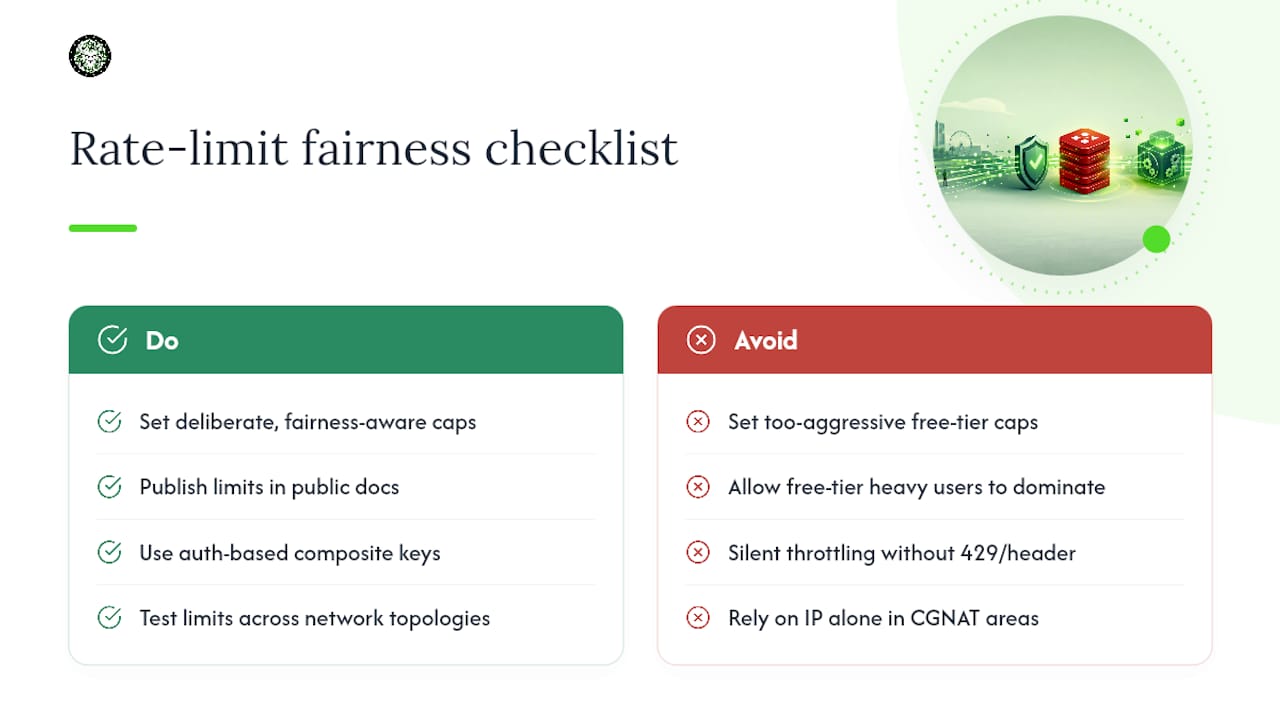
Rate limiting isn't purely a technical decision. Every cap you set makes an implicit statement about whose traffic matters more, and that has real user experience and fairness consequences worth thinking through deliberately.
Consider the free-tier developer building a side project against your API. A limit set too aggressively low doesn't just slow them down. It can make your API practically unusable for legitimate exploratory use, pushing developers toward a competitor before they ever become a paying customer. On the flip side, limits set too generously on a free tier let a small number of heavy users degrade service for everyone else, which is its own fairness failure.
Transparency matters here more than most teams assume. Publishing your rate limits in documentation, rather than letting developers discover them through trial and error, respects their time and lets them build resilient integrations from day one. Silent throttling, where requests are slowed or dropped without any 429 or explanatory header, is a pattern worth avoiding entirely. It erodes trust and makes debugging miserable for the developer on the other end.
There's also a data fairness angle specific to multi-tenant systems: if your limiting logic uses IP addresses in regions with heavy CGNAT deployment, you risk collectively punishing users in those regions more than users elsewhere, an unintentional but real equity gap. Composite keys built on authenticated identity, discussed earlier, solve this technically, but it's worth explicitly checking your limiter's behavior across different network topologies before you assume it's fair by default.
Designing Client Applications to Handle Limits Gracefully
Rate limits change how you should architect a client application, not just how you should react to errors after the fact. A mobile app or SDK that treats every API call as instantaneous and unlimited will eventually hit a 429 in production, usually during your busiest traffic period.
Good client design starts with reading the RateLimit headers proactively rather than waiting for rejection. If a client tracks its own remaining quota, it can throttle its own request queue, delay non-critical background syncs, and prioritize user-initiated actions over automated polling, all before ever triggering a 429.
When a 429 does arrive, the client needs a retry strategy baked in at the architecture level, not bolted on as an afterthought. That means:
- Implementing capped exponential backoff with full jitter as the default retry behavior for any request that returns 429.
- Distinguishing between retryable failures (rate limits, transient network errors) and non-retryable ones (bad request, authentication failure) so the client doesn't waste retry budget on errors that will never succeed.
- Batching or debouncing non-urgent requests client-side, especially for polling patterns like checking notification counts, to reduce baseline request volume before limits become relevant at all.
For mobile and SDK teams, this also affects offline handling. An app that queues actions while offline and then fires them all simultaneously on reconnect is a self-inflicted burst that a well-designed client should stagger. Teams building mobile clients against rate-limited APIs benefit from treating backoff and quota awareness as first-class parts of the app's networking layer, not exception-handling code tucked away in a catch block.
A Practical Rollout Checklist and the Mistakes That Keep Repeating
My opinionated defaults: token bucket for the algorithm, layered per-endpoint and per-tenant limits for the policy, Redis with Lua for atomicity, and full RateLimit headers alongside 429s so clients can behave well.
The recurring mistakes I see are uniform limits applied blindly across every endpoint, missing Retry-After headers that leave clients guessing, no monitoring until a 429 spike becomes a support ticket, and a fail-open or fail-closed choice made accidentally rather than deliberately.
Roll out in stages: audit current traffic patterns, pilot on one non-critical service, measure actual rejection rates against real usage, then expand with confidence.
— Amal
Get Production-Ready Rate Limiting Built Into Your Backend
Reading through token bucket math and Redis Lua scripts is one thing. Shipping a limiter that survives a real traffic spike at 2 a.m. is another, and that gap is where Proud Lion Studios' backend engineering team spends most of its time. As a fully UAE-based technical team, Proud Lion Studios builds custom backend infrastructure, including Redis-backed rate limiting, API gateway integration, and the monitoring layer to validate it under load, as part of its broader web application and API development work.

A typical engagement starts with an audit of your current traffic patterns and endpoint sensitivity, moves into an implementation plan covering algorithm choice and keying strategy, and finishes with load testing before anything touches production. If you're also building the client side of this equation, whether a mobile app or SDK that needs to handle 429s and backoff gracefully, that work falls under the studio's mobile app development services) as well. If you're evaluating third-party marketing or growth integrations that need their own quota planning, partners like BabyLoveGrowth illustrate the kind of high-volume API consumption that makes rate limiting non-negotiable in the first place.
Reach out to request a consultation on your current API architecture and get a concrete implementation plan for rate limiting that fits your actual traffic, not a generic template.
Sources
- What is API Rate Limiting? Understanding Request Throttling and Best Practices - Postman
- API Rate Limiting Explained: Strategies, Algorithms, and Production Best Practices - DEV Community
- draft-ietf-httpapi-ratelimit-headers-10
- Rate Limiting: Protecting Systems from Themselves - The HLD Handbook
- Redis rate limiting howtos / tutorials
FAQ
What Is API Rate Limiting?
API rate limiting is the practice of capping how many requests a client can send to an API within a defined time window, protecting availability, controlling cost, and preventing abuse.
What Is a Good Rate Limit for an API?
There's no universal number. It depends on endpoint cost and user tier, but a common pattern is generous limits (thousands per hour) on read-only endpoints and tight limits (tens per minute) on authentication, search, or checkout endpoints, as tiered limiting guidance recommends.
How Do I Fix an "API Rate Limit Exceeded" Error?
Read the Retry-After header on the 429 response and wait that long before retrying, ideally using exponential backoff with jitter rather than immediate retries, which can trigger repeated rejections.
How Do I Rate Limit an API to 10 Requests Per Minute?
Implement a token bucket with a capacity of 10 tokens that refills fully every 60 seconds, or use a sliding window counter tracking the last 60 seconds of requests per key, rejecting any request once the count hits 10.