

Every API needs seven layered controls to stay defensible: TLS everywhere, mandatory authentication on every endpoint, fine-grained authorization down to the object level, strict schema validation, rate limiting, centralized gateway enforcement, and continuous monitoring. These aren't optional add-ons picked from a menu. They're the baseline, and the details of each one shift depending on where in the API lifecycle you sit, guided by frameworks like the OWASP API Security Top 10 and NIST's SP 800-228 update.
TL;DR:
- Enforcing TLS 1.3 across all endpoints and pairing it with HSTS headers is essential for securing traffic, with mutual TLS recommended for internal service communications.
- Object-level authorization must be implemented in service code, not just at the gateway, to prevent breaches like ID guessing or ownership impersonation.
- Short-lived access tokens under 15 minutes with rotation and validation of claims like issuer, audience, and expiry significantly reduce risks from token leaks.
- Input validation should rely on allow-list schemas at both gateway and service layers, rejecting malformed or unexpected data before processing occurs.
- Focus on fixing object-level authorization issues first, as they are the most common and critical vulnerability, rather than overemphasizing network-layer controls like firewalls.
Table of Contents
- What Does a Layered API Security Architecture Look Like?
- Encrypt Traffic: TLS, HSTS, and mTLS Requirements
- How Should You Handle OAuth 2.0, JWT, and Token Lifetimes?
- Why Does Authorization Need to Go Beyond the Endpoint Level?
- Input Validation and Schema Enforcement That Actually Stops Attacks
- Rate Limiting, Throttling, and Resource Controls
- Where Do Gateway and Service Mesh Responsibilities Split?
- Secrets and Credential Lifecycle Management
- What Should You Log and Monitor to Catch API Attacks Early?
- Security Testing: Threat Modeling, CI Automation, and Penetration Tests
- Common Mistakes and a Concise API Security Checklist
- How Proud Lion Studios Applies These Practices in Production
- What API Security Advice Gets Overrated, and What Actually Matters
- Sources
- FAQ
What Does a Layered API Security Architecture Look Like?
Think of API security as four layers stacked in order: the gateway/edge, the authorization layer, the validation layer, and monitoring/operations. This structure isn't theoretical. Architecture guidance from the Open Security Architecture project maps these same four layers across REST, GraphQL, gRPC, and event-driven systems, because the risks don't change much with the protocol.
The operating principle underneath all four layers is zero trust: authenticate and authorize every call regardless of network location. Your internal microservice-to-microservice traffic gets the same scrutiny as a public endpoint, because "it's behind the firewall" stopped being a security boundary years ago.
Across the lifecycle, this breaks into concrete actions: threat model during design, build schema-first, run automated checks in CI, monitor at runtime, and retire endpoints on a real deprecation schedule. Skip any one stage and the layers above it inherit the gap.
Encrypt Traffic: TLS, HSTS, and mTLS Requirements
Require TLS 1.3 across every API endpoint. TLS 1.2 is acceptable only with strong cipher suites, and TLS 1.1 and 1.0 should be disabled outright, not just deprioritized. Pair this with HSTS headers so browsers and clients refuse to downgrade to plaintext, even when a misconfigured link tries to force it.
For service-to-service traffic, mutual TLS (mTLS) is worth the setup cost once you have more than a handful of internal services talking to each other. It authenticates both sides of the connection, not just the client, and it should be automated: certificate issuance and rotation through a service mesh or internal CA, never manually generated certs sitting in a config file with a two-year expiration nobody tracks.
One architecture decision matters more than teams expect: whether you terminate TLS at the gateway or pass it through to the backend. Terminating at the gateway simplifies certificate management and centralizes logging, but it means traffic between the gateway and backend is unencrypted unless you add mTLS internally. Certificate pinning adds another layer of protection for mobile clients, but it comes with real operational risk. Pin the wrong cert and you've locked users out until the app updates.
How Should You Handle OAuth 2.0, JWT, and Token Lifetimes?
For user-facing flows, OAuth 2.0 combined with OIDC remains the standard choice. For service accounts and machine-to-machine calls, use the client-credentials grant instead of borrowing a user flow that wasn't designed for it. This is the core of the oauth vs jwt confusion many teams run into: OAuth is the authorization framework, JWT is just one token format you can use within it, and the two solve different problems.
Access tokens should be short-lived, ideally 15 minutes or less, with refresh token rotation handling renewal. Postman's API security guidance backs this window specifically because it shrinks the blast radius if a token leaks. Short-lived tokens paired with rotation also make automated revocation realistic instead of theoretical, since a compromised token expires on its own before most incident response teams even finish the first triage call.
Every request needs validation of the standard JWT claims: iss, aud, exp, and nbf. Skipping any of these is how expired or mis-scoped tokens slip through. Never send credentials or API keys in query strings; they end up logged in plaintext across proxies, browser history, and analytics tools. On signature algorithms, prefer RS256 or ES256. Reject HS256 whenever you're operating a distributed trust model, because a shared secret that every verifying service must hold is a single point of failure waiting to be mishandled.
Why Does Authorization Need to Go Beyond the Endpoint Level?
Authentication proves who someone is. Authorization decides what they can touch, and that has to run at three separate levels: endpoint (can this role call this route at all), object (can this specific user access this specific record), and field (can they see or modify this particular attribute within the record). Most breaches trace back to the middle layer.
OWASP names Broken Object Level Authorization as API1:2023, the single most critical risk in its Top 10. It happens when an endpoint correctly checks that a user is logged in, then fails to check whether the record they're requesting actually belongs to them. Change /orders/1001 to /orders/1002 and if there's no ownership check, you're looking at someone else's order.
The fix starts with using indirect or opaque identifiers instead of sequential integers, so guessing a valid ID isn't trivial. Layer that with explicit ownership checks and scope-limited tokens that constrain what a token can even request. Object-specific logic like this belongs in service code, not the gateway, because the gateway has no idea whether user 47 owns order 1002.
For teams managing complex permission sets, ABAC or RBAC models with policy-as-code let you centralize the rules while still enforcing them at the application layer where the context actually lives. Centralizing the policy doesn't mean centralizing the enforcement.
Input Validation and Schema Enforcement That Actually Stops Attacks
Allow-list validation beats deny-list validation every time, because you can't anticipate every malicious pattern, but you can define exactly what a valid request looks like. Enforce content types strictly, cap payload sizes, and set depth limits on nested JSON. OWASP's REST Security Cheat Sheet specifically calls out overly deep JSON as a denial-of-service vector that parsers choke on.
Validate everything, not just the request body: headers, path parameters, and query strings all need the same scrutiny. Reject unexpected fields outright rather than silently ignoring them, since that's exactly how mass-assignment vulnerabilities let an attacker set a field like isAdmin that the form never intended to expose.
Schema-first design (using OpenAPI, GraphQL schemas, or protobuf definitions) means the gateway can reject malformed payloads before they ever touch business logic, which is a huge reduction in attack surface. Still, re-validate inside the service too, and bake schema checks into your CI pipeline so a schema drift never ships unnoticed.
Rate Limiting, Throttling, and Resource Controls
Apply limits at both the per-client and per-endpoint level, since a single generous global limit lets one abusive client starve everyone else. Authentication endpoints deserve progressive throttling specifically, tightening after repeated failures, because that's where credential stuffing shows up first. High-risk business flows, like password resets or payment submissions, need their own quotas independent of general API traffic.
When a client exceeds its limit, return a 429 status and capture the event as a metric, not just a log line. Those metrics are what let you tune thresholds instead of guessing. On the GraphQL side, complexity limits stop a single deeply nested query from acting like a denial-of-service attack, and straightforward payload size caps do the same job for REST.
Where Do Gateway and Service Mesh Responsibilities Split?
The gateway sits at the edge and owns the cross-cutting concerns: TLS termination, initial authentication checks, rate limiting, WAF rules, schema validation, request logging, and routing. Every API request touches it once, which makes it the right place for controls that apply uniformly, regardless of which service ultimately handles the request.
A service mesh handles a different problem: the east-west traffic between services once a request is already inside your infrastructure. That's workload identity through mTLS, service-to-service authorization, and observability across calls the gateway never sees directly. If you're running dozens of microservices, a mesh gives you consistent identity and encryption between them without hand-rolling mTLS in every service.
The design principle that keeps both layers from stepping on each other: gateway for the controls that apply to everyone, services for object-level business logic that only the service itself has enough context to judge. This maps closely to the four-layer architecture pattern referenced earlier, and it's worth revisiting when you're deciding where a new check actually belongs.
Secrets and Credential Lifecycle Management
Static API keys sitting in a .env file or, worse, committed to source control are one of the most common ways teams get burned. A dedicated secrets manager (think HashiCorp Vault, AWS Secrets Manager, or an equivalent) should hold every credential, with rotation automated rather than dependent on someone remembering to do it quarterly.
Where possible, issue ephemeral credentials instead of long-lived ones. Short-lived tokens paired with refresh rotation reduce how much damage a leaked credential can do, and binding refresh tokens to a specific client with rotation on every use closes off replay attacks.
Keep a live credential inventory. You need to know instantly which services hold which keys, so revocation during an incident takes minutes, not a scavenger hunt through Slack history. Build key lifecycle checks directly into CI/CD so an expiring cert or an unrotated key fails a pipeline instead of failing production.
What Should You Log and Monitor to Catch API Attacks Early?
Log every authentication attempt, every authorization decision (both allowed and denied), rate-limit triggers, schema validation failures, and any access to sensitive data, all tied together with correlation IDs so you can trace a single request across services.
The patterns worth watching for are specific: a burst of failed authentications signals credential stuffing, sequential ID access across a short window signals BOLA probing, paginated bulk reads at an unusual volume signal scraping, and off-hours access from an account that never logs in outside business hours is its own red flag.
Protect the logs themselves. Never let secrets or tokens land in log output, set sane retention windows, and restrict who can query them. Have an incident response playbook ready before you need it, covering credential revocation and the ability to isolate a specific route or service without taking the whole API down.
Security Testing: Threat Modeling, CI Automation, and Penetration Tests
Threat modeling belongs at design time, not after launch. Map trust boundaries, identify the flows handling sensitive data, and think through abuse cases before a single line of code ships.
From there, automate what you can. Contract tests catch schema drift, DAST and fuzzing tools catch malformed-input handling, and negative authorization tests (deliberately trying to access another user's object) belong in the same CI pipeline as your unit tests. NIST's lifecycle guidance maps controls to specific stages exactly for this reason: catching a gap in design is cheaper than catching it in production.
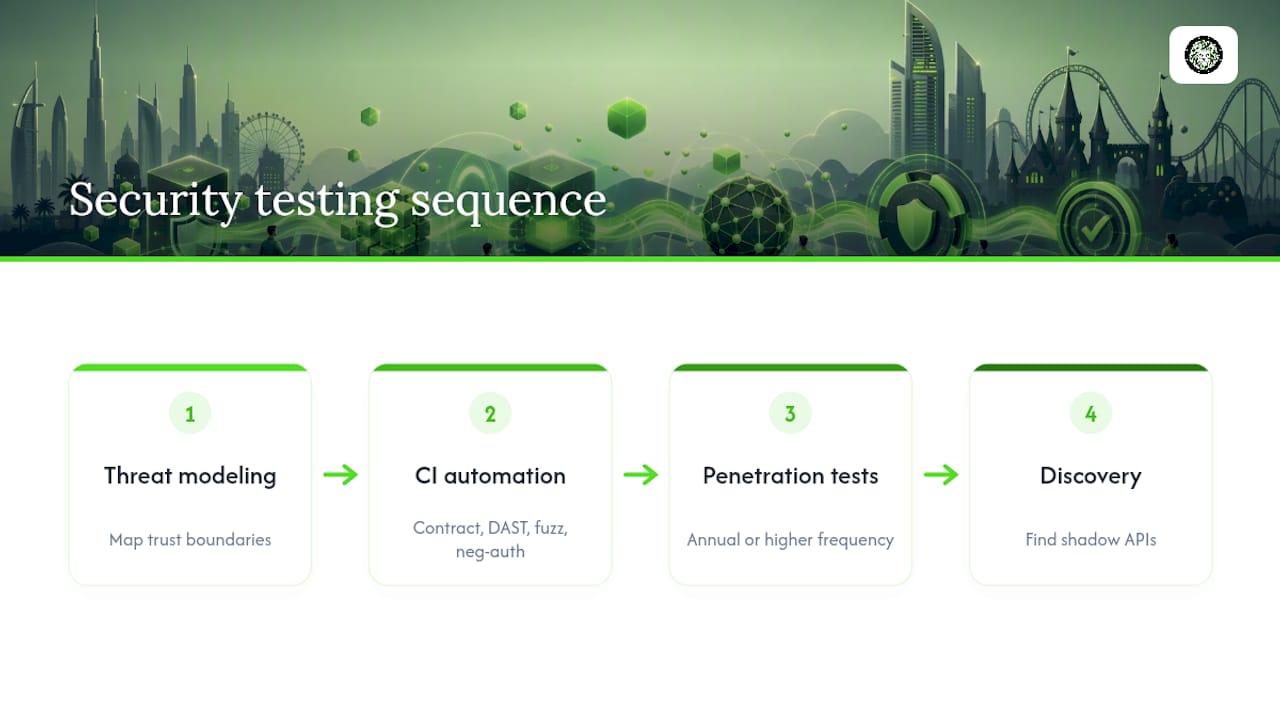
Schedule penetration tests annually at minimum, or more often for high-risk services, and scope them directly against the OWASP API Security Top 10 rather than a generic web app checklist. Pair this with automated discovery to find shadow APIs, since an unmanaged endpoint someone spun up six months ago is usually the one nobody's testing.
Common Mistakes and a Concise API Security Checklist
Most API breaches don't come from an exotic zero-day. They come from a handful of predictable, avoidable errors that show up again and again across the industry, according to guidance from The Security Architecture Site. Run through this list before your next deployment:
- TLS enforced on every endpoint, with older protocol versions disabled.
- Every endpoint requires authentication by default, including internal ones.
- Object-level authorization checks run in service code, not just at the gateway.
- Rate limits apply per-client and per-endpoint, with tighter throttling on auth routes.
- Schema validation runs at both the gateway and the service layer.
- Secrets live in a secrets manager with automated rotation, never in source control.
- A current API inventory exists, tied to owners, with a real versioning and deprecation policy.
- Logs feed a SIEM or equivalent, with correlation IDs across services.
- Pen tests and threat modeling happen on a recurring, risk-based schedule.
Pro Tip: Run a quick audit for sequential numeric IDs in your URLs. If you find /api/users/1042, that's a BOLA vulnerability waiting for someone to change the number.
On the mistake side, watch for: API keys or tokens passed in URL query strings, verbose error messages that leak stack traces or database structure, authentication disabled "temporarily" in staging environments that quietly stay that way, sequential numeric IDs, APIs with no version number, and simply not knowing how many APIs your organization actually has running.
How Proud Lion Studios Applies These Practices in Production
This checklist should be integrated into client work from the first architecture conversation, not as a bolted-on afterthought. Schema-first development is standard practice: OpenAPI or GraphQL schemas define the contract before backend code exists, so gateway-level validation can be enforced from day one rather than retrofitted after a launch scare.
Gateway enforcement can handle the cross-cutting controls, TLS termination, rate limiting, and initial authentication checks, while object-level authorization should stay in service code where the business context actually lives. Token rotation and secrets management should be automated into the CI/CD pipeline for client engagements involving API integrations, whether for Web3 backends, mobile apps, or AI agents pulling from multiple data sources.
For teams shipping under deadline pressure, a minimal rollout path follows this order: TLS and authentication first, object-level checks second, schema validation and rate limiting third, and logging and monitoring last but non-negotiable before go-live. Related guidance on mobile app security and Web3 development practices covers adjacent implementation details for teams building in those specific stacks.
If your team is building an API-backed product and needs a delivery partner who treats these controls as standard rather than optional, Proud Lion Studios' blockchain development services cover secure backend and API architecture from the ground up.
What API Security Advice Gets Overrated, and What Actually Matters
The advice that gets the most airtime, exotic zero-day exploits, novel attack techniques, AI-powered threat detection, isn't what's breaching most APIs in production. It's sequential IDs nobody thought twice about, staging environments where auth got disabled for convenience and never re-enabled, and tokens that never expire because rotating them felt like a hassle six months ago.
Broken Object Level Authorization tops the OWASP list for a reason: it's boring, it's easy to miss, and it's everywhere. Conventional security advice tends to front-load network-layer controls, firewalls, VPNs, IP allowlists, when the actual gap is almost always in application logic. A perfectly encrypted, perfectly firewalled API with no ownership check on /orders/{id} is still wide open.
If you can only fix one thing this quarter, fix object-level authorization. Not because TLS or rate limiting don't matter, they do, but because they're rarely the thing that actually gets exploited. The gap between what teams assume is covered ("we have auth, we're fine") and what's actually enforced at the object level is where real incidents happen. Architecture-first thinking beats tool-first thinking every time: pick your layers, decide where each check lives, and only then choose the products that implement it.
— Amal
Sources
- OWASP API Security Project
- API Security Best Practices (Postman)
- Guidelines for API Protection for Cloud-Native Systems — NIST (2026 update)
- API Security (Open Security Architecture)
FAQ
What Are the Top Best Practices for API Security?
The core practices are TLS encryption, mandatory authentication on every endpoint, object-level authorization, strict schema validation, rate limiting, secrets management with rotation, and centralized logging and monitoring, all mapped across the API lifecycle from design through deprecation.
What Are the Three Pillars of API Security?
Most frameworks converge on authentication (verifying identity), authorization (verifying permissions, including object-level checks), and data protection (encryption in transit plus input validation), with monitoring acting as the feedback loop across all three.
What Are the Top 10 Vulnerabilities in API Security According to OWASP?
The OWASP API Security Top 10 leads with Broken Object Level Authorization (BOLA) as the most critical risk, followed by categories covering broken authentication, broken object property-level authorization, unrestricted resource consumption, and broken function-level authorization, among others.
What Are the Basic Principles of a Secure REST API?
A secure REST API enforces TLS on every call, authenticates and authorizes each request individually, validates input against a defined schema, limits resource consumption through rate limiting, and avoids exposing credentials or sensitive identifiers in URLs or query strings.
How Is JWT Different From OAuth for API Authentication?
OAuth 2.0 is the authorization framework that defines how tokens get issued and used; JWT is one specific token format you can use within that framework, and confusing the two is a common source of misconfigured API authentication patterns.