

TL;DR:
- Scalable software can grow with increasing workloads by adding resources without redesigning the architecture. Starting with a modular, stateless system and measuring bottlenecks ensures effective scaling and avoids costly rebuilds. Proper scalability supports business growth, operational efficiency, and team collaboration.
Scalable software is defined as a system that handles growing workloads by adding resources without requiring a fundamental architectural redesign. Whether you are a developer planning your next product or a business leader projecting user growth, understanding scalability principles separates systems that survive success from those that collapse under it. The three core dimensions of scalability are load, data volume, and geographic reach. Platforms like AWS, Google Cloud, and Azure have made all three dimensions accessible to teams of any size. Getting this right from the start determines whether your product scales gracefully or requires an expensive rebuild at the worst possible moment.
What is scalable software, and why does it matter in 2026?
Scalable software is the ability of a system to handle growing load in requests, data volume, or geographic regions by adding resources without fundamental redesign. That definition matters because growth is not optional for most digital products. A mobile app that works for 1,000 users must also work for 1,000,000 users without a complete rewrite.

The importance of scalable software shows up most clearly at inflection points. A product launch, a viral moment, or a market expansion can multiply traffic overnight. Systems that are not built to scale either crash, degrade, or require emergency engineering work that costs far more than proactive design would have.
For business leaders, scalable software architecture is a direct input to operational efficiency. Systems that scale automatically reduce the cost per transaction as volume grows. That is the economic argument for building with scalability in mind from day one, not as an afterthought.
Scalable technology also supports team growth. When your software architecture is modular and well-bounded, new engineers can work on isolated components without breaking the whole system. Architecture and organizational structure are more connected than most people realize.
What are the primary types and dimensions of software scalability?
Software scalability operates across three dimensions, and conflating them leads to bad design decisions.
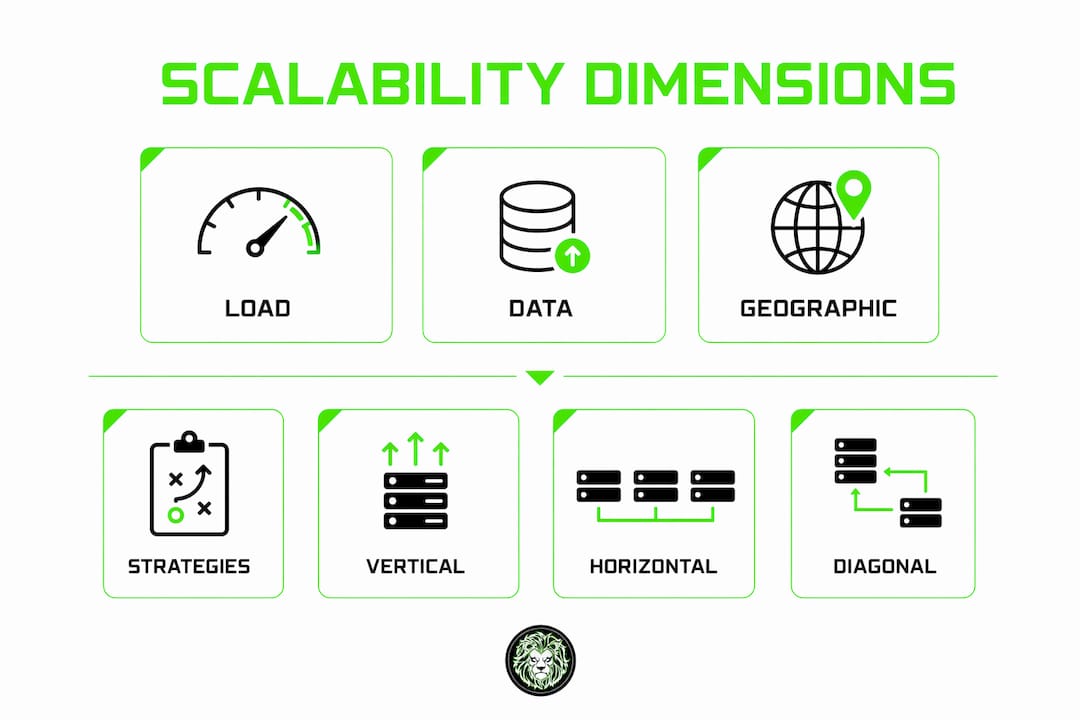
Load scalability is the ability to handle more concurrent users or requests. Data scalability is the ability to store, retrieve, and process growing volumes of data efficiently. Geographic scalability is the ability to serve users across multiple regions with acceptable latency. Each dimension requires different architectural responses.
Beyond dimensions, the two foundational scaling strategies are vertical and horizontal scaling.
| Strategy | How it works | Best for | Limitation |
|---|---|---|---|
| Vertical scaling | Add CPU, RAM, or storage to one machine | Early-stage products, SQL-heavy workloads | Physical hardware ceiling |
| Horizontal scaling | Add more machines or instances | High-traffic, stateless services | Requires stateless design |
| Diagonal scaling | Combine both approaches | Mature systems with mixed workloads | Operational complexity |
Vertical scaling can reach up to 896 vCPUs on leading cloud instances today. That ceiling is high enough to support most products for years. Horizontal scaling removes the ceiling entirely but demands that your application tier store no local state, a constraint that changes how you write code from the start.
Diagonal scaling combines both strategies. You scale up existing nodes while also adding new ones. This is common in mature systems where some components benefit from raw compute power and others benefit from distribution.
Pro Tip: Before choosing a scaling strategy, map your system's actual bottleneck. Adding more machines to a database-bound application does nothing. The constraint is almost always in one specific layer.
What architectural principles enable scalable software?
The most consequential architectural decision you make is not microservices versus monolith. It is whether your system is stateless at the application tier. Statelessness enables horizontal scaling by allowing any instance to handle any request. Session data, file uploads, and user context must live in external stores like Redis, S3, or a relational database, not in memory on the server.
Start with a modular monolith
Premature microservices adoption adds operational complexity without solving actual scaling problems. The better path is a modular monolith: a single deployable unit with clearly separated internal modules. Each module owns its data and its logic. When a specific module becomes a bottleneck, you extract it as a service. You do not start with 30 services before you know where the load actually lands.
Netflix, Airbnb, and Amazon all started as monoliths. They moved to distributed architectures only after identifying specific scaling constraints. That sequence matters.
When microservices make sense
Microservices earn their complexity when two conditions are met: you have identified a specific bottleneck that cannot be resolved within the monolith, and your team has the operational maturity to manage independent deployments, service discovery, and distributed tracing. Without both conditions, microservices create more problems than they solve.
Scalable software design integrates modular monoliths, microservices, event-driven processing, CQRS, and cloud-native architectures as a progression, not a menu. You adopt each pattern when the evidence demands it.
Event-driven architecture and CQRS
Event-driven architectures use asynchronous messaging to smooth demand spikes. Instead of every user action triggering a synchronous chain of database writes, events are queued and processed at a controlled rate. Tools like Apache Kafka and RabbitMQ handle this pattern at scale.
CQRS, which stands for Command Query Responsibility Segregation, separates read and write operations into distinct models. This matters because read traffic and write traffic have different scaling characteristics. Most applications read far more than they write. Separating the two lets you scale each path independently.
Pro Tip: Define your service boundaries around business capabilities, not technical layers. A service that owns "user authentication" is far more stable than one that owns "the database layer."
How does scalability relate to performance and operational efficiency?
Scalability and performance are not the same thing. A system can be scalable yet slow, or fast but completely unscalable. Performance measures the speed of a single request. Scalability measures how well the system maintains that speed as load increases. Treating them as synonyms leads to wrong solutions.
A common mistake is optimizing for raw speed on a single server and then discovering the system cannot distribute load across multiple instances. The reverse is equally dangerous: building a distributed system that handles millions of requests but responds to each one in three seconds.
Measuring what actually matters
Defining the hot path is the most practical step you can take. The hot path is the minimal sequence of dependent calls required to serve a user request. Measure latency and saturation on that path specifically. Everything else is secondary.
Service level objectives, or SLOs, give you a formal target. An SLO might state that 99% of requests must complete in under 200 milliseconds. When your hot path metrics breach that threshold, you have a data-driven signal to act. Without SLOs, scaling decisions are guesswork.
Common bottlenecks in production systems include:
- Database write contention: Too many concurrent writes to a single table or row
- Tail latency: The slowest 1% of requests dragging down user experience
- Unindexed queries: Missing a database index causes full table scans that kill performance at scale
- Synchronous external calls: Waiting on a third-party API in the critical path
Operational maturity is a prerequisite for horizontal scaling. Monitoring, distributed tracing, alerting, and automated deployment pipelines are not optional extras. They are the infrastructure that makes scaling decisions possible and reversible.
Pro Tip: Before adding infrastructure, check for a missing index, an N+1 query, or a missing cache layer. The fix is often a one-line change, not a new server.
What practical strategies and real-world examples show how to build scalable software?
The most cost-effective first move is almost always vertical scaling. Stack Overflow ran on vertically scaled SQL Server boxes for over a decade while serving millions of developers. That is not a failure of ambition. It is disciplined engineering. Vertical scaling requires no code changes and no new operational complexity.
The transition to horizontal scaling is justified when you hit the vertical ceiling or when your availability requirements demand redundancy across multiple machines. Preparing for that transition requires one architectural change above all others: push all state out of the application tier into databases, distributed caches like Redis, or object stores like S3.
Netflix is the canonical example of horizontal scaling done right. Their system handles over 200 million subscribers by distributing load across thousands of instances, using chaos engineering to test resilience, and relying on AWS for elastic capacity. The key is that they built toward that architecture incrementally, not all at once.
Scaling readiness checklist
- Measure your hot path before making any infrastructure changes
- Remove local state from application servers so any instance can serve any request
- Add caching at the appropriate layer, whether CDN, application, or database query cache
- Implement database read replicas to offload read traffic from the primary
- Set up load balancing to distribute traffic across multiple application instances
- Automate deployments so you can add or remove instances without manual intervention
- Define SLOs and alert on breaches before users notice
| Scaling tool | Purpose | When to use |
|---|---|---|
| Redis | Session storage, caching | When removing state from app tier |
| Apache Kafka | Async event processing | When smoothing write spikes |
| CDN (Cloudflare, Fastly) | Static asset delivery | When geographic latency is a problem |
| Database sharding | Horizontal data partitioning | When a single DB cannot handle write volume |
| Load balancer (NGINX, AWS ALB) | Traffic distribution | When running multiple app instances |
For scalable app development, the sequence matters as much as the tools. Solve the problem you have, not the problem you imagine you might have in three years.
Key takeaways
Scalable software succeeds when architecture, measurement, and operational discipline grow together, not when you add more machines to a system that was never designed to distribute load.
| Point | Details |
|---|---|
| Scalability definition | A system handles growing load by adding resources, not by rewriting architecture. |
| Vertical before horizontal | Start with vertical scaling; move to horizontal only when vertical limits are reached. |
| Statelessness is required | Application servers must store no local state before horizontal scaling is possible. |
| Measure the hot path | Define SLOs and monitor the critical request path before making scaling decisions. |
| Modular monolith first | Start with a modular monolith and extract services only when bottlenecks are proven. |
Why I think most teams scale too early and in the wrong direction
The most common mistake I see is teams treating scalability as a prestige decision rather than an engineering one. A startup with 500 users does not need Kafka, Kubernetes, and a service mesh. It needs a well-indexed database, a clear data model, and a deployment pipeline that works.
The teams that scale well share one habit: they measure obsessively before they build. They know their hot path. They know their p99 latency. They know exactly which database table is under pressure. When they add infrastructure, it is because a specific metric crossed a specific threshold, not because a conference talk made microservices sound exciting.
I also think the industry undervalues the modular monolith as a long-term architecture. A well-structured monolith with clean module boundaries is easier to operate, easier to debug, and easier to onboard engineers into than a distributed system with 40 services. The impact on business growth from a well-run monolith is often greater than from a prematurely distributed system that consumes all engineering capacity just to keep running.
For business leaders, the right question is not "are we using microservices?" It is "can our system handle 10x our current load without a rewrite, and do we know exactly what breaks first?" If you cannot answer the second part, you do not have a scaling strategy. You have a hope.
— Amal
Build something that grows with your business
If you are building a product that needs to handle real growth, architecture decisions made today determine your options in two years.

Proud Lion Studios builds scalable blockchain solutions and custom software for startups and enterprises across the UAE and beyond. The team works across mobile app development, Web3 infrastructure, AI automation, and smart contract systems, all designed to handle growth without forcing a rebuild. Whether you are starting from scratch or scaling an existing product, Proud Lion Studios focuses on real business outcomes over templated packages. Reach out to discuss your project and get a tailored architecture recommendation from a team that has built for scale across multiple industries.
FAQ
What is the scalable software definition in simple terms?
Scalable software is a system that handles more users, data, or geographic regions by adding resources rather than rewriting its architecture. The key measure is whether performance holds as load increases.
What are the best scalable software examples?
Netflix and Stack Overflow are two well-known examples. Netflix uses horizontal scaling across thousands of cloud instances, while Stack Overflow famously relied on vertical scaling for over a decade before expanding its infrastructure.
What is the difference between scalability and performance?
Scalability measures how well a system maintains speed as load grows. Performance measures the speed of a single request. A system can be fast at low load but fail to scale, or scale well but respond slowly to every request.
How do you build scalable software from the start?
Start with a stateless application tier, use a modular architecture, measure your hot path with defined SLOs, and apply vertical scaling before moving to horizontal distribution. Add complexity only when a specific bottleneck demands it.
Why is scalable software architecture important for business leaders?
Scalable architecture reduces the cost per transaction as volume grows and prevents emergency rebuilds during high-growth periods. It also supports team scaling by allowing engineers to work on isolated modules without breaking the whole system.