
TL;DR:
- DeFi gaming integrates blockchain technology into video games, allowing players to earn and trade assets with real-world value. The industry has grown rapidly, emphasizing true asset ownership, transparency, and user-controlled wallets, but it also faces risks like market volatility and centralized data storage. Successful DeFi games focus on engaging gameplay and sustainable economies, with new trends including layer 2 solutions and cross-game asset portability.
DeFi gaming is defined as the integration of decentralized finance mechanics into video games, giving players the ability to earn, own, and trade in-game assets with real-world monetary value. The industry term for this is GameFi, a portmanteau of "game" and "decentralized finance." The global Web3 gaming market was valued at approximately $37.55 billion in 2025 and is growing at roughly 19% CAGR as of 2026. That scale signals a structural shift in how games are built and played, not a passing trend. If you have ever wondered what is DeFi gaming and why it keeps showing up in gaming conversations, this guide breaks it down from the ground up.
What is DeFi gaming and how does it actually work?
DeFi gaming works by replacing centralized game servers and asset databases with blockchain networks, smart contracts, and player-controlled wallets. The result is a game economy where no single company controls your assets.
The technical foundation rests on four components working together.
- Blockchain ledger. Every asset, transaction, and ownership record lives on a public blockchain such as Ethereum, Solana, or Ronin. No developer can delete or modify your holdings unilaterally.
- Smart contracts. These are self-executing programs stored on the blockchain. Smart contracts automatically trigger token rewards to your wallet when you hit in-game milestones, with no human intermediary involved. That automation removes the need to trust a company to pay out correctly.
- NFTs as asset certificates. Non-fungible tokens represent unique in-game items, characters, or land. Each NFT is a token record on the blockchain proving you own a specific asset. You can read more about how this ownership model works in this NFT gaming overview.
- Player wallets. You store your assets in a personal crypto wallet, not on a game company's server. Losing your private keys means permanent, irrecoverable loss of everything in that wallet. There is no "forgot password" option.
A typical player workflow looks like this: you create a wallet, connect it to a DeFi game, earn tokens or NFTs through gameplay, then trade or stake those assets on a marketplace or liquidity pool. The entire process runs on-chain, meaning every step is publicly verifiable.
Pro Tip: Before you deposit any real money into a DeFi game, test the wallet connection and withdrawal process with a small amount first. Many players discover friction points only after committing larger sums.
What are the benefits of DeFi gaming for players?
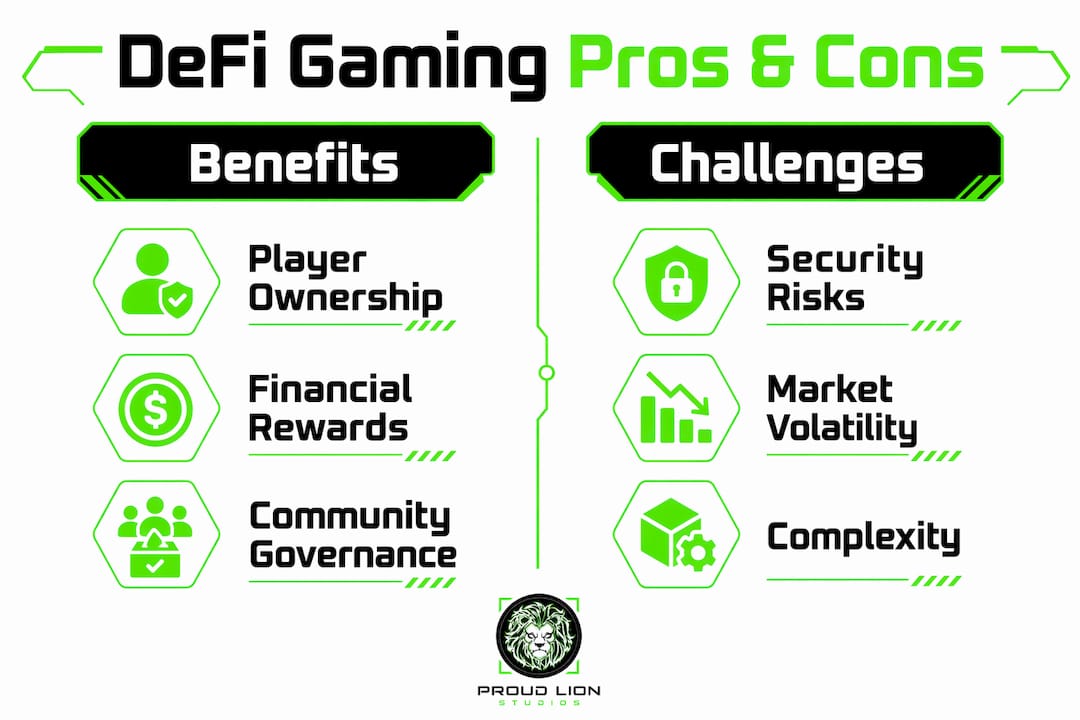
DeFi gaming gives players something traditional games never did: genuine economic ownership. Players become economic participants and co-owners, not just customers paying for entertainment. That distinction changes the entire relationship between a gamer and a game.
The core benefits break down clearly:
- True asset ownership. Your sword, skin, or land parcel exists on a public blockchain. You can sell it on any compatible marketplace, not just the one the developer approves.
- Financial value beyond the game. Assets earned in-game can be traded for cryptocurrency and converted to fiat currency. The financial value extends outside the game's ecosystem entirely.
- Transparency through blockchain. Every drop rate, reward pool, and transaction is publicly auditable. Players can verify that a game's economy works as advertised.
- Staking and yield generation. Beyond play-to-earn, players can stake tokens or provide liquidity to earn passive returns. Real profitability often comes from treating game assets as financial instruments through staking, not just from grinding gameplay hours.
- Global financial inclusion. DeFi games are accessible to anyone with a smartphone and internet connection, regardless of geography or banking access.
"GameFi is not a genre. It is an economic model that can apply to any game style. The key feature is financial value generation through gameplay, staking, and governance participation, not the visual style or mechanics of the game itself."
Developers also benefit. Sustained player engagement increases when players have a financial stake in the game's health. Governance tokens let players vote on development decisions, creating a community that actively wants the game to succeed.
What are the risks and challenges in DeFi gaming?
DeFi gaming carries real financial risk, and understanding those risks before you invest time or money is non-negotiable.
- Market volatility. Token and NFT values can collapse overnight. A game that paid well in one month may be worthless the next if player demand drops.
- Regulatory scrutiny. Regulators may classify in-game asset trading as gambling or securities transactions. That classification could restrict access in certain countries or expose players to tax obligations they did not anticipate.
- Gas fees. Transactions on blockchains like Ethereum cost fees called "gas." During peak network activity, those fees can exceed the value of the transaction itself.
- Unsustainable tokenomics. Some DeFi games build economies that resemble Ponzi structures, where early players profit only because new players keep buying in. When new player growth stalls, the economy collapses.
- Centralized asset storage risk. Owning an NFT does not guarantee that the underlying asset remains functional. If a developer stores game data on centralized servers and shuts them down, your NFT becomes a pointer to nothing. True decentralization requires both the token and the asset data to live on-chain.
Pro Tip: Before buying into any DeFi game, read its whitepaper and check whether its asset data is stored on-chain or on a centralized server. That single detail separates genuinely decentralized games from ones that only use blockchain for marketing.
The distinction between skill-based earning models and pure luck-based reward systems also matters here. Games that reward skill and strategy tend to produce more stable economies than those built entirely on random drops.
DeFi gaming examples and trends shaping 2026
DeFi gaming in 2026 looks meaningfully different from the early play-to-earn wave. The market has matured, and several structural trends now define the space. For a broader look at the ecosystem, the Web3 gaming guide covers the full technology stack in depth.
Dual-token and governance models
Most established DeFi games now use two tokens: one for in-game spending and one for governance. The governance token gives holders voting rights on game updates, treasury spending, and rule changes. This model distributes power away from the developer and toward the player community.
Layer 2 solutions
Layer 2 adoption is the most significant technical trend in 2026. Layer 2 networks process transactions off the main blockchain and settle them in batches, reducing gas fees dramatically and making gameplay fluid. Networks like Polygon and Arbitrum have become standard infrastructure for DeFi games targeting mass audiences.
Metaverse and cross-game asset portability
Assets minted in one game are beginning to appear in others. A character skin earned in one title can carry over to a compatible metaverse environment. This interoperability is still early, but it points toward a future where your digital asset portfolio spans multiple games and platforms. The types of blockchain games guide maps out how different game formats are adopting these mechanics.
| Trend | What it changes | Status in 2026 |
|---|---|---|
| Layer 2 scaling | Reduces gas fees, improves speed | Widely adopted |
| Dual-token models | Separates utility from governance | Standard in major titles |
| Cross-game asset portability | Assets work across multiple games | Early stage |
| On-chain asset storage | Full decentralization of game data | Emerging |
| Mobile-first DeFi games | Lowers entry barrier for new players | Growing rapidly |
The $37.55 billion market valuation reflects genuine demand, not speculation alone. Developers who build games that prioritize entertainment first and financial mechanics second are the ones sustaining player bases past the initial hype cycle.
Key Takeaways
DeFi gaming succeeds when blockchain ownership, smart contract automation, and balanced tokenomics combine with games that are genuinely fun to play.
| Point | Details |
|---|---|
| Core definition | DeFi gaming merges blockchain finance with gameplay, giving players real ownership of in-game assets. |
| Smart contracts automate rewards | On-chain programs pay out tokens automatically, removing the need to trust a developer's manual process. |
| True ownership requires self-custody | Your assets live in your personal wallet; losing private keys means permanent, irrecoverable loss. |
| Risks are real and financial | Volatile tokens, unsustainable tokenomics, and centralized asset storage can wipe out player investments. |
| Layer 2 is the key infrastructure shift | Layer 2 networks reduce gas fees and improve gameplay speed, making DeFi games viable for mainstream audiences. |
DeFi gaming is maturing faster than most gamers realize
I have watched the DeFi gaming space go through a full cycle, from the euphoric play-to-earn boom to the brutal correction that followed. The games that survived were not the ones with the highest token yields. They were the ones where people actually wanted to log in.
The biggest mistake I see gamers make is treating DeFi games purely as income sources. The moment a game's token price drops, players who were there only for the money leave. That exit crashes the economy further, which drives out more players. It is a self-reinforcing collapse, and it happens fast.
What I find genuinely exciting about 2026 is that the builders who stayed through the correction learned that lesson. The new generation of DeFi games leads with gameplay and treats the financial layer as a reward system, not the main attraction. That is a healthier foundation.
My practical advice: start with a game you would play even if the tokens were worthless. Learn how its wallet integration works. Understand the tokenomics before you stake anything. The players who build real knowledge about decentralized gaming mechanics are the ones positioned to benefit when the next strong project launches.
Self-custody is non-negotiable. Keep your private keys offline, use a hardware wallet for any meaningful holdings, and never share your seed phrase with anyone. The financial upside of DeFi gaming is real, but so is the downside of losing everything to a phishing attack or a misplaced piece of paper.
— Amal
Building your own DeFi game with Proud Lion Studios
Proud Lion Studios is a Dubai-based technology studio with deep expertise in blockchain development, NFT marketplaces, and smart contract engineering. The team builds the full technical stack that DeFi games require, from on-chain asset systems to wallet integrations and tokenomics design.
If you are a developer or studio looking to build a DeFi game or integrate blockchain mechanics into an existing title, Proud Lion Studios offers blockchain development services built for real production environments, not demo projects. The team also handles tokenization and NFT infrastructure, covering everything from smart contract deployment to marketplace integration. Proud Lion Studios works with startups and established studios across multiple countries, backed by funding and grants from the Aptos Foundation.
FAQ
What is DeFi gaming in simple terms?
DeFi gaming is a type of video game that uses blockchain technology to let players earn, own, and trade in-game assets with real monetary value. The industry term for it is GameFi, combining "game" and "decentralized finance."
How do players make money in DeFi games?
Players earn cryptocurrency tokens and NFTs through gameplay, then trade or stake those assets to generate returns. Real profitability most often comes from staking and liquidity provision rather than gameplay hours alone.
Is DeFi gaming the same as play-to-earn?
Play-to-earn is one component of DeFi gaming, but the broader model also includes staking, governance participation, and liquidity provision. Focusing only on play-to-earn misses most of the financial mechanics available in a full DeFi gaming ecosystem.
What blockchains do DeFi games use?
DeFi games run on blockchains including Ethereum, Solana, and Ronin, with Layer 2 networks like Polygon and Arbitrum increasingly used to reduce transaction fees and improve speed.
What is the biggest risk in DeFi gaming?
The biggest risks are token price volatility, unsustainable tokenomics that collapse when new player growth slows, and centralized asset storage that can render NFTs worthless if a developer shuts down their servers.