

TL;DR:
- Web3 gaming in 2026 centers on true ownership of digital assets via blockchain, enabling players to trade assets independently of studios.
- The focus has shifted from play-to-earn models to sustainable, gameplay-centric systems with improved economic balancing and easier onboarding.
Most people hear "Web3 gaming" and picture one thing: people grinding crypto tokens in janky browser games hoping to pay rent. That framing is years out of date, and it's holding back a serious conversation about what this technology actually does. What is Web3 gaming in 2026? It's a model where players hold verifiable ownership of in-game assets, economies run on transparent rules enforced by code, and the studio can't unilaterally erase your progress or items. The reality is more technical, more nuanced, and far more interesting than the play-to-earn hype ever suggested.
Table of Contents
- Key takeaways
- What is Web3 gaming: definition, core components, and how it differs from traditional gaming
- How Web3 gaming economics evolved beyond play-to-earn
- How Web3 gaming works technically in 2026
- The Web3 gaming market: growth, challenges, and what's ahead
- My honest take on Web3 gaming's potential
- Build your Web3 game with Proudlionstudios
- FAQ
Key takeaways
| Point | Details |
|---|---|
| Ownership is the core idea | Players truly own in-game assets as NFTs, tradable outside the game without studio permission. |
| Play-to-earn is mostly dead | The industry shifted toward Web2.5 models that prioritize gameplay quality over speculative token rewards. |
| Hybrid architecture is standard | Gameplay runs on traditional servers; blockchain handles ownership and economy records only. |
| Distribution remains a real barrier | Platform bans and niche marketing channels limit Web3 games from reaching mainstream audiences. |
| Market growth is substantial | The Web3 gaming market is projected to reach $88.57 billion by 2029 at a 22.3% CAGR. |
What is Web3 gaming: definition, core components, and how it differs from traditional gaming
At its core, the Web3 gaming definition comes down to one word: ownership. In a traditional Web2 game, when you buy a skin or earn a rare weapon, that item lives in the studio's database. The studio can change it, delete it, or shut down the servers entirely. You have a license to use the item. You don't own it.
Web3 gaming changes that structure by recording asset ownership on a blockchain. An item represented as an NFT (non-fungible token) belongs to your wallet address. The studio can't revoke it, and you can sell or trade it on secondary markets without studio intervention. That's a structural shift, not a cosmetic one.
The main components of a Web3 game include:
- NFTs representing in-game assets like weapons, characters, land, or cosmetics as unique, transferable tokens
- Smart contracts that enforce economy rules automatically, without a central authority approving each transaction
- Token economies using fungible tokens for in-game currency, staking, governance voting, or marketplace trading
- Decentralized wallets giving players custody of their assets independent of any single game platform
One point that often gets lost: Web3 games are not fully decentralized. Gameplay logic runs on centralized servers because blockchain is far too slow for real-time interaction. Blockchain handles the ownership layer and economic records. Think of it as a hybrid model where the game engine is traditional and the asset registry is public and immutable.
Pro Tip: When evaluating a Web3 game, ask specifically what lives on-chain. If only the token price is "blockchain-based," that's not meaningful Web3 integration. Look for on-chain asset ownership and verifiable smart contract logic.
The difference between Web2 and Web3 gaming is not just technical. It changes the relationship between players and studios. Players become stakeholders. That creates new incentive structures, and also new risks, which is exactly why the economics of these games matter so much.
How Web3 gaming economics evolved beyond play-to-earn
The early play-to-earn boom, centered around games like Axie Infinity around 2021 and 2022, attracted enormous capital but carried a structural flaw. Play-to-earn attracted speculators, not gamers. The model required constant new player investment to sustain token prices. When new players stopped joining, token values collapsed and existing players cashed out, accelerating the crash. Classic Ponzi dynamics.
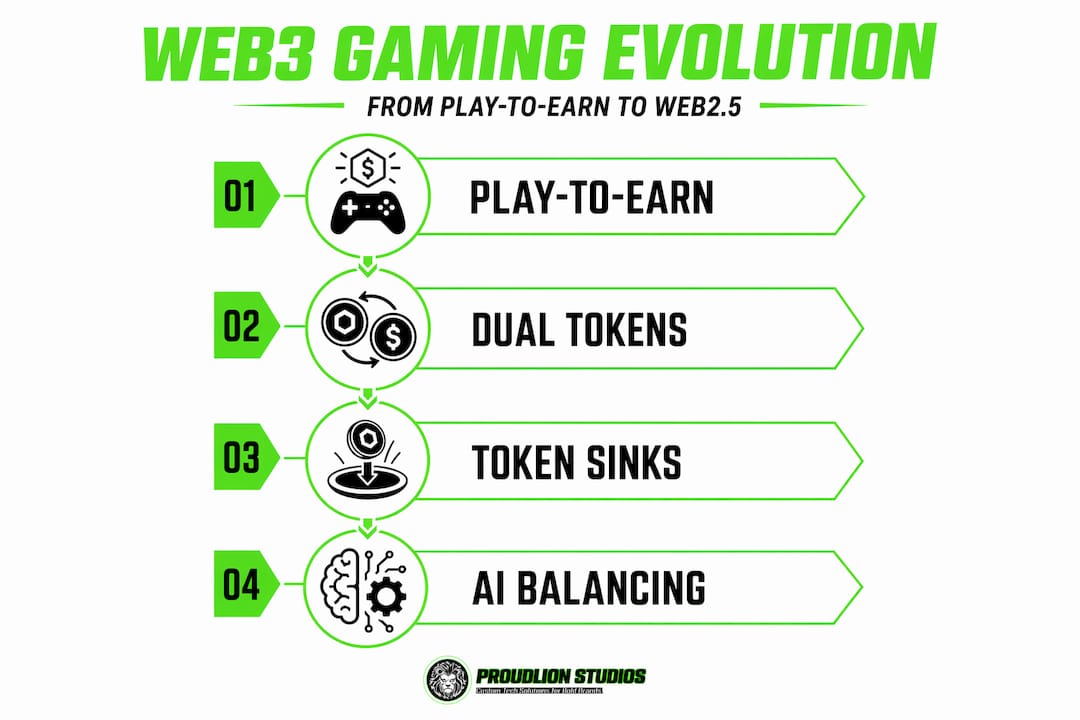
By Q2 2026, the industry moved decisively away from these unsustainable models toward what practitioners call "Web2.5." These games prioritize fun-first design while adding transparent asset ownership as a feature, not the core economic driver.
| Model | Core mechanic | Sustainability |
|---|---|---|
| Early play-to-earn | Single token, earned by playing, sold for profit | Low. Dependent on new player inflows |
| Dual-token system | Governance token (capped) + reward token (earned/burned) | Medium. Separates value store from utility |
| Web2.5 with real yield | External revenue (ads, sales, IP licensing) funds token rewards | High. Rewards backed by actual revenue |
The most significant structural fix has been the dual-token model. Most 2026 Web3 games separate governance tokens, which are scarce and capped in supply, from reward tokens, which players earn through gameplay and spend on upgrades. This prevents the governance token from inflating every time someone plays for an hour.
Beyond token separation, successful games use token sinks to pull currency out of circulation. Token sinks maintain economic balance by requiring players to spend tokens on crafting, item repairs, land fees, or cosmetics. One emerging mechanic is asset entropy, where items degrade over time and must be repaired or replaced, creating persistent demand for the in-game economy.
The next evolution is AI-driven economic balancing. Some studios now deploy systems that monitor token issuance and sink rates in real time, adjusting parameters automatically to prevent hyperinflation before it becomes visible to players. It's the difference between a game economy that breaks and one that self-corrects.
Pro Tip: Before investing in a Web3 game token, check the tokenomics document for explicit sink mechanisms. If the only sink is "burning tokens in special events," that economy is fragile. You want recurring, gameplay-integrated sinks.
How Web3 gaming works technically in 2026
Understanding how Web3 gaming works requires looking at three layers: smart contracts, wallets, and the on-chain/off-chain split.
Smart contracts are self-executing programs stored on a blockchain. When a player trades an NFT, the smart contract automatically transfers ownership, releases payment, and records the transaction. No middleman approves it. No studio employee processes it. The rules are written into the code and cannot be changed retroactively, which is both the strength and the limitation of this approach.
Wallets and onboarding were historically the biggest friction point. Asking a casual gamer to manage a seed phrase before they could play a game was a conversion killer. Account abstraction, specifically the ERC-4337 standard, changed that. Players now sign up with an email or social login. A wallet is created in the background, with keys managed by the application. To the player, it feels like any other app signup.
Modern Web3 games also address transaction fees through gasless transactions, where the game studio subsidizes the cost of on-chain interactions. Players don't pay gas fees on routine actions. This makes the experience feel closer to a traditional free-to-play game while preserving the underlying ownership benefits.
Here's how tokens typically function within a Web3 game:
- Governance tokens give holders voting rights on development decisions, treasury spending, or rule changes. They're capped in supply and not earned through casual play.
- Reward tokens are earned through quests, matches, or achievements and spent within the game on upgrades, crafting, or marketplace fees.
- NFT assets represent unique items. Players trade them on open marketplaces, with smart contracts enforcing royalty payments back to creators.
- Staking mechanics allow players to lock governance tokens for a period in exchange for a share of marketplace revenue or enhanced reward rates.
One honest challenge: players often misunderstand how token rewards work. Vesting schedules and liquidity constraints mean that earned tokens aren't always immediately withdrawable. Converting in-game rewards to real currency still requires navigating exchanges and off-ramp processes that are unfamiliar to most gamers. This friction is real and hasn't been fully solved.
For a technical deep-dive into choosing a blockchain for your game, the tradeoffs between networks like Aptos and Ethereum are significant and worth understanding before committing to an architecture.
The Web3 gaming market: growth, challenges, and what's ahead
The numbers are hard to ignore. The Web3 gaming market is projected at $88.57 billion by 2029, driven by Layer-2 scalability improvements, cross-chain interoperability, and expanding developer toolkits. The investment side confirms early conviction: Web3 games raised over $10 billion in venture capital from 2021 to mid-2023 alone.
But funding hasn't translated to mass adoption. The single biggest structural problem is distribution. Steam banned crypto games. The Epic Games Store provides no organic discovery support for them. App stores impose restrictive policies on blockchain transactions. The real problem is visibility, not funding. Web3 games are being built in a room no mainstream player is looking into.
Several trends are shaping where this goes next:
- Invisible Web3 is becoming the dominant design philosophy. Games hide blockchain complexity entirely, so players enjoy ownership benefits without ever seeing a wallet address or a gas fee notification.
- Layer-2 solutions on Ethereum and alternative chains like Aptos reduce transaction costs to near-zero, making micro-transactions viable without gouging players.
- Cross-chain interoperability is allowing assets to move between game ecosystems. An item earned in one game could theoretically hold value in another, though this remains technically challenging at scale.
- AI-powered economies are moving from concept to deployment, with studios using machine learning to model player behavior and balance reward emissions dynamically.
The market is also splitting into two distinct audiences. Mainstream "video games with blockchain" target existing gamers who care primarily about gameplay, with ownership as a secondary benefit. Crypto-native games target users who understand and actively seek token economics as a core feature. These are different products serving different motivations, and conflating them has caused significant confusion in how the industry is covered and understood.
For a broader look at blockchain game models and how developers are structuring these experiences in 2026, there's good coverage of the evolving design frameworks shaping the next generation of releases.
My honest take on Web3 gaming's potential
I've spent years watching blockchain technology get applied to industries where it didn't belong. Web3 gaming is one of the few areas where the core value proposition, provable digital ownership, actually makes sense for the problem. The frustration I have is with how poorly it's been executed in most cases.
What I've found is that the projects worth paying attention to are the ones where you could remove the blockchain layer and still have a playable, enjoyable game. The blockchain adds ownership and economic transparency. It doesn't substitute for game design. Any project where the token price is the reason to play is a project I'd avoid as both a gamer and an investor.
The onboarding problem is close to being solved. Account abstraction has made wallets invisible, and gasless transactions have removed fee anxiety. The remaining barrier is distribution, and that's a business problem, not a technical one. When mainstream app stores and gaming platforms develop a workable policy for blockchain games, adoption will move faster than most people expect.
My practical advice: if you're a gamer, look for Web3 games with genuine player bases and visible development activity. If you're an investor, evaluate the token sink mechanisms and external revenue streams before touching the token. And if you're building in this space, treat the Web3 integration as an infrastructure choice, not a marketing hook. The games that last will be the ones players recommend for their fun, not their financial potential.
— Amal
Build your Web3 game with Proudlionstudios
If you're serious about building in this space, the technical execution is where most projects fail. Smart contracts with flawed logic, token economies without real sinks, and wallets that intimidate players before they've played a single minute. These are solvable problems with the right team.
Proudlionstudios brings blockchain development expertise and hands-on Web3 game experience from a UAE-based team that has worked across multiple markets. From designing token economies and deploying smart contracts to building NFT marketplace integrations and mobile-ready game clients, the studio handles the full technical stack. If you want to build a Web3 game that works for players and holds up economically, explore Proudlionstudios' Web3 game services to see what's possible.
FAQ
What is the Web3 gaming definition in simple terms?
Web3 gaming refers to video games that use blockchain technology to give players true ownership of in-game assets, recorded as NFTs or tokens on a public ledger that the studio cannot unilaterally modify or remove.
How does Web3 gaming differ from traditional gaming?
In traditional Web2 games, players license digital items from the studio. In Web3 games, assets are recorded on a blockchain, meaning players can trade, sell, or transfer them freely without studio approval.
Are Web3 games still play-to-earn?
Most are not, as of 2026. The industry shifted to Web2.5 models that prioritize gameplay quality and use dual-token systems and token sinks to create sustainable economies rather than speculative reward loops.
What are the biggest challenges in Web3 gaming today?
Distribution remains the core challenge. Major platforms including Steam have banned crypto games, limiting discoverability. Token reward complexity and vesting schedules also create friction for players unfamiliar with crypto.
What does the future of Web3 gaming look like?
The market is projected to reach $88.57 billion by 2029, with growth driven by Layer-2 scaling, invisible Web3 onboarding, cross-chain asset portability, and AI-driven economic balancing systems that self-correct in real time.