

TL;DR:
- Decentralized gaming involves storing game assets and rules on public blockchains, giving players true ownership. Many current games use hybrid models balancing on-chain security with off-chain performance. Challenges remain in scalability, user experience, and maintaining fun, but the potential for open, interoperable ecosystems continues to grow.
Decentralized gaming is defined as a model where game assets, economies, and often core logic operate on public blockchains through smart contracts, removing studio control over what players own. Unlike traditional games where a company can delete your account or shut down a server, decentralized games store your items in your own wallet. Platforms like Axie Infinity, Dark Forest, and games built on Immutable X have already proven this model works at scale. The shift from centralized to decentralized architecture is the most significant structural change in gaming since the move from physical media to digital downloads.
What is decentralized gaming and how does it differ?
Decentralized gaming, also called on-chain gaming or Web3 gaming, is a game architecture where ownership records and game rules live on public blockchains rather than private company servers. The industry term "on-chain gaming" is more precise than "decentralized gaming," but both phrases describe the same core idea: no single entity controls the game's assets or rules.

Traditional Web2 games like Fortnite or World of Warcraft store every item, character, and transaction on servers owned by Epic Games or Blizzard Entertainment. You pay for a skin, but you own a license, not the asset. If the studio shuts down, your items disappear. True decentralized games go beyond storing assets on-chain to running game rules and state as smart contracts, creating trustless, censorship-resistant experiences.
The distinction matters for investors and developers too. A game that sells NFTs but keeps its game logic on a private server is a blockchain game, not a decentralized game. Real decentralization means the rules cannot change without community consensus, and your assets survive any studio decision.
Pro Tip: When evaluating a game's decentralization claims, ask one question: "If the studio disappeared tomorrow, would my assets still exist and be usable?" If the answer is no, the game is not truly decentralized.
How does decentralized gaming work technically?
Blockchain layers and smart contracts
Modern decentralized games use multi-layer blockchain infrastructure, with Layer 1 networks like Ethereum and Solana providing security, and Layer 2 solutions handling high-volume, low-cost transactions. Networks like Ronin (built for Axie Infinity) and Immutable X (built for trading card games and action titles) exist specifically to solve the speed and cost problems of gaming on base-layer blockchains. Smart contracts act as both the asset registry and the game logic engine, executing rules automatically without a middleman.
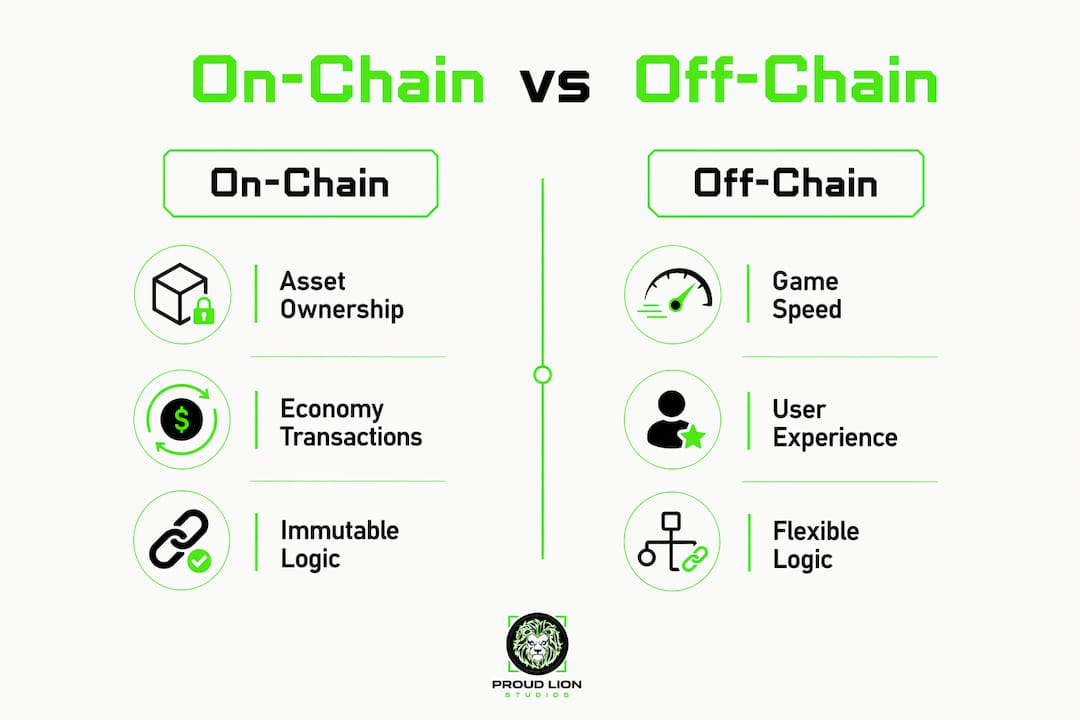
On-chain vs. off-chain: the hybrid model
Running every game action on a blockchain is not practical today. A 60fps action game generating thousands of state changes per second would cost players enormous transaction fees and introduce unacceptable latency. Hybrid designs solve this by keeping fast gameplay logic off-chain while anchoring ownership and economy data on-chain for trust and permanence.
Here is how the split typically works in practice:
| Component | On-Chain | Off-Chain |
|---|---|---|
| Asset ownership records | Yes | No |
| In-game economy transactions | Yes | No |
| Real-time gameplay actions | No | Yes |
| Visual rendering and physics | No | Yes |
| Player authentication | Hybrid | Hybrid |
| Leaderboards and match data | No | Yes |
This architecture means you get the security of blockchain ownership without sacrificing the performance players expect. Think of it like a bank: your account balance is the permanent record, but the ATM interface runs on separate, faster systems.
Pro Tip: If you are a developer evaluating blockchain infrastructure for a new game, compare Aptos vs. Ethereum for gaming before committing to a Layer 1. Transaction costs and finality speed vary dramatically between chains.
What are the benefits of decentralized gaming?
Player ownership means NFTs represent in-game items stored in wallets, surviving developer shutdown and tradable without studio interference. This is the foundational advantage that separates decentralized games from every prior gaming model. Your sword, your character skin, your virtual land plot: these exist on a public ledger that no company can erase.
The benefits extend well beyond ownership:
- Permanence: Game worlds and economies persist even if the original developer stops supporting the title. Dark Forest, a fully on-chain strategy game on Ethereum, continues running because its logic lives in smart contracts, not on a company server.
- Transparency: Open smart contracts let anyone audit the game rules. Players know the exact drop rate of rare items because the code is public. No hidden algorithms, no undisclosed odds.
- Community governance: DAO-based governance shifts development control from studios to players, enabling democratic decisions on game economies and structures. Players vote on major changes rather than receiving patch notes after the fact.
- Cross-game interoperability: Composability allows third parties to build new games or extensions on existing on-chain assets, growing ecosystems beyond original developers' control. An item you earned in one game could theoretically function in another built on the same asset standard.
- Real asset markets: Players trade items on open marketplaces like OpenSea or game-specific exchanges without studio permission or a 30% platform cut.
For investors, these properties create durable digital economies with measurable on-chain activity, making game health transparent in ways that Web2 game metrics never were. You can verify active wallets, transaction volume, and asset liquidity directly from the blockchain.
Decentralized games vs. traditional and blockchain games
Many people use "blockchain game" and "decentralized game" interchangeably. They are not the same thing. Many popular blockchain games only store assets on-chain but keep game logic centralized, meaning the studio still controls the rules and can change them at will.
The table below clarifies the three distinct models:
| Feature | Traditional (Web2) | Blockchain Game | Decentralized Game |
|---|---|---|---|
| Asset ownership | Studio-owned license | Player-held NFT | Player-held NFT |
| Game logic location | Private server | Private server | Public smart contract |
| Rule changes | Studio decides | Studio decides | Community vote (DAO) |
| Survives studio shutdown | No | Partial | Yes |
| Asset tradability | Restricted or banned | Open marketplace | Open marketplace |
| Auditability | None | Asset records only | Full logic and assets |
The industry is also shifting its language. The "play-to-earn" model collapsed due to token inflation, and current games now emphasize "play-and-own," where blockchain assets provide ownership but the game is fun independent of token price. This is a meaningful correction. Early Web3 games attracted speculators, not gamers, and the economies imploded when new player inflows slowed. Play-and-own games prioritize gameplay quality first, with asset ownership as a durable bonus rather than the primary hook.
For a deeper look at how these models affect game development decisions, the structural differences between models have direct implications for tokenomics design and long-term player retention.
Pro Tip: Before investing in or building on a blockchain game, read its smart contract documentation. If the team cannot point you to audited, public contracts governing game logic, the game is centralized regardless of its marketing claims.
What challenges does decentralized gaming still face?
Decentralized gaming is not a solved problem. Several real constraints shape what developers can build today and what players should expect.
- Scalability: High-frequency actions still require off-chain processing. On-chain gaming is a spectrum; high-performance action games require hybrid models that balance decentralization and speed.
- User experience friction: Requiring players to sign blockchain transactions mid-game breaks immersion. Smart wallets and background transaction handling reduce this friction by hiding blockchain complexity, but adoption is still uneven across platforms.
- Economic sustainability: Early play-to-earn models collapsed amid unsustainable tokenomics, and the transition to asset-focused play-and-own games is still underway. Studios that treat tokens as the product rather than the game will repeat those mistakes.
- Governance complexity: DAOs shift governance power to communities but require careful management to avoid dominance by major token holders. A whale with 40% of governance tokens can effectively control a "decentralized" game.
- Fun-first design: Decentralization alone is insufficient to drive engagement. Players stay for gameplay quality, not blockchain architecture. Studios that lead with technology instead of fun consistently underperform.
The studios succeeding in 2026 treat blockchain as infrastructure, not identity. The best decentralized games feel like great games first. The blockchain layer is invisible to the casual player and meaningful to the engaged one.
Key takeaways
Decentralized gaming gives players verifiable ownership of assets through smart contracts, and that ownership persists regardless of what any studio decides to do.
| Point | Details |
|---|---|
| Core definition | Decentralized games store assets and logic in public smart contracts, not on studio servers. |
| Hybrid architecture | Most games use off-chain gameplay with on-chain ownership to balance speed and trust. |
| True ownership | NFT-based assets live in player wallets and survive studio shutdowns or policy changes. |
| Play-and-own shift | The industry moved away from speculative play-to-earn toward gameplay-first asset ownership. |
| Governance risk | DAO voting is powerful but vulnerable to token concentration by large holders. |
Why decentralized gaming's real test is still ahead
I have watched the Web3 gaming space go through a full cycle: the hype, the collapse, and now the quieter, more serious rebuild. The studios that survived the play-to-earn crash did so because they built games people actually wanted to play. That sounds obvious, but it was genuinely rare in 2021 and 2022.
What I find most compelling now is composability. The idea that a third party can build a new game using assets from an existing on-chain world, without asking anyone's permission, is genuinely new in the history of media. It is closer to open-source software than to anything the gaming industry has seen before. That potential has not been fully realized yet, but the architecture for it exists.
My honest concern is user experience. Blockchain interaction is still too visible in most games. When a player has to approve a wallet transaction to open a loot box, you have already lost them. The studios that figure out how to make Web3 UX invisible will capture the mainstream audience that the space has been chasing for five years.
The technology is ready enough. The design discipline is the remaining gap.
— Amal
Build your decentralized game with proud lion studios
If you are a studio, startup, or investor ready to build in the decentralized gaming space, the technical foundation matters more than the pitch deck.
Proud Lion Studios, based in Dubai and backed by the Aptos Foundation, builds the infrastructure that decentralized games run on: audited smart contracts, NFT asset systems, scalable Layer 2 architecture, and blockchain development services designed for real game production timelines. The team also handles NFT and dApp integration for studios that need asset economies built correctly from day one. Every project is custom, not templated, because no two game economies are the same. Reach out to Proud Lion Studios to discuss your project scope and see what the team has already shipped.
FAQ
What is decentralized gaming in simple terms?
Decentralized gaming is a model where game assets and rules live on public blockchains instead of company servers, giving players verifiable ownership that no studio can revoke.
How do decentralized games differ from regular blockchain games?
Regular blockchain games store assets as NFTs but keep game logic on private servers. Fully decentralized games run both assets and rules through public smart contracts, making the game censorship-resistant and auditable.
What are the main benefits of decentralized gaming for players?
Players gain true asset ownership, transparent game rules, the ability to trade items freely, and protection against losing progress if a studio shuts down.
What blockchains are used for decentralized gaming?
Common choices include Ethereum, Solana, Ronin, and Immutable X, with Layer 2 solutions handling high-frequency in-game transactions to keep costs low and speed high.
Is play-to-earn the same as decentralized gaming?
No. Play-to-earn is a business model that collapsed due to unsustainable tokenomics. Decentralized gaming is an architecture. Modern decentralized games use a play-and-own model where asset ownership is the benefit, not token speculation.