
TL;DR:
- NFT gaming involves players owning unique, blockchain-recorded assets that can be traded outside the game environment. These assets are powered by smart contracts, with hybrid models balancing decentralization and performance, and are dependent on active game ecosystems for value. While offering true ownership and monetization opportunities, NFT assets' utility relies on game longevity and ongoing development.
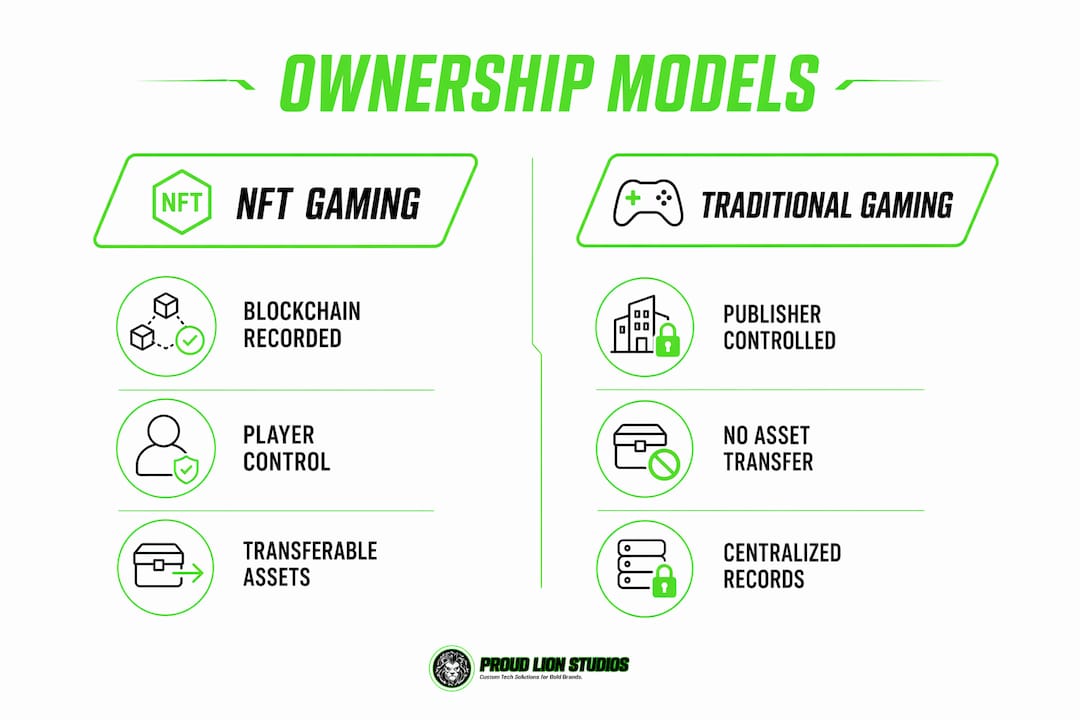
NFT gaming is defined as video games that use blockchain-based non-fungible tokens to create unique, verifiably owned, and tradable in-game assets. Unlike traditional games where a publisher controls every sword, skin, or character in a centralized database, NFT gaming places ownership on a public blockchain. Players hold their assets in crypto wallets, and no developer can delete or revoke them. Platforms like Ethereum, Solana, and Polygon power these games, with smart contracts automating everything from item minting to reward distribution. As of Q3 2025, the blockchain gaming market recorded $135 million in NFT trading volume, a figure that signals genuine economic activity, not just speculation.
What is NFT gaming and how does blockchain make it work?
An NFT, or non-fungible token, is a unique cryptographic record stored on a blockchain. No two NFTs are identical, which makes them ideal for representing one-of-a-kind game items like a legendary weapon, a rare character skin, or a plot of virtual land. The blockchain acts as a decentralized, permanent ledger. Every time an NFT changes hands, that transaction is recorded publicly and cannot be altered.
Smart contracts automate game rules without requiring a developer to manually approve each action. When you defeat a boss and earn a rare item, a smart contract mints that NFT directly to your wallet. When you sell it on a marketplace, the same contract executes the transfer and payment simultaneously. This removes the need for a trusted middleman and makes game economies transparent by design.
Most NFT games in 2026 use a hybrid architecture. The blockchain handles asset ownership and smart contract logic, while traditional servers manage real-time gameplay. This is because blockchains are not fast enough to process thousands of simultaneous player actions. The result is a hybrid on-chain and off-chain model that balances decentralization with performance.
Your wallet is your identity and your inventory. It stores your NFTs and the cryptographic keys that prove ownership. Early NFT games required players to manage seed phrases and pay gas fees manually, which created enormous friction. Modern 2026 titles have largely solved this through embedded wallets and rollups that hide the technical complexity entirely. You log in with an email, and the blockchain layer runs invisibly in the background.
Pro Tip: If you are new to NFT games, look for titles that use embedded wallets. You get the ownership benefits without needing to manage private keys or pay gas fees manually.
How NFT ownership differs from traditional game item ownership
In a traditional game like World of Warcraft or Fortnite, your items exist only in the publisher's database. Epic Games or Blizzard can ban your account, shut down servers, or change item stats at any time. You have no legal claim to those assets and no way to transfer them outside the game's ecosystem. The items are licensed to you, not owned by you.
NFT gaming flips this model. Ownership is recorded on a public blockchain, which means it is permanent, transparent, and not controlled by any single company. You can verify the full history of any NFT, including who created it, how many exist, and every wallet that has ever held it. This provenance is built into the token itself.
| Ownership model | Who controls the asset | Transferable outside game | Permanent record |
|---|---|---|---|
| Traditional game item | Publisher's database | No | No |
| NFT game asset | Public blockchain | Yes | Yes |
| NFT with game shutdown | Blockchain (token persists) | Yes (token only) | Yes |
The comparison above reveals an important nuance. NFT ownership does not include intellectual property rights or access to the game's source code. If the studio shuts down its servers, your NFT still exists on the blockchain, but it loses its in-game function. A sword NFT from a dead game is still yours. It just cannot be equipped anywhere. This is a real limitation that every NFT gamer should understand before investing.
Pro Tip: Before buying NFT assets in any game, check whether the studio has published its smart contracts publicly and whether assets are stored on-chain or via a centralized server. On-chain storage is far more durable.
The mental shift required here is significant. Think of the blockchain as a permanent ledger running behind the game client. The game is the interface. The blockchain is the record of truth. When you understand that distinction, you understand both the power and the limits of NFT ownership.
What are the core mechanics and economic features of NFT games?
NFT games introduce economic systems that traditional games simply cannot replicate. Here is how the core mechanics typically work:
- Minting through gameplay. Players earn NFTs by completing quests, winning battles, or crafting items. The smart contract mints the token directly to the player's wallet. No developer approval is needed.
- Play-to-earn reward distribution. Games distribute fungible reward tokens alongside NFTs. Players earn these tokens through gameplay and can exchange them on open markets. Axie Infinity pioneered this model with its SLP token, which players in Southeast Asia famously used as a primary income source in 2021.
- Open marketplace trading. Players trade NFT assets on open marketplaces like OpenSea or game-specific exchanges without needing developer permission. This peer-to-peer economy means supply and demand determine prices, not the publisher.
- Breeding and crafting mechanics. Games like Axie Infinity allow players to breed two NFT characters to produce a new, unique offspring NFT. The genetic traits of the offspring are determined by smart contract logic, making the outcome verifiable and tamper-proof.
- Shared ecosystem risk. The value of NFT assets depends directly on the game's active player base and ongoing development. A thriving game drives demand for its NFTs. A declining game collapses asset values. Players and developers share this risk in a way that traditional games never required.
The economic model has matured considerably since 2021. NFT games have moved away from purely speculative play-to-earn structures toward ecosystems where NFTs serve as functional inventory with genuine gameplay utility. The best 2026 titles treat NFTs as a feature of the game, not the entire point of it.
What are the benefits and challenges of NFT gaming for players?
NFT gaming offers real advantages over traditional models, but it also carries risks that deserve honest examination.
Benefits players actually experience:
- True asset ownership. Your items exist on a public blockchain and cannot be taken away by a ban or a server shutdown. This is a fundamental shift in the player-publisher relationship.
- Monetization of gameplay time. Players can sell earned NFTs on open markets and recoup real value from their time investment. This is impossible in traditional games where items have no external market.
- Verifiable rarity. Every NFT has a transparent supply record. When a game says only 500 of a particular sword exist, you can verify that claim on-chain. Traditional games offer no such transparency.
- Secondary market access. Rare items from popular NFT games trade on open marketplaces 24 hours a day, creating liquidity that traditional in-game economies never had.
Challenges that remain real in 2026:
- Game longevity dependency. Asset value depends on the game's continued operation and popularity. A shuttered game leaves you with tokens that have no functional use.
- Interoperability is still limited. True cross-game asset use remains largely theoretical. Most NFT games run core gameplay off-chain, and different games use incompatible standards and servers.
- Speculative volatility. NFT prices in gaming markets can swing dramatically based on player sentiment, not just gameplay quality. Buying assets at peak hype and selling at a loss is a common experience.
The user experience gap has closed significantly. UX abstractions in 2026 mean most players never interact with a wallet interface directly. Gas fees are either subsidized by developers or handled through app-specific rollups. The barrier to entry is now closer to a traditional mobile game than to the early DeFi era.
What are some notable NFT games and what do they illustrate?
Axie Infinity, developed by Sky Mavis on the Ethereum network, remains the most studied example of NFT gaming at scale. It demonstrated that players would genuinely earn income through gameplay, and it also demonstrated the fragility of purely token-driven economies when its player base contracted sharply in 2022. The lesson: sustainable NFT games need compelling gameplay first, with economics as a secondary feature.
Off The Grid is a more recent example that integrates NFTs into a battle royale format. It uses the Avalanche blockchain and treats NFT cosmetics as optional enhancements rather than pay-to-win mechanics. This design philosophy reflects the industry's shift toward sustainable NFT ecosystems where the game itself is the primary draw.
Platforms matter as much as games. Ethereum offers the deepest liquidity and the most established NFT standards, but its gas fees pushed many developers toward Polygon and Solana. Polygon's low transaction costs and Solana's high throughput make them practical choices for games with frequent micro-transactions. Understanding blockchain game models helps you evaluate which platform a game uses and what that means for your assets.
Pro Tip: When evaluating an NFT game, check which blockchain it uses and whether its smart contracts are audited. Audited contracts on established chains like Ethereum or Solana carry significantly lower risk of exploit or rug pull.
Key takeaways
NFT gaming grants players verifiable, blockchain-recorded ownership of unique digital assets, enabling open trading and real economic participation, but asset value remains tied to each game's continued operation and player base.
| Point | Details |
|---|---|
| Ownership is real but limited | NFTs give provable ownership on-chain, but not intellectual property rights or game utility if servers close. |
| Smart contracts power the economy | Minting, trading, and rewards are automated by smart contracts, removing developer gatekeeping from transactions. |
| Hybrid architecture is standard | Most NFT games use blockchain for assets and traditional servers for gameplay due to speed and cost constraints. |
| UX friction has dropped sharply | Embedded wallets and rollups in 2026 hide gas fees and key management, making entry far easier than before. |
| Game quality drives asset value | NFT prices depend on active players and ongoing development, not just token scarcity. |
Why NFT gaming is worth your attention in 2026, with realistic expectations
I have spent years watching blockchain gaming cycle through hype and correction, and the 2026 version of NFT gaming is genuinely different from what launched in 2021. The speculative frenzy has cooled, and what remains is a smaller but more serious set of games that treat blockchain as infrastructure rather than a marketing angle.
The ownership model is real. When I look at what traditional publishers do with player assets, including loot box odds hidden behind opaque systems and items that vanish when a game goes offline, the NFT alternative is objectively more honest. You know exactly what you own, how many exist, and what it has sold for historically. That transparency has value independent of price speculation.
What I tell anyone entering this space is to separate the game from the investment. If a game is fun and the NFTs are a bonus, you are in a reasonable position. If you are buying assets primarily because you expect their price to rise, you are speculating on a game's future popularity. That is a legitimate choice, but it is not the same as gaming.
The interoperability promise is still mostly theoretical. I have not seen a convincing cross-game asset system in production at scale. The Web3 gaming space is working on it, and the infrastructure is improving, but do not buy an NFT expecting to use it across ten different games in 2026. Buy it because you want it in the game it was built for.
The next two years will likely produce the first NFT games that mainstream audiences play without knowing they are playing an NFT game. That is when the technology will have truly arrived.
— Amal
Build your own NFT game with Proudlionstudios
Proudlionstudios builds NFT games and blockchain applications from the ground up, with a UAE-based technical team that has shipped real products on Ethereum, Solana, and Aptos. If you are a developer or studio looking to integrate NFT ownership, open marketplaces, or smart contract economies into a game, the team at Proudlionstudios handles the full stack. From blockchain development and NFT tokenization to smart contract development and multiplayer game production, Proudlionstudios delivers custom solutions built for real gameplay, not templated demos. Reach out to discuss your project.
FAQ
What is NFT gaming in simple terms?
NFT gaming is video gaming where players own in-game assets as blockchain tokens that can be bought, sold, or traded outside the game. Unlike traditional games, no publisher can delete or revoke these assets.
How does play-to-earn work in NFT games?
Play-to-earn games reward players with NFTs or fungible tokens for completing in-game activities. Players then sell these rewards on open marketplaces to earn real monetary value from their gameplay time.
Are NFT game assets truly permanent?
The token record on the blockchain is permanent, but its in-game utility depends on the game's servers remaining active. If a studio shuts down, your NFT persists on-chain but loses its functional use within that game.
Which blockchains are most popular for NFT games?
Ethereum, Solana, and Polygon are the most widely used blockchains for NFT gaming. Ethereum offers the deepest liquidity, while Polygon and Solana provide lower transaction costs suited to games with frequent in-game actions.
Is NFT gaming safe for beginners in 2026?
Modern NFT games use embedded wallets that remove the need to manage private keys manually, making entry much safer and simpler than in earlier years. The main risk for beginners is buying assets in games that lose their player base quickly.