
TL;DR:
- Blockchain scalability enables networks to handle increasing transactions without compromising security or decentralization, but current limitations restrict adoption. Layer 2 rollups, sharding, and sidechains offer various solutions that balance throughput, trust, and decentralization. Prioritizing architecture design around application needs is essential for building scalable, reliable blockchain systems.
Blockchain scalability is defined as a network's capacity to process growing transaction volumes without sacrificing security or decentralization. Bitcoin processes about 7 TPS and Ethereum handles 15–30 TPS, numbers that expose a hard ceiling for global adoption. Those limits matter because DeFi protocols, real-world asset tokenization, and AI-linked on-chain workflows all demand far higher throughput than early blockchains were designed to deliver. Understanding blockchain scalability is the first step toward building digital infrastructure that holds up under real production load.
What is blockchain scalability and why does it matter?
Blockchain scalability is the ability of a distributed ledger to handle increasing transaction demand while keeping security and decentralization intact. The standard measurement is Transactions Per Second (TPS), but raw TPS tells only part of the story. Cost per transaction, confirmation latency, and behavior under peak load are equally critical for production applications.

Scalability is increasingly critical due to the convergence of DeFi, real-world assets, and AI-linked on-chain workflows that demand much higher throughput than early blockchains provided. That convergence is not theoretical. Payment networks, gaming platforms, and enterprise settlement layers all hit congestion walls when base-layer TPS runs out. The result is fee spikes and failed transactions at exactly the moments when reliability matters most.
Blockchain performance also affects developer decisions. A team building a high-frequency trading protocol cannot accept 15-second finality. A gaming studio cannot accept $5 gas fees per in-game action. Scalability shapes what you can build, not just how fast it runs.
What is the blockchain trilemma and how does it shape scalability challenges?
The blockchain trilemma, a framework introduced by Vitalik Buterin, states that a blockchain can optimize for only two of three properties at once: decentralization, security, and scalability. Push throughput up on a monolithic Layer 1 chain and you typically compromise one of the other two.
Traditional blockchains handle this trade-off by setting conservative block sizes and slow block times. That keeps the network decentralized and secure, but it caps throughput. Raising the block size increases hardware requirements for node operators, which weakens decentralization by pricing out smaller participants. The trilemma is not a bug. It reflects a genuine engineering constraint in distributed systems.
The 2026 industry standard resolves the trilemma through rollup-centric architectures, where Layer 1 serves as a secure settlement and data availability layer while Layer 2 handles execution. This separation lets each layer do what it does best. Layer 1 provides trust. Layer 2 provides speed.
Key trade-offs in the trilemma framework:
- Decentralization vs. throughput: More nodes mean more coordination overhead and lower TPS.
- Security vs. speed: Faster finality often requires fewer validators, reducing attack resistance.
- Throughput vs. trust: Higher TPS solutions frequently introduce new trust assumptions at the execution layer.
Pro Tip: When evaluating a blockchain for your application, map it against the trilemma explicitly. Identify which two properties the network prioritizes and confirm that the sacrificed property is acceptable for your use case before committing to an architecture.
How do common scalability solutions in blockchain work?
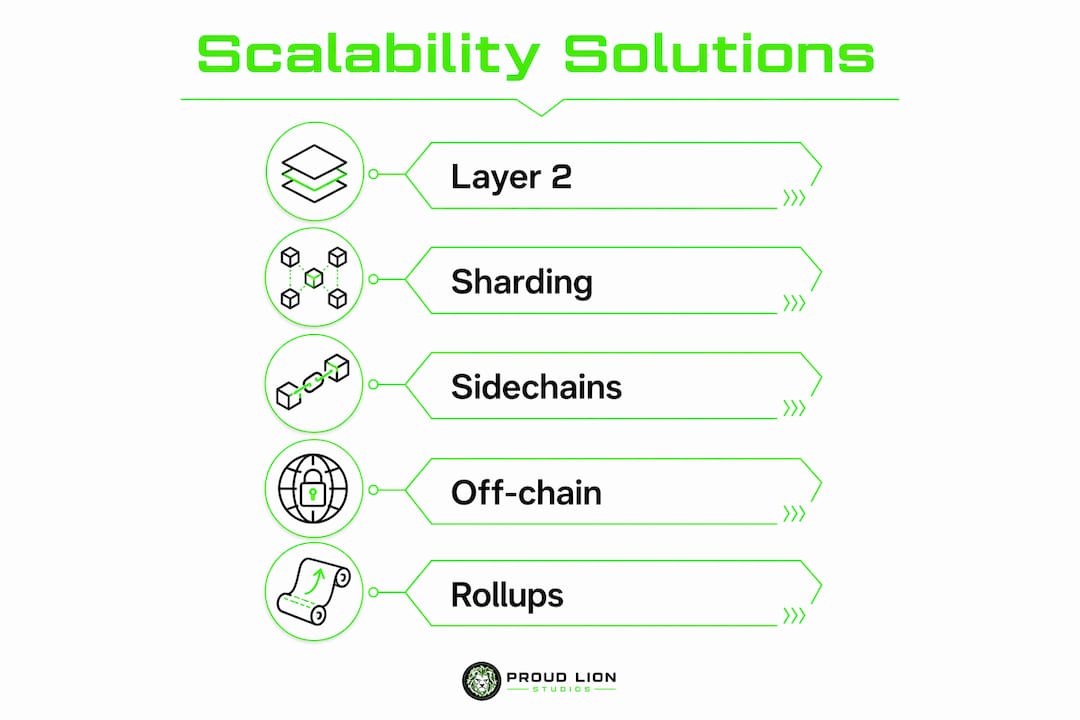
Key scalability techniques include Layer 2 rollups, sharding, sidechains, and off-chain computation, each with distinct mechanisms and trade-offs. No single method fits every application. Choosing the right one requires understanding how each approach handles execution, data, and trust.
Layer 2 rollups
Rollups execute transactions off-chain and post compressed proofs or transaction data back to Layer 1. Optimistic rollups assume transactions are valid by default and allow a challenge window, typically seven days, for fraud proofs. Zero-knowledge rollups generate cryptographic validity proofs for every batch, enabling near-instant finality. ZK rollups carry higher computational cost to generate proofs but offer stronger security guarantees. Optimistic rollups are simpler to implement but introduce withdrawal delays.
Sharding
Sharding splits a blockchain into parallel sub-chains called shards, each processing its own subset of transactions. This horizontal scaling approach multiplies throughput without requiring each node to process every transaction. The coordination challenge is cross-shard communication. Transactions that span multiple shards require additional messaging overhead, which can introduce latency and complexity.
Sidechains and off-chain computation
Sidechains are independent blockchains connected to a main chain via a two-way bridge. They run their own consensus rules and can process transactions at much higher speeds. The trade-off is that sidechain security is independent of the main chain. Off-chain computation moves processing entirely outside the chain and settles only final states on-chain, which works well for applications like payment channel networks that require high-frequency, low-value transfers.
| Method | Throughput gain | Security model | Decentralization impact |
|---|---|---|---|
| Optimistic rollups | High | Fraud proofs, 7-day delay | Inherits L1 security |
| ZK rollups | High | Cryptographic validity proofs | Inherits L1 security |
| Sharding | Very high | Per-shard validators | Moderate, depends on shard size |
| Sidechains | Very high | Independent consensus | Lower, separate trust model |
| Off-chain computation | Extreme | Operator trust required | Lowest |
Pro Tip: ZK rollups are the better long-term choice for applications requiring fast withdrawals and strong security. Optimistic rollups are a practical starting point when ZK proof generation costs are prohibitive for your transaction volume.
What are the technical bottlenecks in blockchain scalability?
Scaling challenges span multiple dimensions: execution throughput, data availability, and consensus latency. Optimizing only one dimension produces diminishing returns. A network with fast execution but slow data availability still congests. A network with high TPS but slow consensus still delays finality.
Execution bottlenecks arise because most blockchains process transactions sequentially. Each transaction must complete before the next begins, which wastes the parallel processing capacity of modern hardware. Multi-core parallelism in blockchain validation can provide up to 7.9x speedup in block construction and execution compared to sequential methods. That is a significant gain available through software design alone, without any protocol changes.
Conflict-aware scheduling takes parallelism further. By identifying which transactions touch the same state and scheduling non-conflicting ones simultaneously, hybrid models can achieve up to 25.5x speedups on Ethereum transactions. That number illustrates how much performance is left on the table in sequential execution models.
Data availability is the second major bottleneck. As transaction volume grows, the amount of data nodes must store and serve grows with it. Modular blockchain architectures address this by separating data availability into a dedicated layer, allowing execution layers to scale without burdening every node with full data storage.
| Bottleneck | Root cause | Primary solution |
|---|---|---|
| Execution speed | Sequential transaction processing | Parallel execution, conflict-aware scheduling |
| Data availability | Full node storage requirements | Data availability sampling, modular layers |
| Consensus latency | Validator coordination overhead | Optimized consensus protocols, Layer 2 offloading |
Layer 2 solutions introduce modified trust assumptions such as delayed fraud proofs in optimistic rollups or sequencer centralization risks. These trade-offs differ from Layer 1's trustless model. Builders must account for them during architecture design, not after deployment.
Pro Tip: Profile your application's bottleneck before selecting a scaling solution. An execution-bound app benefits from parallel processing or rollups. A data-heavy app needs a modular data availability layer. Treating all bottlenecks as throughput problems leads to mismatched solutions.
How do scalability improvements affect real-world blockchain applications?
Decentralized applications in DeFi, gaming, and AI demand scalability not only in throughput but in cost efficiency and reliability under high transaction loads. A DeFi protocol that works at 1,000 daily users may collapse at 100,000 if the underlying chain cannot absorb the volume. Scalability is an operational requirement, not a performance benchmark.
Different application categories have different scaling priorities:
- Payments and micropayments: Need low latency and near-zero fees. Off-chain channels and optimistic rollups fit well.
- DeFi protocols: Need fast finality and strong security. ZK rollups provide the best balance.
- Blockchain gaming: Need high TPS and low cost per action. Sidechains or application-specific chains work effectively.
- Enterprise settlement: Needs auditability and regulatory compliance alongside throughput. Permissioned Layer 2 solutions with ZK proofs are gaining traction.
- AI-linked workflows: Need reliable on-chain state for agent coordination. Modular chains with dedicated execution layers handle this best.
The risk of oversimplified scaling is real. Increasing block size on a monolithic chain raises hardware requirements for node operators, which reduces the number of participants who can run a full node. Fewer nodes mean a more centralized network. That trade-off is acceptable for some enterprise use cases but unacceptable for public, permissionless networks. For building scalable decentralized applications, the architecture choice at the start determines the ceiling you hit later.
Different applications require tailored scalability strategies balancing speed, trustlessness, and security rather than defaulting to the fastest available chain. The fastest chain is rarely the right chain. The right chain is the one whose trade-offs align with your application's specific requirements.
Key Takeaways
Blockchain scalability requires addressing execution, data availability, and consensus bottlenecks together, with rollup-centric architectures serving as the 2026 standard for balancing throughput, security, and decentralization.
| Point | Details |
|---|---|
| Scalability defined | A blockchain's ability to handle growing transaction demand without losing security or decentralization. |
| The trilemma constraint | Decentralization, security, and scalability cannot all be maximized simultaneously on a monolithic chain. |
| Rollups lead in 2026 | ZK and optimistic rollups offload execution to Layer 2 while inheriting Layer 1 security. |
| Parallelism unlocks speed | Conflict-aware scheduling can deliver up to 25.5x speedups over sequential execution models. |
| Match solution to use case | Payments, DeFi, gaming, and enterprise each require different scaling trade-offs. |
The rollup era is here, but the work is not done
The shift to rollup-centric architectures is the most important structural change in blockchain since Proof of Stake. I have watched teams spend months debating block size increases and consensus tweaks when the real gains were sitting in Layer 2 execution offloading. The trilemma does not disappear. It gets managed more intelligently.
What I find underappreciated is the data availability problem. Most builders focus on TPS and ignore the fact that a fast execution layer sitting on top of a slow data layer still congests. Modular architectures that separate execution, settlement, and data availability are not just an academic preference. They are the only architecture that scales without eventually breaking decentralization.
The parallel execution numbers are also striking. A 25.5x speedup from conflict-aware scheduling means most chains are running at a fraction of their potential throughput today. That gap will close as more teams adopt hardware-aware optimization. Builders who understand this now will build systems that age well.
My practical advice: resist the pressure to pick the fastest chain available. Pick the chain whose trust model, data availability guarantees, and execution environment match your application's actual requirements. Speed is easy to add later. Rebuilding trust assumptions after launch is not.
— Amal
Proud Lion Studios builds for blockchain performance at scale
Blockchain architecture decisions made early define the ceiling your application hits later. Proud Lion Studios, a Dubai-based technology studio backed by the Aptos Foundation, builds scalable blockchain applications and smart contracts designed for production load from day one.

The team works across Web3 protocols, DeFi platforms, NFT marketplaces, and enterprise settlement layers, applying the same modular design principles covered in this article. Whether you need a smart contract architecture built for high-frequency execution or a full decentralized application stack, Proud Lion Studios delivers solutions matched to your specific throughput, trust, and cost requirements. Explore the blockchain development trends shaping 2026 to see where the industry is heading next.
FAQ
What is blockchain scalability in simple terms?
Blockchain scalability is a network's ability to process more transactions as demand grows without slowing down or becoming less secure. Bitcoin handles about 7 TPS and Ethereum 15–30 TPS, which illustrates the gap between current capacity and global-scale demand.
How does blockchain scalability work through Layer 2 solutions?
Layer 2 solutions execute transactions off the main chain and post compressed results back to Layer 1, inheriting its security while multiplying throughput. Rollup-centric architectures are the 2026 industry standard for achieving this separation cleanly.
What are the biggest blockchain scalability challenges?
The three core bottlenecks are execution speed, data availability, and consensus latency. Addressing only one while ignoring the others produces limited gains, which is why modular architectures that separate each layer are now the preferred approach.
Why is blockchain scalability important for DeFi and gaming?
DeFi protocols and blockchain games require high TPS, low fees, and reliable performance under peak load. Without adequate scalability, fee spikes and transaction failures occur precisely when user activity is highest, which destroys user experience and protocol trust.
What is the difference between sharding and rollups?
Sharding splits a blockchain into parallel sub-chains that each process a subset of transactions, scaling at the protocol level. Rollups move execution off-chain entirely and settle on Layer 1, scaling above the base layer without changing the underlying protocol.