

The use cases that consistently justify a vector database are retrieval-augmented generation, semantic search, recommendation engines, multimodal retrieval, fraud and anomaly detection, and long-term agent memory. The one-sentence rule for adoption: if your corpus, latency targets, hybrid search needs, or write concurrency have outgrown what a simple vector extension handles, a dedicated store earns its complexity. Gartner frames this as a core shift in how AI systems retrieve information, and Proud Lion Studios sees the same pattern across client builds.
TL;DR:
- Dedicated vector stores are justified when managing large corpora, high write concurrency, or low latency requirements that traditional databases cannot efficiently handle.
- Approximate nearest neighbor algorithms enable fast similarity searches at scale, but metadata filtering and hybrid search are essential for precision and handling exact matches.
- Core use cases like semantic search, retrieval-augmented generation, and recommendations rely on regular updates and careful chunking strategies to maintain relevance and freshness.
- Cross-modal search accuracy is limited by the modality gap, and embedding drift over time demands ongoing re-embedding and version control.
- Industry guidance suggests starting with PostgreSQL extensions like pgvector for pilots before migrating to dedicated vector solutions based on performance and scaling needs.
Table of Contents
- Vector Database Use Cases: How Embeddings and Search Actually Work
- Core Vector Database Use Cases Driving Production Adoption
- Advanced Vector Database Use Cases for Enterprise Teams
- When to Add a Vector Database: A Decision Checklist
- Implementation and Operational Considerations for Vector Databases
- Proud Lion Studios' Approach to Vector Feature Delivery
- Industry-Specific Vector Database Applications
- How Vector Databases Fit Into Broader AI and ML Workflows
- Limitations and Challenges of Vector Databases in Practice
- Where Vector Database Technology Is Headed
- What CTOs and Product Leaders Should Prioritize
- Building Vector-Powered Features With Proud Lion Studios
- Sources
- FAQ
Vector Database Use Cases: How Embeddings and Search Actually Work
A vector database stores embeddings, which are numerical representations of text, images, audio, or any other content, positioned in a shared mathematical space where similar meanings sit close together. A machine learning model converts "running shoes" and "sneakers for jogging" into vectors that land near each other, even though the words share almost nothing in common. That's the entire trick behind vector database use cases: distance in the vector space approximates similarity in meaning.
Finding the nearest neighbors to a query vector across millions of records with brute force would mean comparing every single vector, which becomes too slow to be useful at scale. That's why production systems rely on approximate nearest neighbor (ANN) algorithms, trading a small amount of recall accuracy for a massive gain in speed.
A few mechanics matter more than the marketing copy suggests:
- Metadata filtering narrows results by attributes like date, category, or user permissions before or after the similarity search runs.
- Hybrid search combines dense vector retrieval with traditional lexical (keyword) indexing, because pure semantic search sometimes misses exact matches like product SKUs or legal citations.
- Index tuning determines whether you get fast, slightly fuzzy results or slower, near-exact ones.
For many workloads under a billion vectors, pgvector on PostgreSQL is a defensible starting point. A dedicated vector store becomes the better call once you need hybrid search at scale, high write concurrency, or strict latency guarantees a general-purpose database wasn't built to hold.
Core Vector Database Use Cases Driving Production Adoption
Most enterprise deployments cluster around five patterns, and Google Cloud's own documentation confirms this is now the standard menu rather than a niche experiment.
-
Semantic search over internal documents and product catalogs. Instead of matching exact keywords, semantic search returns results based on intent. A support team searching "customer can't log in" surfaces tickets tagged "authentication failure" even without shared vocabulary. The engineering work here is mostly about chunking: break documents into passages small enough to stay relevant but large enough to preserve context, then tune your recall target (the percentage of truly relevant results your top-K actually returns) against real user queries.
-
Retrieval-augmented generation (RAG). This is the single biggest driver of enterprise vector database adoption today, because it grounds large language models in your own documents instead of relying on what the model memorized during training, which cuts down on hallucinated answers. The hard part isn't the vector search. It's chunk design (too small loses context, too large dilutes relevance) and freshness (stale embeddings from last quarter's pricing page will confidently give a wrong answer).
-
Recommendation systems. User embeddings and item embeddings live in the same vector space, so "users who behave like you" and "products similar to this one" become the same underlying query. The catch is update cadence. A user's taste profile drifts daily; batch-recomputing embeddings once a week means your recommendations are always a little stale for anyone whose behavior just changed.
-
Multimodal search. Text, images, audio, and video get encoded into a shared vector space, so a text query can return matching images and an image query can return matching text or other images. This powers "find products that look like this photo" or "search video archives by description." The caveat engineers underestimate is the modality gap: text-to-image matches are rarely as precise as text-to-text matches, because the embedding model has to bridge two very different kinds of information.
-
Anomaly and fraud detection. Instead of hand-coded rules, embedding-based outlier detection flags transactions or behaviors that sit far outside the normal cluster in vector space. Scoping the search with metadata (by merchant category, geography, or account age) sharpens precision considerably, because "unusual" only means something relative to a peer group.
Pro Tip: Before building a RAG pipeline, run a recall benchmark on a representative set of real user queries against your chunking strategy. Teams that skip this step almost always discover their chunk size was wrong after launch, not before.
Advanced Vector Database Use Cases for Enterprise Teams
Beyond the core five, a second tier of vector database use cases shows up once teams push into agent-based systems and cost-sensitive AI infrastructure.
- Agent memory and episodic recall. AI agents that need to remember prior conversations or actions store per-session embeddings, which makes this workload write-heavy in a way search-only systems aren't. Microsoft's Semantic Kernel documentation treats the vector store as the agent's memory backend, with namespace isolation keeping one user's session history from leaking into another's.
- Semantic caching. Recognizing that a new query means roughly the same thing as one asked five minutes ago lets you reuse the cached LLM response instead of paying for a fresh completion, and Redis has documented meaningful cost and latency wins from this pattern alone.
- Training-data deduplication. Near-duplicate detection across massive datasets uses the same similarity math that powers search, just applied to dataset hygiene instead of user queries.
- Graph and vector combinations. Pairing vector similarity with graph traversal lets you answer questions like "find documents similar to this one, but only within two hops of this entity," which neither structure handles well alone.
A short caution: broader literature on vector database systems documents patient-similarity and clinical use cases in healthcare, but regulated data introduces access-control and audit requirements that most vector platforms weren't originally designed around. Treat those deployments as a compliance project first, an embeddings project second.
Long-term agent memory also demands compacting policies and version coordination between embedding models, or you risk drift between how old memories and new ones get scored.
When to Add a Vector Database: A Decision Checklist
Run through this before committing engineering time to a dedicated store:
- Query pattern: Do you need semantic similarity, or would full-text search actually solve the problem?
- Corpus size: Under a few million vectors, pgvector often performs fine; beyond that, dedicated indexes start to pull ahead.
- Latency targets: If your latency needs require very low response times at scale, purpose-built ANN indexes matter more.
- Write concurrency: Agent memory and real-time personalization write constantly; catalog search barely writes at all.
- Hybrid and filtering needs: Combining dense vectors with keyword search and metadata filters is where general-purpose databases start to strain.
- Access-control constraints: Multi-tenant systems need row-level or namespace-level isolation baked into the retrieval layer, not bolted on after.
Industry guidance consistently recommends starting with pgvector for pilots and proving the use case with real metrics before migrating. The business signal that justifies the jump is simple: when latency complaints, filtering bugs, or infrastructure costs from your current setup start showing up in sprint retros, that's your answer.
Implementation and Operational Considerations for Vector Databases
Index choice is the first lever that matters. HNSW (Hierarchical Navigable Small World) graphs tend to offer strong recall at reasonable speed, while IVF (Inverted File Index) variants trade some accuracy for lower memory overhead. Higher-dimensional embeddings capture more nuance but cost more to compute against, since similarity computation scales with dimensionality, an effect documented as an O(D) relationship where D is the number of dimensions in each vector. Doubling your embedding size doesn't just double storage. It meaningfully increases per-query compute, which is why teams experimenting with 3,072-dimension embeddings often find 768 or 1,024 dimensions perform almost as well for a fraction of the cost.
Operational essentials to track:
- Scaling writes: Streaming pipelines suit real-time personalization; batch pipelines suit nightly catalog refreshes. Picking the wrong one creates either unnecessary load or stale data.
- Index rebuilds: Some ANN indexes need periodic rebuilding as data grows, which briefly affects query performance if not scheduled carefully.
- Hybrid architecture: Combining lexical and dense retrieval requires deciding whether to filter before or after the vector search runs, since the ordering affects both accuracy and your P95 latency budget.
- Metadata and ACLs: Enforce access control at query time rather than reindexing every time a permission changes.
- Monitoring: Track recall, throughput, latency percentiles, and index build time as separate metrics; a system can look fast on average while failing badly at P95.
Cost drivers rarely show up where teams expect. Storage is usually cheap. Compute for high-dimensional similarity scoring and the overhead of frequent index rebuilds are where budgets actually get strained.
Proud Lion Studios' Approach to Vector Feature Delivery
Across client builds, Proud Lion Studios treats vector infrastructure as one layer inside a larger AI agent or automation system, not a standalone product. A typical RAG architecture pairs a document ingestion pipeline with a chunking strategy tuned to the client's content type, while agent memory implementations isolate namespaces per user session from day one rather than retrofitting isolation later. Hybrid search gets built in from the start when a client's catalog or knowledge base mixes exact identifiers with descriptive language.
Before any build starts, the discovery conversation covers corpus size, expected query volume, and whether the data touches regulated categories like health or financial records, since scalable web application architecture decisions made early are expensive to reverse later.
Industry-Specific Vector Database Applications
Healthcare systems use vector search for patient-similarity matching, where clinicians compare a current case against historically similar presentations to inform diagnosis or treatment planning. Broader research documents this pattern alongside molecular similarity search in drug discovery, though healthcare deployments carry the access-control burden already noted above.
Finance applies embedding-based anomaly detection to transaction monitoring, flagging patterns that deviate from a customer's normal behavior cluster rather than triggering static rule thresholds. Fraud teams scope these searches tightly by account age, geography, and merchant category to keep false-positive rates manageable, since an overly broad anomaly search just becomes noise.
E-commerce leans hardest on multimodal search and recommendations. A shopper uploads a photo of a jacket and gets visually similar products back, while the same vector infrastructure powers "customers who viewed this also viewed" logic behind the scenes. Catalog search also benefits from hybrid retrieval, since a shopper searching an exact model number needs lexical precision that pure semantic search can miss.

Gaming and media use vector similarity for asset management, matching 3D models, textures, or audio clips against a library to avoid duplicate work. Teams building visual or interactive experiences increasingly rely on 3D modeling workflows that feed directly into these embedding pipelines.
How Vector Databases Fit Into Broader AI and ML Workflows
A vector database rarely operates alone. It sits inside a pipeline: a machine learning model generates embeddings, an ingestion job writes them to the store, an application queries them, and a feedback loop periodically re-embeds content as models improve or content changes.
A common enterprise pattern looks like this: raw documents or product data enter an ETL (extract, transform, load) pipeline, get chunked and embedded using a model like an OpenAI or open-source embedding model, land in the vector store alongside metadata, and get served through an API that an LLM or recommendation engine calls at query time. Version control matters more than teams expect here. Swapping embedding models without re-embedding your entire existing dataset creates a mismatch where old and new vectors sit in slightly different spaces, quietly degrading recall until someone notices search quality has dropped.
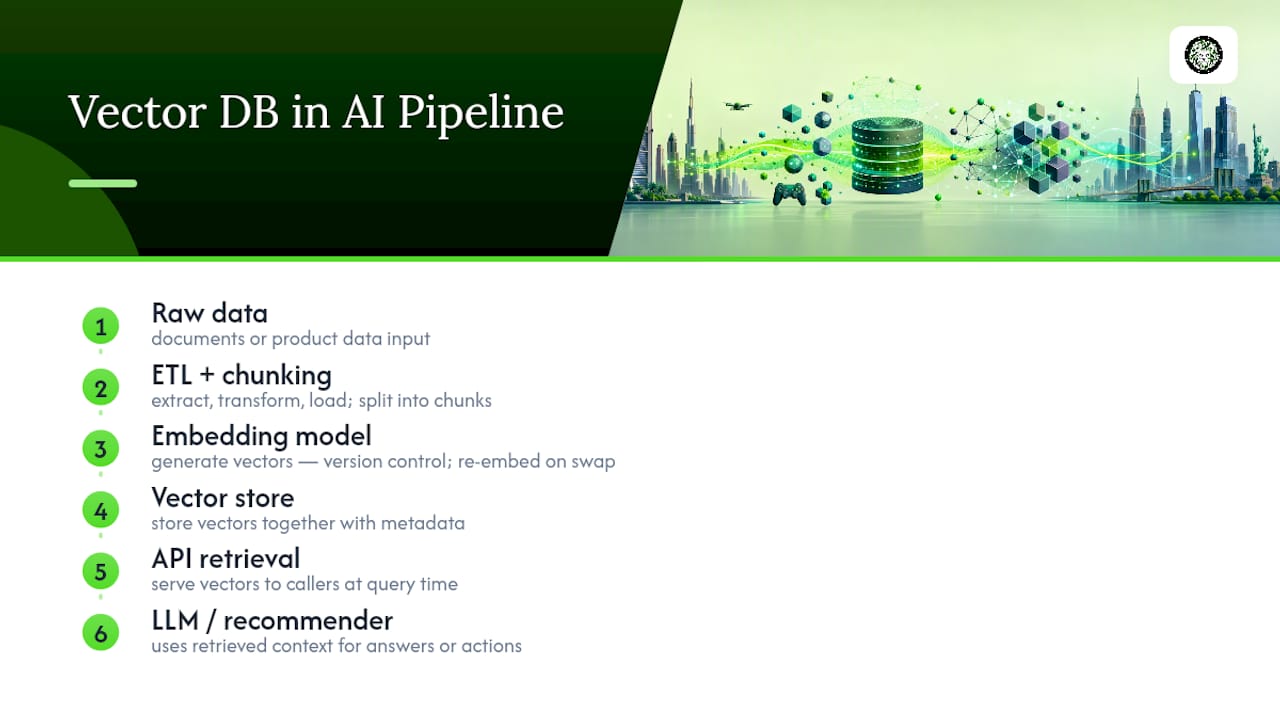
Teams building AI agents for business automation often wire the vector store directly into the agent's decision loop, where retrieved context shapes the next action rather than just answering a question. This is a meaningfully different integration pattern than a search bar bolted onto a website, and it demands tighter latency budgets since the agent can't move to its next step until retrieval completes.
Evaluation pipelines deserve the same rigor as the retrieval system itself. Teams that treat embedding model selection as a one-time decision, rather than something to benchmark against real query logs, tend to discover quality problems months after launch instead of during testing.
Limitations and Challenges of Vector Databases in Practice
The modality gap is real: cross-modal matches (text to image, audio to text) are consistently less precise than same-modality matches, because the embedding model has to translate between fundamentally different kinds of signal. Teams promising "search your videos by description" need to set expectations accordingly rather than assuming image search performs like text search.
Embedding drift creates a slower, sneakier problem. As underlying content changes or embedding models get updated, previously indexed vectors can drift out of alignment with new ones, and nobody notices until search relevance quietly degrades over weeks. Re-embedding an entire corpus is expensive, which is why version coordination has to be planned from the start, not patched in later.
Cost is often misjudged. Teams budget for storage and forget that per-query compute for high-dimensional similarity scoring, plus periodic index rebuilds, is where spending actually accumulates. The O(D) relationship between dimensionality and compute cost means a seemingly small choice, like embedding dimension, has an outsized effect on the infrastructure bill.
Metadata filtering at scale introduces its own tension: filtering before the vector search protects latency but can miss relevant results; filtering after preserves recall but costs more compute. Hybrid search architectures need to make this ordering decision deliberately, not by default.
Finally, access control in multi-tenant vector systems is harder than it looks. Namespace isolation has to be designed at the schema level from day one, because retrofitting row-level security into an existing vector index usually means a painful reindex.
Where Vector Database Technology Is Headed
Native hybrid search, once a workaround bolted onto vector-only systems, is increasingly becoming a first-class feature as vendors build lexical and dense retrieval into a single scoring pipeline rather than two separate systems stitched together.
Agent-native memory architectures are maturing fast. As Gartner's research on AI-enabled information retrieval suggests, vector stores are shifting from a search backend into core infrastructure for AI agents that need persistent, evolving memory across sessions, not just a single query-response cycle.
Multimodal embedding models keep narrowing the modality gap, with newer architectures trained specifically to align text, image, and audio representations more tightly than earlier generation models managed. Expect the "search by photo, get text results" experience to keep improving in precision over the next several product cycles.
On the infrastructure side, expect continued pressure toward lower-dimensional embeddings that preserve most of the semantic signal at a fraction of the compute cost, directly addressing the O(D) scaling problem that shapes so much of today's cost structure. Compression techniques and quantization (representing vectors with fewer bits per dimension) are likely to become standard rather than optional, especially for teams running billion-scale corpora.
What CTOs and Product Leaders Should Prioritize
Start with pgvector, not because it's trendy, but because it lets you prove a use case with real metrics before you commit to migration complexity. Move to a dedicated vector store only once latency, hybrid search, or write concurrency actually justify it, not because a vendor pitch made it sound inevitable.
Cross-team ownership decides more outcomes than architecture does. ML defines embedding strategy, infrastructure owns latency and scaling, and product decides what "good enough" recall means for the user. Skip that alignment checklist and even a technically sound pilot stalls at the handoff.
— Amal
Building Vector-Powered Features With Proud Lion Studios
Choosing between pgvector and a dedicated vector store is only half the decision. The harder part is building the embedding pipeline, the retrieval logic, and the agent or application layer around it correctly the first time, instead of paying twice to fix a rushed first attempt. Proud Lion Studios builds this full stack as one engagement rather than handing off a search feature and leaving the surrounding AI system for someone else to figure out.

Our UAE-based team works across blockchain and Web3 engineering, AI agent development, and backend infrastructure, which matters when a vector feature needs to connect to tokenized data, decentralized identity, or a broader smart contract layer rather than sitting in isolation. For teams exploring how vector search is reshaping discoverability beyond just internal tools, the same underlying architecture decisions apply.
If you're weighing a RAG pilot, an agent memory system, or a recommendation engine and want a second opinion on architecture before you commit engineering hours, reach out to Proud Lion Studios for a technical discovery conversation.
Sources
- Vector DB performance and complexity analysis — Tsinghua DB Group (vldb/journal paper)
- Semantic Kernel: vector DB memories — Microsoft Learn
- Vector Database Use Cases: RAG, Search & More — Airbyte
FAQ
When Should You Use a Vector Database?
Use one when your application needs semantic similarity search, RAG, recommendations, multimodal retrieval, or agent memory at a scale where corpus size, latency targets, or write concurrency exceed what pgvector on PostgreSQL can comfortably handle.
What Are the Top Vector Databases?
The category includes both dedicated vector-native platforms and extensions built into existing databases like pgvector for PostgreSQL; the right choice depends on your corpus size, hybrid search needs, and latency targets rather than any single platform being universally best.
Is SQL a Vector Database?
Standard SQL databases aren't vector databases by default, but extensions like pgvector add vector similarity search directly into PostgreSQL, making it a viable option for many workloads under a billion vectors.
What Are Some Applications of Vector Data?
Common applications include semantic search across documents and catalogs, RAG for grounding LLM responses, recommendation engines, multimodal search across text and images, fraud and anomaly detection, and long-term memory for AI agents.